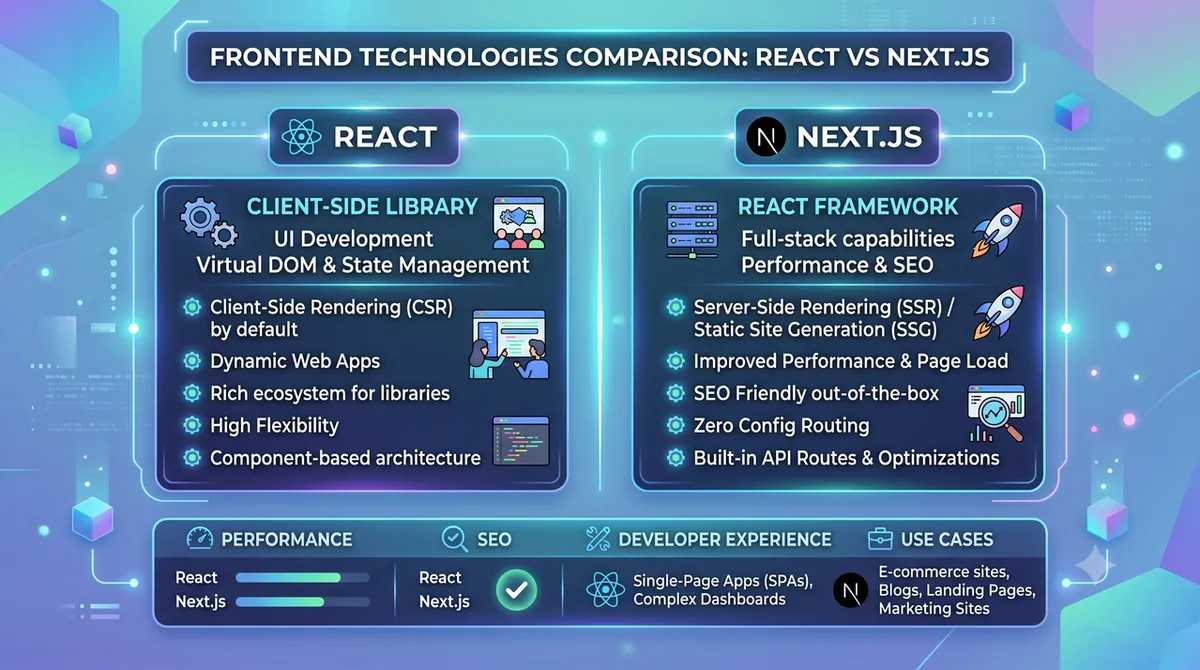
Summary Box
This guide explains the best scalable frontend technologies in 2026 and compares modern frameworks including React and Next.js for performance, scalability, SEO, business growth, and long-term development flexibility.
Key Highlights
- React remains one of the most widely used frontend technologies
- Next.js improves performance and SEO visibility
- Scalable frontend architecture reduces future development costs
- Component-based systems simplify application growth
- Modern web applications require performance-first development
- Frontend technology directly impacts user experience
- SEO and Core Web Vitals influence business growth
- Fast loading applications improve engagement
- Future-ready architecture supports scalability
- Custom development creates better flexibility than rigid templates
Introduction
Building a website in 2026 is no longer simply about making pages look attractive.
Businesses now compete on:
- speed
- user experience
- SEO visibility
- scalability
- performance
As traffic increases and customer expectations rise, choosing the wrong frontend technology can create expensive problems later.
A website that works perfectly with 500 users may struggle with:
- 50,000 users
- complex business workflows
- real-time features
- large databases
- growing product ecosystems
That is why many organizations are moving toward scalable frontend technologies built for long-term growth.
What Are Scalable Frontend Technologies?
Scalable frontend technologies are frameworks and development systems designed to support application growth without requiring complete rebuilds.
Scalability often includes:
- modular architecture
- reusable components
- performance optimization
- maintainable code
- SEO compatibility
- flexible integrations
Modern businesses increasingly prioritize scalable systems because rebuilding software later usually costs significantly more.
Why Frontend Scalability Matters
As businesses grow, websites often evolve into larger digital systems.
Examples include:
- customer portals
- SaaS platforms
- dashboards
- booking systems
- automation tools
- eCommerce systems
Without scalable architecture, teams often face:
- slower performance
- development bottlenecks
- maintenance issues
- SEO problems
- higher costs
"Frontend decisions made today often determine how expensive growth becomes tomorrow."
Top Scalable Frontend Technologies in 2026
React
React remains one of the strongest frontend technologies because of its component-based architecture.
Benefits include:
- reusable UI components
- strong ecosystem
- large developer community
- flexibility
- easier maintenance
React works especially well for:
- SaaS products
- dashboards
- business applications
- custom software platforms
Next.js
Next.js has become increasingly popular because it combines frontend flexibility with performance optimization.
Major advantages:
- Server-side rendering
- Static generation
- faster loading pages
- improved SEO
- image optimization
- code splitting
Businesses focused on search visibility often use Next.js development services because performance and SEO increasingly affect growth.
Flutter Web
Flutter is expanding beyond mobile applications.
Benefits include:
- cross-platform development
- shared codebase
- interactive interfaces
- faster development cycles
However, Flutter Web may not always be the strongest option for SEO-focused business websites.
Vue.js
Vue provides:
- simpler learning curve
- lightweight architecture
- flexible integrations
Small and medium businesses often use Vue for projects requiring faster implementation.
React vs Next.js for Scalability
| Feature | React | Next.js |
|---|---|---|
| SEO Support | Moderate | High |
| Performance Optimization | Medium | Strong |
| Server-Side Rendering | Requires setup | Built-in |
| Scalability | High | High |
| Development Flexibility | High | High |
| Speed Optimization | Moderate | Strong |
For SEO-focused business websites, many organizations increasingly choose Next.js.
For highly customized web applications, React remains highly flexible.
Related comparison:
React vs Next.js for Business Websites
How Modern Frontend Architecture Supports Business Growth
Scalable frontend technologies support growth by improving:
Performance
Faster websites create:
- better user experience
- lower bounce rates
- improved engagement
Development Speed
Reusable systems help developers:
- ship features faster
- reduce repetitive work
- maintain cleaner code
SEO Performance
Search engines increasingly reward:
- speed
- responsiveness
- mobile optimization
- user experience
Role of Frontend Performance in SEO
Google increasingly evaluates:
Largest Contentful Paint (LCP)
Measures:
- loading performance
Interaction to Next Paint (INP)
Measures:
- responsiveness
Cumulative Layout Shift (CLS)
Measures:
- visual stability
Strong Core Web Vitals can contribute to:
- better rankings
- improved user engagement
- lower bounce rates
- stronger conversion performance
Website Performance Optimization Checklist
Before launching a scalable application:
✓ Optimize images
✓ Enable caching
✓ Reduce unnecessary JavaScript
✓ Implement lazy loading
✓ Improve Core Web Vitals
✓ Create clean URL structures
✓ Optimize mobile responsiveness
✓ Monitor performance regularly
✓ Add structured schema
✓ Minimize render blocking resources
Resources
Custom Software Development
Businesses needing advanced systems often move beyond templates.
👉 https://abuqitmirlabs.tech/custom-software
Mobile App Development
Applications increasingly require connected mobile ecosystems.
👉 https://abuqitmirlabs.tech/mobile-app-development
Business Automation Solutions
Automation systems reduce manual work and improve workflows.
👉 https://abuqitmirlabs.tech/business-automation
React Development Services
Build flexible web applications using modern React architecture.
👉 https://abuqitmirlabs.tech/react-development
Next.js Development Services
Create SEO-focused high-performance applications.
👉 https://abuqitmirlabs.tech/nextjs-development
SaaS Development Services
Launch scalable cloud applications with modern architecture.
👉 https://abuqitmirlabs.tech/saas-development
Related Reading
How Next.js Improves Website Speed and SEO Performance
👉 https://abuqitmirlabs.tech/blog/how-next-js-improves-website-speed-and-seo-performance
Why Startups Choose Custom React Applications
7 Signs Your Business Needs Custom Web Development Instead of Templates
Featured Answer
What are the best scalable frontend technologies in 2026?
The best scalable frontend technologies in 2026 include React, Next.js, Vue, and Flutter Web. React provides flexibility, Next.js offers stronger SEO and performance optimization, and scalable architectures help businesses support growth efficiently.
QUOTE
"Scalable applications are not built only for today's users — they are built for tomorrow's growth."
##“Best Frontend Technologies for Scalable Web Applications (2026)”:
FAQ 1: What are scalable frontend technologies?
Scalable frontend technologies are frameworks and tools designed to handle growing user traffic, larger application structures, and complex features without reducing performance.
Examples include:
- React
- Next.js
- Angular
- Vue.js
- Svelte
These technologies help businesses create applications that remain fast, flexible, and easier to maintain as they grow.
FAQ 2: Why is React considered good for scalable web applications?
React is widely used because it offers:
- Component-based architecture
- Reusable code structure
- Strong ecosystem support
- High performance through virtual DOM
- Easy integration with APIs and third-party services
Many startups and enterprise businesses choose React for custom web development projects because it supports long-term scalability.
FAQ 3: How does Next.js improve scalability and SEO?
Next.js improves scalability and SEO by offering:
- Server-side rendering (SSR)
- Static site generation (SSG)
- Image optimization
- Automatic code splitting
- Better Core Web Vitals performance
- Faster loading speed
These features help websites rank better in search engines while improving user experience.
FAQ 4: Which frontend technology is best for startups in 2026?
The best frontend technology depends on business goals.
For example:
- React: flexible custom applications
- Next.js: SEO-focused business websites
- Vue.js: fast development projects
- Angular: enterprise-level applications
Many startups prefer React and Next.js because they support rapid development and future growth.
FAQ 5: Does frontend technology affect SEO performance?
Yes.
Modern frontend architecture can directly impact:
- Website loading speed
- Core Web Vitals
- Mobile responsiveness
- Search engine crawling
- User experience
Technical SEO performance has become increasingly important for Google rankings.
FAQ 6: Why do businesses choose custom frontend development instead of templates?
Businesses often move beyond templates because they need:
- Custom functionality
- Better performance
- Scalability
- Integrations with internal systems
- Improved security
- Flexible future development
Custom solutions typically provide more control for long-term business growth.
FAQ 7: Can scalable frontend frameworks reduce development costs?
Yes.
Well-structured frontend systems can reduce costs by:
- Reusing components
- Simplifying maintenance
- Reducing technical debt
- Improving development speed
- Supporting future expansion
Long-term development costs often become lower compared to repeatedly rebuilding systems.
FAQ 8: How important are Core Web Vitals in 2026?
Core Web Vitals remain highly important because they measure:
- Loading performance (LCP)
- User interaction responsiveness (INP)
- Visual stability (CLS)
Improved Core Web Vitals can help:
- Increase rankings
- Reduce bounce rates
- Improve conversions
- Enhance user experience
Need a scalable website or custom web application? Build high-performance solutions with AbuQitmir Labs using React, Next.js, and custom software architecture designed for long-term growth. +923233260859