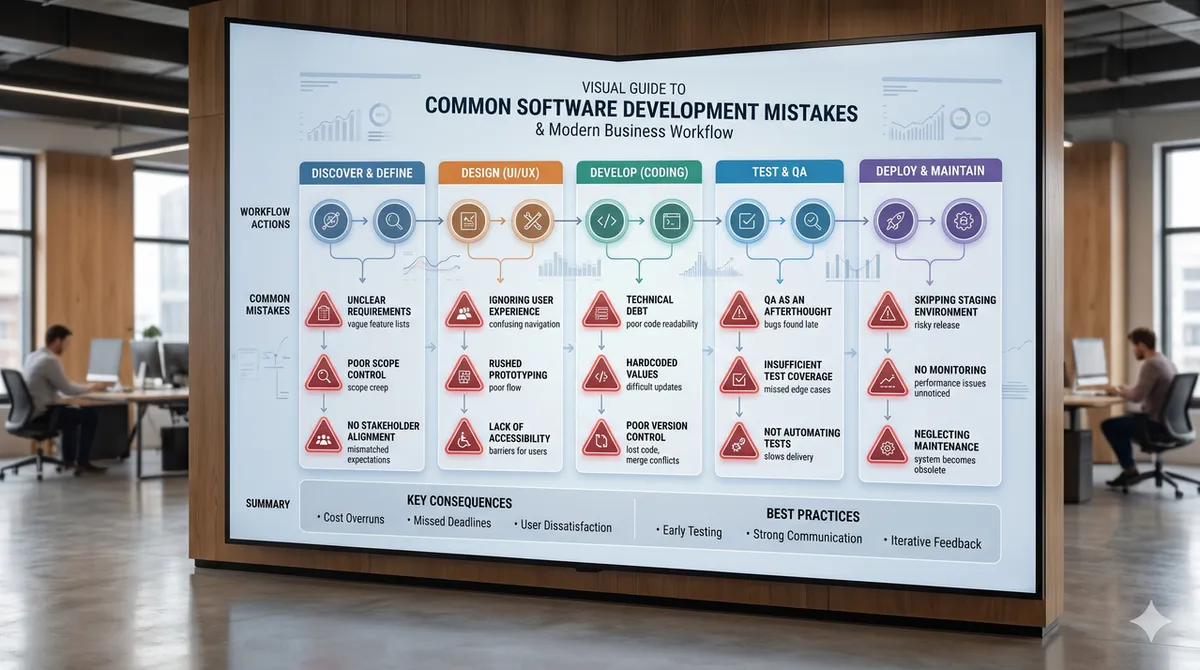
Common Software Development Mistakes Businesses Make (2026 Guide)
Most software projects don’t fail because of coding. They fail because businesses make avoidable decisions long before development starts.
Many companies invest thousands into software expecting:
- faster operations
- automation
- scalability
- better customer experiences
But instead they end up with:
- delayed projects
- buggy systems
- frustrated teams
- rising costs
- software nobody enjoys using
The surprising part?
Most of these problems are predictable.
After working with startups, SaaS businesses, and growing companies, certain software development mistakes appear again and again.
Some businesses:
- rush into coding without planning
- hire based only on price
- ignore scalability
- copy competitors blindly
- overload software with unnecessary features
And eventually the project becomes difficult to manage.
This guide explains the most common software development mistakes businesses make in 2026 — and how to avoid them before wasting time, money, and momentum.
AI Summary Box
This guide explains the most common software development mistakes businesses make, why projects fail, and how modern companies can build scalable, efficient software systems using smarter planning, agile workflows, AI integration, and better user experience strategies.
Why Software Projects Fail More Often Than Businesses Expect
A lot of businesses think:
“Once development starts, everything will work out.”
Actually…
software problems usually begin before coding even starts.
The biggest project failure reasons are often:
- poor planning
- unclear goals
- weak communication
- unrealistic expectations
Not technology itself.
The Real Cost of Bad Software Decisions
Weak software decisions create:
- operational inefficiency
- wasted budgets
- delayed growth
- frustrated employees
- customer churn
And fixing broken software later is usually far more expensive than building correctly from the beginning.
1. Starting Development Without Clear Goals
This is one of the biggest startup software problems.
Businesses often say:
“We need software.”
But they haven’t defined:
- the exact workflow
- operational pain points
- success metrics
- automation needs
Real-World Example
A retail business requested:
- inventory software
- employee dashboards
- AI analytics
- reporting systems
After deeper discovery, the real issue was simple: their warehouse process was disorganized.
The business almost spent huge amounts solving the wrong problem.
What Businesses Should Define First
✅ What problem are we solving?
✅ Who will use the software?
✅ What workflows matter most?
✅ What should the software automate?
✅ How will success be measured?
2. Ignoring User Experience (UX)
Some businesses focus entirely on features and ignore usability.
That becomes a huge mistake later.
Because even powerful software fails if users hate using it.
Poor UX Creates
❌ Employee confusion
❌ Customer frustration
❌ Lower productivity
❌ Increased support requests
❌ User abandonment
Modern Users Expect Better Experiences
In 2026, users expect software that feels:
- simple
- fast
- intuitive
- mobile-friendly
If the system feels complicated, people stop using it properly.
Real Example
A logistics company redesigned their dispatch dashboard.
No new features were added.
But after improving UI/UX:
- staff completed tasks faster
- training time dropped
- operational mistakes reduced significantly
Good UX directly improved business efficiency.
3. Choosing Developers Based Only on Cheap Pricing
Cheap development often becomes expensive later.
This is one of the most common software development mistakes startups make.
Businesses try saving money upfront…
then later spend far more fixing:
- poor architecture
- scalability issues
- buggy systems
- security vulnerabilities
Warning Signs of Weak Development Teams
❌ Unrealistically cheap pricing
❌ No clear development process
❌ Poor communication
❌ No scalability planning
❌ Weak portfolio quality
Why Experienced Teams Matter
Strong development teams think beyond coding.
They help businesses with:
- architecture
- workflows
- scalability
- security
- automation strategy
4. Building Too Many Features Too Early
A lot of startups overbuild.
They try launching with:
- AI systems
- advanced dashboards
- dozens of workflows
- unnecessary integrations
before validating the core idea.
This slows development dramatically.
Why MVP Development Matters
MVP means:
Minimum Viable Product
Instead of building everything immediately, businesses launch:
- essential features first
This helps validate:
- demand
- user behavior
- workflow effectiveness
before scaling.
What Good MVPs Focus On
✅ Core workflow
✅ User onboarding
✅ Basic automation
✅ Essential reporting
5. Ignoring Scalability
Many businesses build software only for current needs.
Not future growth.
That becomes dangerous later.
Signs Software Was Not Built To Scale
❌ Slow performance
❌ Crashes under traffic
❌ Database bottlenecks
❌ Difficult integrations
❌ Expensive rebuilds
Why Scalability Matters More in 2026
Businesses increasingly rely on:
- cloud infrastructure
- AI systems
- automation workflows
- mobile ecosystems
Software must support future expansion from the beginning.
6. Weak Communication Between Teams
Software projects involve:
- developers
- designers
- business owners
- managers
- stakeholders
Poor communication creates:
- delays
- misunderstandings
- feature confusion
- expensive revisions
Agile Workflow Helps Reduce This
Modern agile software workflows improve:
- collaboration
- iteration speed
- transparency
- project organization
That’s why agile development dominates modern software projects.
7. No Proper Discovery Phase
Some businesses rush directly into development without discovery.
This creates major project risks.
Discovery Helps Teams Understand
✅ Business workflows
✅ Operational bottlenecks
✅ User behavior
✅ Automation opportunities
✅ Technical requirements
Why Discovery Saves Money
Good planning prevents:
- unnecessary features
- constant revisions
- workflow confusion
- technical problems later
8. Ignoring Mobile Experience
Many businesses still focus mostly on desktop software.
That’s a huge mistake now.
Modern businesses operate in:
mobile-first environments
Users Expect Software To Work Smoothly On
✅ Smartphones
✅ Tablets
✅ Laptops
✅ Desktop systems
Mobile UX Directly Impacts
✅ Retention
✅ Productivity
✅ Customer engagement
✅ Operational efficiency
9. Weak Security Planning
Security is often ignored until something breaks.
That’s risky.
Especially when businesses store:
- customer data
- financial information
- operational systems
Common Security Mistakes
❌ Weak authentication
❌ Poor API security
❌ No encryption
❌ Weak permissions
❌ No backup strategy
Why Security Matters More in 2026
Cybersecurity threats are increasing rapidly.
Businesses now need:
- secure cloud infrastructure
- encrypted systems
- role-based access
- secure APIs
from day one.
10. Choosing The Wrong Tech Stack
Not every technology fits every project.
Some businesses follow trends blindly instead of choosing based on:
- scalability
- project requirements
- budget
- performance needs
Common Modern Tech Stacks
Frontend
- React
- Flutter
- Next.js
Backend
- Node.js
- Laravel
- Django
Databases
- PostgreSQL
- MongoDB
- Firebase
Why Tech Stack Decisions Matter
Wrong technology choices create:
- performance limitations
- difficult scaling
- developer shortages
- expensive migrations later
11. No Long-Term Maintenance Strategy
Some businesses think software is “finished” after launch.
Actually… launch is only the beginning.
Modern Software Requires Ongoing
✅ Updates
✅ Security patches
✅ Performance optimization
✅ Infrastructure scaling
✅ Feature improvements
Why Maintenance Matters
Without maintenance:
- software becomes outdated
- security risks increase
- integrations fail
- performance drops
12. Ignoring Automation Opportunities
Businesses still waste massive amounts of time on repetitive work.
Modern custom software should automate:
- reporting
- notifications
- customer follow-ups
- inventory tracking
- analytics
Why Automation Matters
Automation improves:
- operational efficiency
- scalability
- employee productivity
- response times
AI Is Changing Software Development
Modern software increasingly includes:
- AI dashboards
- predictive analytics
- AI copilots
- workflow automation
- smart reporting
Businesses ignoring AI opportunities may struggle competitively later.
Why Businesses Need Better Software Strategy
The best software projects focus on:
- business outcomes
- workflow efficiency
- scalability
- usability
—not just features.
Signs Your Software Project Is At Risk
❌ Constant scope changes
❌ Delayed releases
❌ Poor communication (Signs Your Software Project Is At Risk)
❌ Rising development costs
❌ User frustration
❌ Weak performance
Recognizing problems early helps avoid major project failures.
What Successful Software Projects Usually Have
✅ Clear business goals
✅ Strong discovery process
✅ Scalable architecture
✅ Agile workflows
✅ Good UI/UX
✅ Long-term planning
Why Businesses Choose Custom Software
Businesses increasingly move toward custom software because they need:
- automation
- operational flexibility
- scalable infrastructure
- AI integration
- centralized systems
Custom software helps businesses build around their workflows instead of adapting to generic SaaS limitations.
🔗 Learn The Complete Software Development Process
Understand how modern software systems are planned, built, tested, and scaled.
👉 Read this: https://abuqitmirlabs.tech/blog/software-development-process-step-by-step-2026
🔗 Compare SaaS vs Custom Software
Many businesses struggle choosing between SaaS platforms and custom software systems.
👉 Read this: https://abuqitmirlabs.tech/blog/custom-software-vs-saas-which-is-better-for-businesses
🔗 Understand Software Development Costs
Before building software, understand realistic pricing and budgeting.
👉 Read this: https://abuqitmirlabs.tech/blog/how-much-does-custom-software-development-cost-in-2026
🔗 Explore Future Software Trends
AI and automation are rapidly changing modern software development.
👉 Read this: https://abuqitmirlabs.tech/blog/future-of-custom-software-development-2026
🔗 Explore Custom Software Services
Learn how scalable custom software helps businesses automate operations and improve efficiency.
👉 Explore: https://abuqitmirlabs.tech/custom-software
Final Thoughts
Most software failures are preventable.
The biggest mistakes usually happen when businesses:
- rush planning
- ignore scalability
- underestimate UX
- choose developers poorly
- build unnecessary complexity too early
Successful software projects focus on:
- business workflows
- user experience
- scalability
- automation
- long-term growth
In 2026, software is no longer just a technical tool.
For many businesses, it becomes the operational foundation that determines how efficiently the company grows.
FAQs
1. What are the most common software development mistakes?
Common mistakes include:
- poor planning
- ignoring UX
- weak scalability
- no MVP strategy
- poor communication
2. Why do software projects fail?
Most projects fail because of:
- unclear requirements
- unrealistic expectations
- weak workflows
- poor development management
—not coding itself.
3. What is the biggest startup software problem?
Overbuilding too early is one of the most common startup mistakes.
Many startups create unnecessary complexity before validating the core idea.
4. Why is scalability important in software?
Scalable software supports:
- growth
- higher traffic
- larger operations
- future integrations
without major rebuilds.
5. How can businesses avoid software development failures?
Businesses should focus on:
- clear planning
- agile workflows
- strong UI/UX
- experienced development teams
- realistic MVP strategies
Related Engineering Resources
- For engineering teams deploying production workflows, explore our blueprint on custom AI agent development and enterprise RAG architecture and our AI automation solutions.
- Ready to turn these engineering principles into production software? Explore our custom web application development services or run a live diagnostic with our free technical website audit tool.