Summary Box
🔄 Summary: This guide delivers a complete, actionable digital transformation strategy framework for 2026 — covering the six phases of strategy development, how to define and measure transformation KPIs, the most common strategic failures, and how technology decisions fit into a strategy rather than leading it. AbuQitmirLabs builds the custom software, SEO infrastructure, and content systems that digital transformation strategies require to deliver measurable business outcomes. Read time: approximately 12 minutes.
Table of Contents
- Introduction
- What a Digital Transformation Strategy Actually Is
- Why Most Transformation Strategies Fail Before They Begin
- The Six-Phase Digital Transformation Strategy Framework
- Defining Your Transformation KPIs — What to Measure and Why
- Building Your Digital Transformation Roadmap
- The Technology Decision — Where It Fits in the Strategy
- Digital Visibility as a Strategic Pillar
- How AbuQitmirLabs Supports Transformation Strategy
- Digital Transformation Strategy by Business Size
- Frequently Asked Questions
- Final Thoughts
Quote
"A digital transformation strategy that begins with a technology selection is not a strategy. It is a purchase order with a mission statement attached to it." — AbuQitmir Mohammad Shiraz Al-Madani
Highlights
- A digital transformation strategy must begin with business outcomes, not technology selection — the sequence determines whether the strategy succeeds or fails
- The six phases of a working transformation strategy are: Assess, Define, Prioritize, Design, Execute, and Optimize — each dependent on the previous
- KPIs for digital transformation must be business metrics, not technology metrics — adoption rates and system uptime are not transformation success
- A transformation roadmap is not a project plan — it is a phased capability-building sequence that compounds in value as each phase enables the next
- Technology decisions are Phase 4, not Phase 1 — and the businesses that reverse this sequence consistently produce expensive deployments that do not deliver transformation outcomes
- SEO and content strategy are not marketing activities separate from transformation — they are the digital visibility infrastructure that makes transformation ROI measurable in customer acquisition terms
- The businesses succeeding at transformation in 2026 are not running the boldest initiatives — they are running the most disciplined ones
Introduction
Most digital transformation strategies are written backwards.
They begin with a technology selection. A new ERP platform is chosen at the board level. A cloud migration is mandated. An AI tool generates enthusiasm in a leadership offsite. A vendor relationship produces a compelling proposal. And then — a strategy is written around the technology that was already selected, providing a narrative framework for a decision that was made before the strategic thinking began.
The result looks like a strategy. It has phases, milestones, KPIs, and a roadmap. What it does not have is a clear line from the technology investment to the business outcome — because the outcome was not the starting point. The technology was.
This is why most digital transformation initiatives produce capability rather than competitive advantage. The capabilities are real. The deployment happened. The system is live. But the business outcome — the specific, measurable improvement in revenue, efficiency, customer retention, or competitive position — either does not materialize or materializes far below the level the investment justified.
This guide is about writing the transformation strategy the right way around. Starting with the business outcome. Working backwards through the organizational change, the process redesign, and the cultural shift required to achieve it. And arriving at the technology decision — last, informed, and in service of a clearly defined outcome rather than in search of one.
What a Digital Transformation Strategy Actually Is
A digital transformation strategy is a structured plan for how a business will use digital capabilities to achieve specific, measurable business outcomes — organized across a realistic timeline, resourced appropriately, and governed with clear accountability.
That definition has four load-bearing components:
Specific, measurable business outcomes. Not "become more digital." Not "modernize our operations." Not "leverage AI." Specific outcomes: reduce operational cost by a defined percentage, increase customer retention by a defined number of points, expand into a new revenue channel by a defined date, reduce the time-to-decision for a specific operational bottleneck from days to hours.
Organized across a realistic timeline. Transformation does not happen in a quarter. A strategy that promises significant organizational transformation in six months is either scoped too narrowly to be called transformation, or scoped optimistically enough to guarantee failure. A realistic timeline acknowledges the organizational change that transformation requires alongside the technical implementation.
Resourced appropriately. A transformation strategy that is not funded for the organizational change management, the training, the process redesign, and the cultural shift it requires — alongside the technology — is a strategy for the technology procurement component of transformation, not transformation itself.
Governed with clear accountability. Transformation initiatives without named owners, defined decision rights, and regular strategic reviews do not transform. They drift into business-as-usual while maintaining the language of transformation.
"Most transformation strategies are plans for technology deployment. A real transformation strategy is a plan for organizational capability-building — for which technology deployment is one input, not the entire output."
Why Most Transformation Strategies Fail Before They Begin
The most common strategic failures in digital transformation happen before any technology is selected, any vendor is engaged, or any implementation begins. They happen in the strategy development process itself.
Strategic Failure 1: Outcomes defined as technology states rather than business results. "Complete cloud migration by Q4" is a technology state. "Reduce infrastructure cost by 30% and enable remote operational access for all departments by Q4" is a business result. Strategies built around technology states measure completion rather than value — and completion without value is the definition of a failed transformation.
Strategic Failure 2: Transformation scope defined by what technology can do rather than what the business needs. When the technology selection comes before the outcome definition, the transformation scope is shaped by the capabilities of the selected technology rather than the needs of the business. Features that the technology offers but the business does not need get built. Capabilities the business needs but the technology does not offer get ignored.
Strategic Failure 3: No distinction between transformation priorities and business-as-usual improvements. Every business has a list of digital improvements it would like to make. Not all of them are transformation priorities. A transformation strategy that includes everything on the list is not a transformation strategy — it is a digital to-do list. Transformation requires prioritization: identifying the two or three capabilities that will produce the most significant business outcome shift and building the strategy around delivering those.
Strategic Failure 4: Strategy ownership without organizational authority. A transformation strategy owned by a team that does not have the authority to make the organizational changes transformation requires — process changes, resource reallocation, reporting structure changes, cultural norm changes — is a strategy that will encounter the first significant obstacle and stop.
Strategic Failure 5: No defined failure conditions. A strategy without defined failure conditions — specific outcomes that, if not achieved by specific dates, trigger a strategic review and potential direction change — is a strategy that will be defended long past the point where honest evaluation would have redirected it. The most expensive transformation failures are the ones that continued for years after the evidence had turned against them.
The Six-Phase Digital Transformation Strategy Framework
Phase 1: Assess — Know Where You Are
Before defining where transformation needs to take the business, the strategy must establish an honest picture of where the business currently is — digitally, organizationally, and competitively.
The assessment covers four dimensions:
Digital capability inventory: What digital tools does the business currently use? How effectively are they used? Where are the manual processes that digital could replace? Where are the data silos that prevent information from flowing to where it is needed?
Organizational readiness: What is the current level of digital literacy across the organization? Where is there leadership commitment to sustained transformation? Where is there likely resistance that the strategy needs to account for?
Competitive landscape: What is the digital maturity of the business's competitive set? Where are competitors ahead? Where are there gaps in the market that digital capability could exploit?
Customer expectation mapping: What digital experiences do the business's customers currently receive from competitors? What are they asking for that the business cannot currently provide? Where is the business losing customers to digitally superior alternatives?
Phase 2: Define — Know Where You Are Going
With an honest current-state picture, the strategy can define the specific business outcomes transformation needs to deliver — in measurable terms, across a realistic timeline.
The outcome definition process asks three questions:
What does this business need to be capable of doing in three years that it cannot do today? Not what technology it needs to have — what capability it needs to have. Serving customers in a channel that does not currently exist. Making operational decisions in hours that currently take days. Growing revenue in a geography or segment that is currently inaccessible.
What is the most significant business risk if transformation does not happen? Customer retention loss to digitally superior competitors. Operational cost disadvantage that compounds over time. Inability to attract staff who expect digital-first working environments. Market position erosion as the industry's digital standard advances.
What would success look like in measurable terms at twelve months, twenty-four months, and thirty-six months? Specific numbers attached to specific outcomes, against which the strategy can be evaluated honestly throughout its execution.
Phase 3: Prioritize — Know What to Do First
A transformation strategy that attempts to achieve all defined outcomes simultaneously is a strategy that will achieve none of them fully. Prioritization is the phase where the strategy becomes executable.
Prioritization criteria:
Business impact per unit of effort: Which transformation initiative delivers the most significant business outcome per unit of organizational disruption and investment?
Dependency mapping: Which capabilities must exist before others can be built on top of them? The sequencing of transformation initiatives is a strategic decision — building in the wrong order means rebuilding.
Quick wins vs. foundational investments: A transformation strategy needs both. Quick wins — visible improvements achievable within ninety days — maintain organizational momentum and demonstrate that transformation is producing results. Foundational investments — data infrastructure, platform architecture, cultural change — take longer but enable everything that follows.
Risk concentration: Transformation initiatives should be sequenced to avoid concentrating too much organizational disruption in any single period. A business that is simultaneously restructuring its customer service model, replacing its core operating system, and training its entire staff on new tools has concentrated risk beyond its capacity to absorb.
Phase 4: Design — Know How You Will Get There
With priorities established, the strategy can design the specific initiatives, organizational changes, technology requirements, and resource allocations that will deliver the defined outcomes.
This is the phase where technology decisions belong — informed by the outcome definition, the organizational readiness assessment, and the prioritization framework. Technology selected here serves a defined purpose in a defined initiative, rather than generating a strategic narrative to justify a selection already made.
Design decisions include:
- Which processes need to be redesigned before digital tools can improve them
- Which organizational structures need to change to enable cross-functional digital workflows
- Which technology platforms, custom software systems, and AI capabilities the initiatives require
- Which skills gaps need to be addressed through hiring, training, or partnerships
- Which content writing and SEO infrastructure is required to make transformation outcomes visible in the market
Phase 5: Execute — Build and Learn
Execution is where most transformation strategies encounter the gap between planning and organizational reality. The initiatives that seemed clearly defined in the design phase encounter complexity, resistance, and unexpected dependencies in execution.
Execution disciplines that distinguish successful transformation from stalled initiatives:
Iterative delivery over big-bang releases: Delivering transformation value in increments — each one usable and measurable — rather than in a single large release that arrives after months of invisible work.
Continuous measurement against defined KPIs: Regular, honest evaluation of whether the initiatives are producing the outcomes they were designed to produce — not measuring completion of activities, but change in business metrics.
Organizational change management running parallel to technical implementation: Change management is not a communications activity at the end of a technical project. It is a sustained program running alongside every phase of execution, preparing the organization to use the capabilities being built.
Escalation pathways for strategic blockers: Clear processes for escalating organizational obstacles — budget shortfalls, resistance from business units, competing priorities — to decision-makers with the authority to resolve them.
Phase 6: Optimize — Make It Compound
The final phase of the transformation strategy framework is the one most commonly absent from transformation plans: the sustained optimization phase where early capability investments are matured, measured, and compounded.
Optimization activities:
- Analyzing usage data to understand where new capabilities are being adopted effectively and where adoption is lagging
- Identifying the next layer of transformation initiative that the Phase 5 capabilities now enable
- Updating the strategy based on competitive landscape changes, customer expectation evolution, and business performance data
- Building the organizational habits — data-driven decision making, continuous improvement, cross-functional collaboration — that make transformation self-sustaining rather than dependent on a specific initiative
Defining Your Transformation KPIs — What to Measure and Why
The most common KPI mistake in digital transformation is measuring technology adoption rather than business outcome change. System uptime, user login rates, and feature utilization are technology metrics. They tell you whether the technology is being used. They do not tell you whether the transformation is delivering value.
Business outcome KPIs for digital transformation:
Operational efficiency:
- Cost per transaction / cost per unit of output (before and after automation)
- Process cycle time (days to hours, hours to minutes)
- Error rate in automated vs. manual processes
- Staff hours reallocated from automated tasks to higher-value work
Customer experience:
- Customer retention rate (quarterly, annually)
- Net Promoter Score (trend, not snapshot)
- Customer effort score (how hard is it to do business with the company)
- Digital channel adoption rate among existing customers
- Customer acquisition cost through digital channels
Revenue:
- Revenue from new digital channels (absolute and as percentage of total)
- Conversion rate improvement across digital touchpoints
- Average revenue per customer (before and after personalization capabilities)
- Time to revenue for new product or service launches
Digital visibility:
- Organic search ranking for defined keyword targets
- Organic traffic growth (month over month, year over year)
- Content-driven lead generation volume and quality
- Share of voice in digital channels vs. defined competitive set
Organizational capability:
- Digital literacy assessment scores (baseline vs. post-training)
- Time-to-decision for data-informed decisions (before and after data infrastructure)
- Cross-functional initiative success rate (proxy for collaboration culture change)
Building Your Digital Transformation Roadmap
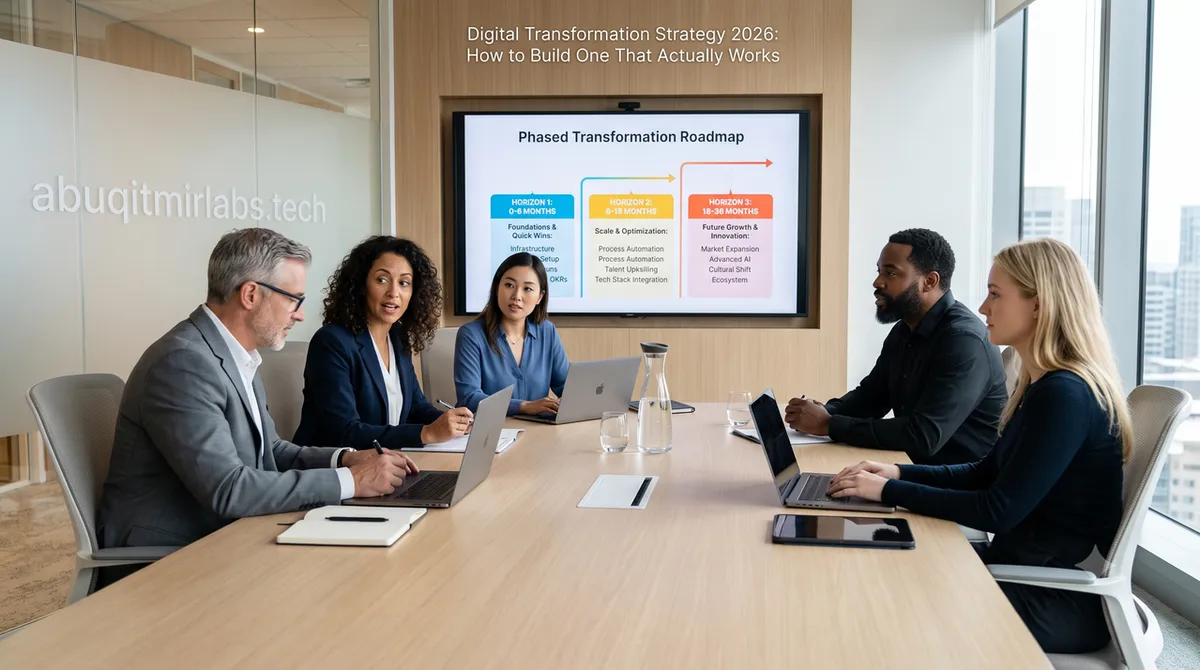
A transformation roadmap is not a project Gantt chart. It is a phased capability-building sequence — showing how each phase of transformation investment creates the foundation for the next, and how the cumulative effect compounds toward the defined business outcomes.
Roadmap structure:
Horizon 1 (0–6 months) — Foundation and Quick Wins Establish the data, infrastructure, and organizational foundations that subsequent transformation phases require. Deliver visible, measurable quick wins that demonstrate transformation value and maintain organizational momentum.
Typical Horizon 1 investments:
- Data quality remediation and integration (so subsequent AI and analytics initiatives have reliable data to work with)
- Process documentation and redesign for the highest-priority automation targets
- Digital literacy baseline training across the organization
- SEO mastery foundation — technical SEO audit, keyword strategy, and content infrastructure setup
- Quick-win automation of the highest-volume, lowest-complexity manual processes
Horizon 2 (6–18 months) — Capability Building Build the primary transformation capabilities defined in the strategy — the customer experience improvements, operational automation, and digital channel development that the Horizon 1 foundation enables.
Typical Horizon 2 investments:
- Custom software development for the primary operational transformation initiatives
- Customer-facing digital experience improvements
- AI and analytics capabilities built on the clean data infrastructure established in Horizon 1
- Content writing program execution — building the content authority that makes digital visibility sustainable
- Staff training and adoption programs for new capabilities
Horizon 3 (18–36 months) — Compounding and Innovation Mature the capabilities built in Horizon 2, measure their business outcome impact, and use that capability foundation to pursue the innovation initiatives that the earlier transformation made possible.
Typical Horizon 3 investments:
- Advanced AI capabilities built on the operational data accumulated through Horizon 2
- Business model innovation enabled by the digital capabilities now in place
- Market expansion initiatives made possible by digitally scalable operations
- Organizational culture maturation — embedding the habits and norms of a digitally mature organization
Attention needed
Technology Decisions: If your business is at the point where the outcomes are clear but the strategy sequence is not — where to start, how to prioritize, which technology decisions come when — AbuQitmirLabs is happy to work through the assessment and definition phases before any implementation decisions are made.
The Technology Decision — Where It Fits in the Strategy
Technology decisions belong in Phase 4 of the six-phase framework — after outcomes are defined, priorities are set, and the organizational and process design decisions that the technology must support are understood.
This sequencing is the single most important discipline in transformation strategy — and the one most consistently violated by businesses under pressure to show visible progress quickly.
When technology decisions come first:
- The technology's capabilities define the transformation scope rather than the business outcomes
- Processes are redesigned to fit the technology rather than the technology being selected to serve the redesigned process
- Organizational change is driven by the technology's requirements rather than the business's transformation goals
- The strategy is defensible against criticism ("we are implementing the technology we selected") but not against outcome evaluation ("the business has not changed in the ways we said it would")
When technology decisions come last (in the right place):
- Technology is selected from a defined set of requirements rather than evaluated against its own feature set
- Build vs. buy decisions are made on the basis of the business's specific requirements rather than general market preference
- Integration requirements with existing systems are a specification before vendor selection rather than a discovery after contract signing
- The investment in custom software vs. off-the-shelf platforms is driven by the specific capabilities the strategy requires rather than budget defaults
Digital Visibility as a Strategic Pillar
One of the most consistently underdeveloped components of digital transformation strategies is the digital visibility pillar — the SEO, content, and digital marketing infrastructure that ensures the operational and customer experience improvements of transformation translate into market presence and customer acquisition.
A business can transform its operations, its customer experience, and its business model — and still lose market share to a less operationally capable competitor that ranks higher in search, produces more valuable content, and maintains stronger digital authority in its market.
SEO mastery is not a marketing function separate from transformation strategy. It is the infrastructure that makes the transformed business findable by the customers it is newly capable of serving. A transformation strategy that does not include SEO as a pillar is a strategy that builds capability without building the market visibility to capitalize on it.
Content writing is not a content marketing add-on. It is the mechanism by which a digitally transforming business communicates its evolving capabilities to the market — building the content authority that earns search rankings, answers customer questions, and makes digital visibility sustainable over time rather than dependent on paid advertising budgets.
In the transformation roadmap, digital visibility investment belongs in Horizon 1 — because search authority and content infrastructure take time to compound, and businesses that defer SEO and content to Horizon 3 arrive at their most capable state with the weakest digital visibility.
How AbuQitmirLabs Supports Transformation Strategy
Strategy Before Anything Else
Every digital transformation engagement at AbuQitmirLabs begins with the outcomes assessment — not a technology recommendation. The six-phase framework above is not a theoretical model. It is the engagement structure we use before a single technical decision is made for any client.
The Technical Infrastructure of Transformation
The custom software systems, web platforms, and AI capabilities we build are Phase 4 decisions — designed in service of outcomes defined in Phases 1 through 3. They are built to integrate with what the business already runs, to scale with the transformation roadmap, and to be owned and maintainable by the business rather than dependent on a vendor relationship.
SEO and Content as Transformation Infrastructure
SEO mastery and content writing are integrated into every transformation strategy we support — not as optional add-ons, but as the digital visibility infrastructure that makes transformation ROI measurable in market presence and customer acquisition terms. Horizon 1 of every roadmap includes the SEO foundation and content infrastructure that takes time to compound into competitive visibility.
The Long-Term Partnership
Digital transformation strategy is not a deliverable. It is a sustained capability-building partnership — one that evolves as the business's digital maturity grows, the competitive landscape shifts, and the outcomes of Horizons 1 and 2 create the foundation for Horizon 3 innovation. AbuQitmirLabs works with transformation clients across all three horizons, not as a vendor for a specific phase.
Digital Transformation Strategy by Business Size
Small Business (1–50 staff) Transformation priorities are typically customer experience and operational efficiency — not business model reinvention. The strategy should be tightly scoped: two or three specific process improvements, one new digital customer channel, and a digital visibility foundation. Technology decisions favor affordable custom software for specific needs over expensive enterprise platforms built for scale the business does not yet have.
Mid-Market Business (50–500 staff) The transformation complexity increases with organizational scale — more processes to redesign, more staff to change, more integration requirements. The strategy should sequence transformation across business units rather than attempting simultaneous transformation of the entire organization. Data infrastructure investment becomes critical at this scale — the operational data generated by a mid-market business is a significant asset if the infrastructure to use it is in place.
Enterprise (500+ staff) Enterprise transformation strategy requires dedicated governance structures, formal change management programs, and phased rollouts that manage organizational disruption. The technology decisions are more complex — integration with multiple legacy systems, security and compliance requirements, and vendor relationships that need to be managed as long-term partnerships rather than one-time procurements. The SEO and content writing infrastructure operates at a scale that requires dedicated resourcing rather than a side project.
Frequently Asked Questions
What is a digital transformation strategy?
A digital transformation strategy is a structured plan for how a business will use digital capabilities to achieve specific, measurable business outcomes — organized across a realistic timeline, resourced appropriately, and governed with clear accountability. It begins with business outcomes, not technology selection.
What are the phases of a digital transformation strategy?
The six phases are: Assess (understand current state), Define (set measurable outcomes), Prioritize (determine what to do first), Design (plan the initiatives and technology), Execute (build and learn iteratively), and Optimize (compound the capability investments).
What should digital transformation KPIs measure?
Business outcomes — not technology adoption. Relevant KPIs include operational cost reduction, process cycle time improvement, customer retention rate, digital channel revenue, organic search ranking, and content-driven customer acquisition. System uptime and user login rates are technology metrics, not transformation success metrics.
How long should a digital transformation strategy cover?
A working transformation strategy should cover three horizons: 0–6 months (foundation and quick wins), 6–18 months (primary capability building), and 18–36 months (compounding and innovation). Strategies with shorter horizons tend to be digitization plans rather than transformation strategies.
Where do technology decisions fit in a transformation strategy?
Phase 4 — after outcomes are defined, priorities are established, and the organizational and process design that the technology must support is understood. Technology decisions that come before outcome definition produce expensive deployments that do not deliver transformation outcomes.
What is a digital transformation roadmap?
A phased capability-building sequence that shows how each phase of transformation investment creates the foundation for the next and how the cumulative effect compounds toward the defined business outcomes. It is not a project Gantt chart — it is a strategic sequencing document.
Why do transformation strategies fail even when the technology works?
Because technology working is not the same as transformation happening. Strategies fail when outcomes are defined as technology states rather than business results, when organizational change is underfunded relative to technology, when scope is defined by what technology can do rather than what the business needs, and when there are no defined failure conditions that trigger honest strategic review.
How does SEO fit into a digital transformation strategy?
SEO is the digital visibility pillar of transformation — ensuring that operational and customer experience improvements translate into market presence and customer acquisition. It belongs in Horizon 1 of the transformation roadmap because search authority takes time to compound, and businesses that defer SEO investment arrive at their most capable state with the weakest market visibility.
Final Thoughts
The businesses succeeding at digital transformation in 2026 are not the ones running the boldest initiatives. They are the ones running the most disciplined ones — defined clearly, prioritized ruthlessly, measured honestly, and sustained across the multi-year horizon that real organizational capability-building requires.
The framework in this guide is not complicated. Assess. Define. Prioritize. Design. Execute. Optimize. What makes it difficult is the discipline to follow the sequence — especially the discipline to keep technology decisions in Phase 4, where they belong, rather than letting them migrate to Phase 1, where they produce the procurement-led transformation initiatives that generate impressive announcements and disappointing outcomes.
That discipline is the standard AbuQitmirLabs holds to — not a transformation strategy that looks bold on paper, but one that produces measurable business outcomes at six months, eighteen months, and three years, long after the announcement was made and the vendor contracts were signed.
Attention needed (Part 2)
Digital Authority: Whether the priority is the custom software that executes your transformation initiatives, the SEO infrastructure that makes your transformed business visible to the market, or the content strategy that builds the digital authority your transformation needs to capitalize on — visit AbuQitmirLabs to start the strategy conversation that should come before any vendor conversation.