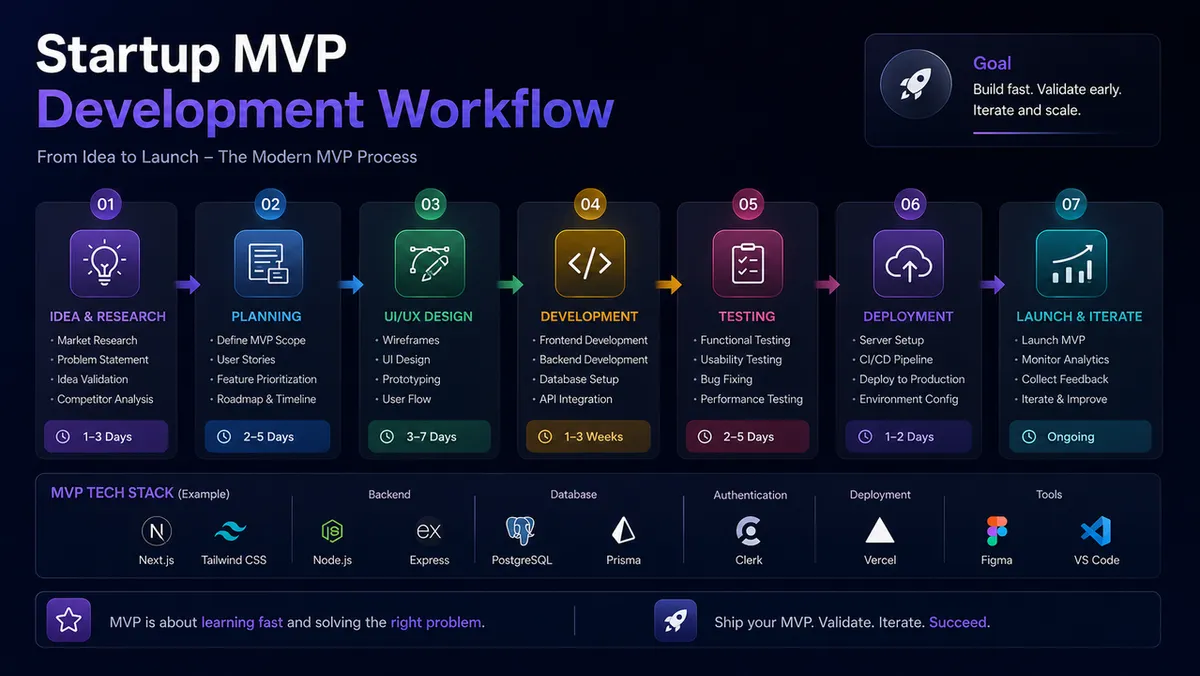
How Startups Build MVP Software Products Fast (2026 Guide)
Most startup founders don’t fail because their ideas are bad.
They fail because they spend:
- too much money
- too much time
- too many months building features nobody actually needs
That’s why modern startups focus heavily on:
MVP software development
Instead of building a huge platform immediately, successful startups launch:
- smaller
- faster
- smarter
products first.
An MVP helps startups:
- validate ideas
- test demand
- reduce risk
- save development costs
- improve products using real feedback
This approach became even more important in 2026 because:
- AI tools speed up development
- competition moves faster
- users expect rapid iteration
- startup funding became more selective
The startups growing fastest today are usually the ones launching quickly, learning rapidly, and improving continuously.
This guide explains how startups build MVP software products fast using modern workflows, AI tools, agile development, and smart product strategy.
Summary
This guide explains how startups build MVP software products fast using agile development, AI-powered tools, lean product strategy, scalable architecture, rapid prototyping, and user-focused workflows to validate ideas before scaling.
What Is MVP Software Development?
MVP stands for:
Minimum Viable Product
It means building:
- the smallest functional version of a product
with only the core features required to solve a real problem.
The Goal of an MVP
The goal is NOT:
- perfection
- massive feature lists
- complex dashboards
The goal is:
validation
You want to discover:
- if users actually want the product
- if the workflow solves a real problem
- if the idea deserves scaling
Why Startups Use MVP Development
Startups move fast because they usually have:
- limited budgets
- limited time
- limited resources
MVP development reduces unnecessary risk.
Benefits of Building MVP Software Fast
✅ Faster market validation
✅ Lower development cost
✅ Reduced startup risk
✅ Real user feedback
✅ Faster iteration
✅ Easier scalability planning
Real Startup Example
A founder wanted to build:
- AI dashboards
- advanced analytics
- team collaboration
- automation systems
for a productivity app.
After launching a smaller MVP first, they discovered users mostly cared about:
- task automation
- reminders
- simple reporting
The roadmap changed completely.
That saved months of unnecessary development.
Why Many Startups Build Too Much Too Early
This is one of the biggest startup software mistakes.
Founders often believe:
“More features = better product.”
Usually the opposite happens.
Too many early features create:
- development delays
- confusing UX
- higher costs
- technical complexity
Modern MVP Strategy in 2026
Modern MVP software products focus on:
- solving ONE major problem extremely well
instead of solving:
- twenty problems poorly.
Step 1 — Validate The Startup Idea
Before writing code, smart startups validate demand.
This is where many startup founders skip important steps.
Questions Founders Must Answer
✅ Who is the target user?
✅ What pain point exists?
✅ How are users solving it today?
✅ Why is the current solution frustrating?
✅ What makes this solution better?
Best Validation Methods
✅ Reddit discussions
✅ Startup communities
✅ Twitter/X feedback
✅ Discord groups
✅ Landing pages
✅ Waitlists
✅ Customer interviews
Why Validation Matters
Validation helps startups avoid:
- building products nobody wants
which is one of the biggest startup failure reasons.
Step 2 — Define Core MVP Features
Now startups decide:
what NOT to build
This matters more than most founders realize.
Good MVP Features Usually Focus On
✅ One main workflow
✅ One user type
✅ One clear problem
✅ Simple onboarding
✅ Essential automation
Example MVP Structure
Instead of building:
- full AI CRM platform
Startups often launch:
- lead tracking
- AI follow-up reminders
- simple analytics
first.
Why Simplicity Wins
Simple products:
- launch faster
- improve faster
- collect feedback faster
Step 3 — Choose The Right Tech Stack
Technology decisions directly impact:
- cost
- speed
- scalability
Popular MVP Tech Stacks in 2026
Frontend
- React
- Next.js
- Flutter
Backend
- Node.js
- Firebase
- Supabase
Database
- PostgreSQL
- MongoDB
Why Startups Prefer Flexible Tech
Modern startups need:
- rapid iteration
- cloud scalability
- AI integrations
- cross-platform support
Why Flutter Became Popular
Many startups use Flutter because it allows:
- Android apps
- iOS apps
- web apps
from one codebase.
That reduces MVP development cost significantly.
Step 4 — Use AI Tools To Build Faster
AI dramatically changed startup software development.
Founders now use AI to:
- speed up coding
- generate prototypes
- automate testing
- create UI layouts
Popular AI Development Tools
✅ GitHub Copilot
✅ Cursor AI
✅ ChatGPT
✅ FlutterFlow
✅ Replit
✅ v0
How AI Helps MVP Development
AI reduces time spent on:
- repetitive coding
- debugging
- frontend generation
- documentation
Real Workflow Example
A startup building an AI SaaS dashboard used:
- Cursor AI for debugging
- v0 for frontend components
- Firebase for backend systems
This reduced development time dramatically.
Step 5 — Design UX Before Coding
Good startups prioritize:
user experience early
Bad UX kills many MVPs.
Why UX Matters For MVPs
Users forgive:
- missing features
But they rarely forgive:
- confusing workflows
MVP UX Should Focus On
✅ Simplicity
✅ Fast onboarding
✅ Clear navigation
✅ Mobile responsiveness
✅ Smooth workflows
Common Startup UX Mistakes
❌ Too many menus
❌ Complex dashboards
❌ Poor onboarding
❌ Slow mobile performance
Step 6 — Build Using Agile Development
Modern startups rarely use rigid development workflows anymore.
Most successful startups use:
agile software development
What Agile Means
Instead of building everything at once, teams release software in:
- smaller iterative cycles
called:
- sprints
Agile MVP Benefits
✅ Faster releases
✅ Better feedback
✅ Easier improvements
✅ Reduced development risk
Example Agile Workflow
Week 1:
- authentication
Week 2:
- dashboard
Week 3:
- reporting
Week 4:
- testing
Week 5:
- beta launch
This keeps development focused.
Step 7 — Launch Early
A lot of founders delay launching because they want:
- perfection
That slows growth.
Modern startups often launch:
- imperfect but functional MVPs
and improve later using real feedback.
Why Early Launches Matter
Early users reveal:
- workflow problems
- UX confusion
- missing features
- onboarding issues
that internal teams often miss.
Step 8 — Collect User Feedback Fast
The first users are incredibly valuable.
Smart startups actively collect:
- feature requests
- complaints
- usability issues
- retention patterns
Best Feedback Tools
✅ Hotjar
✅ PostHog
✅ Mixpanel
✅ Intercom
✅ Google Analytics
Why Data Matters
Founders often assume they know what users want.
Real user behavior usually tells a different story.
Step 9 — Improve Based On Real Usage
This is where strong startups separate from weak ones.
Good startups:
- iterate rapidly
based on:
- real usage data
instead of assumptions.
What Startups Usually Improve First
✅ Onboarding
✅ Performance
✅ Retention workflows
✅ Notifications
✅ Dashboard clarity
Step 10 — Scale Carefully
Scaling too early can destroy startups financially.
That’s why smart founders scale:
- gradually
after validating:
- retention
- demand
- workflows
- monetization
Signs Your MVP Is Ready To Scale
✅ Consistent user growth
✅ Strong retention
✅ Positive feedback
✅ Repeat usage
✅ Stable infrastructure
Common MVP Development Mistakes
1. Overbuilding Features
Trying to launch with:
- too many features
- too much complexity
slows growth dramatically.
2. Ignoring User Feedback
Users often reveal problems founders never noticed.
3. Weak Mobile Experience
Most users now interact primarily through mobile devices.
4. Poor Scalability Planning
Weak infrastructure creates:
- crashes
- slow performance
- difficult growth
5. Choosing Cheap Development Teams
Cheap development often creates:
- technical debt
- poor architecture
- scalability issues
Why AI Startups Build Faster in 2026
AI now accelerates:
- coding
- prototyping
- testing
- automation
- UI generation
This allows startups to validate ideas much faster than before.
Why Custom MVP Software Matters
Startups increasingly choose custom software because they need:
- workflow flexibility
- scalability
- AI integrations
- operational control
instead of forcing business models into rigid SaaS platforms.
MVP Development vs Full Product Development
| MVP Development | Full Product |
|---|---|
| Faster launch | Longer timelines |
| Lower cost | Higher budget |
| Core features only | Complete ecosystems |
| Validation-focused | Scaling-focused |
| Rapid iteration | Mature workflows |
How Long Does MVP Development Take?
Typical MVP timelines in 2026:
Simple MVP
4–8 weeks
Medium SaaS MVP
2–4 months
AI-Powered Platform
3–6 months
This depends heavily on:
- complexity
- integrations
- team size
- architecture
MVP Development Costs in 2026
Startup MVP costs vary widely.
Typical Ranges
Basic MVP
$5,000–$15,000
SaaS MVP
$15,000–$50,000
AI-Powered MVP
$30,000–$100,000+
What Impacts MVP Cost
✅ Features
✅ AI systems
✅ Backend complexity
✅ UI/UX quality
✅ Integrations
✅ Scalability requirements
Why Startups Need Strong Technical Strategy
The fastest-growing startups usually combine:
- lean MVP strategy
- strong architecture
- AI-powered workflows
- user-focused UX
- scalable infrastructure
—not just fast coding.
🔗 Learn The Full Software Development Process
Understand how scalable software systems are built step-by-step.
👉 Read this: https://abuqitmirlabs.tech/blog/software-development-process-step-by-step-2026
🔗 Avoid Common Software Development Mistakes
Many startup software projects fail because of avoidable planning mistakes.
👉 Read this: https://abuqitmirlabs.tech/blog/common-software-development-mistakes-businesses-make
🔗 Explore AI Tools For Developers
Discover the best AI software development tools startups use in 2026.
👉 Read this: https://abuqitmirlabs.tech/blog/best-ai-tools-for-software-development-in-2026
🔗 Explore Future Software Trends
AI and automation are rapidly transforming startup software development.
👉 Read this: https://abuqitmirlabs.tech/blog/future-of-custom-software-development-2026
🔗 Explore Custom Software Services
Learn how scalable custom software helps startups automate workflows and build modern digital products.
👉 Explore: https://abuqitmirlabs.tech/custom-software
Final Thoughts
The startups building successful software products in 2026 are usually not the ones building the biggest systems first.
They’re the ones:
- validating faster
- learning faster
- improving faster
MVP development helps startups:
- reduce risk
- save money
- launch earlier
- build smarter products
And with modern AI tools accelerating software workflows, startups can now test ideas faster than ever before.
FAQs
1. What is MVP software development?
MVP software development means building the smallest functional version of a product to validate demand before scaling.
2. Why do startups build MVPs first?
Startups use MVPs to:
- reduce risk
- validate ideas
- save development costs
- collect user feedback faster
3. How fast can startups build MVP software?
Simple MVPs can launch within:
- 4–8 weeks
More advanced SaaS or AI systems may take several months.
4. What is the best tech stack for MVP development?
Popular MVP stacks include:
- React
- Flutter
- Firebase
- Node.js
- Supabase
depending on project goals.
5. Can AI tools help startups build MVPs faster?
Yes.
AI tools help accelerate:
- coding
- debugging
- UI generation
- testing
- prototyping
Related Engineering Resources
- For engineering teams deploying production workflows, explore our blueprint on custom AI agent development and enterprise RAG architecture and our AI automation solutions.
- Ready to turn these engineering principles into production software? Explore our custom web application development services or run a live diagnostic with our free technical website audit tool.