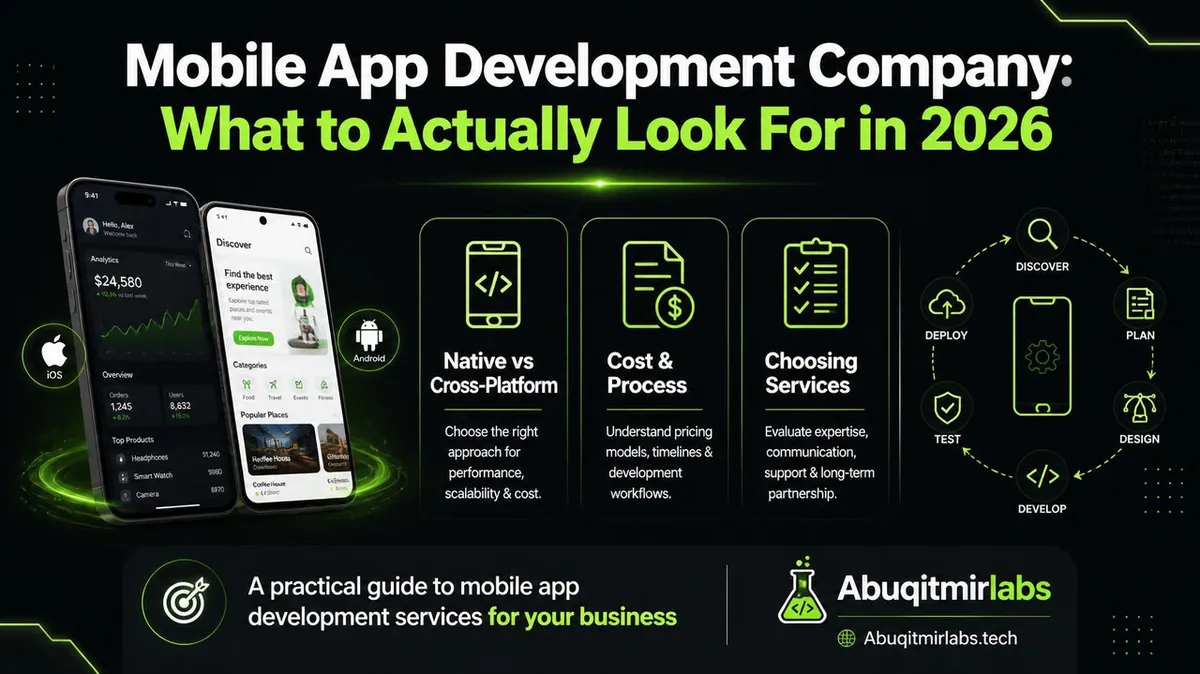
Mobile App Development Company: What to Actually Look For in 2026
Every mobile app development company claims to be the best fit for your project. Most of that claim rests on a decision they will make before they write a single line of code: native, cross-platform, or hybrid — and which framework.
That decision affects your budget, your timeline, your app's performance, and how much of your codebase you can reuse if you expand from iOS to Android, or from mobile to web. Getting it wrong is expensive to reverse.
This guide covers what a mobile app development company actually does, how native and cross-platform development compare in 2026, what drives cost, and how to evaluate mobile app development services before committing to one.
What Does a Mobile App Development Company Actually Do?
A mobile app development company designs and builds applications for iOS and Android — but "building an app" covers a wide range of technical work most people never see:
- UI/UX design specific to mobile interaction patterns (touch targets, gesture navigation, one-handed use)
- Front-end engineering — the interface layer users interact with
- Back-end architecture — user authentication, data storage, APIs, push notification infrastructure
- Platform integration — camera, GPS, biometric authentication, payment gateways, device sensors
- App Store and Google Play submission — compliance with platform-specific review guidelines
- Post-launch maintenance — OS updates break things; someone needs to keep the app working
A serious mobile app development firm handles all of this as one coordinated engineering process, not a checklist of disconnected deliverables.
Native vs. Cross-Platform Mobile App Development
This is the single most consequential decision in any mobile app development project.
Native Mobile App Development
Native development means building separately for each platform — Swift for iOS, Kotlin for Android. Native mobile app development gives you the highest possible performance, full access to platform-specific features on release day, and the smoothest match to each OS's design language.
The tradeoff is cost and timeline: two separate codebases mean two separate development efforts, and any new feature has to be built twice.
Native makes sense when:
- Performance is critical (gaming, AR/VR, complex animations)
- You need day-one access to the newest iOS or Android APIs
- Your budget supports maintaining two codebases long-term
Cross-Platform Mobile App Development
Cross-platform mobile app development uses a single codebase to deploy on both iOS and Android. The two dominant frameworks in 2026 are Flutter (Google's UI toolkit, compiled to native code) and React Native (Meta's framework, using JavaScript with native components).
Flutter mobile app development compiles directly to native ARM code, which gives it performance close to native apps while sharing a single Dart codebase across platforms. It also renders its own UI components, meaning visual consistency between iOS and Android is easier to guarantee.
React Native mobile app development lets teams already familiar with JavaScript and React build mobile apps using largely the same skill set as web development — which speeds up hiring and can shorten timelines for teams already invested in the React ecosystem. React Native for mobile app development bridges to native components at runtime rather than compiling to native code directly, which historically meant a small performance gap versus Flutter, though the gap has narrowed significantly with recent framework versions.
Hybrid mobile app development (using WebView-based frameworks) sits a step below both — it wraps web technology in a native shell. It is the fastest and cheapest option but comes with real performance and platform-integration limitations, and most serious mobile app development companies recommend it only for simple, low-interaction apps.
Which Should You Choose?
| Factor | Native | Flutter | React Native |
|---|---|---|---|
| Performance | Highest | Near-native | Near-native (improving) |
| Codebase | Separate for iOS/Android | Single | Single |
| Time to market | Slowest | Fast | Fast |
| Best for | Performance-critical, platform-specific apps | Visual consistency, startups scaling fast | Teams with existing React/JS expertise |
| Long-term cost | Highest (two codebases) | Lower | Lower |
For most startups and mid-sized businesses, cross-platform mobile app development — via Flutter or React Native — delivers the best balance of cost, speed, and quality. Enterprise mobile app development for performance-critical or highly regulated use cases more often justifies native.
What Is Mobile App Development, Practically Speaking?
If you're asking "what is mobile app development" from a business perspective rather than a technical one, here's the practical answer: it is the process of turning a business requirement — a customer-facing service, an internal workflow, a product experience — into a working application that runs reliably on the devices your users actually own.
That process typically runs through five phases:
- Discovery — mapping user flows and business requirements before any design work starts
- UI/UX Design — wireframes and interactive prototypes validated before development begins
- Development — front-end, back-end, and API work, usually in short sprints so progress is visible
- Testing — device testing across OS versions, screen sizes, and network conditions
- Launch & Maintenance — App Store/Google Play submission, then ongoing updates as OS versions change
Companies that skip discovery or testing are the ones whose apps get rejected at App Store review, or ship successfully and then break on the next iOS update.
Mobile App Development for Specific Industries
Healthcare Mobile App Development
Healthcare mobile app development carries compliance requirements most general-purpose developers are not equipped to handle correctly. In the US, HIPAA-compliant mobile app development means encrypting patient data at rest and in transit, implementing strict access controls, maintaining audit logs, and signing Business Associate Agreements with any third-party service the app touches (analytics, push notification providers, cloud storage). A mobile app development company without healthcare experience will often miss these requirements until an audit catches them — at which point the cost of retrofitting compliance is far higher than building it in from the start.
E-Commerce Mobile App Development
E-commerce mobile app development requires tight integration with inventory systems, payment gateways, and — critically — the same backend that powers the web storefront, so stock levels and pricing stay synchronised across channels. A well-built e-commerce app also needs offline-tolerant cart behaviour, push notifications for cart abandonment and order updates, and checkout flows optimised for one-handed mobile use, where every extra tap measurably reduces conversion.
Enterprise Mobile App Development
Enterprise mobile app development usually means internal-facing tools rather than public consumer apps: field service applications, inventory scanning tools, sales enablement apps, or internal dashboards. These projects prioritise integration with existing enterprise systems (ERP, CRM, SSO/identity providers) over public app store polish, and often need offline functionality for field staff working in areas with unreliable connectivity — a requirement that shapes the entire technical architecture from day one.
Fitness, Food Delivery, and Travel Apps
Fitness mobile app development, food delivery mobile app development, and travel mobile app development share a common technical backbone: real-time location tracking, push notification systems, and payment processing, layered with category-specific features — workout tracking and wearable integration for fitness apps, live order tracking and driver-matching logic for delivery apps, and booking/itinerary management for travel apps. The frameworks are often shared (Flutter or React Native for cross-platform speed) even though the feature sets diverge significantly.
What Drives Mobile App Development Cost
Mobile app development cost varies enormously because "an app" can mean a simple utility with three screens or a full marketplace platform with real-time messaging, payments, and multi-sided logic. The main cost drivers are:
- Platform choice — native (two builds) costs more than cross-platform (one build)
- Feature complexity — real-time features, payments, and third-party integrations add development time
- Design complexity — custom animations and highly tailored UI cost more than standard component libraries
- Back-end requirements — a simple app with minimal server logic costs less than one requiring custom APIs, real-time databases, or AI integration
- Compliance requirements — healthcare, fintech, and insurance apps carry additional development and testing overhead for regulatory compliance
- Post-launch maintenance — OS updates, bug fixes, and feature iterations are an ongoing cost, not a one-time expense
Any mobile app development company that quotes a fixed price without a discovery phase is either underestimating scope or padding heavily for risk. A credible quote follows a scoping conversation, not the other way around.
How AbuQitmirLabs Approaches Mobile App Development
AbuQitmirLabs is a custom mobile app development company based in Karachi, serving clients across the United States, United Kingdom, Europe, and Pakistan. Full details on the service are available at /mobile-app-development.
The team builds native iOS applications in Swift, native Android applications in Kotlin, and cross-platform applications in Flutter — chosen based on the project's actual requirements rather than a default framework preference. Every mobile engagement includes App Store and Google Play submission support, push notification and payment integration, and offline-mode functionality where the use case requires it.
Development runs in two-week sprints, so clients see working features regularly rather than a single delivery at the end of a multi-month build. For projects that also require back-end systems, AbuQitmirLabs' custom software development team builds the API and database architecture the mobile app runs on — and for apps that need automation or AI-driven features, the same team integrates custom AI agents grounded in the business's actual data.
For clients in the United States specifically, more detail on how AbuQitmirLabs works with US-based businesses is available at /us-market.
Every project begins with a free technical consultation — a scoping conversation before any pricing conversation, so the estimate reflects the actual project rather than a generic package.
Frequently Asked Questions
What is the difference between native and cross-platform mobile app development?
Native mobile app development means building separate codebases for iOS (Swift) and Android (Kotlin), giving the highest performance and platform-specific feature access, at higher cost and longer timelines. Cross-platform mobile app development, using frameworks like Flutter or React Native, uses a single codebase for both platforms, reducing cost and development time with only a small performance tradeoff compared to native.
Should I use Flutter or React Native for my app?
Flutter compiles to native code and renders its own UI components, giving strong performance and consistent visuals across iOS and Android — a good fit for startups prioritising visual consistency and fast scaling. React Native is often the better fit for teams that already have JavaScript or React expertise, since it lets developers reuse familiar skills and, in many cases, share logic with an existing web codebase. Both are credible, production-grade choices in 2026; the right one depends on your team's existing skills and the app's performance requirements.
How much does mobile app development cost?
Cost depends primarily on platform choice (native vs. cross-platform), feature complexity, back-end requirements, and compliance needs. A simple cross-platform app with standard features costs significantly less than an app with real-time messaging, payment processing, or industry-specific compliance requirements like HIPAA. A credible mobile app development company provides a cost estimate only after a discovery/scoping conversation, not before.
How long does mobile app development take?
A straightforward cross-platform app typically takes 10–16 weeks from discovery to App Store launch. More complex applications — with custom back-end systems, third-party integrations, or multi-role user systems — can take 4–7 months. Native development for two platforms generally takes longer than cross-platform development for the same feature set, since the work is largely duplicated across iOS and Android.
What does HIPAA-compliant mobile app development involve?
HIPAA-compliant mobile app development requires encrypting patient data both at rest and in transit, implementing strict role-based access controls, maintaining detailed audit logs of data access, and signing Business Associate Agreements (BAAs) with every third-party service the app uses — including analytics tools, cloud storage, and push notification providers. These requirements need to be built into the architecture from the start; retrofitting compliance after development is significantly more expensive than designing for it from day one.
Can a mobile app development company also build the back-end and web version of my product?
Yes, and it is generally advisable to use one team for both. A mobile app development company that also handles custom software and web development can build a shared back-end and API layer that powers your mobile app, web application, and admin dashboard consistently — avoiding the data synchronisation problems that arise when mobile and web platforms are built by separate teams on separate systems.
Ready to Build Your Mobile App?
Whether you need a native iOS and Android build, a cross-platform Flutter application, or a full mobile product backed by custom software and AI, the conversation starts with a free technical consultation — a scoping discussion, not a sales pitch.