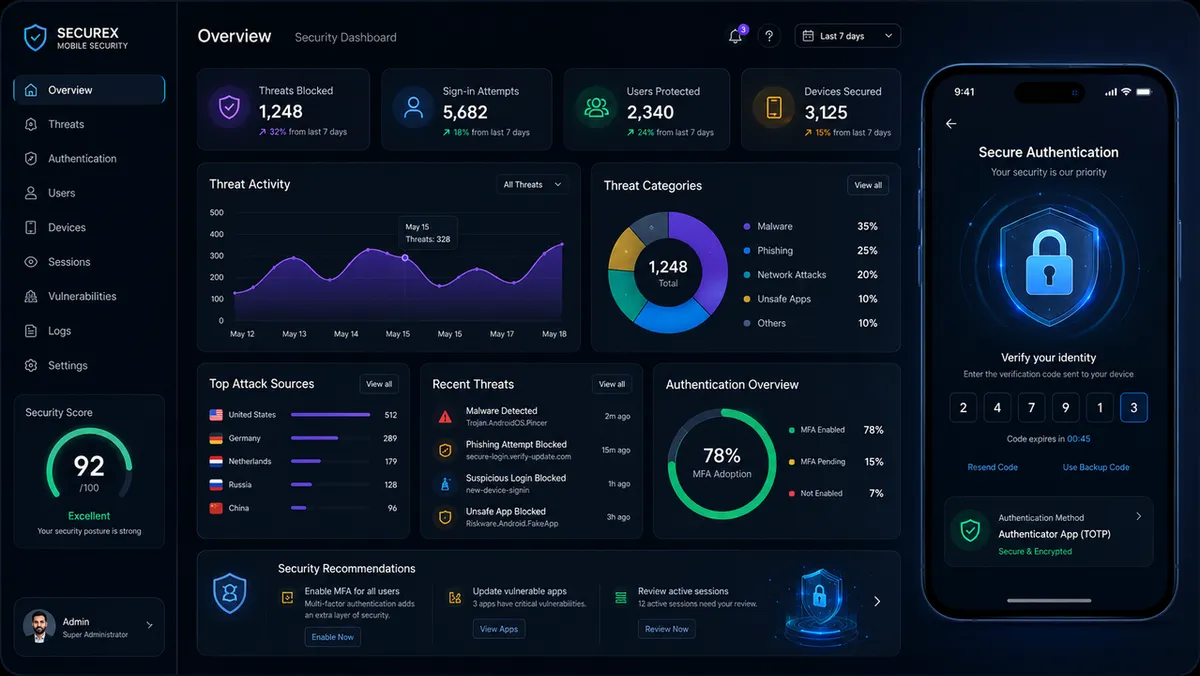
Mobile App Security Guide 2026 — Protect Apps & User Data
Most businesses think about mobile app security after something goes wrong.
That’s usually when:
- customer accounts get compromised
- APIs leak data
- payment systems fail
- admin dashboards get attacked
- fake versions of apps appear online
And by that point, the damage is already expensive.
I’ve seen startups spend months building polished apps only to ignore simple security basics like:
- exposed API keys
- weak authentication
- insecure databases
- poor admin access controls
The scary part?
Many security problems are not caused by “elite hackers.”
They happen because businesses move too fast without planning proper protection.
Mobile apps in 2026 handle:
- payments
- AI systems
- customer data
- business analytics
- health information
- financial transactions
Which means security is no longer optional.
It’s part of product quality.
“Users may forgive bugs. They rarely forgive broken trust.”
Why Mobile App Security Matters More Than Ever
Apps are becoming more connected every year.
Modern mobile apps interact with:
- cloud servers
- APIs
- payment gateways
- AI systems
- third-party integrations
- real-time databases
Every connection creates potential risk.
And attackers are increasingly targeting:
- startups
- small businesses
- fast-growing SaaS platforms
because they often have weaker security systems.
Common Mobile App Security Threats
Most app security problems repeat themselves.
Understanding these threats helps businesses avoid expensive mistakes.
1. Weak Authentication Systems
One of the biggest mistakes startups make is poor login security.
Examples:
- weak passwords
- no rate limiting
- no two-factor authentication
- insecure session management
This allows attackers to:
- hijack accounts
- access user data
- compromise admin systems
2. Insecure APIs
APIs connect mobile apps to servers.
If APIs are poorly protected:
- sensitive data can leak
- attackers can bypass permissions
- private systems become exposed
This is extremely common in rushed MVPs.
3. Data Storage Vulnerabilities
Many apps improperly store:
- passwords
- tokens
- customer information
inside local device storage.
That creates major risk.
4. Unencrypted Data
Data should always be encrypted:
- during transmission
- during storage
Without encryption, attackers can intercept sensitive information.
5. Reverse Engineering
Attackers sometimes decompile apps to:
- analyze source code
- steal API keys
- discover vulnerabilities
This is especially common with Android apps.
6. Third-Party SDK Risks
Apps often rely on:
- analytics tools
- payment SDKs
- advertising libraries
- AI integrations
Poorly maintained third-party services can introduce vulnerabilities.
7. Fake Apps & Cloning
Popular apps sometimes get cloned and redistributed.
These fake apps can:
- steal user credentials
- spread malware
- damage brand trust
Essential Mobile App Security Best Practices
Strong app security usually comes from consistent small decisions — not one magical solution.
Use Secure Authentication
Authentication should never be treated casually.
Recommended Security Features
✅ Two-Factor Authentication (2FA)
Adds an extra verification layer.
Especially important for:
- fintech apps
- admin dashboards
- SaaS systems
✅ OAuth Authentication
Using trusted login providers like:
- Apple
- Microsoft
can improve security significantly.
✅ Biometric Authentication
Modern apps increasingly support:
- fingerprint login
- Face ID
- device biometrics
This improves both:
- security
- user experience
Encrypt Sensitive Data
Encryption is essential.
Data in Transit
Use HTTPS and SSL/TLS encryption for all communication.
Never transmit sensitive information over insecure connections.
Data at Rest
Sensitive data stored in databases should also be encrypted.
Especially:
- payment information
- customer records
- business analytics
Secure APIs Properly
API security is one of the most overlooked areas in mobile development.
Best Practices
✅ Use Authentication Tokens
JWT or secure token systems help protect APIs.
✅ Validate Every Request
Never trust incoming requests automatically.
Always validate:
- permissions
- roles
- access rights
✅ Rate Limiting
Prevents brute-force attacks and abuse.
Avoid Hardcoding Secrets
Many beginners accidentally expose:
- API keys
- credentials
- tokens
inside mobile apps.
Attackers can extract these easily.
Instead:
- store secrets securely on servers
- use environment variables
- rotate credentials regularly
Use Secure Backend Infrastructure
App security isn’t only about the frontend.
The backend matters even more.
Recommended Backend Platforms
Popular secure platforms include:
- Firebase
- Supabase
- AWS
- Google Cloud
- Azure
when configured correctly.
Keep Dependencies Updated
Outdated libraries create vulnerabilities.
This includes:
- frameworks
- SDKs
- plugins
- packages
Regular updates reduce risk significantly.
Mobile App Security for Flutter Apps
Flutter apps are generally secure, but developers still make common mistakes.
Flutter Security Tips
✅ Obfuscate Code
Helps reduce reverse engineering risks.
✅ Secure API Calls
Never expose backend logic directly inside Flutter apps.
✅ Use Encrypted Storage
Store sensitive tokens securely.
Mobile App Security for React Native Apps
React Native apps require careful handling because JavaScript logic can sometimes expose vulnerabilities.
React Native Security Tips
✅ Secure Local Storage
Avoid storing sensitive data insecurely.
✅ Use Native Modules Carefully
Third-party libraries should be reviewed carefully.
✅ Monitor Dependencies
React ecosystems move fast.
Old packages can become dangerous quickly.
AI & Mobile App Security in 2026
AI is changing cybersecurity rapidly.
Both positively and negatively.
AI Security Advantages
AI systems now help:
- detect suspicious behavior
- identify fraud
- monitor unusual logins
- automate security alerts
Modern apps increasingly use AI-powered protection systems.
AI Security Risks
AI integrations also introduce new risks:
- prompt injection attacks
- AI API abuse
- automated scraping
- malicious automation
Businesses integrating AI features must secure them properly.
Payment Security for Mobile Apps
Any app handling payments requires extra protection.
Important Security Standards
✅ PCI Compliance
Important for payment systems.
✅ Secure Payment Gateways
Use trusted providers like:
- Stripe
- PayPal
- Razorpay
instead of handling raw card data directly.
User Privacy & Compliance
Privacy laws continue expanding globally.
Businesses should:
- explain data usage clearly
- minimize unnecessary data collection
- allow account deletion
- protect customer information properly
Trust matters more than ever.
Real-World Example
A startup launched a delivery app quickly to beat competitors.
The app looked impressive visually.
But internally:
- admin routes were exposed
- API permissions were weak
- user tokens expired improperly
Within weeks:
- customer accounts were compromised
- fake orders appeared
- support systems became overwhelmed
The problem wasn’t poor design.
It was rushed security planning.
After rebuilding:
- authentication improved
- APIs were secured
- admin systems were isolated
User trust slowly recovered.
That recovery process cost more than proper security would have initially.
Common Mobile App Security Mistakes
❌ Prioritizing Features Over Security
Many founders rush launches without proper testing.
❌ Ignoring Backend Security
Apps are only as secure as their servers.
❌ Exposing API Keys
This remains surprisingly common.
❌ Weak Admin Protection
Admin dashboards should always have stronger security layers.
❌ Skipping Security Testing
Penetration testing reveals critical issues before attackers do.
Mobile App Security Testing Checklist
Before launching any app:
✅ Test Authentication
✅ Test API Security
✅ Review Permissions
✅ Encrypt Sensitive Data
✅ Review Third-Party SDKs
✅ Test Rate Limiting
✅ Audit Admin Access
✅ Check Cloud Configuration
✅ Monitor Crash Reports
✅ Enable Logging & Alerts
Future of Mobile App Security
Mobile apps are becoming:
- smarter
- more connected
- AI-driven
- cloud-dependent
Which means security will increasingly rely on:
- AI monitoring
- automation
- behavioral analysis
- predictive threat detection
Businesses ignoring security will struggle to maintain user trust.
🔗 Learn the Full Mobile App Development Process
Security works best when planned from the beginning.
👉 Read this: https://abuqitmirlabs.tech/blog/mobile-app-development-guide-for-businesses-startups-2026
Learn:
- app architecture
- UI/UX workflows
- backend planning
- development strategy
- AI integration
🔗 Compare Flutter vs React Native Before Building
Framework choice also affects security workflows.
👉 Read this: https://abuqitmirlabs.tech/blog/flutter-vs-react-native-which-framework-is-better-for-mobile-app-development-2026
This comparison explains:
- architecture differences
- scalability
- security considerations
- development tradeoffs
Final Thoughts
The safest apps are usually not the ones with the most complicated security systems.
They’re the ones built carefully from the start.
Good security is often invisible.
Users don’t notice:
- encrypted APIs
- secure sessions
- protected databases
But they absolutely notice data breaches.
And rebuilding trust is far harder than protecting it early.
In 2026, app security is no longer just a developer responsibility.
It’s a business responsibility.
FAQs
1. Why is mobile app security important?
Mobile apps handle sensitive user data, payments, and business systems that attackers may target.
2. What is the biggest mobile app security risk?
Weak authentication and insecure APIs are among the most common risks.
3. How can apps protect user data?
Apps should use encryption, secure authentication, protected APIs, and safe cloud infrastructure.
4. Are Flutter apps secure?
Yes, when developers follow proper security practices like encrypted storage and secure API handling.
5. How often should apps receive security updates?
Apps should receive regular updates whenever vulnerabilities or dependency risks appear.
SEO Title
Mobile App Security Guide 2026 — Protect Apps & User Data
Related Engineering Resources
- For engineering teams deploying production workflows, explore our blueprint on custom AI agent development and enterprise RAG architecture and our AI automation solutions.
- Regulated platforms require strict architectural guardrails from day one—learn how we architect compliance-first custom software engineering and enterprise fintech systems.