AI Agents Cost Benefit Analysis: When They Actually Save Money (And When They Don't)
Introduction
Every AI agent pitch deck claims the same thing: deploy agents, cut costs, scale infinitely. Then the first invoice arrives.
One developer left an AI coding assistant running for four days straight. By the time anyone noticed, it had made 4,819 API calls at a total cost of $3,762. Nobody had budgeted for that bill.
That story is not an outlier. It is the predictable result of treating AI agents like SaaS subscriptions rather than what they actually are: autonomous systems that consume resources proportional to their reasoning effort. Customer-facing AI agents in some banks cost $20,000 to $30,000 to run a single-agent workflow and $100,000 to $200,000 to run a multiagent team.
Nearly half of 2,145 global business leaders surveyed by KPMG said they scaled back AI agent use because costs outweighed the benefits. Gartner predicts over 40% of agentic AI projects will be canceled by the end of 2027, citing escalating costs, unclear business value, and inadequate risk controls.
But here is the other side of the data. GitLab's Forrester-validated study found organizations using its agent platform achieved 400% ROI and $7.5 million in net present value over three years, with payback in under six months. LaunchDarkly saved roughly $1 million by building internal tools with AI coding agents instead of buying additional software. On benchmarked office tasks, AI agents completed work at $0.94 to $2.39 per task versus $24.79 for human workers. That is a 90% to 96% cost reduction.
Both sets of numbers are real. The difference is not the technology. It is the decision framework.
This article is for CTOs, product leaders, and founders who need to answer one question honestly: will an AI agent save money in this specific workflow, or will it become an expensive experiment that never reaches breakeven? You will get a structured cost benefit analysis framework, real cost breakdowns from 2026 deployments, and a decision checklist to run before you approve the build.
What Is an AI Agent Cost Benefit Analysis?
An AI agent cost benefit analysis is a structured evaluation that compares the total cost of building, deploying, and operating an autonomous AI agent against the measurable value it delivers. That value can be reduced labor cost, faster throughput, higher revenue, or avoided hiring.
Unlike traditional software ROI calculations, agent economics are variable and probabilistic. The same task may cost $0.50 one day and $15 the next depending on reasoning depth, tool calls, retries, and validation overhead.
Traditional software has predictable costs. You buy licenses, provision servers, and the bill stays flat. AI agents are different in three structural ways that break conventional budgeting.
Variable cost per execution
An agent does not follow a fixed path. It plans, calls tools, checks results, retries when something fails, and escalates when confidence drops. A single customer query might trigger ten, twenty, or fifty LLM calls under the hood. Memory lookups, safety filters, retries, and escalation logic all stack into operational cost while you watch the demo.
Validation cost exceeds generation cost
McKinsey found that nearly 60% of the operating cost of an agentic AI task is incurred in validating and refining responses rather than generating the initial output. You are not paying for answers. You are paying for the agent to check its own work.
Token consumption multiplies dramatically
Agentic AI tasks consume nearly 1,000 times more tokens than traditional chat-based AI workloads. Token consumption multiplies 20 to 30 times in agentic versus standard generative AI workloads. The per-token price is falling. The total token bill is rising.
This is why cost per token is a misleading metric. The metric that matters is cost per completed task. That means everything a model spent across every attempt, including failed runs, retries, and timeouts, divided by the number of times it actually finished the job. A model with a low token price and a 33% success rate may cost more per completed task than a premium model that succeeds on the first attempt.
When AI Agents Save Money: The Four Conditions That Predict ROI
AI agents consistently deliver positive ROI when four conditions are met simultaneously. Remove any one, and the economics degrade.
Condition 1: The workflow is high-volume and repetitive enough to amortize build cost
Code review agents hit 66x cost savings versus human review. Customer service agents hit 9x. The difference is not model quality. It is volume. Code review happens on every pull request, hundreds of times per week. Customer service handles thousands of tickets. Low-frequency, one-off tasks never reach the volume needed to justify the build.
Condition 2: The output is machine-verifiable
AI agents excel when success can be checked automatically. Code that compiles, tests that pass, and data that validates against a schema are all machine-verifiable. If verifying correctness requires human judgment, you have not eliminated labor. You have relocated it to validation, and validation is where 60% of agent operating cost already sits.
Condition 3: The workflow crosses system boundaries that humans currently bridge manually
Agentic AI savings come from executing complete workflows. They remove handoffs, exception labor, and coordination overhead rather than accelerating individual tasks. If your current process requires a person to copy data from CRM to spreadsheet to email, an agent that does all three steps saves the coordination cost, not just the typing time.
Condition 4: The build scope is narrow enough to control
Gartner predicts that by 2028, 80% of tangible ROI from agentic AI will come from specialized, domain-specific agents rather than general-purpose agents. The agents that pay back are boring. They do one thing, they do it well, and they do not attempt open-ended reasoning. General-purpose agents that try to handle everything cost more than they return because their failure modes are unbounded.
Real 2026 ROI Data from Production Deployments
| Organization | Use Case | Measured Result | Timeframe |
|---|---|---|---|
| GitLab (Forrester TEI) | DevSecOps agent platform | 400% ROI, $7.5M NPV | 3 years, under 6 month payback |
| LaunchDarkly | Coding agents + IT support | About $1M software cost avoided, $50K annual support savings | 1 year |
| West Monroe Partners | IT/HR service desk agent | 40% reduction in managed service costs, 2,700 hours saved per year | Ongoing |
| ABC Legal | 50+ agents across departments | Up to 50% reduction in cost of human tasks | 6 months |
| European 3PL | Logistics support orchestration | $980K support cost reduction | 18 months |
| Bouygues Telecom | Customer acquisition agent | 34% reduction in acquisition costs | Campaign duration |
These are not best-case demos. They are production systems with published methodology. The pattern is consistent: narrow scope, high volume, machine-verifiable output, and cross-system orchestration.
When AI Agents Cost More Than They Save: The Five Failure Patterns
The failures are equally consistent, and equally predictable.
Failure Pattern 1: You used an agent where a workflow belonged
Microsoft's own decision framework is blunt. If the steps are clear, repeatable, and follow strict rules, use regular code or nongenerative AI. A useful rule of thumb from production deployments: use an agent when the path to the goal is uncertain, and a workflow when the path is known.
If you can write down the steps, write them down. A deterministic pipeline is cheaper, faster, and more reliable than an agent reasoning its way through a known process.
Failure Pattern 2: You deployed a general-purpose agent on a task that needed a specialist
The AI agent cost benefit analysis for general-purpose agents almost always fails because the failure surface is too large. A general agent must handle every edge case. A specialist handles the five cases that actually occur. Gartner's projection that 80% of ROI will come from specialized agents is not a preference. It is an economic constraint.
Failure Pattern 3: Your data was not agent-ready
Gartner found that organizations prioritizing semantics in AI-ready data increase agentic AI accuracy by up to 80% and reduce costs by up to 60%. If your CRM has duplicate records, your knowledge base has contradictory answers, and your API documentation is outdated, the agent will spend its budget discovering these problems at runtime, one failed tool call at a time. Data readiness is not a prerequisite you can skip.
Failure Pattern 4: You underestimated integration and governance
Integration complexity frequently exceeds model development cost by three to five times. Governance adds another layer. Risk and compliance budget compounds with every agent deployed, with limited economies of scale.
One study of 127 enterprise implementations found 73% went over budget, some by more than 2.4 times, burning an extra $2.3 million on items nobody considered.
Failure Pattern 5: You deployed autonomy before you had monitoring
Ungoverned agents do not fail quietly. In at least nine documented cases over the past year, AI agents destroyed live company systems by wiping data and deleting databases using valid credentials. Their efforts were invisible to standard monitoring until the damage appeared.
The financial failure mode is equally invisible. Every dollar lost goes out through the agent's normal, working, authorized behavior. Model quality does not catch this. Only usage monitoring and spend limits do.
The True Cost of an AI Agent: A Full TCO Breakdown
Most AI agent cost benefit analyses fail before the first line of code because they compare raw API token cost against fully loaded human salary. That comparison is structurally dishonest. Real agents in production carry evaluation, integration, orchestration, and maintenance costs that demo decks rarely itemize.
A proper total cost of ownership calculation has five layers.
Layer 1: Build Cost
| Agent Scope | Initial Build Cost | Timeline | Typical Scope |
|---|---|---|---|
| Basic / static agent | $10K to $50K | 4 to 8 weeks | One workflow, one or two integrations, pre-trained model |
| Contextual agent | $20K to $70K | 6 to 12 weeks | Proprietary data, retrieval, monitoring, API integrations |
| Autonomous workflow agent | $80K to $120K+ | 3 to 6 months | Multi-step reasoning, tool orchestration, human escalation |
| Enterprise / regulated agent | $100K to $200K+ | 6 to 12+ months | Audit trails, compliance controls, high traffic, post-launch support |
| Multi-agent program (compliance) | $1M to $5M+ | 12 to 18+ months | Orchestration across multiple agents, governance layer, regulatory compliance |
For teams evaluating offshore development, Pakistan-based AI agent builds typically range from $10,000 to $30,000 for production agents, with ongoing monitoring retainers of $2,000 to $5,000 per month. The cost advantage is real, but it only matters if the underlying ROI conditions are met.
Layer 2: Integration Cost
This is where budgets break. Custom-built AI systems must integrate with ERP, CRM, data lakes, compliance tooling, and identity systems that have accumulated over decades. The integration bill frequently exceeds the model development cost by three to five times.
If your agent needs to read from Salesforce, write to NetSuite, and check against a legacy Oracle database, you are not building an AI agent. You are building an integration layer with an AI reasoning component attached.
Layer 3: Runtime Cost
Frontier model pricing as of mid-2026 sits at approximately $5 per million input tokens and $30 per million output tokens for GPT-5.5-class models. But token price is not the real cost driver. The real driver is cost per successful task, which includes retries, failed tool calls, and validation overhead.
Arize's benchmark of 10 models across 2,400 agent runs found that cheap models often cost more per completed task due to retry taxes:
| Model | Pass Rate | Cost per Attempt | Cost per Successful Task | Retry Tax |
|---|---|---|---|---|
| gpt-oss-120b | 33% | $0.018 | $0.054 | 3.0x |
| GPT-5.5 | 67% | $0.424 | $0.636 | 1.5x |
| Claude Sonnet 5 | 49% | $0.494 | $1.014 | 2.1x |
The cheap model has a 3x retry tax. The premium model has a 1.5x retry tax. For high-stakes tasks, the premium model may be cheaper per completed unit of work.
Layer 4: Human Validation and Oversight
This is the "hallucination tax." Every hallucinated output is paid for at full token rates. The agentic shift has amplified token consumption by orders of magnitude while unit prices fell 10 times.
Just over half of surveyed organizations (51%) report spending significant staff hours manually reviewing and correcting autonomous AI agent outputs before they go live. If your AI agent cost benefit analysis excludes human validation time, it is not a cost benefit analysis. It is a sales projection.
Layer 5: Governance and Maintenance
Organizations need agentic FinOps to manage total agent costs across infrastructure, governance, organizational change, failure recovery, and regulatory risk. Governance designed top-down costs less than governance paid for later with interest.
Budget for monitoring, access management, audit trails, data lineage, and periodic retraining. These are not optional line items. They are the difference between an agent that pays back and an agent that appears on a cancellation report.
AI Agent ROI Timeline: Why 12 to 18 Months Is the Realistic Model
Vendor decks promise 45-day payback. Production deployments tell a different story.
A realistic enterprise-grade agentic AI program follows four phases:
| Phase | Months | Monthly Cost | Monthly Savings | Cumulative Status |
|---|---|---|---|---|
| Investment | 1 to 3 | $60K to $100K | $0 | Negative, building and integrating |
| Tuning | 4 to 6 | $40K to $70K | $10K to $30K | Still negative, agent learning, humans parallel-running |
| Breakeven | 7 to 9 | $30K to $50K | $40K to $60K | Cumulative ROI turns positive |
| Payoff | 10 to 18 | $20K to $40K | $60K to $100K+ | Full productivity gains, $350K+ annualized value |
The median payback across successful deployments is 6.7 months, with 41% hitting positive ROI in year one. But "successful deployments" is doing heavy lifting in that sentence. The median across all deployments, including the 40% that Gartner expects to be canceled, is negative.
The practical implication: if your CFO cannot approve an 18-month timeline with negative cash flow for the first two quarters, you are not ready to deploy an AI agent. You are ready to run a pilot. Those are different decisions.
Decision Framework: Should You Build an AI Agent?
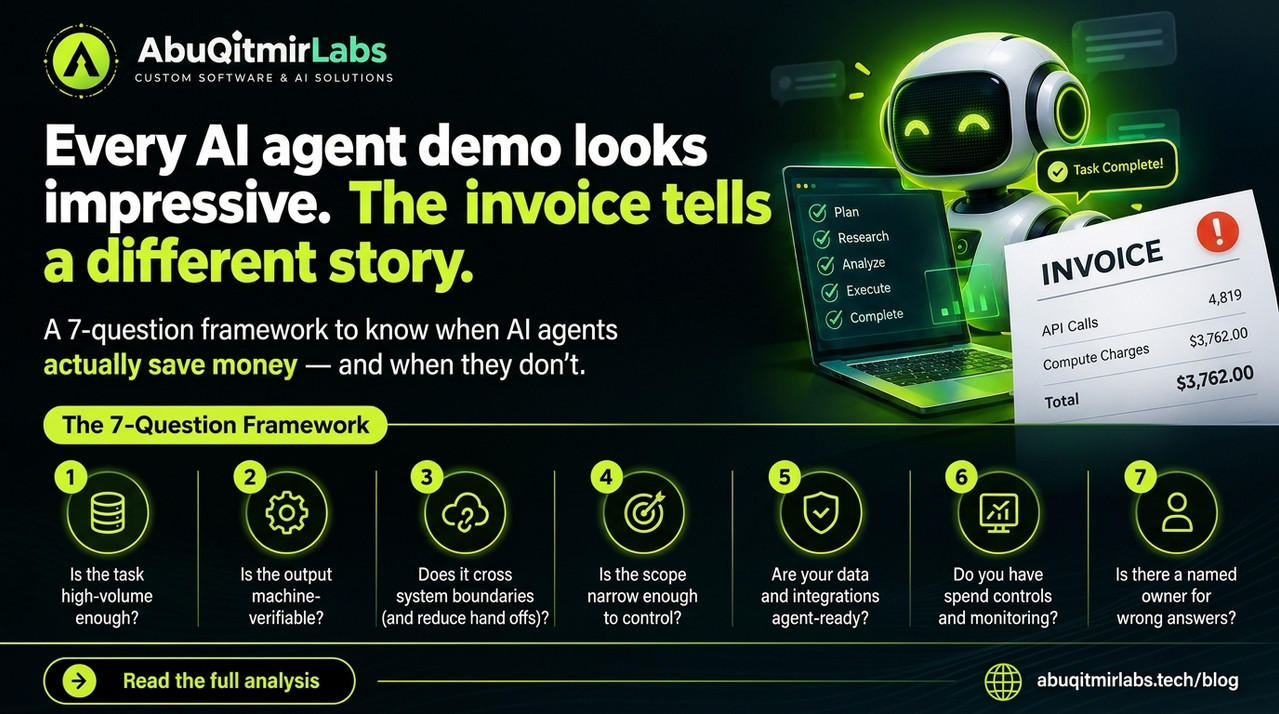
Run this checklist before approving any agent build. If you answer "no" to three or more, do not build. Fix the underlying condition first.
-
Is the task high-volume enough? Does this workflow execute at least 500 times per month? Below that threshold, the build cost will not amortize within 12 months. If no, use a scripted automation or off-the-shelf tool.
-
Is the task path uncertain? Does completing this task require reasoning about which step comes next, or is the sequence predetermined? If predetermined, use a deterministic pipeline. It is cheaper, faster, and more reliable.
-
Is the output machine-verifiable? Can you programmatically confirm whether the agent completed the task correctly? If verification requires human judgment, your cost savings are illusory. You are paying for generation and validation.
-
Is your data agent-ready? Are your knowledge sources consistent, your APIs documented, and your records deduplicated? If no, budget 3 to 5 times your model cost for integration and data preparation.
-
Can you define a narrow scope? Can you describe the agent's job in one sentence with explicit boundaries? If the scope is broad or open-ended, split it into specialized agents. General-purpose agents do not pay back.
-
Do you have spend controls ready? Can you set per-agent token budgets, monitor usage in real time, and kill a runaway agent automatically? If no, do not deploy. One unmonitored agent ran 4,819 calls over four days and cost $3,762.
-
Is there a named owner for wrong answers? When the agent makes a mistake, who is accountable? If nobody, do not deploy autonomous actions. Restrict the agent to recommendations, not execution.
AbuQitmirLabs builds AI agents for startups and enterprises that pass this checklist before any code is written. If you want to evaluate your specific workflow against these criteria, the AI Readiness Score tool takes about 15 minutes and produces a build/no-build recommendation with cost estimates. For teams that already know they are building, the Project Cost Estimator provides a full TCO breakdown for your agent scope.
FAQ: AI Agent Cost Benefit Analysis
How much does a custom AI agent cost to build in 2026?
A basic AI agent starts around $20,000. Production agents with multiple integrations, proprietary data, and monitoring typically range from $25,000 to $80,000. Enterprise-grade autonomous agents with compliance requirements can exceed $150,000. Multi-agent programs with governance layers easily reach $1 million to $5 million.
The biggest cost variable is not model choice. It is integration complexity and data readiness.
How long does it take for an AI agent to pay for itself?
The realistic payback period is 12 to 18 months for enterprise-grade deployments. Successful deployments show a median payback of 6.7 months, but those are the survivors. The first three months are pure investment with zero savings. Breakeven typically arrives in months seven to nine.
If your organization cannot sustain negative cash flow for six months, an agent deployment is the wrong tool.
What is the biggest hidden cost in AI agent projects?
The hallucination tax, which is the cost of human staff reviewing and correcting AI outputs. Over half of surveyed organizations report spending significant staff hours on manual review of agent outputs.
This cost does not appear in vendor pricing models. It appears in your operations budget. Budget for it explicitly, or your ROI calculation will be wrong.
When should you NOT use an AI agent?
Do not use an AI agent when the task is structured and predictable (use regular code), when it requires static knowledge retrieval (use classic RAG), when the output requires human judgment to verify, when you lack a named owner for wrong answers, or when the business case is headcount reduction rather than a defined customer problem.
A useful rule: if you can write down the steps, write them down. Use an agent only when the path is genuinely uncertain.
Do AI agents actually save money compared to hiring?
For narrow, high-volume, machine-verifiable tasks, yes, dramatically. AI agents completed benchmarked office tasks at $0.94 to $2.39 per task versus $24.79 for human workers. That is a 90% to 96% cost reduction.
For complex, judgment-heavy, or low-volume work, no. Nvidia's VP of applied deep learning stated that for his team, compute cost currently runs above employee cost. The answer depends entirely on workload characteristics, not on AI capability.
Conclusion: The Agent Pays Back Only When the Workflow Fits
AI agents are not universally cost-saving or universally expensive. They are economically rational in a narrow band: high-volume workflows with uncertain paths, machine-verifiable outputs, and integration surfaces you control. Outside that band, they consume budget without returning value, and the consumption is invisible until the invoice arrives.
Run the seven-question checklist before your next agent build. If the workflow passes, you have a genuine opportunity to cut operating cost by 50% to 90%. If it fails, you have saved yourself a six-figure experiment.
AbuQitmirLabs builds AI agents for startups and enterprises that need production systems, not demos. If you want to evaluate whether your specific workflow will pay back, start with the AI Readiness Score. If you already know what you are building, get a full cost breakdown with the Project Cost Estimator, or talk to our team about your build.

Abu Qitmir Mohammad Shiraz Al-Madani
Founder & Lead Systems Architect at AbuQitmirLabs. Specializing in high-performance digital ecosystems, AI-driven architectures, and building scalable full-stack software systems.