Introduction
In 2026, roughly 60% of all Google searches are zero-click. Users get their answers directly from AI Overviews, featured snippets, and knowledge panels without ever visiting a website. At the same time, AI writing tools have made it possible to generate a 2,000-word article in three minutes.
This combination has created panic among founders and marketers. They wonder: If everyone is using AI, and Google is answering questions on the search page, does content marketing still work?
Yes, it does. But the rules have changed completely. Google does not penalize AI content. Google penalizes unhelpful content.
This guide breaks down exactly what Google's 2026 guidelines say about AI vs human content. You will learn how to use AI safely, how to structure your content for AI Overviews, and the exact "Human-in-the-Loop" workflow we use at AbuQitmirLabs to build topical authority.
Quick Verdict: Google's 2026 Stance on AI Content
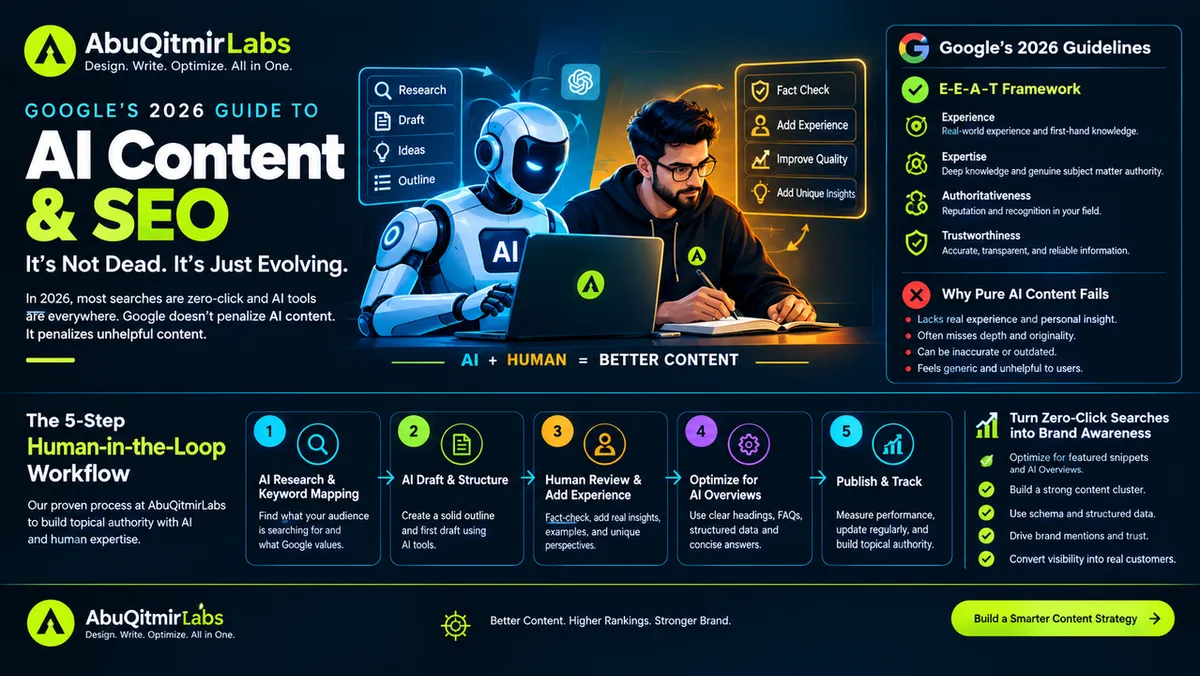
Google does not care whether AI or a human wrote the content. Google cares about E-E-A-T (Experience, Expertise, Authoritativeness, Trustworthiness). If the content is helpful, accurate, and demonstrates first-hand experience, it will rank. If it is generic, unverified AI fluff, it will fail.
What Google's 2026 Guidelines Actually Say
Direct Answer: Google's "Helpful Content" system evaluates content based on people-first value, not its method of creation.
In their official guidance, Google explicitly states that they reward high-quality content, however it is produced. The focus is on the "Who, How, and Why" of the content:
- Who: Is there a clear author with real credentials? (Authoritativeness)
- How: Was the content created to help people, or just to manipulate search rankings?
- Why: Does this content provide a unique perspective or original data?
If you use AI to write an article about "How to fix a leaky faucet," but you have never fixed a faucet, you lack Experience. The content will read like a generic manual and will be beaten by a plumber who includes real photos and mentions specific brands of washers.
To master this, you need a strong foundation in SEO mastery that prioritizes user intent over word count.
AI Content vs Human Content: The Real Difference
Direct Answer: AI provides speed and structure. Humans provide experience, original data, and emotional nuance.
Here is the side-by-side breakdown of what works and what fails in 2026:
| Feature | Pure AI Content | Human-Edited Content (Human-in-the-Loop) |
|---|---|---|
| Speed | Extremely fast | Slower, requires research and editing |
| Information Gain | Low (regurgitates existing data) | High (includes original data, case studies) |
| E-E-A-T Signals | Weak (no real experience) | Strong (first-hand knowledge, author bios) |
| Brand Voice | Generic and robotic | Consistent, conversational, and branded |
| AI Overview Citation | Rarely cited | Frequently cited as a primary source |
The goal is not "AI vs Human." The goal is AI-assisted human content.
Why Pure AI Content Fails in 2026
Direct Answer: Pure AI content fails because it lacks "Information Gain" and often contains hallucinations that destroy trust.
If five agencies in Karachi ask ChatGPT to write "What is Custom Software?", they will get five nearly identical articles. Google's algorithms detect this lack of uniqueness.
Furthermore, AI models often invent statistics or cite non-existent sources (hallucinations). For a business, publishing false data destroys the Trust component of E-E-A-T.
You also cannot rely on AI for visual assets. While you can use AI tools to generate ideas for your brand, you still need professional graphics design to create the infographics and UI screenshots that prove your expertise.
The "Human-in-the-Loop" AI Workflow
Direct Answer: To rank in 2026, you must use a structured workflow where AI does the heavy lifting, but humans do the thinking, fact-checking, and optimizing.
Here is the 5-step workflow we recommend for 2026:
- Human-Led Research: A human must identify the target keywords, analyze the top competitors, and gather original data (surveys, client metrics, industry reports). AI cannot do this for you.
- AI-Assisted Drafting: Use AI to generate the initial outline or draft based on the specific data points you provide. Do not just say "write an article about SEO." Give it specific constraints.
- Human Editing & E-E-A-T Injection: Add your personal stories, client examples, and specific technical details. Inject your unique brand voice.
- Human Fact-Checking: Verify every statistic, quote, and link. Remove any AI-generated fluff or repetition.
- Formatting for AEO: Structure the final draft with direct answers, bullet points, and comparison tables so AI engines can extract the data.
If you need help mapping this out over a month, read our guide on building a content calendar strategy.
Structuring Content for AI Overviews (GEO & AEO)
Direct Answer: AI Overviews extract concise, factual answers. To get cited, your content must lead with the answer, use clear H2/H3 headers, and include structured data.
Here is how to format your content for the 60% zero-click reality:
- Direct Answers: Every H2 section must start with a 40 to 60 word direct answer. AI engines pull this exact block.
- Lists and Tables: Use numbered lists for processes and HTML tables for comparisons.
- The "Information Gain" Rule: Google prefers content that offers a unique angle. Our guide on SEO content vs thought leadership explains how to balance traffic-driving SEO content with authority-building thought leadership.
- Structured Data: Implement
Article,FAQPage, andBreadcrumbListschema markup to help AI understand your content hierarchy.
Frequently Asked Questions
Is AI content penalized by Google?
No, Google does not have a penalty specifically for AI content. However, Google penalizes content created primarily for search engines rather than people. If AI content is unhelpful, lacks expertise, or contains false information, it will not rank.
Can AI-generated content rank on Google?
Yes, AI-generated content can rank, but only if it is heavily edited by a human to include original insights, factual accuracy, and a unique voice. Pure, unedited AI content rarely ranks for competitive terms in 2026.
What is E-E-A-T in 2026?
E-E-A-T stands for Experience, Expertise, Authoritativeness, and Trustworthiness. It is the framework Google uses to evaluate content quality. Content written by someone with first-hand experience (like a founder sharing a case study) scores higher than generic AI summaries.
How much human editing does AI content need?
Every sentence should be reviewed. The AI should provide the structural framework, and the human should provide the data, the brand voice, and the fact-checking. Aim for at least a 50% human rewrite of the initial AI draft.
What is the "Human-in-the-Loop" workflow?
It is a process where AI is used for drafting or brainstorming, but a human is responsible for the final output. The human does the research, prompts the AI, edits the draft, adds original data, and verifies all facts before publishing.
Why is zero-click search a problem for marketers?
Zero-click search means users get answers directly from Google's AI Overviews without clicking your link. Marketers must adapt by optimizing for AI citations (GEO) and focusing on high-intent keywords that drive actual website visits and conversions.
How do I optimize my content for AI Overviews?
Lead every section with a direct, 40-60 word answer. Use clear H2 and H3 headings. Use bullet points for lists. Provide original statistics and data, as AI engines prefer citing sources with unique information.
What is Information Gain in SEO?
Information Gain is a metric Google uses to measure how much new information a page provides compared to other pages ranking for the same query. Content with high Information Gain includes original research, unique opinions, and first-hand case studies.
Conclusion
The debate of AI content vs human content is a distraction. The real debate is between helpful content and unhelpful content. AI is a powerful tool for structure and speed, but it cannot replace real human experience.
If you want to rank in 2026, you need to use AI to scale your production, but use humans to maintain your expertise. Build topical authority by linking your content together, optimize for AI Overviews with direct answers, and focus heavily on digital marketing strategies that convert traffic into revenue.
At AbuQitmirLabs, we combine AI efficiency with human expertise to build content engines that rank. If you need a content strategy that actually drives business results, get in touch.