AI Is Quietly Stealing Your Ability to Think | AbuQitmirLabs
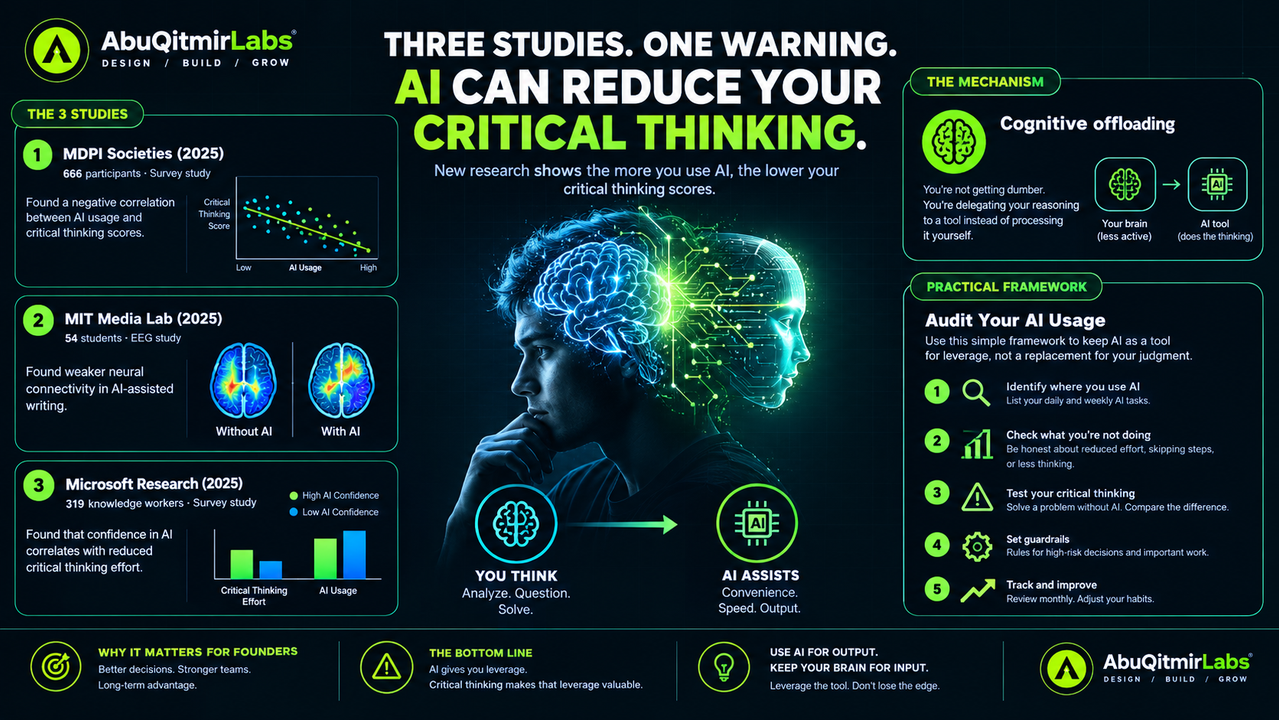
A 2025 Study in the Journal Societies surveyed 666 participants. It found one pattern that should concern every knowledge worker in 2026: the more people used AI tools, the lower their critical thinking scores dropped. The researchers gave it a name — cognitive offloading. You are not getting dumber. You are getting dependent. And dependence has a cost that no productivity dashboard will ever show you.
What Three Peer-Reviewed Studies Actually Found
The story is not told by one study. It is told by three, published across four years, using three completely different methodologies. And they all point to the same conclusion.
Study 1: The Cognitive Offloading Effect (MDPI Societies, 2025)
Researchers surveyed 666 participants and assessed their critical thinking abilities against their self-reported frequency of AI tool usage. The correlation was negative and statistically significant. Higher AI usage predicted lower critical thinking scores. The mechanism is what matters: cognitive offloading. Instead of reasoning through a problem, the user delegates the reasoning to the tool. The tool produces output. The user accepts the output without evaluation.
The study did not find that AI makes you smarter. It found the opposite — that heavy reliance on AI tools correlates with reduced engagement in the reflective, analytical thinking that builds long-term cognitive strength.
Study 2: The MIT Media Lab EEG Experiment (2025)
Fifty-four students were fitted with EEG headsets and asked to write essays under three conditions: pure human writing, AI-assisted writing, and AI-dominant writing. The results were measured by neural connectivity across brain regions associated with critical thinking, attention, and memory consolidation.
The findings:
- AI-assisted writers showed weaker neural connectivity in the regions tied to critical thinking.
- Pure human writers showed the strongest neural activity and the best memory recall of their own essays.
- AI-dominant writers showed the weakest brain activity of all three groups.
Then came the follow-up session, which is the part most people miss. Participants who had used AI first and then switched to writing without it performed worse than participants who had never used AI at all. The tool had not helped them learn. It had made the task harder to do without it.
Study 3: The Microsoft Research + Carnegie Mellon Survey (2025)
Three hundred nineteen knowledge workers were surveyed about their AI usage patterns and critical thinking behaviors. The finding was counterintuitive at first, then obvious on reflection:
- Confidence in AI was associated with reduced critical thinking effort.
- Confidence in self was associated with increased critical thinking effort.
In other words, the more you trust the machine, the less you apply your own judgment. The more you trust yourself, the more you exercise the judgment that made you trustworthy in the first place.
Why This Is a Business Problem, Not Just a Personal One
You might read those studies and think: "I use AI for tasks that do not require thinking anyway." That assumption is precisely the problem. The tasks you delegate today are the tasks you will not be able to do tomorrow.
Three patterns show up in teams that have gone deep on AI adoption without guardrails.
Pattern 1: The Slow Loss of Judgment
A founder who once traced an attribution model by hand now asks a chatbot to summarize a dashboard. The chatbot gives a confident answer. The founder accepts it. Six months later, when the dashboard has a data issue, the founder cannot detect it because the underlying model was never internalized. The judgment was never built.
At AbuQitmirLabs, we build revenue attribution systems for B2B companies. The teams that succeed are not the ones that automate the most. They are the ones that automate execution while preserving the judgment of the people responsible for the outcome. There is a difference, and it shows up six months into the engagement.
Pattern 2: The Erosion of Troubleshooting Capacity
When a system breaks, the person who built the system mentally knows where to look. The person who watched a chatbot build the system does not. This is not a small inefficiency. It is a structural vulnerability. The team becomes dependent on the tool that created the dependency.
This is why we design AI agent development projects with an explicit human escalation path. The agent handles volume. The human handles anomalies. The moment those roles reverse, the system becomes fragile.
Pattern 3: The Illusion of Velocity
Teams ship faster with AI. They also ship more work that requires rework. Research on AI-assisted coding has documented this pattern repeatedly: velocity increases, but the defect rate increases alongside it. The net effect depends entirely on whether the team has retained the critical thinking capacity to catch what the tool missed.
One of our clients built a growth infrastructure project where we explicitly structured the workflow so that every AI-generated output passed through a human review gate tied to a specific decision criterion. The result was a system that ran faster than a manual process and produced fewer errors than a pure AI pipeline. That is what healthy AI use looks like.
The Distinction That Matters: Leverage Versus Atrophy
Not all AI use is the same. The difference between healthy and harmful usage comes down to one question:
Does the output require your evaluation, or does the task you delegated require your judgment?
If the task requires judgment, delegating it erodes the very capacity that made you valuable. If the task does not require judgment, delegating it frees capacity for the work that does.
Here is a practical framework to audit your own usage:
| Task Type | Healthy AI Use | Atrophy Risk |
|---|---|---|
| Drafting a first version | AI produces the draft, you refine it | You ship the draft unread |
| Summarizing a document | AI produces the summary, you verify the claims | You accept the summary as fact |
| Debugging code | AI proposes a fix, you reason through the logic | You paste the fix and move on |
| Strategic decision-making | AI presents options, you own the decision | You ask AI what to do |
| Data analysis | AI surfaces patterns, you interpret them | You accept the interpretation |
| Client communication | AI drafts the message, you finalize the tone | You send the draft with your name on it |
The pattern: AI belongs in the execution layer, not the judgment layer. When it crosses that line, the dependency begins.
What This Means for Founders in 2026
You are not going to stop using AI. That is not the answer. The answer is to use it in a way that keeps your team capable of thinking clearly when the tool fails, when the data is ambiguous, and when the decision actually matters.
Three things we recommend to every founder we work with:
1. Audit Where Judgment Has Been Outsourced
Pick a critical workflow. Map every step. For each step, ask: who owns the final decision? If the answer is "the AI does," you have found a dependency. If the answer is "a human who reviews AI output against a defined criterion," the workflow is healthy.
2. Preserve the Practice of Manual Analysis
Even if AI can produce the number, someone on your team should be able to reproduce it manually. Not every time. But enough that the skill does not disappear. This is why our growth engineering engagements include an audit phase where the client team participates in the analysis, not just consumes the output.
3. Build Systems Where AI Handles Volume, Humans Handle Anomalies
The right architecture for most B2B companies is not full automation. It is a pipeline where AI processes the routine cases and escalates the exceptions. Our AI agent projects are designed this way by default. The agent does not replace the human. It gives the human more time to be human.
The One Question to Ask Yourself Today
Open your AI chat history. Look at your last twenty prompts. Sort them into two buckets:
- Bucket A: Tasks where you evaluated the output, edited it, or made a decision based on it.
- Bucket B: Tasks you already knew how to do but handed off because it was faster.
Bucket A is leverage. Bucket B is atrophy.
The ratio between them determines whether AI is making you more capable over time or less. There is no neutral. Every interaction tips the scale one direction or the other.
What Comes Next
The studies are clear. The mechanism is clear. The path forward is a choice, not a default.
You can use AI to expand what you are capable of. Or you can use it to replace what you would rather not practice. The first produces compounding capability. The second produces compounding dependency.
If you want to see how we structure this for client teams — building growth infrastructure that amplifies judgment rather than replacing it — the full framework is on the AbuQitmirLabs growth engineering page. If you want to talk through your own team's AI usage and where the boundary should sit, reach out directly. We build systems that use AI to make people sharper, not to make them optional.
The tool will not wait for you to decide which side of that line you want to be on. The line moves every day you do not.

Abu Qitmir Mohammad Shiraz Al-Madani
Founder & Lead Systems Architect at AbuQitmirLabs. Specializing in high-performance digital ecosystems, AI-driven architectures, and building scalable full-stack software systems.