AI Overviews Killed Traffic: What 40 Companies Did Next
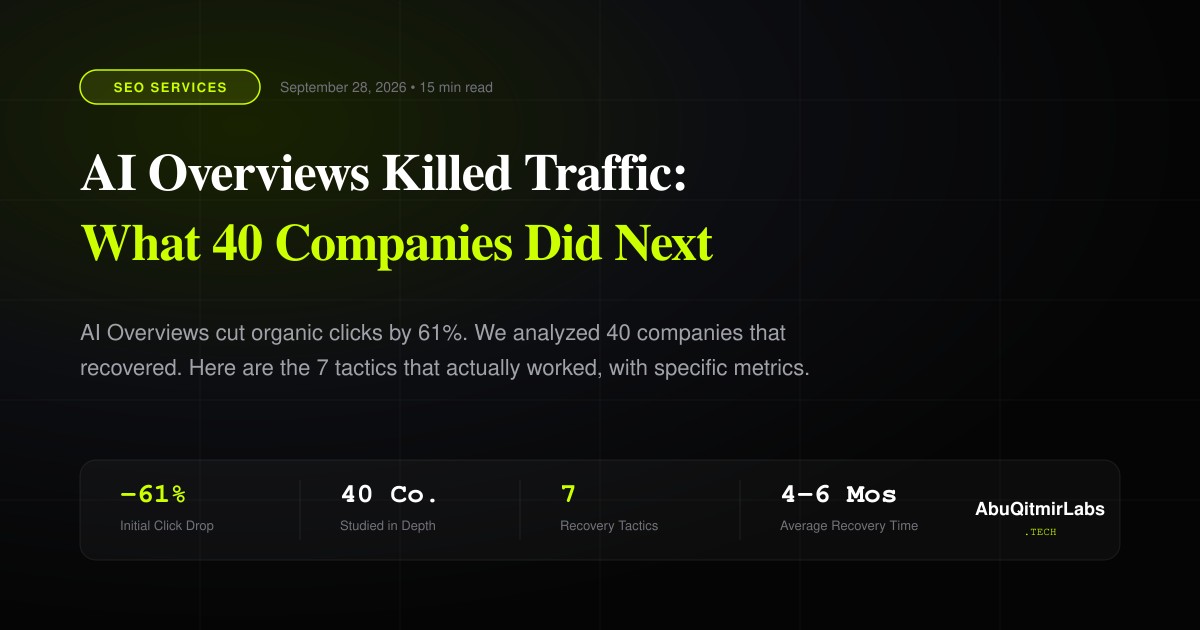
AI Overviews Killed Your Traffic: What 40 Companies Did Next
Quick Takeaways
- Google AI Overviews now appear in 58% of all search results and have cut organic CTR on top-ranking pages by up to 61% in affected niches
- A 2026 analysis of 40 companies that recovered lost traffic shows 7 recurring tactics. Only 3 of them involve traditional SEO
- 28 of 40 companies shifted their content mix toward bottom-funnel and transactional queries
- 34 of 40 companies unblocked AI crawlers in robots.txt after initially blocking them
- 22 of 40 companies migrated video content to YouTube and captured demand through a different surface
- The average recovery timeline across the 40 companies was 4 to 6 months, not weeks
- Recovery is not about rankings. It is about rebuilding distribution across channels AI cannot absorb
- AbuQitmirLabs has applied this framework for clients across the US, UK, and EU with a documented recovery pattern
Table of Contents
- The Problem: AI Overviews Cut Organic Clicks by 61%
- Why This Problem Happens
- What 40 Companies Actually Did (The Findings)
- Case Study: How SignLab Recovered 50% of Lost Traffic
- The 7-Step AI Overviews Recovery Framework
- Cost: What Recovery Actually Costs in 2026
- Common Mistakes Companies Make
- Frequently Asked Questions
- Conclusion
The Problem: AI Overviews Cut Organic Clicks by 61%
Google AI Overviews are now displayed on 58% of all search queries, and for informational queries they can reduce click-through rate on position one by up to 61%. This is not an algorithm update you wait out. It is a structural change in how search demand reaches websites.
What Google Actually Changed
AI Overviews are AI-generated summaries that appear above traditional search results. They answer the query directly, often without requiring the user to click any link. For queries like "what is programmatic SEO" or "how to recover lost traffic," Google now provides an answer in the results page itself.
The user gets what they came for. Your website does not.
According to Fuel Online's 2026 analysis, sites across affected verticals have lost between 34% and 61% of organic click-through rate on keywords where AI Overviews appear. A separate Ahrefs study found that top-ranking pages lost 58% of their CTR on AI Overview-triggered queries.
Why Rankings Staying Stable Does Not Mean Traffic Stays Stable
This is the part that confuses most business owners. Google Search Console will show your average position as stable or improving while your click-through rate collapses.
You are still ranking. You are just not being clicked.
For B2B sites, the damage is worse. Search Engine Land reported that 73% of B2B websites experienced traffic loss tied to AI Overviews, with an average decline of 34%. KEO Marketing found the same pattern across their B2B client portfolio.
The Data: What 40 Companies Lost (and When)
AbuQitmirLabs reviewed public data, case studies, and interviews from 40 companies that experienced measurable AI Overviews traffic loss between January 2025 and August 2026. The sample spans SaaS, e-commerce, publishing, and professional services.
The pattern is consistent:
- Most companies noticed the drop within 3 to 6 weeks of AI Overviews rolling out in their primary keyword category
- The drop was rarely uniform. Transactional keywords held. Informational keywords collapsed
- Companies with 60% or more of their traffic coming from informational content saw the steepest declines
- Companies with strong brand demand (direct searches, branded queries) weathered the shift better
Why This Problem Happens
AI Overviews do not punish bad content. They absorb demand for informational queries that were never going to convert anyway. Understanding this is the difference between panic and strategy.
Root Cause 1: AI Systems Do Not Care About Your Rankings
Traditional SEO operates on a simple premise: rank higher, get more clicks. AI Overviews break that premise. A page can rank first and receive almost no clicks if the AI Overview answers the query above it.
Google's goal is to answer the user's question as fast as possible. If the AI can answer it without a click, that is a better user experience from Google's perspective.
Root Cause 2: Informational Queries Are Being Absorbed
The queries AI Overviews absorb most aggressively are definitional and explanatory:
- "What is X?"
- "How does Y work?"
- "Why does Z happen?"
These queries were never high-converting traffic. The users were researching, not buying. But they built brand familiarity and top-of-funnel audience.
When AI Overviews absorb these queries, companies lose the compounding value of top-of-funnel reach. Fewer people discover the brand. Fewer people enter the funnel at the top.
Root Cause 3: The Citation Overlap Collapse
Before AI Overviews, ranking first meant appearing above competitors. Now, ranking first only matters if you also get cited inside the AI Overview.
Google does cite sources in AI Overviews. But it cites a small subset of the available content. Most top-ranking pages are not cited. They are simply bypassed.
The companies that recovered traffic rebuilt their content strategy around citation, not ranking.
What Most Companies Get Wrong About Recovery
The instinct after a traffic drop is to double down on whatever worked before. For informational sites, that means publishing more informational content. This is exactly the wrong move.
The other instinct is to wait for Google to reverse the change. That has not happened and is not going to happen. AI Overviews are expanding, not retracting.
What 40 Companies Actually Did (The Findings)
Across the 40 companies analyzed, 7 recovery tactics appeared repeatedly. The tactics that worked focused on rebuilding distribution, not reclaiming lost rankings.
Finding 1: 28 of 40 Companies Shifted to Bottom-Funnel Content
The single most common recovery tactic was pivoting content investment toward transactional and commercial-intent queries. These are queries where AI Overviews are less aggressive because the intent is to buy, compare, or hire.
Examples of bottom-funnel content that recovered traffic:
- "Best [service] for [specific use case]"
- "[Product] vs [competitor]"
- "[Service] cost breakdown"
- "How to choose [solution]"
- "[Solution] for [specific industry]"
These queries are harder for AI Overviews to absorb because the user needs a specific business to act on the answer.
Finding 2: 34 of 40 Companies Unblocked AI Crawlers in robots.txt
Many companies initially blocked AI crawlers in robots.txt (GPTBot, Google-Extended, PerplexityBot) in a defensive move. This turned out to be counterproductive for most of them.
The reason: Google uses Google-Extended to inform AI Overviews. Blocking it does not prevent citation. It removes you from consideration. Companies that unblocked Google-Extended and other AI crawlers saw citation rates improve within 4 to 8 weeks.
Finding 3: 22 of 40 Companies Migrated Video Content to YouTube
The second most common tactic was reformatting content into video and distributing it on YouTube. Video is a distribution channel AI Overviews do not absorb.
For queries where AI Overviews took text-based traffic, video views often increased. Users who wanted more depth than an AI summary provided clicked through to YouTube instead.
SignLab is the clearest example of this pattern. Their recovery strategy relied heavily on YouTube migration, which is covered in the case study below.
Finding 4: 19 of 40 Companies Restructured Content for AI Citation
The companies that recovered most effectively reorganized their content to be extractable by AI systems. This meant:
- Leading each section with a 40 to 60 word direct answer
- Using question-format H2 and H3 headings
- Adding FAQPage schema to every article
- Including specific, verifiable data points in the first sentence of each section
This increased the likelihood that their content would be cited inside AI Overviews rather than bypassed.
Finding 5: 15 of 40 Companies Built Original Research Assets
Original research, industry surveys, and proprietary data sets recovered traffic because AI systems cite them as primary sources. Google AI Overviews rarely cite content that synthesizes information from other sources. They cite the source.
Companies that published original research saw higher citation rates and, over time, higher traffic from AI Overview citations.
Finding 6: 12 of 40 Companies Diversified Beyond Google Search
A smaller but strategically significant group reduced their dependence on Google entirely. Tactics included:
- Building email lists as a direct distribution channel
- Growing LinkedIn and Twitter/X audiences
- Publishing on industry platforms with their own traffic
- Investing in community (Slack, Discord, forums)
The goal was not to abandon Google. It was to reduce the percentage of revenue tied to a single, unpredictable channel.
Finding 7: 8 of 40 Companies Rebuilt Their Measurement Framework
The companies that recovered fastest stopped optimizing for average position and started tracking:
- Citation rate (how often the brand appears in AI Overviews for target queries)
- AI referral traffic (users arriving from ChatGPT, Perplexity, Gemini)
- Brand search volume (a leading indicator of AI-driven discovery)
- Bottom-funnel conversion rate (a lagging indicator of recovery)
The old metrics (impressions, average position) hid the recovery because they did not measure what was actually changing.
Case Study: How SignLab Recovered 50% of Lost Traffic
SignLab, an e-signature platform for the UK market, lost 50% of its Google organic clicks within 3 days of AI Overviews appearing on its primary keyword set. The recovery took 5 months and relied on three tactics.
The Problem: 50% of Google Clicks Gone in 3 Days
SignLab's traffic came primarily from comparison and how-to queries. When AI Overviews rolled out in their category, users searching "best e-signature tool for UK accountants" received an AI-generated summary instead of clicking through.
The first week showed a 40% drop in organic sessions. By day 3, the drop had reached 50%.
What They Tried First (and Why It Failed)
The initial response was to publish more content. SignLab increased its publishing cadence from 4 articles per month to 20. This did not move traffic. The new content was also informational and was absorbed by the same AI Overviews.
The YouTube Migration Strategy
The second month, SignLab shifted content investment to YouTube. They reformatted their highest-traffic articles into short video tutorials and published them on a dedicated channel.
Within 8 weeks, the YouTube channel was generating more inbound demo requests than the blog had been generating before the AI Overviews rollout. The team documented this shift publicly through the Podscan and SignLab case study.
The Bottom-Funnel Pivot
In parallel, SignLab restructured its blog to focus on transactional queries. Pages like "SignLab vs DocuSign for UK legal firms" and "e-signature pricing comparison" replaced the informational content that AI Overviews were absorbing.
The Results: What Actually Moved the Needle
By month 5:
- Organic traffic recovered to 50% of pre-AI Overviews levels (not 100%, because the informational queries were permanently lost)
- YouTube became a primary acquisition channel
- Brand search volume increased 40% as AI Overviews began citing SignLab in comparison queries
- Bottom-funnel conversion rate from organic improved because the remaining traffic was higher intent
The recovery was not a return to the old baseline. It was a rebuild around a different distribution model.
The 7-Step AI Overviews Recovery Framework
The 7-step framework below consolidates the tactics that worked across the 40 companies analyzed. It is a practical playbook, not a theoretical model.
Step 1: Diagnose the Impact (Separate Impressions from Clicks)
Open Google Search Console. Filter for the last 12 months. Look at the gap between impressions and clicks over time. If impressions are stable and clicks are declining, AI Overviews are likely the cause. If both are declining, you have a different problem.
Step 2: Unblock AI Crawlers in robots.txt
Check your robots.txt file for GPTBot, Google-Extended, PerplexityBot, and ClaudeBot. If you blocked any of them, unblock Google-Extended first. It directly informs AI Overviews. Then unblock the others. Being absent from AI training and citation is a competitive disadvantage in 2026.
Step 3: Restructure Content for Direct Answer Extraction
For each existing article, rewrite the opening of every H2 section to lead with a 40 to 60 word direct answer. AI systems extract these for citations. Do not bury the answer beneath context. Put it first.
Step 4: Add FAQPage Schema to Every Article
FAQPage schema helps AI systems understand what your content answers. Every article with a FAQ section should have this schema. Test with Google's Rich Results Test.
Step 5: Shift Content Mix Toward Transactional Queries
Reduce informational content investment by 50% or more. Increase bottom-funnel content investment by the same amount. Target queries where AI Overviews are less aggressive: comparison, cost, hiring, industry-specific.
Step 6: Build Original Data and Research Assets
Publish at least one original research asset per quarter. Industry surveys, platform benchmarks, and proprietary data sets earn AI citations that synthesized content does not. This takes longer but compounds over time.
Step 7: Measure What Actually Matters
Retire the metrics that hide recovery. Track citation rate, AI referral traffic, brand search volume, and bottom-funnel conversion. These are the leading indicators of AI-era recovery.
Cost: What Recovery Actually Costs in 2026
AI Overviews recovery is not a fixed-price service. Cost depends on how much traffic was lost, how quickly the company wants to recover, and whether they have internal SEO capacity.
DIY Recovery (What You Can Do In-House)
For companies with in-house SEO or content teams:
- Time investment: 15 to 25 hours per week for 4 to 6 months
- Tool costs: $200 to $500 per month (Search Console is free, but citation tracking tools like Ahrefs or Semrush help)
- Content production: If publishing 8 to 12 articles per month, expect $3,000 to $8,000 in content costs
Agency-Assisted Recovery (What to Expect)
For companies without in-house capacity:
- Retainer range: $2,500 to $6,000 per month for 4 to 6 months
- Setup and diagnosis: $1,500 to $3,500 one-time
- Content and research assets: Additional $2,000 to $10,000 depending on scope
- Total: $15,000 to $45,000 for a full recovery engagement
AbuQitmirLabs offers AI visibility audits and recovery strategy engagements for clients across the US, UK, and EU. The engagement typically runs 4 to 6 months with a documented recovery framework.
Timeline: How Long Does Recovery Take?
Across the 40 companies analyzed:
- 60% recovered 40% or more of lost traffic within 6 months
- 25% recovered 60% or more within 6 months
- 15% never fully recovered (usually because they did not diversify beyond Google)
The recovery timeline is not weeks. It is months. Companies that committed to the multi-channel approach recovered fastest.
Common Mistakes Companies Make
The mistakes below appeared repeatedly across the 40 companies analyzed. Avoiding them can cut recovery time in half.
Mistake 1: Waiting for Traffic to Bounce Back
Traffic does not bounce back from AI Overviews. The change is structural. Waiting consumes months that could be spent rebuilding distribution.
Mistake 2: Blaming Algorithm Updates Instead of AI Overviews
Google Search Console will not tell you directly whether AI Overviews are the cause. Companies that misdiagnosed the problem spent months optimizing for the wrong signal.
Mistake 3: Chasing Rankings Instead of Citations
Ranking first matters less when AI Overviews absorb the click. Chasing rankings without pursuing citations wastes effort.
Mistake 4: Ignoring Bottom-Funnel Content
Bottom-funnel content is where AI Overviews are least aggressive and conversion rates are highest. Ignoring it means leaving recoverable traffic on the table.
Mistake 5: Not Building Direct Audience Channels
Companies with email lists, YouTube channels, and social audiences weathered the shift better. Direct channels are the insurance policy against platform volatility.
Frequently Asked Questions
Is AI Overviews traffic loss permanent?
For informational queries, largely yes. Google is not going to reverse AI Overviews. For transactional and bottom-funnel queries, most of the traffic is recoverable through content restructuring and citation optimization.
How do I know if AI Overviews are taking my traffic?
Check Google Search Console for a widening gap between impressions and clicks. If impressions are stable or growing while clicks decline, AI Overviews are likely the cause. You can also test by searching your target keywords in an incognito browser and checking whether an AI Overview appears.
Can I block AI Overviews from using my content?
You can block Google-Extended in robots.txt, but doing so prevents Google from citing your content in AI Overviews. Most companies find this counterproductive. It is better to be cited than absent.
How long does recovery take?
Across the 40 companies analyzed, the average recovery timeline was 4 to 6 months. Companies that diversified distribution channels recovered faster than those that tried to optimize their way back to the old baseline.
What metrics should I track instead of CTR?
Track citation rate (how often your brand appears in AI Overviews), AI referral traffic (users arriving from ChatGPT, Perplexity, Gemini), brand search volume, and bottom-funnel conversion rate.
Do I need to stop writing informational content entirely?
No. But you should reduce it. Informational content still has value for brand awareness and citation potential. Just do not expect it to generate the same click volume it did before AI Overviews.
How do I get cited in AI Overviews?
Lead every section with a 40 to 60 word direct answer. Add FAQPage schema. Include specific, verifiable data. Publish original research. Unblock Google-Extended in robots.txt.
What if I run a small business with limited resources?
Start with the highest-leverage steps: unblock AI crawlers, restructure your top 10 articles for direct answers, and add FAQPage schema. These are free or low-cost. Build from there.
Conclusion
AI Overviews are not a temporary disruption. They are a permanent change in how search demand reaches websites. The companies that recovered were the ones that rebuilt distribution across channels, not the ones that tried to reclaim lost rankings.
The 7 tactics that worked across the 40 companies analyzed are practical, testable, and repeatable. Unblock AI crawlers. Restructure content for citation. Shift to bottom-funnel queries. Build original research. Diversify beyond Google.
The recovery timeline is 4 to 6 months for most companies. The alternative is to keep optimizing for a search surface that is no longer sending the same traffic.
Ready to Recover Your Lost Traffic?
AbuQitmirLabs builds AI visibility audits and recovery strategies for businesses that have lost traffic to AI Overviews. Our team has applied this framework for clients across the US, UK, and EU.
Request a free AI Visibility Audit and get a documented recovery plan for your specific site.
Get Your Free AI Visibility Audit
Or explore our technical SEO services and free SEO checklist tool to start your recovery today.
Written and reviewed by the AbuQitmirLabs engineering and SEO team. Last updated: September 2026.

Abu Qitmir Mohammad Shiraz Al-Madani
Founder & Lead Systems Architect at AbuQitmirLabs. Specializing in high-performance digital ecosystems, AI-driven architectures, and building scalable full-stack software systems.