The 2026 Digital Marketing Stack: What Moves Revenue
Quick Verdict: What Actually Moves Revenue in 2026
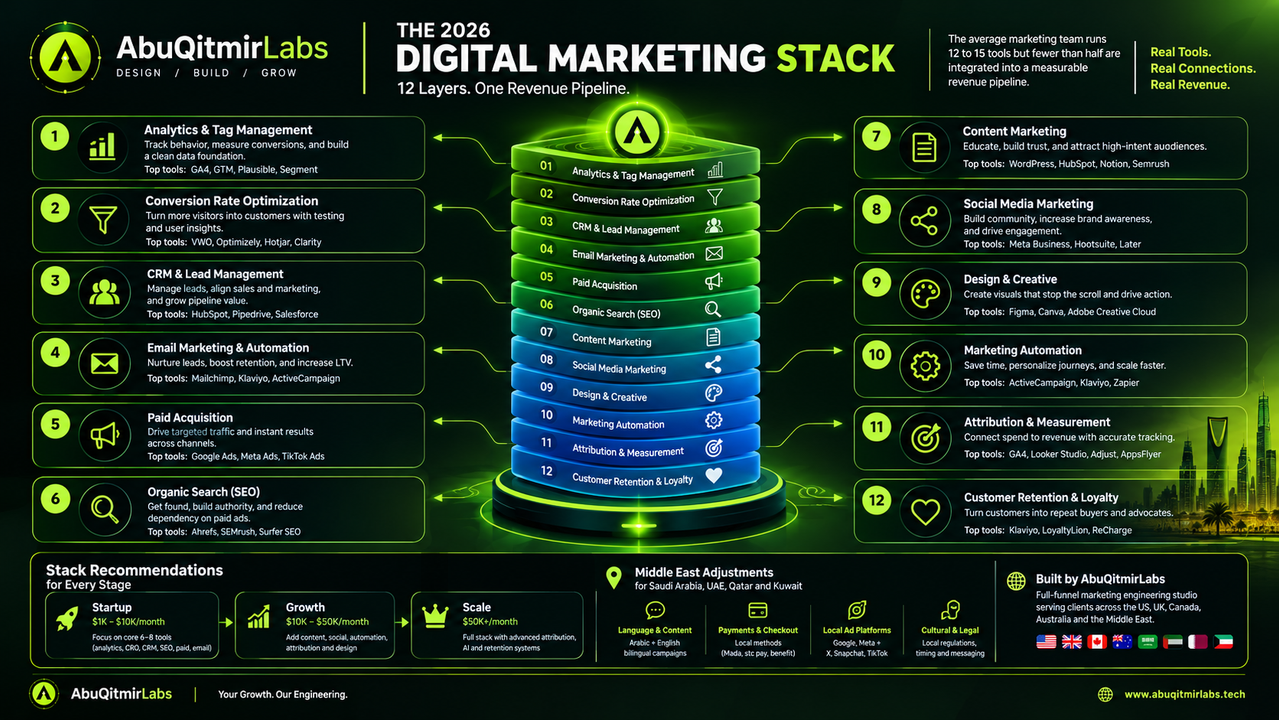
A modern digital marketing stack is not a random collection of disconnected SaaS subscriptions. In 2026, the companies generating predictable revenue treat their marketing stack as a coherent 12-layer operating system. Each layer feeds clean data to the next, eliminates customer friction, and attributes revenue back to specific acquisition investments.
For early-stage startups and mid-market companies alike, tool sprawl is the single largest hidden tax on marketing performance. Most organizations use between 14 and 22 marketing tools, but only actively integrate 4 of them. The result is fragmented customer journeys, inaccurate attribution models, and wasted ad spend.
This guide provides an exhaustive blueprint of the 12 digital marketing stack layers that directly impact revenue, accompanied by critical operational adjustments required for the GCC markets—specifically Saudi Arabia, the United Arab Emirates, Qatar, and Kuwait.
The 12-Layer Digital Marketing Stack Architecture
+-----------------------------------------------------------------------+
| LAYER 12: Business Intelligence & Revenue Attribution (Looker, Triple)|
+-----------------------------------------------------------------------+
| LAYER 11: Customer Retention & Lifecycle Marketing (Klaviyo, Brevo)   |
+-----------------------------------------------------------------------+
| LAYER 10: Conversion Rate Optimization & Testing (VWO, PostHog)       |
+-----------------------------------------------------------------------+
| LAYER 9:  Lead Capture & Interactive Forms (Typeform, HubSpot Forms)  |
+-----------------------------------------------------------------------+
| LAYER 8:  Customer Relationship Management (HubSpot, Pipedrive)       |
+-----------------------------------------------------------------------+
| LAYER 7:  Paid Acquisition & Paid Social (Google Ads, Meta, LinkedIn) |
+-----------------------------------------------------------------------+
| LAYER 6:  Organic Search & Technical SEO (Ahrefs, Semrush, GSC)       |
+-----------------------------------------------------------------------+
| LAYER 5:  Content Management & Headless Publishing (Next.js, Strapi)  |
+-----------------------------------------------------------------------+
| LAYER 4:  Audience Segmentation & Behavioral Tracking (Mixpanel, GA4) |
+-----------------------------------------------------------------------+
| LAYER 3:  Tag Management & Server-Side Tracking (GTM Server-Side)     |
+-----------------------------------------------------------------------+
| LAYER 2:  Consent Management & Regional Privacy (Cookiebot, OneTrust) |
+-----------------------------------------------------------------------+
| LAYER 1:  Cloud Infrastructure & Edge Delivery (Cloudflare, Fastly)   |
+-----------------------------------------------------------------------+
Layer-by-Layer Breakdown
1. Cloud Infrastructure & Edge Delivery
Fast page loads are the baseline requirement for conversion. Delivering cached static assets at the network edge ensures sub-second Time to First Byte (TTFB).
- Core Platforms: Cloudflare Enterprise, Fastly, AWS CloudFront.
- Revenue Impact: Every 100ms reduction in load latency yields a measurable 1.1% lift in checkout and lead conversion.
2. Consent Management & Privacy Compliance
Strict regional regulations mandate explicit user consent prior to client-side script execution.
- Core Platforms: OneTrust, Cookiebot, Usercentrics.
- Revenue Impact: Avoids punitive regulatory fines under GDPR and regional frameworks while maintaining clean tracking pipelines for consented users.
3. Server-Side Tag Management
Client-side browser extensions and Safari ITP block up to 35% of standard JavaScript pixels. Server-side tracking restores conversion observability.
- Core Platforms: Google Tag Manager (Server-Side container deployed on GCP or AWS), Stape.io.
- Revenue Impact: Restores accurate signal flow to ad algorithms, lowering blended Cost Per Acquisition (CPA) by 15% to 28%.
4. Product Analytics & Audience Behavioral Tracking
Understanding drop-off points between initial landing and transactional conversion.
- Core Platforms: Google Analytics 4, Mixpanel, PostHog.
- Revenue Impact: Pinpoints friction points in high-intent conversion funnels, enabling rapid product and landing page refinement.
5. Content Management & High-Velocity Publishing
Decoupled headless architectures eliminate the performance bottlenecks of monolithic legacy systems.
- Core Platforms: Next.js / Astro frontends paired with headless CMS options (Strapi, Sanity).
- Revenue Impact: Allows rapid deployment of programmatic landing pages and content assets with zero compromise to Core Web Vitals.
6. Organic Search Intelligence & Technical SEO
Identifying high-intent commercial keywords and monitoring technical crawler access.
- Core Platforms: Google Search Console, Ahrefs, Screaming Frog SEO Spider.
- Revenue Impact: Sustained, compounding organic pipeline that reduces dependency on escalating paid search auction costs.
7. Paid Acquisition & Conversion APIs
Targeting high-intent buyers across intent-based search and demographic feeds, backed by direct server-to-server conversion APIs.
- Core Platforms: Google Ads (Search & Performance Max), Meta Ads Manager with Conversions API (CAPI), LinkedIn Campaign Manager.
- Revenue Impact: Delivers immediate, scalable customer volume to balance long-term brand equity development.
8. Customer Relationship Management (CRM)
The central operational database housing pipeline stages, account contacts, and revenue milestones.
- Core Platforms: HubSpot Sales Hub, Pipedrive, Salesforce.
- Revenue Impact: Prevents inbound lead leakage and aligns marketing pipeline generation directly with sales rep closing velocity.
9. Lead Capture & Frictionless Conversion
Interactive form interfaces designed to maximize completion rates without sacrificing data hygiene.
- Core Platforms: Typeform, HubSpot Embedded Forms, custom multi-step React forms with field-level validation.
- Revenue Impact: Multi-step progressive disclosure forms routinely lift completion rates by 22% over single-screen walls of form fields.
10. Conversion Rate Optimization & Experience Testing
Controlled experimentation to systematically improve page economics.
- Core Platforms: VWO, PostHog Experiments, Microsoft Clarity for qualitative heatmaps.
- Revenue Impact: Directly multiplies the yield of every existing traffic source without increasing media spend.
11. Lifecycle Marketing & Automated Retention
Retaining and expanding customer lifetime value (LTV) through event-driven automated email and SMS workflows.
- Core Platforms: Klaviyo, Brevo, Customer.io.
- Revenue Impact: Repeat customer purchases and automated abandoned-cart recovery generate up to 30% of total revenue at near-zero marginal acquisition cost.
12. Revenue Attribution & Business Intelligence
Connecting first-touch ad clicks to closed bank receipts across multi-month sales cycles.
- Core Platforms: Looker Studio, Triple Whale, Northbeam.
- Revenue Impact: Eliminates guesswork in capital allocation, ensuring marketing directors scale profitable channels and ruthlessly cut non-performing campaigns.
Middle East Market Adjustments: Saudi Arabia, UAE, Qatar & Kuwait
Deploying a global marketing stack into the GCC without local adaptations will suppress conversion rates. The Gulf economies feature unique consumer behaviors, payment rails, and regulatory environments:
1. Saudi Arabia (KSA)
- Local Payment Rails: Integration of Mada, Tamara, and Tabby is non-negotiable. Mada accounts for over 70% of local digital debit transactions.
- Communication Channels: WhatsApp Business API integration carries significantly higher open and response rates than transactional email.
- Regulatory Framework: Compliance with the Saudi Personal Data Protection Law (PDPL), enforcing domestic data processing principles.
2. United Arab Emirates (UAE)
- B2B Channel Concentration: LinkedIn and direct WhatsApp enterprise messaging dominate B2B deal origination in Dubai and Abu Dhabi.
- Multi-Currency & Instant Checkout: High expat demographics demand transparent USD/AED currency toggles and seamless Apple Pay integration.
- Mobile Velocity: Over 85% of transactions occur on mobile devices, making mobile Core Web Vitals the primary ranking and conversion factor.
3. Qatar
- High Basket Sizes: Premium positioning, concierge customer support, and local NAPS payment gateway compatibility.
- Government & Enterprise Alignment: Heightened demand for enterprise-grade data privacy and localized Arabic/English bilingual interfaces.
4. Kuwait
- Knet Payment Integration: Knet is the dominant domestic debit rail in Kuwait. Any eCommerce or SaaS checkout lacking Knet support suffers immediate cart abandonment exceeding 60%.
- Social Commerce: Instagram and Snapchat ads paired with instant WhatsApp checkout funnels represent the primary acquisition driver.
Stack Cost Benchmarks for 2026
| Growth Tier | Monthly Software Cost | Typical Team Size | Core Focus |
|---|---|---|---|
| Startup / Pre-Seed | $150 – $500 / month | 1–3 People | GA4, HubSpot Free, Klaviyo, Search Console, Cloudflare |
| Growth Stage | $1,500 – $5,000 / month | 4–10 People | Server-side GTM, Mixpanel, HubSpot Pro, VWO, Ahrefs |
| Scale & Enterprise | $10,000 – $50,000+ / month | 10+ People | Custom Data Warehouse, Looker, OneTrust, Salesforce, CDPs |
Frequently Asked Questions
What is a digital marketing stack?
A digital marketing stack is the integrated collection of software tools, cloud services, and tracking APIs an organization uses to attract, convert, retain, and measure customers across all digital channels.
What tools should be in a startup digital marketing stack in 2026?
A lean startup stack should focus on four foundational pillars: Analytics (GA4), CRM (HubSpot or Pipedrive), Retention Email (Klaviyo or Brevo), and SEO/Search Console. Paid media and dedicated CRO testing tools can be added once baseline conversion data exists.
How much does a complete marketing technology stack cost?
A startup stack costs between $150 and $500 per month. A growth-stage company typically invests $1,500 to $5,000 per month, while enterprise operations with dedicated attribution pipelines and CDPs spend $10,000 to $50,000+ monthly.
What is the most underrated layer in the marketing stack?
Server-side attribution and tracking. Most marketing teams treat tracking as an afterthought until browser privacy policies degrade ad performance. Implementing server-side tag management immediately restores data accuracy and improves return on ad spend.
How do marketing stacks differ in Saudi Arabia and the UAE?
In Saudi Arabia, UAE, Qatar, and Kuwait, stacks must support local debit payment gateways (Mada, Knet, NAPS), regional Buy Now Pay Later services (Tamara, Tabby), and automated WhatsApp messaging pipelines alongside traditional email marketing.
Conclusion & Strategic Implementation
A high-performing marketing stack is measured not by how many tools it includes, but by how cleanly those tools communicate. When infrastructure, analytics, CRM, and attribution operate as a unified system, marketing ceases to be a speculative expense and becomes a predictable revenue engine.
Explore our comprehensive digital marketing services and regional strategies for the Saudi Arabia market and UAE market to see how AbuQitmirLabs builds high-performance revenue systems.

Abu Qitmir Mohammad Shiraz Al-Madani
Founder & Lead Systems Architect at AbuQitmirLabs. Specializing in high-performance digital ecosystems, AI-driven architectures, and building scalable full-stack software systems.