E-Commerce Platform Development: Custom Build vs Shopify Plus 2026
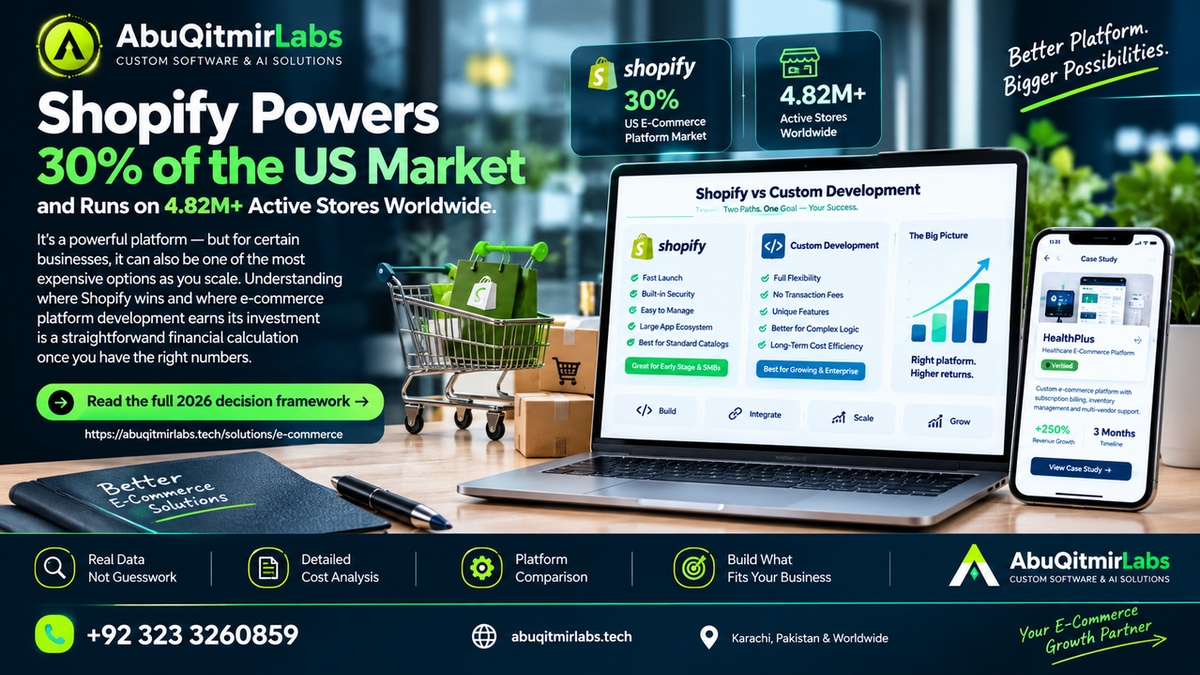
E-Commerce Platform Development: Custom Build vs Shopify Plus in 2026
Shopify Plus costs $2,300/month before transaction fees. A custom ecommerce build breaks even at $2M–$4M GMV. Here's the 2026 decision framework.
1. The Rent Dilemma: 2026 E-Commerce Reality
In 2021, the standard recommendation was to default to Shopify Plus. In 2026, the unit economics have drastically inverted. With Shopify Plus base rates running $2,300/month, variable platform fees of 0.40% over $800k/month GMV, and essential enterprise app stacks costing $1,500–$4,500/month, high-velocity brands are facing six-figure annual platform rents without acquiring proprietary software equity.
2. The 3-Year Break-Even Calculus ($2M–$4M GMV)
At $3M–$4M in annual GMV, the 3-year Total Cost of Ownership (TCO) of Shopify Plus ($210,000–$310,000) matches and then significantly exceeds the cost of architecting, deploying, and maintaining a bespoke headless commerce platform ($160,000–$240,000 over 3 years).
3. The 5 Structural Ceilings of Monolithic Shopify
- Complex B2B Hierarchies: Departmental budgets, parent-child accounts, and net-term invoicing require fragile app workarounds.
- Multi-Vendor & Marketplace Dynamics: Shopify's single-merchant model cannot handle native escrow settlements and split multi-vendor disbursements cleanly.
- Checkout Extensibility Limits: Sandboxed Web Worker UI Extensions prevent custom localized VAT calculation engines and high-dimensional bundling rules.
- Catalog Scale Above 100,000 SKUs: API rate limits and variant caps force expensive third-party search engines like Algolia.
- Enterprise Valuation Multiples: Acquirers and PE sponsors assign higher multiples to owned, defensible technology assets than rented storefronts.
4. The 2026 Custom Commerce Stack
- Storefront: Next.js 15 App Router with React Server Components (RSC) and sub-85ms global Edge TTFB.
- Commerce Core: MedusaJS v2 or Saleor (PostgreSQL, modular microservices architecture).
- Search & Discovery: Self-hosted Meilisearch / Typesense clusters under 15ms latency.
- AI & Personalization: Autonomous shopping assistants, vector recommendation pipelines, and predictive restocking.
5. Headless Commerce: The Pragmatic Middle Path
For merchants that want to keep Shopify's PCI-DSS compliant checkout and OMS while unlocking sub-second frontends and complete design freedom, Headless Shopify (Next.js storefront querying Shopify's Storefront GraphQL API) serves as an optimal transitional architecture.
Frequently Asked Questions
When should I build a custom ecommerce platform instead of using Shopify Plus?
When your catalog, pricing logic, or checkout requirements fall outside Shopify's assumptions — specifically B2B pricing, multi-vendor operations, or marketplace models — or when your GMV has reached the point where transaction fees and app costs over 3 years exceed the cost of a custom build (typically $2M–$4M GMV).
How much does custom ecommerce platform development cost in 2026?
The range is wide: $3,000–$30,000 for a template-based or semi-custom build, $80,000–$250,000 for a mid-market custom platform, and $500,000+ for a complex enterprise marketplace. Annual maintenance typically adds $30,000–$80,000/year.
Is Shopify Plus worth it for a large store?
It depends entirely on GMV and pricing complexity. At $30M GMV, a Shopify Plus store typically costs $120,000–$250,000/year in direct platform costs — over 3 years, that's $360,000–$750,000, often exceeding the full cost of a custom build.
What is headless commerce and is it better than Shopify?
Headless commerce uses Shopify as a backend data layer while replacing its frontend with a custom-built storefront (typically Next.js). It solves Shopify's frontend and performance limitations without requiring a full rebuild of the backend operations layer.

Abu Qitmir Mohammad Shiraz Al-Madani
Founder & Lead Systems Architect at AbuQitmirLabs. Specializing in high-performance digital ecosystems, AI-driven architectures, and building scalable full-stack software systems.