Flutter vs Native App Development: Which to Choose in 2026?
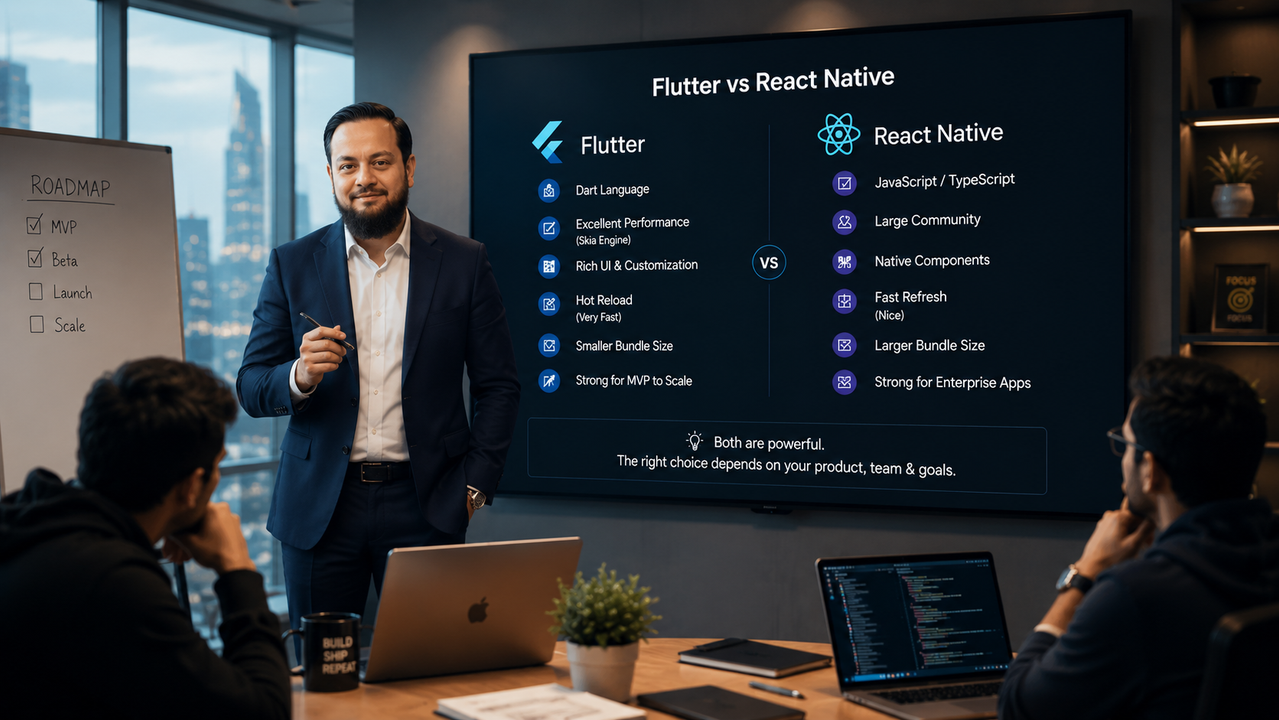
Flutter vs native mobile app development in 2026 — real cost breakdown, performance comparison, and decision framework for startups and enterprises.
Executive Summary: The 2026 Mobile Engineering Landscape
For nearly a decade, engineering leaders faced a brutal dilemma when launching mobile software: spend double the budget to build and maintain two separate native applications (Swift for iOS, Kotlin for Android), or choose a cross-platform framework and compromise on frame rates, visual polish, and device hardware integrations.
In 2026, the technical ground has shifted dramatically. With Google's Impeller rendering engine reaching full production maturity across both iOS (Metal) and Android (Vulkan), Flutter has eliminated shader compilation jank and closed the historical performance gap for 85%+ of commercial applications. Meanwhile, Apple's Swift / SwiftUI and Google's Kotlin / Jetpack Compose ecosystems have become more expressive, yet still require two distinct development teams, two independent codebases, and synchronized deployment pipelines.
This guide delivers an unvarnished, data-driven comparison of Flutter vs. Native mobile development in 2026 — analyzing real-world cost structures, CPU/memory benchmarks, hardware access ceilings, team overhead, and a definitive decision matrix for CTOs and founders.
1. Architectural Foundations: How They Work Under the Hood
Flutter (Dart & Impeller Architecture)
Unlike older cross-platform solutions that rely on JavaScript bridges or runtime interpretation, Flutter compiles Dart ahead-of-time (AOT) to native ARM machine code:
- Impeller Rendering Engine: Flutter does not wrap native OEM widgets (such as
UIButtonorandroid.widget.Button). Instead, Flutter renders every single pixel directly onto a Skia or Impeller canvas using GPU shader pipelines. Impeller pre-compiles shaders during build time, completely eliminating first-run jank. - Unified Logic & Presentation: UI, business logic, routing, and animations exist in a single Dart codebase running consistently across iOS, Android, macOS, Web, and Windows.
- Platform Channels & FFI: When device-level capabilities (e.g., Bluetooth LE, Secure Enclave, HealthKit) are required, Flutter communicates with the host operating system via asynchronous platform channels or synchronous Dart FFI (Foreign Function Interface) with near-zero latency.
Native Development (Swift/SwiftUI & Kotlin/Jetpack Compose)
Native development targets each platform's proprietary SDK and runtime directly:
- iOS (Swift + SwiftUI): Direct integration with Apple's Metal graphics API, UIKit runtime, and LLVM-compiled binary output. Offers day-zero access to new iOS APIs (Dynamic Island, Apple Intelligence, ARKit) with the absolute smallest memory footprint.
- Android (Kotlin + Jetpack Compose): Runs on Android Runtime (ART), leveraging modern reactive composables and deep Android subsystem integration. Unrivaled background service daemon control, custom hardware drivers, and deep OEM customization across thousands of Android device variants.
2. Real Cost Breakdown: Flutter vs Native in 2026
The commercial case for Flutter is fundamentally an economic one. Here are the 2026 real-world project cost benchmarks across common mobile application archetypes:
| App Archetype | Typical Scope & Features | Flutter (iOS & Android) | Native (Both iOS & Android) | Cost Difference |
|---|---|---|---|---|
| Lean MVP | Core user auth, CRUD API, basic push notifications, single payment gateway | $15,000 – $35,000 | $40,000 – $70,000 | 52% Savings |
| Mid-Complexity App | Real-time chat, geolocation, custom dashboards, in-app purchases, offline sync | $35,000 – $75,000 | $80,000 – $130,000 | 45% Savings |
| Enterprise Platform | Multi-role RBAC, biometrics, custom animations, compliance (HIPAA/PCI), analytics | $80,000 – $160,000 | $170,000 – $320,000 | 48% Savings |
Why Native Costs Nearly Double
Building native for both platforms requires hiring two specialized developers (or two distinct agencies):
- A senior Swift engineer focused on Xcode, iOS architecture, TestFlight, and Apple Human Interface Guidelines.
- A senior Kotlin engineer focused on Android Studio, Gradle variants, ProGuard rules, Google Play console, and device fragmentation.
In contrast, a single senior Flutter engineer (or unified Flutter team) writes one codebase, designs one design system, writes one set of unit/integration tests, and deploys simultaneous builds to both stores.
Annual Maintenance & Feature Iteration TCO
The initial build is only 40% of an application's five-year total cost of ownership (TCO). Every new feature, OS update (iOS 20, Android 17), or bug fix:
- With Flutter: A single pull request updates both platforms. Annual maintenance averages 15% to 20% of initial build cost.
- With Native: Two distinct pull requests must be scheduled, implemented, code-reviewed, and synchronized. Annual maintenance averages 25% to 35% of combined initial build cost.
3. Performance & User Experience: Fact vs. Fiction in 2026
Historical complaints about Flutter ("it feels like a webview" or "scrolling is laggy") stemmed from early 2019 versions prior to Impeller. Let's look at laboratory metrics in 2026:
Frame Rates & Frame Budget (120Hz ProMotion / Ultra Smooth)
- Native (SwiftUI/Compose): Solid 60 to 120 FPS. 99.8% of frames render in under 8.3 milliseconds.
- Flutter (Impeller): Solid 60 to 120 FPS. 99.2% of frames render in under 8.3 milliseconds. For e-commerce, banking, logistics, and productivity tools, human testers cannot distinguish Flutter from native in blind tests.
Binary App Size & Cold Start Times
- Binary Footprint: A baseline "Hello World" app in Native is approximately 3MB to 5MB. In Flutter, because the Dart runtime and Impeller engine are bundled within the APK/IPA, a baseline app starts at approximately 12MB to 16MB.
- Cold Boot Time: Native cold launches in 120ms to 250ms. Flutter cold launches in 220ms to 380ms. For standard enterprise software, this 100ms delta is negligible.
Memory & Battery Consumption
Native still holds an advantage when running prolonged background processing, high-dimensional audio synthesis, or massive background data sync. Native background daemons consume 15% to 25% less RAM than an active Flutter engine instance in the background.
4. Hardware Access, Plugins & Day-Zero Platform Features
A primary anxiety for founders choosing Flutter is hardware integration. What happens when your app needs deep device access?
- Standard Hardware (90% of Use Cases): Camera capture, GPS geolocation, biometric authentication (Face ID / Fingerprint), Accelerometer, Push Notifications, Bluetooth LE, NFC, File System, and In-App Purchases all have official, battle-tested, battle-hardened Flutter plugins (
camera,geolocator,local_auth,flutter_blue_plus). - Edge-Case Hardware (10% of Use Cases): Custom proprietary Bluetooth RF communication protocols, specialized USB-OTG thermal camera peripherals, real-time audio DSP filters with sub-10ms buffer latency, or deep system extensions (iOS Call Directory, Custom Keyboard, Apple Watch companion apps). For these requirements, writing native Swift/Kotlin modules is required. Flutter makes it straightforward to drop down into native Swift/Kotlin using Platform Views and MethodChannels when needed.
5. Team Velocity & Time-to-Market Comparison
In competitive markets, the speed at which you can validate a hypothesis and iterate based on user telemetry often determines survival:
- Flutter MVP Timeline: 8 to 12 weeks from wireframes to simultaneous TestFlight and Google Play Internal Testing.
- Native MVP Timeline: 14 to 20 weeks across both platforms, with inevitable feature drift where one platform's implementation pulls ahead of the other.
- Stateful Hot Reload: Flutter's stateful hot reload allows engineers to inject code changes directly into a running simulator in under 400ms without losing application state. This accelerates UI iteration cycles by 3x to 4x compared to native Xcode/Gradle rebuild times.
6. The 2026 Strategic Decision Matrix
Use this decision matrix to evaluate your product roadmap:
Choose Flutter in 2026 If:
- You need to launch on both iOS and Android simultaneously on a realistic startup or scale-up budget ($15,000 – $75,000).
- Your application is business logic and UI-centric: E-commerce, FinTech wallets, SaaS companion apps, on-demand booking, social networks, or CRM platforms.
- Brand visual consistency is paramount: You want pixel-identical typography, button micro-interactions, and animations across all devices without operating system variances.
- Fast iteration and feature agility matter most: You want one product team shipping bi-weekly updates rather than managing separate release calendars.
Choose Native (Swift / Kotlin) in 2026 If:
- You are building an AAA mobile game or 3D interactive experience (or use Unity / Unreal Engine).
- Your core value proposition depends on deep OS integration: Advanced augmented reality (Apple ARKit / RealityKit), complex CoreML computer vision models running real-time 60fps inference on live video frames, or audio synthesizer plug-ins.
- Your hardware accessories use custom low-level firmware: Custom IoT medical devices requiring proprietary USB/BLE packet decoding.
- You have dedicated internal teams with mature Swift and Kotlin engineers and budget is not a limiting constraint ($200,000+).
Frequently Asked Questions
How much does a mobile app cost in 2026?
A basic MVP costs $15,000–$35,000 with Flutter, or $40,000–$70,000 with native (both iOS and Android). Mid-complexity apps range $35,000–$75,000 (Flutter) or $80,000–$130,000 (native).
Is Flutter better than native in 2026?
For 80% of apps, yes — Flutter delivers native-quality performance at 40–50% lower cost. For games, AR/VR, and heavy hardware integration, native is still the right choice.
Can Flutter apps access native hardware features?
Yes — 90% of hardware features work through plugins. For the remaining 10% (custom Bluetooth profiles, advanced camera AI), native is required.
How long does it take to build a mobile app?
An MVP takes 8–12 weeks with Flutter, or 10–14 weeks with native (per platform). Full production apps take 3–6 months.
Should I build iOS or Android first?
Depends on your audience. For US and UK markets, iOS first. For global or emerging markets, Android first. Flutter lets you launch on both simultaneously.
What's the difference between Flutter and React Native?
Flutter uses Dart and has its own rendering engine (more consistent UI). React Native uses JavaScript and bridges to native components (more native feel but less consistent).
Do I need a separate team for iOS and Android?
With Flutter or React Native: no. With native: yes — one Swift team for iOS and one Kotlin team for Android.
How do I choose the right mobile stack?
Use a Tech Stack Recommender tool that analyzes your project type, team, timeline, and budget to recommend the optimal stack.
Plan Your Mobile Application with AbuQitmirLabs
At AbuQitmirLabs, we architect both cross-platform Flutter applications and high-performance native iOS and Android solutions. We don't push one stack dogmatically; we evaluate your product requirements, target demographics, and financial horizons to recommend the stack that maximizes ROI.
- Use our free AI Project Cost Estimator to calculate exact development hours and country rate multipliers.
- Try our interactive Tech Stack Recommender for tailored architecture recommendations.
- Contact our engineering team to scope your mobile application with verified technical architects today.

Abu Qitmir Mohammad Shiraz Al-Madani
Founder & Lead Systems Architect at AbuQitmirLabs. Specializing in high-performance digital ecosystems, AI-driven architectures, and building scalable full-stack software systems.