Generative AI Chatbot Development: What It Actually Costs in 2026
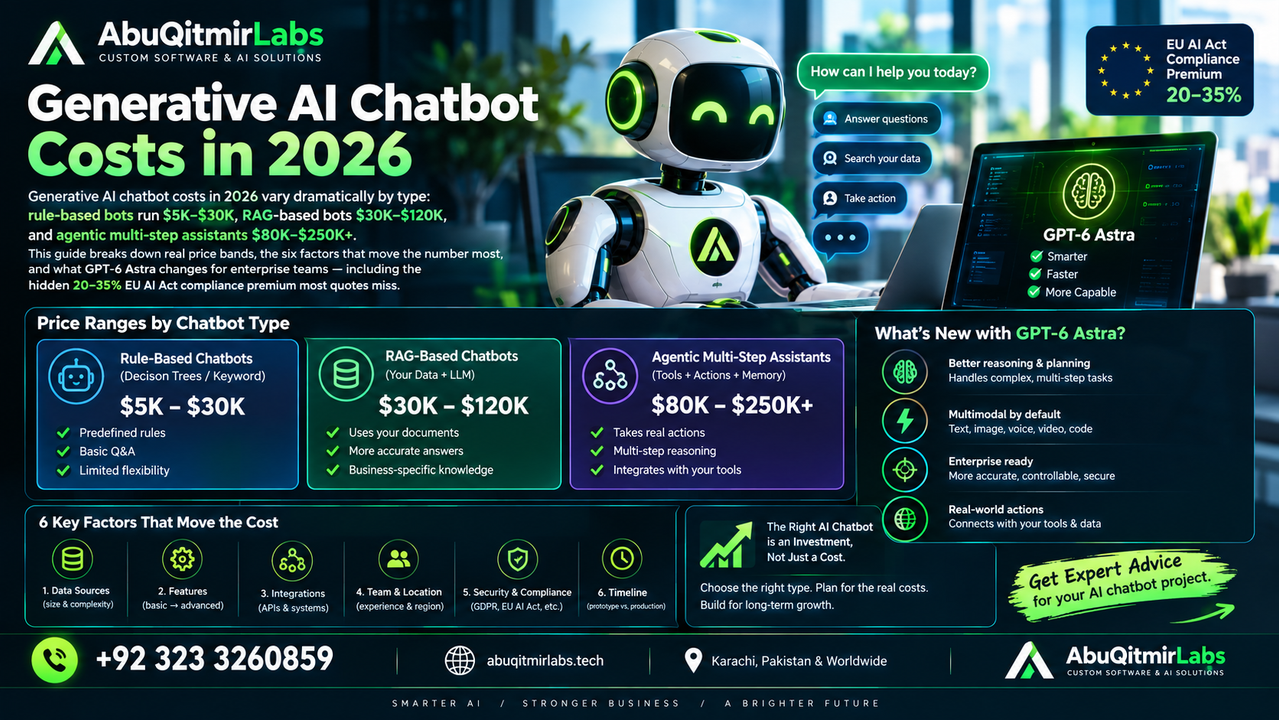
On September 3, 2026, OpenAI released GPT-6 Astra — the first model the company has ever rated "Critical" under its own Preparedness Framework, and a genuine step change in what a chatbot can actually be asked to do. If you're scoping a generative AI chatbot development project this quarter, the cost conversation looks meaningfully different than it did even six months ago.
This guide breaks down real 2026 cost bands by chatbot type, the factors that move the number most, and what the latest generation of frontier models changes for teams building enterprise chatbots right now.
Quick Takeaways
- Chatbot cost depends far more on type than on generic "AI chatbot" pricing — rule-based bots run $5K–$30K, while agentic multi-step assistants run $80K–$250K+
- Annual maintenance typically runs 15–20% of the original build cost, indefinitely
- EU AI Act compliance now adds a documented 20–35% premium to total AI development cost for regulated deployments
- GPT-6 Astra's release doesn't change the fundamentals of chatbot cost, but it raises both the capability ceiling and the security bar for anything built on frontier models this year
Why 2026 Is a Different Conversation
Two structural shifts define generative AI chatbot pricing in 2026. First, billing has moved: Intercom set the template with per-resolution pricing on its Fin product, and Zendesk and ChatBot.com followed by billing per resolved conversation rather than per seat — which can make costs lower than a headline subscription suggests, or higher if your resolution rate is poor. Second, and more significant: OpenAI's GPT-6 Astra, released this month, is the first commercially available model to cross OpenAI's "Critical" cybersecurity threshold, reflecting a genuine jump in autonomous, multi-step capability. It's priced at $10 per million input tokens and $50 per million output tokens via the API, with enterprise administrators required to manually enable it — a meaningful signal that model-tier capability now comes with model-tier governance overhead too.
4 Types of AI Chatbots (and What Each Actually Costs)
Chatbot cost varies more by type than by any other single factor. Current 2026 industry benchmarks, cross-referenced across several development firms, land in these bands:
- Rule-based bots ($5,000–$30,000): Scripted flows and keyword matching, handling FAQs, basic lead capture, and simple routing. No real AI reasoning involved.
- NLP/AI-powered bots ($20,000–$80,000): Natural language understanding without full generative capability — better intent recognition, still largely scripted responses underneath.
- RAG-based generative bots ($30,000–$120,000): The leading format for enterprise deployments in 2026. Trained on a company's proprietary knowledge base using Retrieval-Augmented Generation, these bots retrieve and synthesize accurate answers from internal documents rather than generating generic responses.
- Agentic, multi-step bots ($80,000–$250,000+): Built on frontier models like GPT-6, Claude, or Gemini with tool-use capability — reasoning across multi-step tasks, calling external APIs, updating records, and executing workflows autonomously rather than just answering questions.
Enterprise-grade deployments with deep system integrations, custom infrastructure, and compliance requirements can reach $200,000–$1,000,000+, regardless of which base category they start from.
The 6 Factors That Move the Number
Within any given category, six factors do most of the work in determining where a project actually lands:
- Integration depth — connecting to CRMs, ERPs, or internal databases costs meaningfully more than a standalone widget
- Data preparation — for RAG-based bots specifically, cleaning and structuring the knowledge base the bot retrieves from is frequently underestimated in initial scoping
- Compliance and governance requirements — regulated industries add both engineering and audit overhead
- Voice capability — adding voice interaction typically adds $18,000–$45,000 on top of a text-based build
- Multi-language support — each additional language adds both development and ongoing QA cost
- Autonomy level — the jump from "answers questions" to "takes actions" is the single biggest cost driver in the entire list
Build vs. Subscribe in 2026
The per-resolution billing shift changes this calculation from what it looked like a year ago. A subscription platform charging per resolved conversation can be dramatically cheaper than a custom build for low-to-moderate volume — but the same billing model can become more expensive than an in-house team's costs once volume climbs high enough, since a dedicated in-house team (project manager, developers, an NLP engineer, a designer, a QA tester) runs $400,000–$700,000 a year in salaries alone, which is only a rational trade at meaningful scale. For most mid-sized deployments, a custom or agency-built bot in the $30,000–$150,000 range remains the more cost-effective middle path between an off-the-shelf subscription and a full in-house team.
What GPT-6 Astra Actually Changes for Enterprise Chatbot Teams
Astra's headline capability — autonomously identifying security vulnerabilities and executing multi-step technical workflows without step-by-step human direction — matters less for a typical customer-support chatbot and more for the agentic, tool-using category at the top of the cost range. If your chatbot roadmap includes autonomous actions (updating records, executing transactions, calling external systems), building on a frontier-tier model in 2026 means budgeting for the governance overhead that now comes attached: OpenAI itself reports decreased chain-of-thought monitorability on Astra relative to its predecessor, which is precisely the kind of finding that pushes serious enterprise deployments toward stronger oversight tooling, not less.
The practical takeaway isn't that agentic AI chatbots got more expensive to build — it's that the safety and monitoring layer around them is no longer optional scope creep. It's baseline.
EU AI Act Compliance — The Hidden 20–35% Premium
With the EU AI Act and parallel global regulations now fully in force, AI development teams are budgeting for formal compliance audits, continuous bias monitoring, explainability documentation, and model traceability by default rather than as an afterthought. This typically adds 20–35% to total AI development costs — often translating to an additional $100,000–$300,000 on top of an otherwise mid-size build. A quote for an enterprise generative AI chatbot that doesn't explicitly account for this has likely scoped a different, non-compliant project.
In-House vs. Agency vs. Offshore
Three realistic paths exist for most teams:
- In-house team: $400,000–$700,000/year in salaries alone, before benefits and tools — rational mainly at genuine scale, where the team will be fully utilized across multiple ongoing AI initiatives
- Agency build: Roughly $10,000–$30,000 for a simple rule-based bot, $75,000–$150,000 for a moderate AI/RAG bot, and $150,000–$500,000+ for advanced generative or agentic builds
- Offshore/hybrid delivery: Development teams based in lower-cost regions working under direct oversight from a local project lead can deliver comparable enterprise quality at roughly 40–60% of US-only pricing — the model AbuQitmirLabs itself operates on for international clients
Annual Running Costs
The build cost is never the full picture. Budget for:
- Maintenance: 15–20% of the initial build cost annually — a $75,000 chatbot requires roughly $11,000–$15,000/year just to stay current
- Model/token costs: ongoing API usage fees scale with volume and model tier — frontier models like GPT-6 Astra carry meaningfully higher per-token pricing than smaller models
- Monitoring and governance: an increasingly non-negotiable line item for any bot with autonomous or tool-using capability
What This Looks Like in Practice
AbuQitmirLabs' AI agent development practice builds RAG-based conversational systems using this same architecture pattern — most concretely demonstrated in the TajweedPage.com production deployment, a RAG-based AI Tajweed teaching assistant currently serving students across 20+ countries. It's an EdTech deployment rather than a customer-support chatbot, but it demonstrates the same core capability this guide's mid-tier RAG category covers: retrieval-grounded, context-aware responses built on a proprietary knowledge base, running reliably in production.
A Decision Framework for 2026
- Define what the bot actually needs to do — answer questions (RAG tier) or take actions (agentic tier)? This single distinction moves the budget more than any other factor.
- Estimate realistic conversation volume before comparing subscription vs. custom build costs — per-resolution pricing math changes meaningfully at scale
- Scope compliance requirements explicitly if operating in or serving the EU — budget the 20–35% premium up front, not as a surprise later
- Match model tier to actual need — a frontier model like GPT-6 Astra is justified for genuinely agentic, multi-step workloads, not for a standard FAQ bot
- Budget maintenance from day one — 15–20% of build cost annually, indefinitely, is a real ongoing commitment, not a rounding error
Frequently Asked Questions
How much does it cost to build a generative AI chatbot in 2026?
It depends heavily on type. Rule-based bots run $5,000–$30,000, NLP-powered bots $20,000–$80,000, RAG-based generative bots $30,000–$120,000, and agentic multi-step bots $80,000–$250,000 or more. Enterprise deployments with deep integrations can exceed $200,000–$1,000,000.
What did GPT-6 Astra change for chatbot development?
Astra raised the capability ceiling for agentic, tool-using chatbots specifically, while also raising the governance and monitoring bar for anything built on frontier-tier models. It's less relevant for standard FAQ or support chatbots.
Is it cheaper to build in-house or hire an agency for an AI chatbot?
For most mid-sized projects, an agency build in the $30,000–$150,000 range is more cost-effective than an in-house team, which costs $400,000–$700,000/year in salaries alone. In-house teams make more sense at genuine scale with multiple ongoing AI initiatives.
Does EU AI Act compliance really add that much to the cost?
Yes — compliance audits, bias monitoring, explainability documentation, and model traceability typically add 20–35% to total development cost for regulated deployments, often $100,000–$300,000 on a mid-size build.
Generative AI chatbot costs vary enormously by type and ambition, and 2026's frontier-model landscape has made "what tier of AI do we actually need" a bigger cost question than ever. If you're scoping a chatbot build and want a realistic estimate for your specific use case, AbuQitmirLabs' AI agent team can help map the right tier before you commit to a budget.
Scoping an AI chatbot project? Get in touch with AbuQitmirLabs to talk through your requirements.

Abu Qitmir Mohammad Shiraz Al-Madani
Founder & Lead Systems Architect at AbuQitmirLabs. Specializing in high-performance digital ecosystems, AI-driven architectures, and building scalable full-stack software systems.