Healthcare Software Development Solutions 2026 | Custom EHR & Clinical Software
Summary Box
Summary: This guide covers healthcare software development in 2026 — EHR systems, telemedicine platforms, clinical workflow tools, and the compliance, interoperability, and security requirements that distinguish healthcare software from every other category. AbuQitmirLabs builds custom healthcare software, web platforms, and mobile applications for clinics, hospitals, and health-tech companies across the US, UK, and Europe. Read time: approximately 12 minutes.
Table of Contents
- Introduction
- What Makes Healthcare Software Different
- The Core Categories of Healthcare Software
- Why Generic Software Fails Healthcare at Scale
- The Architecture Requirements of Healthcare Software
- HIPAA, Interoperability, and Compliance as Design Constraints
- Build vs. Buy — EHR Platforms vs. Custom Clinical Software
- Common Mistakes in Healthcare Software Development
- How AbuQitmirLabs Approaches Healthcare Software
- Healthcare Software by Care Setting
- Frequently Asked Questions
- Final Thoughts
Excerpt
Healthcare software carries a property that most software categories never have to reckon with: the cost of a failure is not a lost sale or a frustrated user — it is a missed allergy alert, a delayed diagnosis, or a compliance breach involving a patient's most sensitive data. That single property reshapes almost every decision in healthcare software development, from how patient records are structured to how a mobile app handles a dropped connection mid-consultation.
Pull Quote
"Healthcare software is not judged on how it performs in a demo. It is judged on whether a nurse can trust the allergy banner at 2 a.m. during a busy shift — and that trust has to be engineered in, not hoped for." — AbuQitmir Mohammad Shiraz Al-Madani
Key Highlights
- Healthcare software has architectural requirements driven by patient safety, regulatory compliance, interoperability, and the operational reality of clinical environments — not just standard software engineering practices
- Generic EHR templates and off-the-shelf clinic software consistently hit ceilings around interoperability, specialty-specific workflows, and integration with lab, pharmacy, and billing systems
- HIPAA compliance is a design constraint that shapes data architecture, access control, and audit logging from the first technical decision — not a checklist applied before launch
- Interoperability standards like HL7 and FHIR determine whether healthcare software can actually communicate with the other systems a clinic or hospital already runs
- The build-vs-buy decision in healthcare software is rarely binary — most successful healthcare technology combines a certified EHR core with custom-built clinical workflow, patient engagement, and specialty tools layered around it
- Mobile healthcare applications — patient portals, clinician tools, telemedicine apps — require the same security and reliability rigor as backend clinical systems, including behavior in low-connectivity conditions
- The healthcare software solutions that succeed are the ones built around how clinicians actually work, not how a generic template assumes they work
Introduction
Healthcare software carries a property that most software categories never have to reckon with: the cost of a failure is not a lost sale or an annoyed user. It is a missed allergy alert during a busy shift. A delayed diagnosis because a lab result did not surface where a physician was looking for it. A compliance breach involving a patient's most sensitive personal information, at a moment when trust in the institution is already fragile.
This single property reshapes almost every decision in healthcare software development — from how patient records are structured, to how an application behaves when a clinician's connection drops mid-consultation, to what "testing" has to mean before software is allowed anywhere near a real patient encounter.
It is also why generic software approaches — the ones that work adequately for e-commerce, content platforms, or standard business tools — consistently underperform when applied directly to healthcare. A clinic, hospital, or health-tech company evaluating healthcare software development solutions is not evaluating a feature list. It is evaluating whether a piece of software can be trusted with the operational and clinical weight that healthcare actually carries.
This guide is for clinic administrators, hospital IT leaders, and health-tech founders who need to understand what healthcare software actually requires — not to become engineers, but to make the decisions only the business and clinical leadership can make before development begins.
What Makes Healthcare Software Different from Generic Software
Patient Safety as an Architectural Requirement
In most software categories, a bug produces an inconvenience. In healthcare software, a bug can produce a clinical error — a missed allergy warning, an incorrect dosage calculation, a lab result routed to the wrong chart. Patient safety is not a feature layered on top of the software. It is an architectural requirement that must shape how data is validated, how alerts are surfaced, and how failure states are handled throughout the system.
Regulatory Compliance Across Multiple Frameworks
Healthcare software must navigate a denser compliance landscape than almost any other industry: HIPAA in the United States, GDPR for any platform touching European patient data, and additional frameworks depending on jurisdiction and care setting — behavioral health confidentiality rules, substance use treatment record protections, and state-specific medical record retention requirements. These are not optional add-ons. They are design constraints that shape data architecture, access control, and audit logging from the very first technical decision.
Interoperability as a Baseline Expectation
Healthcare software rarely operates in isolation. A clinic's EHR needs to communicate with lab systems, pharmacy systems, billing platforms, insurance clearinghouses, and increasingly, other providers' systems entirely. Interoperability standards — HL7 v2, FHIR, and DICOM for imaging — are not advanced features. They are the baseline expectation for any healthcare software that intends to function inside a real clinical environment rather than as an isolated silo.
The Operational Reality of Clinical Environments
Healthcare software is used by clinicians under time pressure, often while multitasking across multiple patients, frequently on shared devices, and sometimes in environments with unreliable connectivity. Software designed without accounting for this operational reality — long forms, unclear alert hierarchies, workflows that assume uninterrupted attention — gets worked around by staff rather than adopted, regardless of how technically sound it is.
"The most technically impressive healthcare software in the world fails if a nurse on a night shift cannot trust it fast enough to use it in the moment that matters."
The Core Categories of Healthcare Software
Electronic Health Records (EHR) and Practice Management
EHR software manages patient charts — demographics, medical history, allergies, medications, visit notes, and diagnostic records. Practice management layers on top of this to handle scheduling, billing, insurance verification, and administrative workflows. The core technical challenge is building a searchable, structured, and clinically usable record system that clinicians can navigate quickly during time-constrained encounters.
Telemedicine and Virtual Care Platforms
Telemedicine software enables remote clinical encounters — video consultations, asynchronous messaging, remote monitoring, and virtual triage. The architecture challenge extends beyond video infrastructure: telemedicine platforms must integrate with the clinical record, handle prescription workflows compliantly, and perform reliably across the variable connectivity conditions patients actually have at home.
Clinical Decision Support and Diagnostic Tools
Clinical decision support software surfaces relevant information — drug interaction warnings, diagnostic suggestions, care protocol reminders — at the point of clinical decision-making. Increasingly, this category includes AI-assisted diagnostic support, which requires particular rigor around training data quality, explainability, and the clear positioning of these tools as clinician-augmenting rather than clinician-replacing.
Hospital and Clinic Operations Software
Operations software covers the non-clinical infrastructure that keeps a healthcare facility running: bed management, staff scheduling, pharmacy and drug inventory tracking, diagnostic lab workflow, and administrative reporting. The technical complexity here is less about clinical safety and more about real-time operational visibility across departments that historically operate in silos.
Patient Engagement and Portal Software
Patient-facing software — portals for viewing records and lab results, appointment scheduling tools, medication reminder systems, and patient education platforms — is where healthcare software increasingly competes on the same user experience expectations patients have from every other digital product in their lives, while carrying the same compliance weight as the clinical systems behind it.
Why Generic Software Fails Healthcare at Scale
Off-the-shelf EHR templates and generic clinic software follow a predictable failure pattern as a healthcare business grows past the platform's original design assumptions.
The platform works at launch. Basic patient records, scheduling, and billing are functional. The clinic or practice goes live and begins seeing patients.
The specialty workflow ceiling appears. A cardiology practice needs an ECG waveform view integrated into the chart. A physical therapy practice needs a treatment-plan structure the generic template does not support. The platform's generic chart structure was not designed around any specific specialty's actual workflow.
The interoperability wall appears. The practice needs to exchange records with a hospital system, a specialist's office, or a regional health information exchange — and discovers that the platform's interoperability support is partial, requiring manual workarounds or expensive middleware.
The integration ceiling appears. The pharmacy system, the lab the practice uses, or the billing clearinghouse is not supported natively by the platform's integration ecosystem, and connecting them requires workarounds that add fragility rather than capability.
The scale ceiling appears. As the practice adds locations, providers, or patient volume, the platform's performance degrades, or its licensing model becomes prohibitively expensive at the new scale — a problem invisible at the size the business was when the platform was originally chosen.
| Factor | Generic EHR Template | Custom Healthcare Software |
|---|---|---|
| Specialty workflow fit | Generic, one-size-fits-all | Built around actual clinical workflow |
| Interoperability depth | Partial, vendor-dependent | Built to HL7/FHIR standards as required |
| Integration with lab/pharmacy/billing | Ecosystem-limited | Any integration, by design |
| Multi-location scalability | Licensing and performance ceiling | Architected for growth |
| Data ownership | Vendor-held | Client-owned |
| AdSense-level customization for patient experience | Limited | Fully controllable |
The Architecture Requirements of Healthcare Software
Structured, Auditable Patient Data
Patient records require a data architecture that supports structured clinical data (diagnoses, medications, lab values coded to standard terminologies like ICD-10, SNOMED CT, and LOINC) alongside free-text clinical notes — with a complete, immutable audit trail of every access and change, since healthcare data access itself is subject to regulatory scrutiny.
Interoperability-Native Design
Building healthcare software with HL7 v2 messaging and FHIR API support as foundational architecture — rather than retrofitted integration work — determines whether the platform can actually exchange data with labs, pharmacies, hospitals, and health information exchanges without custom, brittle point-to-point connections for every partner.
Role-Based Access Control at Clinical Granularity
Healthcare software requires access control more granular than most business software — a front-desk scheduler, a nurse, a physician, and a billing specialist each need access to different slices of the same patient record, and the system must enforce the principle of least privilege precisely, while still allowing rapid access in genuine clinical emergencies.
Real-Time Alerting Without Alert Fatigue
Clinical decision support requires alerts — drug interactions, allergy warnings, abnormal lab values — that surface reliably without generating so much noise that clinicians begin ignoring them. This is as much a design and clinical workflow problem as a technical one, and it requires close collaboration with actual clinical users during development, not just engineering judgment.
Resilience for Clinical Environments
Healthcare software must handle network interruptions gracefully, particularly for telemedicine and mobile clinical tools used in settings with variable connectivity — a dropped video consultation or a chart that fails to save mid-encounter is not an inconvenience; it is a clinical continuity risk.
HIPAA, Interoperability, and Compliance as Design Constraints
HIPAA as Architecture, Not Policy
HIPAA compliance shapes technical architecture directly: encryption of protected health information at rest and in transit, strict access logging for every record access, business associate agreements governing any third-party service that touches patient data, and breach notification procedures that must be operationally ready before they are ever needed. Treating HIPAA as a policy document reviewed after development, rather than a set of technical requirements designed in from the start, is one of the most consistent and costly mistakes in healthcare software projects.
Interoperability Standards in Practice
HL7 v2 remains the dominant messaging standard for lab results, admissions, and clinical data exchange between legacy systems. FHIR (Fast Healthcare Interoperability Resources) is the modern, API-based standard increasingly required for patient data access, particularly under information-blocking regulations that require patients to be able to access their own health data electronically. DICOM governs medical imaging exchange. Healthcare software that does not support the relevant standards for its use case will struggle to integrate into the broader healthcare data ecosystem regardless of how well it performs as a standalone product.
Security Beyond HIPAA's Minimum
HIPAA sets a compliance floor, not a security ceiling. Healthcare organizations are high-value targets for ransomware and data theft, and software built only to the letter of HIPAA's minimum technical safeguards frequently falls short of the security posture the threat landscape actually demands — encryption key management, intrusion detection, and regular penetration testing should be standard practice, not aspirational.
True advice
health-tech product: If your clinic or health-tech product is hitting the specialty workflow ceiling, the interoperability wall, or the integration limits of a generic EHR platform — AbuQitmirLabs is happy to start with a compliance and workflow discovery conversation before any development begins.
Build vs. Buy — EHR Platforms vs. Custom Clinical Software
The most pragmatic healthcare technology strategy is rarely fully custom or fully off-the-shelf — it combines a certified EHR core, where certification and broad interoperability compliance genuinely matter, with custom-built software layered around it for the workflows, patient experience, and specialty tools that differentiate the practice or drive its specific operational needs.
Buy (certified EHR platform) when:
- Core clinical documentation and e-prescribing require government certification (such as ONC certification in the US) that is impractical to build independently
- The requirement is genuinely standard across the industry — basic scheduling, standard billing codes, general clinical documentation
Build custom when:
- The specialty workflow is not well served by generic EHR templates — a cardiac monitoring view, a physical therapy treatment plan structure, a behavioral health session-note format
- Patient engagement and experience is a competitive differentiator that a generic patient portal cannot deliver
- Operational software — bed management, pharmacy inventory, lab workflow — needs to reflect the facility's actual physical and operational layout rather than a generic template
- The organization needs deep integration between its EHR and other systems that off-the-shelf integration tools handle poorly
The right healthcare technology architecture typically uses custom software for the differentiating clinical workflows, patient engagement layer, and operational tools — integrated cleanly with the certified EHR core where certification requirements make that the sensible foundation.
Common Mistakes in Healthcare Software Development
Mistake 1: Treating HIPAA compliance as a pre-launch checklist rather than a design constraint. Compliance requirements not embedded in the architecture from the beginning require expensive remediation later — and introduce genuine risk during the period between discovery and fix.
Mistake 2: Designing for the clinical workflow on paper rather than the clinical workflow in practice. Software built from a process document without observing actual clinical work — the interruptions, the multitasking, the time pressure — produces interfaces that look correct and get worked around in practice.
Mistake 3: Underinvesting in the mobile experience for clinicians and patients. For many care settings, mobile applications are the primary interface — for clinicians rounding on a ward, for patients managing a chronic condition at home. Mobile healthcare software needs the same security and reliability rigor as backend systems, including graceful behavior under poor connectivity.
Mistake 4: Choosing a generic web architecture that does not account for healthcare-grade security expectations. The web development layer of a patient portal or provider-facing web application carries the same compliance obligations as backend clinical systems, and must be architected accordingly from the outset — not as a general-purpose website with a login screen added.
Mistake 5: Building alerting systems that generate alert fatigue. Clinical decision support that alerts on every possible risk, regardless of clinical significance, trains clinicians to dismiss alerts reflexively — which defeats the purpose of the alert system entirely and can itself become a patient safety risk.
Mistake 6: Underestimating interoperability requirements. Assuming that a lab or pharmacy integration will be straightforward without confirming the specific standards, message formats, and certification requirements involved routinely produces integration timelines that run well past initial estimates.
Mistake 7: Not planning for multi-location or multi-specialty scale from the start. Healthcare software architected only for a single location or a single specialty's workflow typically requires significant rework when the organization expands — a cost that is usually cheaper to design around upfront than to retrofit later.
How AbuQitmirLabs Approaches Healthcare Software
Compliance and Clinical Safety Architecture First
Every healthcare engagement at AbuQitmirLabs begins with a compliance and patient-safety architecture review before any feature development starts. HIPAA requirements, the relevant interoperability standards, and the specific clinical safety considerations of the care setting are mapped into concrete technical requirements — data architecture, access control, audit logging, and alerting design — before development begins, rather than remediated after launch.
Built Around Real Clinical Workflows
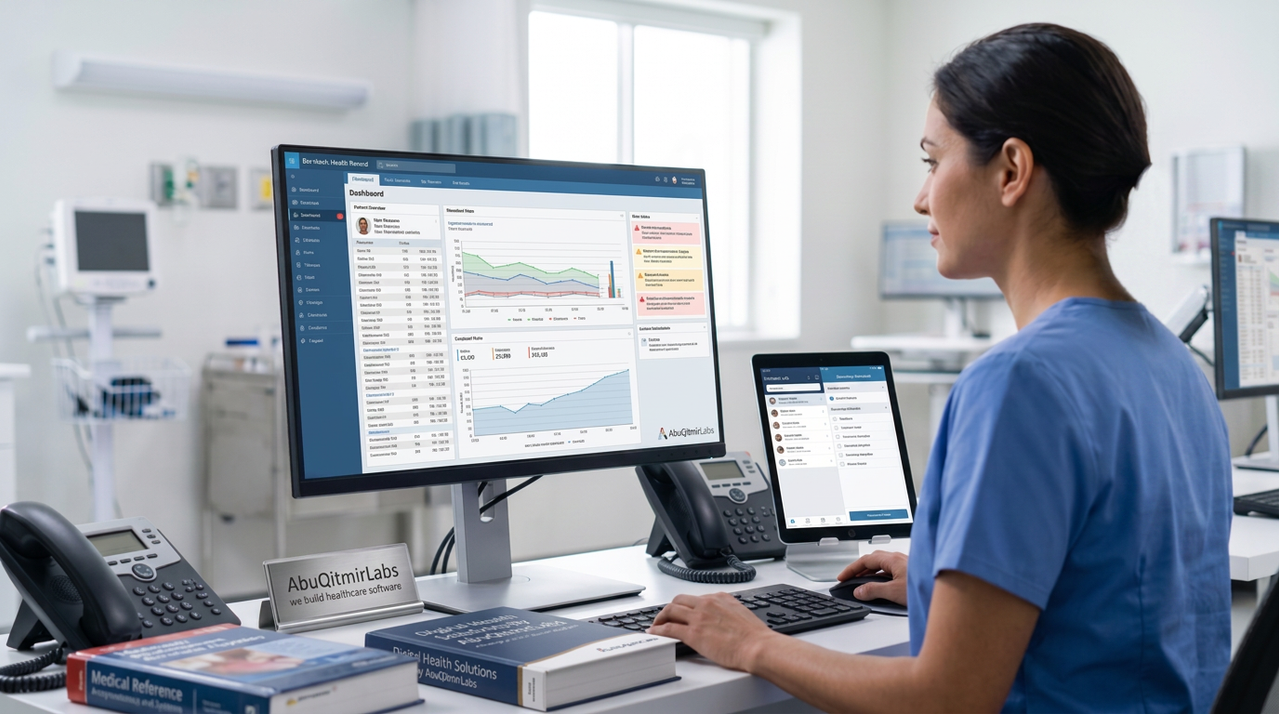
We design healthcare software around how clinicians and administrative staff actually work — informed by direct engagement with the clinical and operational teams who will use the system daily — rather than assuming a generic workflow applies universally across specialties and care settings. This is the same discipline behind our own ClinicOS Pro platform, a clinical ERP and EHR system built with an eleven-screen operational dashboard covering real-time operations, physician workstations, pharmacy inventory, diagnostic labs, and inpatient bed management — designed around how a clinic actually runs day to day, not around a generic template.
Full-Stack Healthcare Technology
AbuQitmirLabs builds across the full stack that healthcare software requires — backend clinical data systems, interoperability integration with labs and pharmacies, web platforms built to healthcare-grade security standards, and mobile applications for clinicians and patients built with the same rigor as the systems they connect to.
Owned, Documented, and Maintainable
Healthcare organizations that do not own their software outright face both a business risk and a compliance risk — since audit trails, patient data, and system behavior that regulators may need to review should be fully within the organization's control. Every system AbuQitmirLabs delivers is documented, structured for maintainability, and owned by the client.
Healthcare Software by Care Setting
Private Practices and Outpatient Clinics — Architecture priorities center on efficient patient check-in, streamlined billing and insurance claims, and a chart structure suited to the specific specialty — cardiology, dermatology, physical therapy, and general practice each benefit from meaningfully different workflow structures.
Hospitals and Multi-Department Facilities — Architecture priorities include real-time bed management, cross-department data visibility, pharmacy and lab integration at scale, and interoperability with a wider network of external providers and health information exchanges.
Telemedicine and Virtual Care Companies — Architecture priorities center on reliable video and messaging infrastructure, compliant e-prescribing workflows, integration with the patient's broader medical record, and performance across the variable connectivity conditions of patients accessing care from home.
Behavioral and Mental Health Providers — Architecture priorities include heightened confidentiality protections beyond standard HIPAA requirements in many jurisdictions, session-note structures suited to therapeutic documentation, and careful design of any patient-facing communication given the sensitivity of the care context.
Health-Tech Startups and Digital Health Products — Architecture priorities center on building a compliant foundation from day one — since retrofitting compliance into a product built without it is often more expensive than building it correctly the first time — alongside a patient or clinician experience distinctive enough to differentiate in a competitive digital health market.
Frequently Asked Questions
What is healthcare software development? Healthcare software development is the design and engineering of technology solutions for clinical and administrative use in healthcare settings — including EHR systems, telemedicine platforms, clinical decision support tools, hospital operations software, and patient engagement applications — built to meet the compliance, interoperability, and patient safety requirements specific to healthcare.
What makes healthcare software development different from other software development? Healthcare software carries patient safety consequences for failure, must comply with regulatory frameworks like HIPAA, requires interoperability with other clinical systems through standards like HL7 and FHIR, and must be designed around the operational realities of clinical environments — time pressure, multitasking, and variable connectivity — rather than general software usage patterns.
Is custom healthcare software HIPAA compliant by default? No. HIPAA compliance must be deliberately architected into the software — through encryption, access controls, audit logging, and appropriate business associate agreements with any third-party services involved. Custom development allows compliance to be designed in from the start, but it is not automatic; it requires the same care as any other implementation.
What is the difference between HL7 and FHIR? HL7 v2 is an older, widely used messaging standard for exchanging clinical data like lab results and admissions information, common in legacy healthcare systems. FHIR (Fast Healthcare Interoperability Resources) is the modern, API-based interoperability standard increasingly required for patient data access and system-to-system integration, particularly under current information-blocking regulations.
Should a healthcare organization build custom software or use an existing EHR platform? Most organizations benefit from a hybrid approach: a certified EHR platform for core documentation and e-prescribing where regulatory certification matters, combined with custom-built software for specialty workflows, patient engagement, and operational tools that a generic template cannot serve well. Fully custom development from scratch is appropriate when the organization's clinical or operational model differs significantly from what generic platforms assume.
How long does healthcare software development typically take? A focused clinical tool — a specialty workflow module, a patient portal feature, a telemedicine integration — can move from architecture to production in three to six months. A full clinical ERP or multi-department hospital operations platform typically requires a longer timeline due to the breadth of compliance, interoperability, and clinical workflow requirements involved.
What role does mobile app development play in healthcare software? Mobile applications are frequently the primary interface for both clinicians (rounding tools, clinical messaging) and patients (portals, medication reminders, telemedicine access). Mobile healthcare software requires the same security rigor as backend systems, along with careful design for connectivity interruptions and the on-the-go context in which it is typically used.
What makes AbuQitmirLabs different for healthcare software development? AbuQitmirLabs approaches healthcare software with compliance and patient-safety architecture as the first phase of every engagement, builds around real clinical workflows validated with actual clinical and operational users, and delivers systems that are owned, documented, and maintainable by the client rather than dependent on an ongoing vendor relationship.
Final Thoughts
Healthcare software is not simply software with stricter rules. It is a category shaped by patient safety consequences, a denser compliance landscape than almost any other industry, interoperability requirements that determine whether the software can function inside a real clinical ecosystem, and an operational environment — busy, interrupted, time-constrained — that most generic software was never designed to serve.
The organizations that recognize this early, and build their healthcare software with compliance, interoperability, and clinical workflow realism as foundational requirements rather than features added later, build systems that clinicians actually trust and patients actually benefit from. The ones that treat healthcare software like any other business application discover the gap — in a missed alert, a failed integration, or a compliance review — at the moment it is most costly to discover it.
That is the standard AbuQitmirLabs builds toward — not healthcare software that looks complete in a demo, but software that holds up on a busy Tuesday afternoon in a real clinic, under real clinical pressure, for years after the initial build is complete.
Built for Clinicians: Whether the need is a clinical ERP built around your specific specialty, a telemedicine platform with compliant e-prescribing, a patient portal that competes on real user experience, or a mobile app built for clinicians on the move — visit AbuQitmirLabs to start the discovery conversation before the wrong architecture becomes the foundation you have to work around.

Abu Qitmir Mohammad Shiraz Al-Madani
Founder & Lead Systems Architect at AbuQitmirLabs. Specializing in high-performance digital ecosystems, AI-driven architectures, and building scalable full-stack software systems.