MVP to Scale: A Non-Technical Founder's Roadmap for Version 2.0 (2026)
Quick Takeaways
Launching an MVP is not the finish line. It is the starting point of the harder engineering phase.
Most Version 2.0 projects fail because founders rebuild too early, too late, or without enough data to justify the decision.
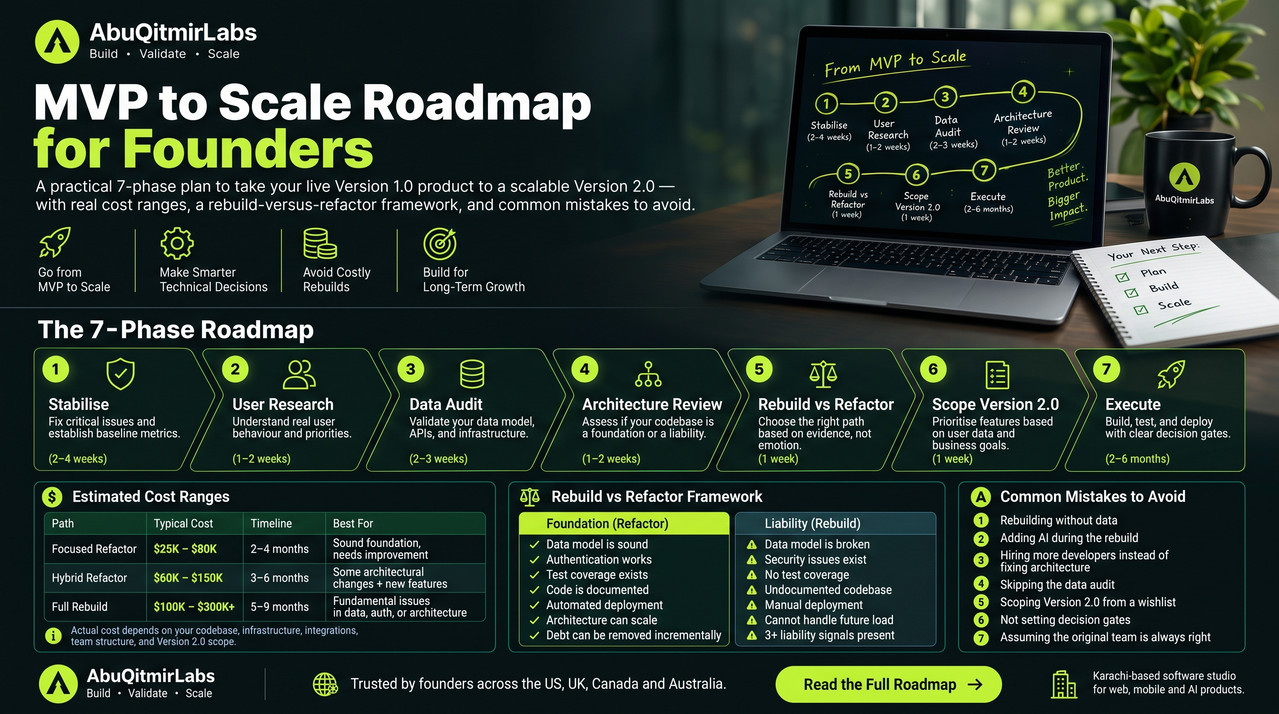
The 7-Phase MVP to Scale Roadmap gives non-technical founders a structured path from a live Version 1.0 product to a scalable Version 2.0.
Most Version 2.0 efforts are 30% to 40% refactoring and 60% to 70% new development. A complete rebuild is much less common than founders are often told.
AI features added during a scaling rebuild are also one of the most common reasons projects exceed their original budget.
AbuQitmirLabs provides architecture reviews, technical due diligence, refactoring plans, and Version 2.0 engineering for founders moving beyond the MVP stage.
Introduction: The Phase Nobody Warns Founders About
You launched your MVP.
It works. Users are coming in. Customers are using it. Maybe you are even generating revenue.
The hardest part should be over, right?
Not quite.
Launching the MVP is often the easy part. The harder challenge is deciding what happens next without spending $100,000 or more on a rebuild that your product never actually needed.
Once an MVP starts gaining traction, founders usually face three choices:
- Scale the existing product and hope the architecture survives increasing traffic and usage.
- Refactor the weak areas while keeping the parts that already work.
- Rebuild from scratch because the original architecture cannot support the next stage.
Choose incorrectly and the cost is not just the development contract.
The real cost is the unplanned rebuild, lost development time, delayed growth, and technical debt that follows.
AbuQitmirLabs builds production software for startups and enterprises through its custom software development practice. We have seen the same MVP-to-scale pattern repeatedly.
This guide explains the seven-phase roadmap we use to help founders move from MVP to Version 2.0 without automatically throwing away everything they have already built.
Why Most MVP-to-Scale Attempts Fail
Most MVP scaling attempts do not fail because the product cannot scale.
They fail because the founder makes the rebuild decision based on emotion instead of evidence.
The pattern usually looks like this:
- Founder launches MVP.
- Users start growing.
- The product becomes slower or begins showing technical problems.
- The founder panics.
- Someone recommends rebuilding everything.
- The original budget disappears.
- The new product still has many of the same problems.
The rebuild was not necessarily the problem.
The lack of a structured decision process was.
A proper roadmap replaces panic with evidence. It helps you determine when to scale, when to refactor, when to rebuild, and when to leave the existing architecture alone.
Before you start, however, there is another question worth answering:
Can your current engineering partner actually execute a scaling roadmap?
If you have not verified your developer or development team yet, read our 5-Minute Technical Audit for Founders first.
Phase 1: Stabilise the Live Product
Your MVP does not need more features yet.
It needs to stop being broken.
Before planning Version 2.0, close the active bugs. Fix the workflows users complain about repeatedly. Reduce measurable downtime. Stabilise the current product.
A scaling plan built on top of an unstable foundation will eventually fail when real users put pressure on it.
What to Do in This Phase
- Collect every support ticket from the last 90 days.
- Identify the three most common failure patterns.
- Fix those problems before adding unnecessary new features.
- Establish baseline measurements for uptime, error rate, and load time.
- Document the current production environment.
You cannot measure whether Version 2.0 is actually improving the product if you do not know where Version 1.0 started.
Phase 2: Study Your Actual Users
Version 2.0 should be based on what users actually do, not what the founder assumes they want.
Look at your analytics, session recordings, support tickets, conversion data, and customer feedback.
Then identify the three workflows users rely on most.
Those workflows deserve protection during the scaling process.
What to Look For
- Which features are used every day?
- Which features are rarely used?
- Where do users abandon the main workflow?
- Which workflows generate the most support requests?
- Which missing features are repeatedly requested by paying customers?
- Which workflows appear directly connected to retention or revenue?
This phase typically takes one to two weeks.
The goal is not to satisfy every feature request.
The goal is to protect the workflows that actually drive the business.
Phase 3: Audit the Data Foundation
Most Version 2.0 rebuilds are not really application rebuilds.
They are data-model rebuilds.
If the database schema is fundamentally wrong, endless refactoring will not solve the underlying problem.
If API contracts are undocumented, integrations become fragile.
If authentication and authorisation were designed incorrectly, adding more users can expose structural security problems.
This is where founders need an experienced engineering review.
The data audit should answer one fundamental question:
Is the current technical foundation strong enough to support the next stage of the business?
What to Audit
- Database schema and indexing
- API contracts and versioning
- Authentication and authorisation
- Third-party integrations and failure handling
- Backup and recovery procedures
If your engineering partner cannot clearly explain the condition of these five areas, they are not ready to plan your Version 2.0 architecture.
Phase 4: Review the Architecture Honestly
Before spending money on Version 2.0, you need an honest answer to one question:
Is your existing codebase a foundation or a liability?
For a non-technical founder, this can be one of the hardest questions to answer.
You need an engineer who is willing to tell you the truth rather than recommend the most expensive option.
Foundation vs Liability
| Signal | Foundation | Liability |
|---|---|---|
| Test coverage | Existing automated tests | No meaningful tests |
| Deployment | One-command deployment and working rollback | Manual deployment process |
| Monitoring | Errors tracked and alerts configured | Problems discovered by users |
| Documentation | New developers can understand the system | Only the original developer understands it |
| Dependencies | Updated and maintained | Years out of date with security warnings |
If your codebase looks like a liability across three or more rows, Version 2.0 may be the right opportunity to rebuild the affected foundation.
If it mostly looks like a foundation, refactoring is usually the cheaper and lower-risk path.
Phase 5: Scope Version 2.0 Based on Data
Version 2.0 should come from Phases 1 through 4.
Not from a founder wishlist.
Every feature introduces development cost.
Every feature also introduces maintenance, testing, support, security, and future technical debt.
Your Version 2.0 scope should therefore contain only:
- Fixes for workflows users actually struggle with.
- Infrastructure improvements that prevent known future failures.
- Features repeatedly requested by paying customers.
- Changes required to support measurable growth.
Nothing else.
The temptation is to turn Version 2.0 into:
"Everything we could not build in Version 1.0."
Resist that temptation.
Version 2.0 is not supposed to be a complete relaunch of your product.
It should be the professional, scalable version of what already works.
If you are considering adding AI features during the rebuild, evaluate the business case before committing the budget. In many products, AI belongs in a later iteration rather than being allowed to increase the complexity of the core scaling project.
Phase 6: Refactor or Rebuild?
This is the decision most founders get wrong.
The answer should not be based on how old the code looks or whether another developer says they would build it differently.
It should be based on the condition of the system.
Refactor When
Refactoring is generally the better option when:
- The data model is fundamentally sound.
- Authentication works correctly.
- The main workflows have test coverage.
- The codebase is documented.
- Deployment is automated.
- The architecture can reasonably support projected usage.
- Technical debt can be isolated and removed incrementally.
Rebuild When
A rebuild becomes more reasonable when:
- The data model is fundamentally wrong.
- Authentication or security has structural problems.
- The architecture cannot support projected load.
- Three or more liability signals from the architecture review are present.
- Maintenance costs are increasing faster than feature velocity.
- Critical architectural assumptions from the MVP are no longer valid.
Most startups should refactor more often than they rebuild.
Large-scale enterprise rebuilds are more common when the original MVP was built quickly, the team has disappeared, and the underlying architecture cannot be responsibly extended.
Typical Cost Ranges
| Path | Typical Cost | Timeline | When to Choose |
|---|---|---|---|
| Focused refactor | $25K–$80K | 2–4 months | Foundation is sound but workflows need improvement |
| Hybrid refactor | $60K–$150K | 3–6 months | Architectural changes plus new modules |
| Full rebuild | $100K–$300K+ | 5–9 months | Core data model or authentication is fundamentally broken |
If your team tells you that a complete rebuild is required, get a second opinion.
Full rebuilds are relatively rare.
Overstated rebuild recommendations are not.
For teams building new customer-facing platforms after the scaling decision, our web development practice can handle the architecture and implementation. When mobile applications are part of the product roadmap, the mobile platform should also be planned as part of the same overall system rather than developed as a disconnected product.
Phase 7: Execute with Clear Decision Gates
Execution is where many scaling plans collapse.
The roadmap matters, but the gates between phases matter even more.
Do not move to the next phase simply because the calendar says it is time.
Move forward when the current phase has produced its required output.
The Seven Decision Gates
- Gate 1: Baseline metrics are documented.
- Gate 2: The top three user workflows are identified.
- Gate 3: The data audit is complete.
- Gate 4: The architecture review is documented.
- Gate 5: Version 2.0 scope is frozen.
- Gate 6: Refactor or rebuild decision is documented in writing.
- Gate 7: The execution plan includes rollback criteria.
Every gate should produce a written deliverable.
No verbal promises. No "we will handle it later."
The 7-Phase MVP-to-Scale Roadmap at a Glance
| Phase | Focus | Primary Output | Typical Duration |
|---|---|---|---|
| 1 | Stabilise | Baseline metrics and critical bugs fixed | 2–4 weeks |
| 2 | Study users | Top 3 workflows documented | 1–2 weeks |
| 3 | Audit data | Data foundation report | 2–3 weeks |
| 4 | Review architecture | Foundation vs liability assessment | 1–2 weeks |
| 5 | Scope Version 2.0 | Frozen feature list | 1 week |
| 6 | Refactor or rebuild | Written decision and cost estimate | 1 week |
| 7 | Execute | Phased releases and rollback criteria | 2–6 months |
Total roadmap planning time: approximately 8–13 weeks.
Total execution time: approximately 2–9 months, depending on the chosen path.
Common Mistakes Founders Make When Scaling an MVP
Mistake 1: Rebuilding Without Data
A rebuild based on a hunch can quickly become a six-figure project.
A rebuild based on a structured technical audit gives you evidence for the investment.
Mistake 2: Adding AI Features During the Rebuild
AI can be valuable, but introducing AI while simultaneously restructuring the entire product increases complexity.
If the core product is unstable, stabilise it first.
Mistake 3: Hiring More Developers Instead of Fixing Architecture
Adding more developers to a broken architecture does not automatically make development faster.
Sometimes it makes the architecture harder to fix.
Mistake 4: Skipping the Data Audit
Many rebuilds are actually data-model rebuilds.
Skip the data audit and you may spend months rebuilding the wrong part of the system.
Mistake 5: Scoping Version 2.0 From a Wishlist
Version 2.0 should be driven by:
- User behaviour
- Customer feedback
- Production failures
- Revenue priorities
- Technical constraints
Not by every feature the founder has imagined.
Mistake 6: Not Setting Decision Gates
Without decision gates, a two-week stabilisation phase can quietly become a six-month engineering project.
Mistake 7: Assuming the Original Team Is Automatically the Right Team
The team that built the MVP may not be the team that should scale it.
That is not necessarily a failure.
It is a normal part of the product lifecycle.
Real-World Example: Scaling TajweedPage.com
AbuQitmirLabs built an AI-powered Quran learning platform at TajweedPage.com. The platform combines real-time speech diagnostics with structured learning paths and an AI Tajweed Teacher grounded in verified course content.
The scaling roadmap followed the same seven phases described in this guide:
- Phase 1: Stabilised the core workflows before introducing additional features.
- Phase 2: Studied how students actually progressed through lessons.
- Phase 3: Audited the data foundation for scalability across multiple languages.
- Phase 4: Reviewed the architecture against global user load patterns.
- Phase 5: Scoped AI features around actual user demand rather than speculation.
- Phase 6: Extended the existing architecture rather than automatically rebuilding it.
- Phase 7: Executed through phased releases with clear rollback criteria.
The platform now operates across multiple time zones, while its AI teacher provides support at a volume that would be difficult for human tutors to deliver alone.
The important lesson is not that every product should follow exactly the same technical architecture.
The lesson is that each phase built on the evidence produced by the previous phase.
No phase was skipped.
Frequently Asked Questions
What Is the Roadmap for MVP to Scale?
The MVP-to-scale roadmap is a seven-phase framework covering stabilisation, user research, data auditing, architecture review, Version 2.0 scoping, refactor-versus-rebuild decisions, and execution.
Each phase has specific deliverables and decision gates designed to reduce the risk of an unnecessary full rebuild.
When Should a Founder Start Planning Version 2.0?
Start planning Version 2.0 once your MVP has enough stable usage data to reveal meaningful patterns.
A useful starting point is at least three months of consistent user activity, especially when you also have paying customers and clear evidence of where the product struggles.
Planning too early can waste engineering resources.
Planning too late can allow technical debt to become expensive.
Do I Need to Completely Rebuild My MVP for Version 2.0?
Usually, no.
Most Version 2.0 efforts should combine refactoring with new development.
A complete rebuild is more appropriate when the core data model, authentication system, or primary architectural assumptions are fundamentally broken.
How Much Does It Cost to Scale an MVP to Version 2.0?
Typical ranges are:
| Scaling Path | Estimated Cost | Typical Timeline |
|---|---|---|
| Focused refactor | $25,000–$80,000 | 2–4 months |
| Hybrid refactor | $60,000–$150,000 | 3–6 months |
| Full rebuild | $100,000–$300,000+ | 5–9 months |
Actual cost depends on the codebase, infrastructure, data model, integrations, team structure, and Version 2.0 scope.
What Are the Most Common MVP Scaling Mistakes?
The most common mistakes include:
- Scaling before there is enough product data.
- Rebuilding without technical evidence.
- Ignoring technical debt until it affects production.
- Hiring more developers instead of fixing architecture.
- Skipping the data audit.
- Adding AI before stabilising the core product.
- Turning Version 2.0 into an unrestricted feature wishlist.
How Do I Know When My MVP Is Ready to Scale?
Your MVP is generally ready for a structured scaling review when you have:
- At least three months of stable usage data.
- Paying customers or consistent engagement.
- Repeatable acquisition channels.
- Clear user workflows.
- Measurable product bottlenecks.
- Evidence of where the system fails, slows down, or limits growth.
You do not need to wait until the product is breaking under massive traffic.
In fact, planning before the crisis is usually cheaper.
Should I Add AI Features During the Version 2.0 Rebuild?
Only when the AI feature directly solves an existing user problem and the underlying data and infrastructure can support it.
AI features added during a scaling rebuild can become a major source of additional scope, complexity, testing requirements, and cost.
For many products, stabilising the core first and introducing AI in a subsequent version is the safer approach.
How Does AbuQitmirLabs Help Founders Scale From MVP to Version 2.0?
AbuQitmirLabs provides architecture review, technical due diligence, refactoring plans, and Version 2.0 engineering for founders moving beyond the MVP stage.
The process begins with an assessment of the existing codebase, data model, infrastructure, and product requirements.
From there, the team can develop a phased roadmap with cost estimates for the available paths.
Conclusion: Plan the Next Version Before You Need It
Launching the MVP is not the hardest part.
Deciding what comes next is.
The seven-phase roadmap gives non-technical founders a structured path from a live Version 1.0 product to a scalable Version 2.0:
- Stabilise the product.
- Study actual users.
- Audit the data foundation.
- Review the architecture honestly.
- Scope Version 2.0 from evidence.
- Decide whether to refactor or rebuild.
- Execute with clear decision gates.
Every phase should produce an output.
Every output should inform the next decision.
No phase should be skipped simply because the team is eager to start coding.
Founders who plan Version 2.0 systematically can avoid many of the expensive, unplanned rebuilds that consume budgets and delay growth.
Founders who skip the process are often forced to make architectural decisions after the problems have already become expensive.
If you are planning Version 2.0 and need an engineering second opinion, start with an honest assessment of your existing product before committing the rebuild budget.
If you are ready to build the next version, AbuQitmirLabs can handle custom software architecture, development, deployment, and scaling as one engineering engagement. When AI is part of the roadmap, AI agent development can be treated as a dedicated track rather than allowing it to derail the core product rebuild.
Verify the roadmap first. Then commit the budget.

Abu Qitmir Mohammad Shiraz Al-Madani
Founder & Lead Systems Architect at AbuQitmirLabs. Specializing in high-performance digital ecosystems, AI-driven architectures, and building scalable full-stack software systems.