Performance Marketing vs Brand Marketing: A Budget Allocation Framework for Startups
Introduction
Every startup founder faces the same uncomfortable question: should I spend my limited marketing budget on ads that generate immediate leads, or on brand-building that pays off later? Get it wrong, and you either burn cash on ads that stop working the moment you pause them, or you build a beautiful brand nobody discovers because you never invested in distribution.
This guide answers that question with a practical framework. You will learn the core difference between performance marketing and brand marketing, when each one makes sense for a startup, and how to allocate your budget using a tested model that balances short-term revenue with long-term brand equity.
At AbuQitmirLabs, a Karachi-based digital marketing and software development studio, we have helped startups across the US, UK, and GCC markets build marketing systems that scale. This framework comes from real client engagements, not theory.
Quick Verdict: The 60/40 Rule for Early-Stage Startups
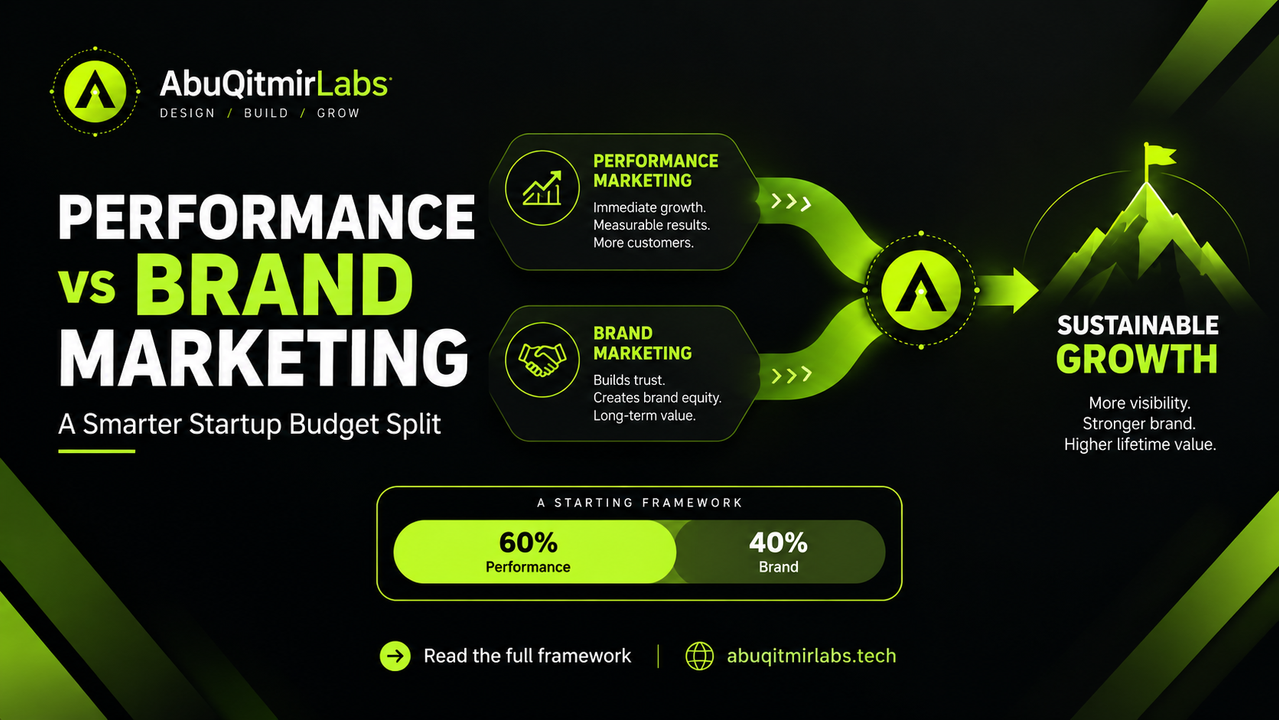
For most startups in their first 18 months, the optimal budget split is 60% performance marketing and 40% brand marketing. This allocation balances the immediate need for customer acquisition with the long-term need for brand recognition and defensibility.
As your startup matures and your customer acquisition cost stabilizes, shift toward a 50/50 split. Mature companies with strong brand equity can go as low as 30% performance and 70% brand because their brand does the heavy lifting in the sales process.
What Is the Difference Between Performance Marketing and Brand Marketing?
Performance marketing drives immediate, measurable actions like clicks, leads, and purchases. It includes paid search, social media ads, affiliate marketing, and email campaigns where you can track every dollar spent to a specific outcome.
Brand marketing builds long-term awareness, trust, and emotional connection with your audience. It includes content marketing, public relations, community building, and thought leadership that may not generate immediate sales but creates the brand equity that makes future sales easier.
The core difference is time horizon. Performance marketing optimizes for today's revenue. Brand marketing invests in tomorrow's pricing power, customer loyalty, and word-of-mouth growth.
According to research from the Institute of Practitioners in Advertising, brands that maintain consistent marketing investment during economic downturns grow market share significantly faster than those that cut spending. This is because brand marketing compounds over time while performance marketing resets to zero the moment you stop paying.
Why Startups Get This Wrong
Most founders default to performance marketing because it is measurable. You spend $1,000 on Google Ads, you see $3,000 in revenue, and you feel like a genius. But this short-term thinking creates three predictable problems.
First, performance marketing costs rise over time. As more competitors bid on the same keywords, your cost per acquisition increases. Without brand equity, you have no pricing power and no organic defensibility.
Second, performance marketing has a ceiling. You can only scale paid acquisition until your customer acquisition cost exceeds your lifetime value. At that point, you have a business that cannot grow profitably.
Third, performance marketing creates no memory. Customers who find you through an ad and never interact with your brand again are the most likely to churn. They have no emotional connection to your product, only a transactional one.
A 2025 study by Nielsen found that brand marketing drives 60% of long-term sales lift while performance marketing drives only 40%. Yet most startups allocate 90% or more of their budget to performance channels.
When Performance Marketing Wins
Performance marketing is the right choice when you need to validate demand, when you have a product that solves an urgent problem, and when your target audience is actively searching for a solution.
Performance marketing works best when:
Your product solves a specific, urgent pain point
Your target audience is already searching for a solution
You have a clear conversion path and can measure ROI within days
You need to generate revenue quickly to fund operations
You are testing a new market or new messaging
For startups, performance marketing is often the fastest path to product-market fit validation. If you cannot acquire customers profitably through paid channels, you either have a product problem or a messaging problem. Both need fixing before you invest heavily in brand.
When Brand Marketing Wins
Brand marketing is the right choice when you want to build defensibility, when your product requires trust before purchase, and when you want to reduce your long-term customer acquisition cost.
Brand marketing works best when:
Your product category is crowded and differentiation matters
Your sales cycle is long and requires multiple touchpoints
You want to attract talent, partners, and press
You want to reduce price sensitivity among customers
You are building for acquisition or long-term market leadership
Strong brand marketing rests on two pillars: consistent content writing that demonstrates expertise, and a technical SEO foundation that ensures your brand is discoverable when people search for solutions. Design also plays a critical role in brand recognition, which is why investing in graphics design for consistent visual identity pays dividends over time.
At AbuQitmirLabs, we have seen this firsthand. Startups that invest in brand marketing through SEO, content, and design consistently outperform competitors who rely solely on paid ads. The brand investment pays off in lower acquisition costs, higher conversion rates, and stronger customer retention. You can see examples of this in our case studies.
The 60/40 Budget Split Model
The 60/40 model gives you a starting point. Here is how to apply it based on your startup's stage and goals.
Stage 1: Pre-Revenue to First $10K MRR
Budget split: 80% performance / 20% brand
Your priority is validation. Spend most of your budget on performance channels that generate immediate feedback. Use the 20% brand budget for foundational content, a professional website, and basic brand identity.
Stage 2: $10K to $50K MRR
Budget split: 60% performance / 40% brand
You have validated demand. Now invest in brand assets that reduce your long-term acquisition cost. Build an SEO strategy, start a content engine, and invest in design systems that make your brand memorable.
Stage 3: $50K to $250K MRR
Budget split: 50% performance / 50% brand
Your brand is now a competitive advantage. Invest equally in performance channels for growth and brand channels for defensibility. This is when thought leadership, original research, and community building become critical.
Stage 4: $250K+ MRR
Budget split: 30% performance / 70% brand
Brand equity does the heavy lifting. Your performance marketing becomes more efficient because your brand already warms up the audience. Invest heavily in brand to maintain market leadership and pricing power.
How to Measure ROI for Both Channels
Measuring performance marketing ROI is straightforward. You track spend, clicks, conversions, and revenue. The formula is simple: (Revenue - Cost) / Cost = ROI.
Measuring brand marketing ROI is harder, but not impossible. Here are three methods that work for startups.
Method 1: Brand Lift Studies
Run surveys before and after a brand campaign to measure changes in awareness, consideration, and preference. Tools like Google Brand Lift and Meta Brand Lift can automate this.
Method 2: Share of Search
Track your brand's share of search volume compared to competitors. If your share of search increases over time, your brand marketing is working. This metric correlates strongly with market share.
Method 3: Customer Acquisition Cost Trend
If your performance marketing CAC decreases over time without changes to your ad creative or targeting, your brand marketing is working. Strong brands convert better at every stage of the funnel.
For a deeper dive into measurement frameworks, use our website audit tool to check your technical performance and identify areas where brand and performance can work together.
Common Mistakes in Budget Allocation
Mistake 1: Spending 100% on performance from day one. This creates a business that cannot survive without paid ads. The moment you stop paying, revenue stops.
Mistake 2: Spending 100% on brand before validating demand. This creates a beautiful brand that nobody needs. Validate with performance first, then invest in brand.
Mistake 3: Not tracking brand metrics at all. If you cannot measure brand impact, you cannot defend the budget. Start with share of search and brand lift studies.
Mistake 4: Changing the split too frequently. Brand marketing compounds. Give it at least 6-12 months before judging results. Performance marketing can be evaluated monthly.
Mistake 5: Copying a competitor's split. Your split should match your stage, category, and goals. A B2B SaaS startup needs a different split than a D2C e-commerce brand. If you are unsure how to choose the right partner for your split, review our our process to understand how we evaluate and onboard marketing engagements.
Frequently Asked Questions
What is the difference between performance marketing and brand marketing?
Performance marketing drives immediate, measurable actions like clicks and purchases. Brand marketing builds long-term awareness and trust. The key difference is time horizon: performance optimizes for today's revenue, brand invests in tomorrow's customer loyalty.
What percentage of my budget should go to performance marketing?
Most startups should allocate 60% to performance marketing and 40% to brand marketing in their first 18 months. Shift toward 50/50 as you mature, and 30/70 as brand equity becomes your primary competitive advantage.
When should a startup invest in brand marketing?
Invest in brand marketing after you have validated demand through performance channels. For most startups, this is after reaching $10K MRR. Before that, focus on performance to prove your product solves a real problem.
How do I measure brand marketing ROI?
Measure brand marketing through brand lift studies, share of search tracking, and customer acquisition cost trends. If your CAC decreases over time without changes to performance campaigns, brand marketing is working.
Is performance marketing better than brand marketing?
Neither is better. They serve different purposes. Performance marketing generates immediate revenue and validates demand. Brand marketing builds defensibility, reduces long-term acquisition costs, and creates pricing power.
Can I do both performance and brand marketing at the same time?
Yes. The 60/40 model is designed for startups to invest in both simultaneously. The key is to set the right split based on your stage and adjust as you grow.
How long does brand marketing take to show results?
Brand marketing typically shows measurable results in 6-12 months. Share of search and brand lift metrics may move sooner, but revenue impact usually takes longer to materialize.
What is the best marketing budget for a startup?
There is no single best budget. A common starting point is 20-30% of projected revenue for marketing. Allocate 60% to performance and 40% to brand, and adjust based on what you learn.
Conclusion
The performance marketing vs brand marketing debate has a simple answer: you need both, but the ratio matters. Start with 60% performance and 40% brand, adjust by stage, and measure both channels with the right metrics.
Performance marketing keeps the lights on today. Brand marketing builds the business that survives tomorrow. Founders who master both create companies that grow profitably and defend themselves against competitors.
At AbuQitmirLabs, we help startups build marketing systems that balance performance and brand. Our team combines technical SEO, content strategy, and performance marketing to create growth engines that scale. If you want help allocating your marketing budget, get in touch.

Abu Qitmir Mohammad Shiraz Al-Madani
Founder & Lead Systems Architect at AbuQitmirLabs. Specializing in high-performance digital ecosystems, AI-driven architectures, and building scalable full-stack software systems.