Semantic SEO Strategy: The Complete 2026 Framework | AbuQitmirLabs
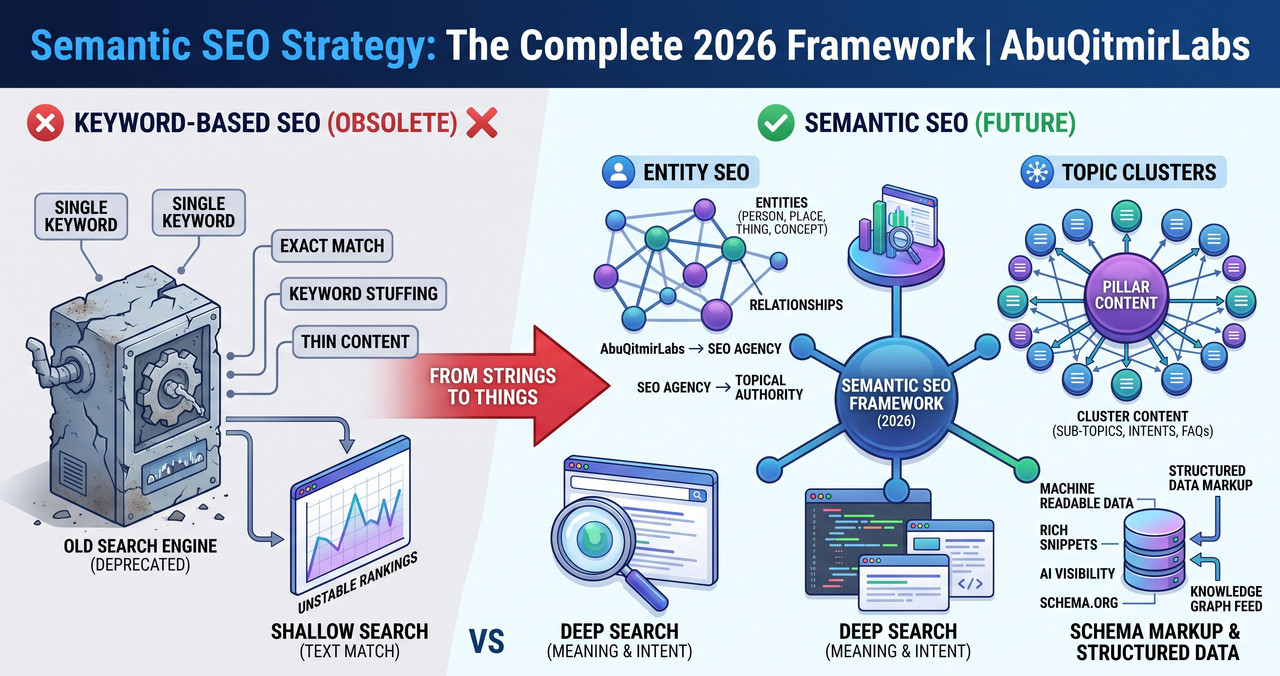
If you're still building content around single keywords and hoping to rank, you're optimizing for a search engine that no longer exists. A semantic SEO strategy is the practice of structuring content around topics, entities, and user intent — not isolated keyword phrases — so that both Google's ranking systems and AI answer engines understand what your content actually means.
AbuQitmirLabs .TECH is a custom software and AI development studio that also runs technical and semantic SEO engagements for clients across the US, UK, Pakistan, Canada, Poland, and Australia. This guide breaks down what semantic SEO actually involves, how it differs from keyword-based SEO, and how to build a semantic SEO strategy step by step in 2026.
Quick Takeaways
- Semantic SEO optimizes for meaning and intent, not exact-match keyword density
- It relies on topic clusters, entity SEO, and schema markup working together
- It's become more important, not less, as AI Overviews and answer engines (ChatGPT, Perplexity, Google AI Mode) pull directly from well-structured, semantically clear content
- Keyword stuffing is the opposite of semantic SEO — it signals thin content rather than topical depth
What Semantic SEO Actually Means
Semantic SEO is the practice of optimizing content for the underlying meaning of a search query, not just the words in it. Instead of writing one page per exact-match keyword, you build content that comprehensively covers a topic and the concepts, questions, and related terms connected to it.
The shift dates back further than most marketers realize. Google's Hummingbird update in 2013 moved ranking systems toward understanding the intent behind a query rather than matching individual words. RankBrain (2015) and BERT (2019) extended this by applying machine learning and natural language processing to interpret context, synonyms, and relationships between concepts — a progression detailed in Embryo's semantic SEO guide.
In practice, this means a single well-structured page can rank for hundreds of related long-tail variations without ever targeting them individually — a point Backlinko's semantic SEO guide makes clearly: comprehensive content built around a medium-tail keyword tends to absorb the long-tail variations around it automatically, once the page earns enough authority.
Semantic SEO vs. Traditional Keyword SEO
| Traditional SEO | Semantic SEO | |
|---|---|---|
| Unit of optimization | Exact-match keyword | Topic and entity |
| Content approach | One page per keyword | Comprehensive topic coverage |
| Ranking signal | Keyword density | Context, intent, relationships |
| Structure | Isolated pages | Interlinked topic clusters |
| Risk | Keyword stuffing, thin content | None inherent — but requires real depth, not just length |
The core distinction is simple: traditional SEO asks "does this page contain the keyword enough times?" Semantic SEO asks "does this page fully answer what the searcher actually wants to know?"
Why Semantic SEO Matters More in 2026
The direct answer: semantic SEO now determines whether your content gets cited by AI search tools, not just whether it ranks on a traditional results page.
Generative and answer engines — Google AI Overviews, ChatGPT, Perplexity — don't rank pages in the traditional sense. They extract and synthesize information from content they judge to be clear, well-structured, and topically authoritative. A page stuffed with keyword variants but thin on actual explanation gives these systems nothing usable to cite. A page that answers a question directly, in a self-contained paragraph, gives them exactly what they need.
This is the practical overlap between semantic SEO and what's often called Generative Engine Optimization (GEO) and Answer Engine Optimization (AEO): the same structural discipline — topic depth, clear entity definition, direct answers — that satisfies Google's semantic ranking systems also makes content citable by AI engines. It's the same discipline AbuQitmirLabs applies when building AI agents and RAG-based systems — both rely on giving a machine unambiguous, well-structured information to work from.
Entity SEO: Teaching Google Who You Are
An entity, in SEO terms, is any distinct "thing" search engines can recognize and store facts about — a brand, a person, a product, a concept. Entity SEO is the practice of making sure search engines correctly identify your brand as an entity and associate it with the right facts and related concepts.
WordLift's entity SEO guide frames this as helping search engines see your brand as its own recognized entity with defined expertise in specific topics, rather than just a collection of pages targeting keywords. Practically, this means:
- Stating your brand name and category clearly near the top of key pages
- Using consistent naming across your site (no variant spellings or abbreviations)
- Connecting your brand to specific, real technical work — not vague claims
AbuQitmirLabs applies this directly: pages state plainly that AbuQitmirLabs .TECH is a custom software and AI agent development studio, and connect that identity to a real, verifiable project — the TajweedPage.com case study, where AbuQitmirLabs engineered a RAG-based (Retrieval-Augmented Generation) AI Tajweed teacher, a programmatically accelerated Islamic EdTech platform. That's a concrete, citable fact — the kind of specific detail both search engines and AI answer engines can extract and trust, rather than a generic "we build innovative solutions" claim.
Building Topic Clusters and Pillar Pages
A topic cluster is a group of interlinked pages built around one core (pillar) page, each covering a specific subtopic in depth and linking back to the pillar. This structure signals topical authority far more effectively than a single isolated page ever could.
The pattern works like this:
- Pillar page — a broad, comprehensive page on the core topic (for example, AbuQitmirLabs' own SEO services page)
- Cluster content — supporting articles targeting specific subtopics, such as local citation building or local SEO audits
- Internal links — every cluster piece links back to the pillar, and the pillar links out to relevant cluster content
SE Ranking's semantic SEO guide notes that this internal link structure does double duty — it distributes ranking authority across the cluster while also helping search engines map exactly how the pages relate to one another.
Schema Markup: The Machine-Readable Layer
Schema markup is structured data — code added to a page that explicitly tells search engines what the content is, in a format machines can parse directly rather than infer.
Without schema, a search engine has to guess whether a block of text is a price, a review, an FAQ answer, or a step in a process. With schema, you tell it directly. This matters more than ever for AI answer engines, which rely heavily on structured, unambiguous data to extract facts confidently. As Schema App's guide to semantic SEO explains, structured data lets you categorize entities and explicitly define how they relate to each other — giving search engines direct contextual information instead of leaving it to inference.
Common schema types worth implementing:
- Article schema for blog content
- FAQPage schema for question-and-answer sections
- Service schema for service pages
- BreadcrumbList schema for site navigation clarity
- LocalBusiness schema for market-specific pages
Matching Content to Search Intent
Every keyword carries an implied intent — informational, commercial, transactional, or navigational — and semantic SEO requires matching your content format to that intent precisely, not just the topic.
A search for "what is semantic SEO" wants a clear informational explanation. A search for "semantic SEO agency" wants a commercial page that helps someone evaluate a provider. Writing the wrong content type for the intent — a hard sales page for an informational query, or a vague blog post for a transactional one — is one of the most common reasons otherwise well-written content underperforms.
How do you find search intent for a keyword?
Look directly at what's already ranking. If the top results for a keyword are all comprehensive guides, the intent is informational — a landing page won't outrank them. If the top results are service or product pages, the intent is commercial or transactional, and a blog post won't compete effectively. Google's own results are the most reliable intent signal available.
Internal Linking for Topical Authority
Internal linking isn't just navigation — it's how you explicitly tell search engines which pages on your site relate to each other and how strongly.
Effective semantic internal linking uses descriptive, keyword-rich anchor text (never "click here"), links between genuinely related pages rather than every page to every page, and connects cluster content back to its pillar consistently. A market page and a relevant service page should link to each other; a blog post should link to the service page it supports and to a proof point like a case study.
Common Semantic SEO Mistakes
The most common mistake isn't a lack of effort — it's mistaking keyword repetition for topical depth. Some sites respond to "cover the topic thoroughly" by cramming every keyword variant of a phrase into a single paragraph — "software development services," "software development firm," "software development agency" — stacked back to back. This is precisely what semantic SEO is meant to replace, and search engines increasingly recognize the pattern for what it is: an attempt to game density rather than genuinely inform the reader.
Other frequent mistakes:
- Thin cluster content — publishing short, templated pages just to "fill out" a cluster, rather than genuinely useful subtopic coverage
- Orphaned pages — content with no internal links pointing to or from it, leaving search engines unable to place it in a topic structure
- Schema mismatched to content — marking up content with schema types that don't accurately reflect what's on the page
- Ignoring intent — targeting a keyword with the wrong content format entirely
Applied Example: Programmatic Content at Scale
Semantic SEO principles apply just as directly to programmatic content as they do to a single article. AbuQitmirLabs' engineering work on TajweedPage.com involved building a programmatically accelerated content architecture for an Islamic EdTech platform — generating structured, topically organized content at scale rather than one-off pages, while keeping each page tied clearly back to its core topic and entity.
The same underlying principle applies whether you're publishing ten pages or ten thousand: content earns topical authority when it's structured around real subtopics and internally connected, not when pages are duplicated with light variation.
A Practical Semantic SEO Implementation Roadmap
If you're starting from scratch, sequence matters more than trying to do everything simultaneously:
- Audit your existing content for keyword-stuffed or duplicate-boilerplate pages — fix or consolidate these first, since they actively work against topical authority
- Define your core topics — the 3-5 subjects your site should be recognized as an authority on
- Build or identify your pillar pages for each core topic
- Map your cluster content — what subtopics does each pillar need supporting articles for?
- Add schema markup to pillar and cluster pages, starting with Article, FAQPage, and Service types
- Interlink deliberately — every new piece of content should link to its pillar and at least one related page
- Write for direct answers — lead every major section with a one-to-two sentence answer before adding supporting detail
Frequently Asked Questions
What is the difference between semantic SEO and traditional SEO?
Traditional SEO optimizes individual pages around exact-match keywords and keyword density. Semantic SEO optimizes around topics, entities, and user intent, using topic clusters and structured data to help search engines understand meaning rather than just match words.
Does semantic SEO replace keyword research?
No. Keyword research still identifies what people are searching for and how often — SE Ranking's guide confirms keyword data remains foundational. What changes is what you do with it: instead of one page per keyword, you group related keywords under a single, comprehensive topic page.
How does semantic SEO relate to AI Overviews and answer engines?
AI answer engines extract and synthesize information rather than simply linking to it. Content structured with clear entities, direct answers, and schema markup is far more likely to be cited, because these systems need unambiguous, well-organized information to draw from — the same qualities that support strong semantic SEO in traditional search.
Is schema markup required for semantic SEO to work?
It's not strictly required, but it significantly helps. Schema gives search engines and AI systems explicit, machine-readable confirmation of what your content is, rather than requiring them to infer it — which speeds up and improves how accurately your content is understood and cited.
Building a semantic SEO strategy is less about any single tactic and more about restructuring how your site's content relates to itself — topics, entities, and internal links working as one coherent system rather than isolated pages competing for individual keywords. If your site's current content was built the traditional way, AbuQitmirLabs' SEO services team can audit what's holding it back and rebuild it around topical authority instead of keyword density.
Ready to fix your site's topical structure? Get in touch with AbuQitmirLabs to start a semantic SEO audit.

Abu Qitmir Mohammad Shiraz Al-Madani
Founder & Lead Systems Architect at AbuQitmirLabs. Specializing in high-performance digital ecosystems, AI-driven architectures, and building scalable full-stack software systems.