Small Business Branding Mistakes Pakistan (And How to Fix It) | AbuQitmirLabs
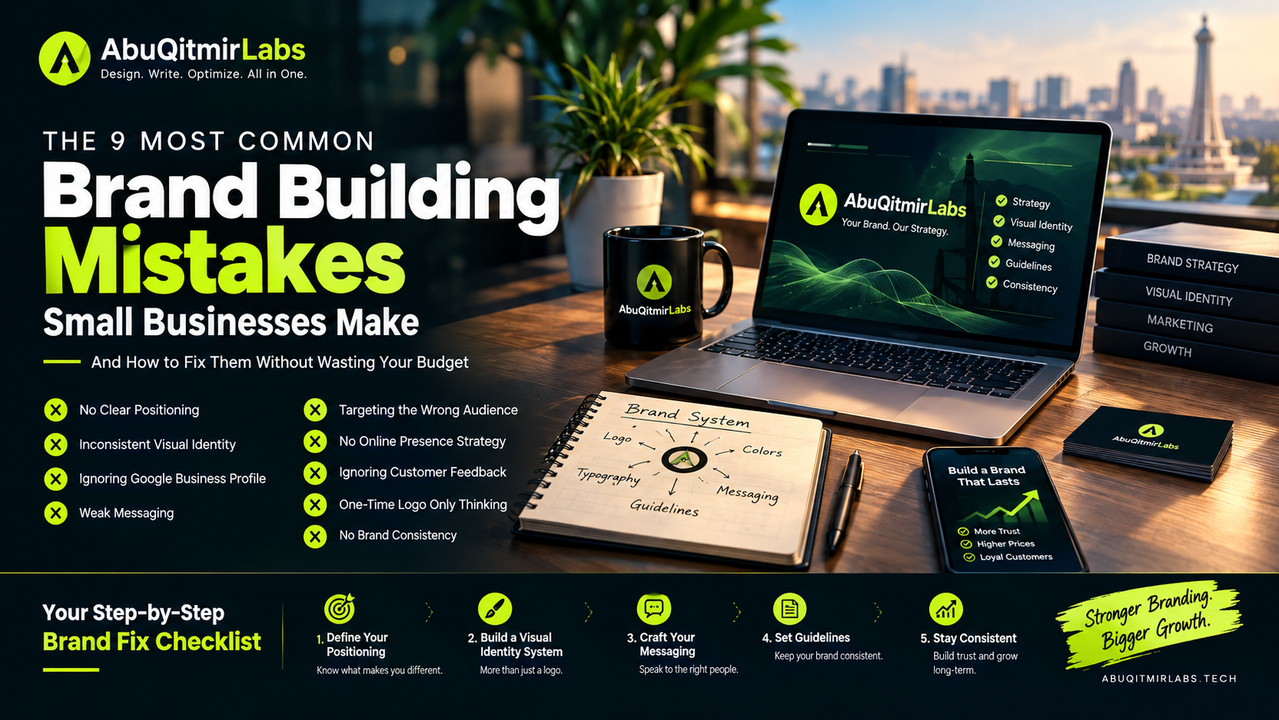
Quick Takeaways
- Most small businesses treat branding as a one-time logo purchase rather than an ongoing strategy.
- When an SME skips positioning, uses inconsistent colors, and ignores their digital presence, they signal to buyers that they are an amateur operation.
- A brand is a system of trust. Without a system, you cannot command premium pricing.
- Here are the 9 most common brand building mistakes Pakistani SMEs make, and a practical checklist to fix each one without wasting your budget.
- AbuQitmirLabs builds scalable visual identities through our brand building services.
Introduction: The $500 Logo Mistake
You run a small business in Pakistan. You want to look professional. So you pay a freelancer $500 for a logo. You slap it on a Facebook page, print it on some flyers, and assume your branding is done.
Six months later, you wonder why customers are choosing the competitor down the street.
The problem is not your product. It is not your price. It is the fact that your brand looks like a collection of random assets rather than a cohesive, trustworthy business.
Branding is not a visual mark. It is a system of trust. When you confuse a logo with a brand, you waste money and lose customers.
Here are the 9 most common brand building mistakes small businesses make, and exactly how to fix them.
The 9 Brand Building Mistakes (And How to Fix Them)
1. Confusing a Logo with a Brand
Direct Answer: A logo is a single visual mark; a brand is the complete system of visual and verbal rules that governs how your business is perceived.
The Mistake: Thinking that once the logo is designed, the branding is done. The Fix: You need a brand identity system. This includes a logo suite, typography, color palette, and brand guidelines. Read our guide on brand identity vs logo design to understand the exact difference.
2. Skipping Market Positioning
Direct Answer: Positioning is the process of defining exactly who your brand is for and why it is different from competitors.
The Mistake: Trying to sell to everyone. If your brand speaks to everyone, it resonates with no one. The Fix: Define your niche. Who is your ideal customer? What is the one problem you solve better than anyone else? Write this down before you design a single asset.
3. Visual Inconsistency (Random Colors and Fonts)
Direct Answer: Visual inconsistency happens when a business uses different fonts, colors, and logo variations across different platforms.
The Mistake: Using a blue logo on the website, a green logo on Instagram, and a blurry PNG on Facebook. The Fix: Create a simple brand guidelines document. Define the exact HEX codes for your colors and the exact fonts you will use. This ensures that every designer, developer, or employee uses the same rules. See how we approach graphics design to enforce this consistency.
4. Ignoring the Digital First Impression (Slow Website)
Direct Answer: Your website is often the first interaction a customer has with your brand. If it is slow or broken, your brand looks untrustworthy.
The Mistake: Paying for a beautiful homepage that takes 8 seconds to load on a mobile phone. The Fix: Invest in high performance. Google's Core Web Vitals measure the technical quality of your brand online. A fast, secure website is a trust signal. Our web development practice builds platforms that load in under a second.
5. No Brand Voice Online
Direct Answer: Brand voice is the tone and personality your brand uses when communicating with the world.
The Mistake: Sounding like a corporate robot on LinkedIn, a meme page on Instagram, and a salesperson on your website. The Fix: Define your voice. Are you authoritative, playful, technical, or empathetic? Write down 3 words that describe your tone and ensure every content writing piece matches it.
6. Neglecting the Google Business Profile (GMB)
Direct Answer: Your GMB is the most critical asset for local search visibility. It is how local customers find and trust you.
The Mistake: Having no photos, no reviews, and no business hours listed on Google Maps. The Fix: Optimize your profile. Add high-quality photos, respond to reviews, and post weekly updates. As we detail in our digital marketing services, a strong GMB builds local trust instantly.
7. Bad Social Media Presentation
Direct Answer: Your social media grid is the modern storefront of your brand. It must look professional and cohesive.
The Mistake: Posting blurry text graphics, low-quality images, and inconsistent visual styles. The Fix: Use the same colors and fonts from your guidelines on every post. Use a tool like Canva or Figma to create a template, and stick to it.
8. No Review Management
Direct Answer: 93% of consumers read online reviews before making a purchase.
The Mistake: Ignoring negative reviews or never asking happy customers for feedback. The Fix: Build a system. Ask every satisfied customer for a review on Google or Facebook. Respond professionally to every single review, positive or negative.
9. Copying Competitors Instead of Differentiating
Direct Answer: When you copy a competitor's brand, you are telling the market you have nothing unique to offer.
The Mistake: Using the same stock photos, the same messaging, and the same visual style as the market leader. The Fix: Find your unique angle. If you cannot compete on price, compete on service, speed, or expertise. Your brand must highlight that difference.
The Brand Building Fix Checklist
Use this table to audit your own brand today.
| # | Mistake | The Fix | Who is Responsible? |
|---|---|---|---|
| 1 | Confusing logo with brand | Build a full identity system (logo suite, fonts, colors, guidelines) | Founder / Designer |
| 2 | Skipping positioning | Define a specific niche and target audience | Founder |
| 3 | Visual inconsistency | Create and enforce a brand guidelines document | Designer / Marketer |
| 4 | Slow website | Optimize Core Web Vitals and page load speed | Developer |
| 5 | No brand voice | Define 3 tone words and apply them to all content | Content Writer |
| 6 | Neglected GMB | Optimize profile, add photos, and update weekly | Marketing Team |
| 7 | Bad social media | Use templates that match brand guidelines | Social Media Manager |
| 8 | No review management | Implement a system to ask for and respond to reviews | Sales / Support |
| 9 | Copying competitors | Identify your unique selling proposition (USP) and highlight it | Founder / Strategist |
The Cost of Branding: Why It's an Investment, Not an Expense
Direct Answer: Building a professional brand identity system typically costs between $1,000 and $5,000 for a small business. However, the cost of a bad brand is significantly higher.
If your brand looks amateurish, you will lose customers to competitors who look more trustworthy. You will also be forced to compete on price rather than value.
When you invest in a system, you speed up development. Your web developer does not have to guess your hex codes. Your marketer does not have to invent a tone of voice. You save money in the long run.
Frequently Asked Questions
Why do small businesses fail at branding?
Small businesses often fail at branding because they treat it as a one-time logo purchase rather than an ongoing strategy. They skip positioning, lack visual consistency, ignore digital trust signals, and fail to align their brand promise with actual customer experience.
How much should a small business spend on branding?
A small business should expect to invest 5% to 10% of its annual revenue into marketing and branding. For a new brand identity system (logo, colors, guidelines), expect to spend between $1,000 and $5,000 depending on the region and complexity.
What is the most common branding mistake in Pakistan?
The most common mistake is confusing a logo with a brand. Many Pakistani SMEs spend heavily on a visual mark but fail to establish brand guidelines, a consistent voice, or a clear market positioning.
Do small businesses need a brand guideline document?
Yes. Even a simple 5-page document defining your exact colors, fonts, logo usage, and tone of voice is critical. Without it, every flyer, social media post, and website page will look like it came from a different company.
How can a small business build trust online?
Online trust is built through consistency and social proof. This means having a professional website, an optimized Google Business Profile with reviews, a consistent social media presence, and responding to customer feedback promptly.
Should a small business rebrand if it is struggling?
Not necessarily. Before spending money on a rebrand, analyze if the problem is the brand or the product. A rebrand will not save a bad product. However, if the brand looks amateurish or inconsistent, a visual refresh can significantly boost customer confidence.
What is the difference between branding and marketing?
Branding is who you are (your identity, values, and voice). Marketing is how you tell people about it (ads, SEO, social media). Branding comes first; marketing amplifies the brand.
How can AbuQitmirLabs help a small business fix its branding?
AbuQitmirLabs builds scalable visual identities through our graphics design practice. We use a compressed Startup Brand Sprint to deliver strategy, logo, typography, color palette, and guidelines in under two weeks, ensuring the brand is built to scale.
Conclusion: Build the System, Not Just the Logo
A logo without a system is just a decoration. A logo inside a system is a business asset.
When you build the brand identity system first, everything that follows, your website, your ads, your content, your pitch deck, moves faster and looks consistent. You avoid the expensive cycle of redesigning the logo later when you realize it does not fit the system you actually needed.
If you are a small business in Pakistan and need the foundational system without the six-month agency timeline, contact AbuQitmirLabs to discuss a Startup Brand Sprint.
You can also explore our full brand building services to see how we structure brand systems for clients in the US, UK, Canada, Australia, the Middle East, and Pakistan.
Build the system first. The logo is the easy part.

Abu Qitmir Mohammad Shiraz Al-Madani
Founder & Lead Systems Architect at AbuQitmirLabs. Specializing in high-performance digital ecosystems, AI-driven architectures, and building scalable full-stack software systems.