The Complete Guide to RAG AI Integration for Startups
The Complete Guide to RAG AI Integration for Startups
Quick takeaways
- RAG (Retrieval-Augmented Generation) connects a large language model to your own data, so it answers using facts instead of guesses.
- A lean startup RAG build typically runs $5,000–$45,000, far below the $35,000–$400,000+ range enterprise vendors quote.
- Most early RAG failures trace back to messy source data and poor chunking, not the model itself.
- You don't need to fine-tune a model to ship a trustworthy AI feature — for most startups, RAG is the faster, cheaper path.
If you've tried bolting a chatbot onto your product, you already know the problem: it sounds confident and gets things wrong. It doesn't know your pricing page changed last week. It doesn't know your refund policy. It answers questions about your product with information from someone else's product, because that's what its training data looked like.
That's the gap RAG AI integration closes. Instead of relying only on what a model learned during training, RAG gives it a way to look up your actual data — docs, policies, product specs — before it answers. This guide walks through what RAG AI integration actually involves, what it costs at startup scale, where teams get it wrong, and how to decide whether to build it yourself or bring in a partner.
What Is RAG AI Integration, Really?
RAG AI integration means connecting a large language model to a retrieval system that pulls in your specific data before the model generates a response, so answers are grounded in facts you control rather than the model's static training data.
Technically, it's a two-part system. The retrieval half searches a knowledge base — your docs, support tickets, product catalog, whatever's relevant — and pulls back the most relevant chunks of information for a given question. The generation half is the language model itself, which takes those retrieved chunks plus the user's question and writes a response grounded in that context.
Why does this matter for a startup? Because your product data changes constantly, and retraining a model every time your pricing or policies update isn't realistic. RAG lets you update a document and have the AI reflect that change on the very next query, with no retraining step at all.
How RAG Differs from Fine-Tuning
RAG separates knowledge from the model, while fine-tuning bakes knowledge directly into the model's weights — which is why RAG suits fast-changing startup data and fine-tuning suits fixed tone or formatting needs.
Fine-tuning changes how a model writes — its tone, its format, its style — but it doesn't reliably teach it new facts, and every data update means retraining from scratch. For a startup shipping weekly, that's an expensive treadmill. Fine-tuning still earns its place when you need a very specific voice or output structure. But if the problem is "our AI doesn't know our own data," RAG is almost always the faster fix.
Why Startups Are Adopting RAG in 2026
Startups are adopting RAG because it's the most direct way to ship an AI feature that actually knows their business, without the cost or fragility of training a custom model from scratch.
The category is growing fast for a reason: the global RAG market was valued at roughly $1.94 billion in 2025 and is projected to reach $9.86 billion by 2030, a compound annual growth rate above 38%. That growth is being driven less by big enterprise pilots and more by the fact that RAG has become the practical default architecture any team reaches for when they want an AI feature people can actually trust.
What Problem Does RAG AI Integration Solve?
RAG solves the core reliability problem with generative AI: language models answer confidently even when they don't know the answer, and RAG stops that by grounding every response in retrieved, real data.
This is the difference between an AI chatbot that says "I'm not sure, let me check our docs" (badly) versus one that actually retrieves your refund policy and quotes it correctly. Without retrieval, a model has no way to distinguish "I know this" from "I'm pattern-matching my way to a plausible-sounding sentence." With retrieval, the model is answering from something, not just about something.
How RAG Works — The Core Pipeline
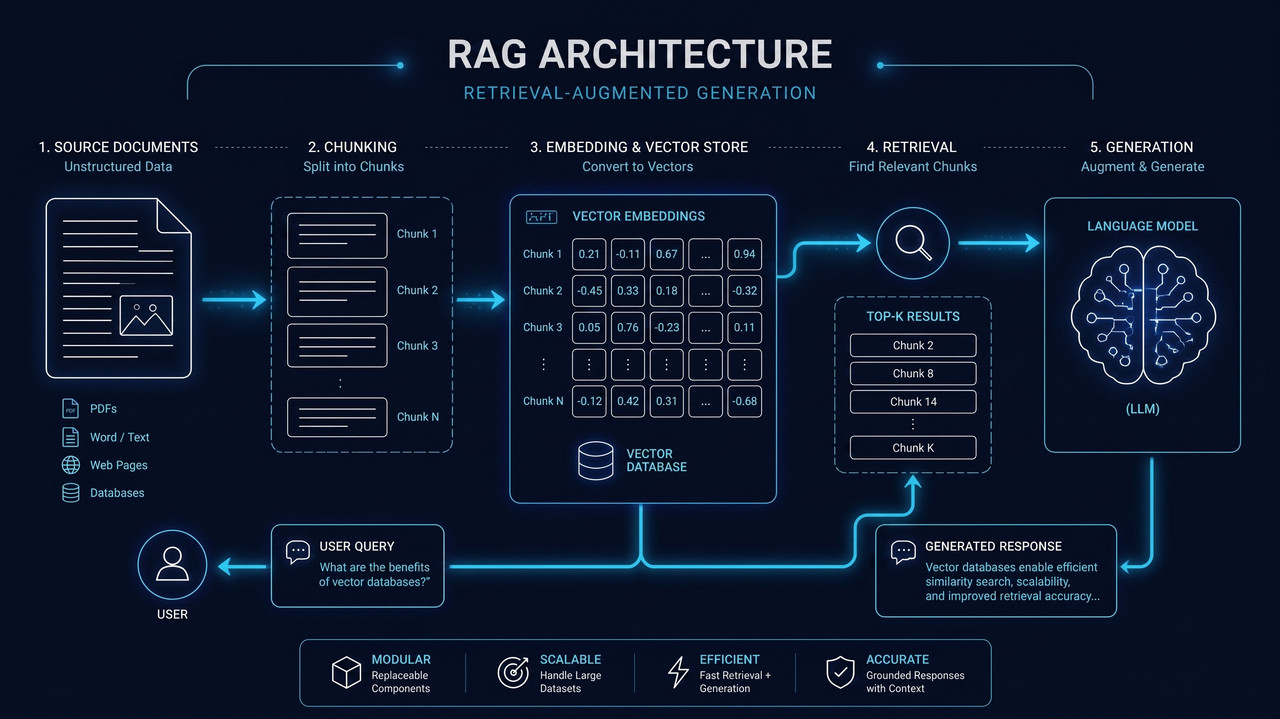
A RAG pipeline has three core stages: it ingests and chunks your data, converts that data into searchable embeddings, and retrieves the most relevant chunks to hand to the model at query time.
Data Ingestion & Chunking
Before anything else, your source material — help docs, product specs, internal wikis — gets broken into smaller chunks small enough for the retrieval system to search precisely, but large enough to keep meaningful context. This step sounds simple and is usually where the most engineering time actually goes: real documents have tables, headers, and inconsistent formatting that all need cleaning before they're usable.
Embeddings & Vector Storage
Each chunk gets converted into a vector embedding — a numerical representation of its meaning — and stored in a vector database like Pinecone, Weaviate, or Chroma. This is what lets the system search by meaning rather than exact keyword match, so a question phrased differently from your source docs can still find the right chunk.
Retrieval & Generation
When a user asks a question, it's converted into the same kind of embedding, compared against your stored vectors, and the closest-matching chunks are retrieved and handed to the language model as context. The model then generates its answer using that retrieved context — which is why a well-built RAG system can cite exactly which document backs up its answer, something a plain chatbot can't do.
How Much Does RAG AI Integration Cost for a Startup?
A lean, single-use-case RAG integration for a startup typically costs $5,000–$45,000 depending on data volume and complexity, well below the $35,000–$400,000+ range quoted for full enterprise deployments.
Enterprise-focused agencies often cite eye-watering numbers — one widely cited breakdown puts full enterprise RAG integration at $100,000 to $400,000 or more once it spans multiple departments, data sources, and compliance requirements. That range makes sense for a bank connecting RAG to 100,000 internal documents under strict audit requirements. It does not describe what a startup needs to ship a single, focused AI feature.
At startup scale, the picture looks different:
- Initial development: roughly $5,000–$15,000 for a solid, single-use-case AI feature (a support bot trained on your docs, a product-search assistant)
- API and infrastructure costs: typically $100–$500/month for moderate usage, though edge-optimized stacks can bring this down to $5–$10/month for smaller-scale retrieval workloads
- Full custom builds with more complex data prep: $8,000–$45,000, based on breakdowns from teams that have shipped dozens of production RAG systems
Lean MVP vs. Full Production Build
The biggest cost lever isn't the model — it's your data. Messy, inconsistent source documents can eat 30–50% of a project's total cost in cleaning and preprocessing alone, so the fastest way to control your budget is to start with one clean, well-scoped data source rather than trying to connect everything at once.
Common RAG Integration Mistakes Startups Make
The most common RAG mistakes are treating it as a one-time setup instead of an ongoing system, skipping data cleanup, and assuming more documents automatically means better answers.
A few patterns show up again and again in early RAG builds:
- Dumping in everything at once. Feeding a retrieval system your entire, unstructured document library often makes accuracy worse, not better, because the system has more noisy, overlapping content to search through.
- Ignoring chunking strategy. How you split documents directly affects how precisely the system can retrieve the right passage — get this wrong and you'll retrieve technically-related but practically-useless chunks.
- No evaluation loop. Shipping a RAG feature without tracking retrieval accuracy over time means you won't notice quality degrading until users complain.
- Underestimating integration effort. Connecting your retrieval system to Slack, your helpdesk, or your app is often 40–60% of the total build effort — plan for it up front, not as an afterthought.
Why Does My RAG Chatbot Still Hallucinate?
RAG reduces hallucination but doesn't eliminate it, because the model can still misread or extend retrieved context incorrectly, especially when too much irrelevant information gets retrieved alongside the right answer.
One well-documented failure mode is "noisy context" — the model pulls information from one part of a retrieved document into an answer about a different part, blending contexts that shouldn't be mixed. This is why retrieval precision matters as much as the model itself: a system that retrieves five loosely relevant chunks instead of the two genuinely relevant ones gives the model more room to guess.
Build In-House or Partner with an AI Agency?
Whether to build RAG in-house or partner with an agency comes down to one question: do you already have engineers who've shipped a production retrieval pipeline, or would this be your team's first one?
Building in-house makes sense if you have the engineering bandwidth to own data cleaning, chunking strategy, vector database selection, and the ongoing tuning that comes after launch — RAG is not a "ship once and forget it" feature. Partnering makes sense when you'd rather compress a multi-month learning curve into weeks, particularly if your core engineering team's time is better spent on your actual product rather than retrieval infrastructure. This decision often overlaps with a broader custom software development conversation, since RAG rarely ships in isolation — it usually plugs into a larger product architecture.
Teams considering the partner route are often already evaluating AI agent development support more broadly — RAG is frequently just one component of a larger AI agent or chatbot system, not a standalone project.
How AbuQitmirLabs Approaches RAG AI Integration
AbuQitmirLabs .TECH is a custom software and AI agent development studio that has shipped a real, production RAG system — not just advised on one.
AbuQitmirLabs engineered TajweedPage.com, the world's first RAG-based AI Tajweed teacher — a programmatically accelerated Islamic EdTech platform built to deliver real-time, retrieval-grounded Quranic recitation guidance. That build required the same core decisions covered in this guide: what to chunk, how to structure retrieval for a highly specific and sensitive domain, and how to keep generated responses grounded rather than improvised.
If you're weighing whether to build your RAG pipeline internally or bring in engineering support, that's exactly the kind of AI agent development work AbuQitmirLabs specializes in — taking a RAG concept from architecture decisions through to a shipped, reliable product feature.
Frequently Asked Questions
How Long Does RAG Integration Take?
A focused, single-use-case RAG integration can go live in as little as six to eight weeks, while broader deployments spanning multiple data sources or departments typically take several months.
The timeline depends almost entirely on data readiness. Clean, well-organized source documents can move fast. Scattered, inconsistent documentation across five different systems will add weeks to the data preparation stage before any retrieval work even begins.
Is RAG Better Than Fine-Tuning for Startups?
For most startups, RAG is the better first move because it keeps your data separate from the model, so updates are instant and don't require retraining.
Fine-tuning still has a place — if you need a very specific writing style or output format that a general model can't match through prompting alone. But if what you actually need is "our AI should know our product, our policies, our data," that's a retrieval problem, and RAG solves it directly without the retraining cost fine-tuning carries.
Conclusion
RAG AI integration isn't an enterprise-only technology anymore — it's become the practical default for any startup that wants an AI feature people can actually trust. The core idea is simple: ground your model's answers in your real data instead of letting it guess. The execution — clean data, thoughtful chunking, a retrieval system tuned for your specific use case — is where the real work happens, and where most early implementations either succeed or quietly underperform.
If you're scoping a RAG feature and want a second set of eyes on the architecture, or you'd rather hand the build to a team that's already shipped one in production, get in touch with AbuQitmirLabs to talk through what a lean, well-scoped RAG integration would look like for your product. You can also browse more case studies to see how AbuQitmirLabs approaches technical builds end to end.

Abu Qitmir Mohammad Shiraz Al-Madani
Founder & Lead Systems Architect at AbuQitmirLabs. Specializing in high-performance digital ecosystems, AI-driven architectures, and building scalable full-stack software systems.