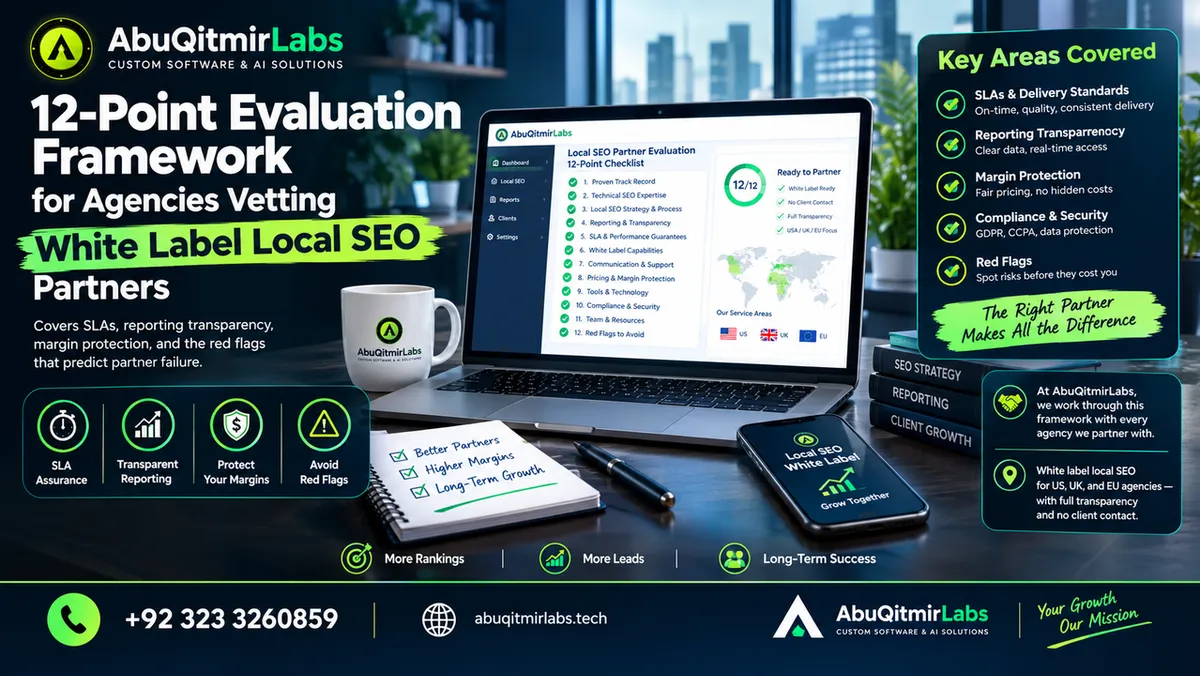
Quick Takeaways
- Most agencies discover white label local SEO quality problems after they've already promised results to a client — this guide shows you how to vet partners before signing
- The average reseller margin on white label local SEO runs 35–55%, but agencies that skip due diligence lose margin to rework, refunds, and churn
- A 12-point evaluation framework covering SLAs, reporting transparency, communication boundaries, and quality assurance
- Red flags that predict failure: no direct account manager, unclear reporting access, junior execution on senior-priced contracts
- AbuQitmirLabs, a Karachi-based studio, provides white label local SEO services for agencies across the US, UK, and EU — with full white-label reporting and no client contact
Introduction
Most agencies discover white label local SEO quality problems after they've already promised results to a client. This guide shows you how to vet partners before signing — with a 12-point evaluation framework, cost breakdowns, and the red flags that predict failure.
White label local SEO is one of the highest-margin services an agency can resell. It's also one of the highest-risk. When you put your brand on someone else's work, you inherit every quality gap, missed deadline, and reporting inconsistency.
The agencies that succeed with white label partnerships do one thing differently: they vet before they commit. Not after the first client complains.
This guide walks through the exact evaluation framework we recommend to agencies — whether they're vetting us or another partner. It covers pricing, red flags, SLAs, reporting, and the questions that separate a reliable white label partner from an expensive mistake.
The Problem: Why White Label SEO Partnerships Fail
White label local SEO partnerships fail for one reason: the agency discovers quality gaps too late.
Here's the typical pattern:
- An agency signs a white label partner on a low-commitment trial
- The first client gets delivered — results look fine
- The agency sells white label SEO to 5, 10, 20 more clients
- The partner's capacity strains — quality drops
- The agency discovers the drop when clients start churning
- Rebuilding trust costs more than the original margin was worth
Common Pain Points
- Quality control issues — junior execution on senior-priced contracts
- No client reporting visibility — the agency can't see what's being done
- Slow vendor delivery — SLA gaps that hurt client retention
- Pricing opacity — hidden fees, scope creep, unclear deliverables
- Bait-and-switch quality — impressive sales demo, junior execution
- Language/communication barriers — misaligned deliverables
- No SERP guarantee clarity — vague promises with no accountability
- Reseller margin crushed — rework and refunds eat profit
- Contract terms unclear — IP ownership, non-compete, termination
- Inconsistent results — some clients rank, others don't, no pattern
What Agencies Lose
An agency that sells white label local SEO to 20 clients at $500/month each generates $10,000/month in revenue. At a 45% margin, that's $4,500/month in gross profit.
If the white label partner fails on 20% of those clients — 4 clients churn, 2 demand refunds, 1 leaves a bad review — the agency loses:
- $2,400/month in recurring revenue from churned clients
- $2,000+ in refunds and rework costs
- Reputation damage that takes 6–12 months to recover
The margin calculation changes completely when quality isn't guaranteed.
Why This Problem Happens
Root Cause 1: Agencies Vet on Price, Not Process
The first question most agencies ask a white label partner is "What's your per-client rate?" The better question is "Show me your QA process." Price is easy to compare. Process quality isn't — until it fails.
Root Cause 2: Trial Periods Are Too Short
A 30-day white label trial doesn't reveal much. Local SEO results take 90–180 days to materialize. The quality problems show up in month 3, not month 1.
Root Cause 3: Reporting Is Treated as a Deliverable, Not a Transparency Requirement
Some white label partners provide "white-label reports" — but the agency can't see the underlying data. If you can't audit the work, you can't vouch for it.
Root Cause 4: No Direct Account Manager
The best white label partners assign a dedicated account manager to each agency. The worst assign a shared pool with no consistency. Without a direct contact, issues escalate slowly and inconsistently.
Common Misconceptions
| Misconception | Reality |
|---|---|
| "White label is just a cheap execution layer" | It's a service partnership — quality matters as much as price |
| "We can audit the work ourselves" | Most agencies don't have the technical depth to audit local SEO at scale |
| "Reporting is what matters" | Reporting is table stakes — what matters is underlying data access |
| "Any agency can white label SEO" | Only if they have client demand + margin discipline + vetting process |
The 12-Point Evaluation Framework
This is the framework. Work through it in order. If a partner fails on 3 or more points, walk away.
1. Request Live Client Examples
Ask for three live client URLs the partner manages. Run them through a local SEO audit. Check GBP completeness, citation consistency, review velocity, and on-page optimization. If the partner can't share examples, that's a red flag.
2. Verify Direct Account Manager Assignment
Ask: "Will we have a dedicated account manager, or a shared pool?" Dedicated is standard at top partners. Shared pools create accountability gaps.
3. Check Reporting Data Access
Ask: "Can we see the raw data behind white-label reports?" If the answer is "no," the partner controls the narrative. You need access to rankings, citation data, and GBP insights — not just polished PDFs.
4. Confirm No Direct Client Contact
Ask: "Will your team ever contact our clients directly?" The answer must be "no." If the partner contacts your clients, they can poach them — or confuse them. All communication flows through you.
5. Understand the SLA Structure
Ask: "What are your turnaround times for deliverables?" Get specific:
- GBP audit: within X days
- Citation building: within X days
- Content delivery: within X days
- Monthly reporting: by X of each month
Vague SLAs are no SLAs.
6. Review the Quality Assurance Process
Ask: "Who reviews the work before it's delivered?" Top partners have senior QA before every deliverable. Junior execution without QA is the most common quality failure.
7. Confirm Pricing Transparency
Ask for a full cost breakdown:
- Per-client monthly fee
- Setup fees (if any)
- Add-on pricing (content, citations, GBP optimization)
- Volume discounts
If pricing is vague, you'll discover hidden costs after signing.
8. Check Contract Terms
Key terms to verify:
- Term length: Month-to-month preferred; annual with exit clauses acceptable
- Termination: 30-day notice standard
- IP ownership: All work product transfers to you
- Non-compete: Limited scope, defined duration
- Data handling: Client data stays with you, not the partner
9. Request Margin Analysis
Ask: "What margin should we expect at 10 clients? At 50 clients?" A reliable partner will share realistic margin ranges — usually 35–55% depending on service tier.
10. Verify English Communication Quality
For US, UK, and EU agencies, English fluency is non-negotiable. Ask for a sample of written deliverables — reports, audit summaries, content drafts. Poor English kills client perception.
11. Check Reporting Customization
Ask: "Can reports be fully white-labeled?" Some partners apply their branding subtly. Others leave traces. Verify the reports are 100% your brand.
12. Confirm Exit Process
Ask: "What happens when we terminate?" You need:
- All data exported in a usable format
- Access to rankings, citations, and GBP history
- Confirmation of no client contact post-termination
- 30-day transition support
Clean exits matter as much as clean onboarding.
Cost: What White Label Local SEO Costs in 2026
The table below compares typical white label local SEO pricing tiers:
| Tier | Monthly Per-Client Fee | What's Included | Expected Reseller Margin |
|---|---|---|---|
| Basic | $150–$250 | GBP optimization, 10 citations, basic reporting | 45–55% |
| Standard | $250–$400 | GBP + 25 citations + 2 content pieces + reporting | 40–50% |
| Advanced | $400–$700 | Full local SEO stack + GBP posts + reviews + reporting | 35–45% |
| Enterprise | $700–$1,500+ | Multi-location, schema, advanced GBP, custom reporting | 30–40% |
Hidden Costs to Budget For
- Setup fees: $0–$500 per client (top partners waive)
- Add-on content: $75–$200 per piece
- Additional citations: $2–$5 per directory
- Rush fees: 15–30% premium for expedited delivery
- Reporting customization: $0–$100/month if custom dashboards required
What You Keep
At a $500/month client fee with a $300/month white label cost, the agency margin is $200/month per client — a 40% margin. At 20 clients, that's $4,000/month in gross profit from white label local SEO alone.
Comparison: White Label SEO vs In-House vs Freelance
| Factor | White Label Partner | In-House Team | Freelance |
|---|---|---|---|
| Monthly cost per client | $150–$700 | $1,500–$4,000 | $200–$800 |
| Scalability | High (add clients instantly) | Low (hire + train) | Medium (freelancer capacity) |
| Quality consistency | Depends on partner | High if managed well | Variable |
| Reporting | White-labeled | Custom | Manual |
| Margin | 35–55% | 10–30% | 20–40% |
| Risk | Partner quality failure | Hiring + retention risk | Reliability risk |
| Best for | Agencies scaling past 5 clients | Agencies with SEO expertise | Agencies with <5 clients |
Real-World Example: What "Good" Looks Like
Scenario: A UK-based digital marketing agency wanted to add local SEO to their service offering. They had 12 existing clients, but no in-house local SEO expertise.
What they did:
- Vetted 4 white label partners using the 12-point framework
- Chose a partner with dedicated account management and full reporting access
- Started with 3 clients on a trial basis
- Expanded to 12 clients over 4 months
Result:
- 40% margin on average across all clients
- Zero client churn in the first 12 months
- Client NPS improved by 22 points after adding local SEO to existing services
- Agency grew monthly revenue by $4,800 within 6 months
Key differentiator: The agency spent 3 weeks vetting partners before signing. That 3-week investment saved 12 months of client recovery.
Step-by-Step Implementation
- Document your requirements — What services will you resell? What's your target client profile?
- Build a shortlist — Find 4–6 white label partners using Clutch, GoodFirms, and industry referrals
- Run the 12-point evaluation — Score each partner on every point
- Request trial delivery — Ask for a paid trial on 1–2 clients before committing
- Review trial results — Full audit of trial output, reporting quality, SLA adherence
- Sign with clean contract terms — Month-to-month, clear termination, IP transfer
- Onboard your team — Train account managers on the partner's process
- Monitor monthly — Review SLAs, reporting quality, and client feedback
- Scale carefully — Add clients in batches, not all at once
- Annual re-evaluation — Re-run the 12-point framework every 12 months
Common Mistakes to Avoid
Mistake 1: Signing without a trial. A paid trial on 1–2 clients reveals more than any sales pitch. If a partner won't offer a trial, walk away.
Mistake 2: Not verifying reporting data access. White-labeled PDFs are easy to produce. Access to underlying rankings, citation data, and GBP insights is what matters.
Mistake 3: Overlooking account manager assignment. A shared pool means no accountability. Insist on a dedicated account manager.
Mistake 4: Accepting vague SLAs. "Within a few business days" is not an SLA. Get specific turnaround times in writing.
Mistake 5: Skipping the margin analysis. If you don't know your margin at 10 vs. 50 clients, you don't know your business model.
Mistake 6: Ignoring exit terms. The clean exit clause matters as much as the entry. Verify data export, post-termination contact, and 30-day transition support.
Frequently Asked Questions
What is white label local SEO?
White label local SEO is a service model where an agency resells local SEO services delivered by a third-party partner. The partner executes the work — GBP optimization, citation building, content, reporting — and the agency presents it under their own brand. The agency keeps the client relationship; the partner operates behind the scenes.
How much should an agency pay for white label local SEO?
White label local SEO costs $150–$700 per client per month, depending on scope. Basic packages ($150–$250) cover GBP optimization and citations. Standard packages ($250–$400) add content and GBP posts. Advanced packages ($400–$700) include full local SEO stacks and custom reporting.
What margin should an agency keep on white label SEO?
The typical reseller margin runs 35–55%, depending on the service tier and client pricing. Higher-margin tiers (Basic) give 45–55%. Lower-margin tiers (Enterprise) give 30–40%. At 20 clients on a Standard package, an agency can expect $4,000/month in gross profit.
How do I vet a white label local SEO partner?
Use the 12-point framework: request live client examples, verify direct account manager assignment, check reporting data access, confirm no direct client contact, understand the SLA structure, review QA process, confirm pricing transparency, check contract terms, request margin analysis, verify English communication quality, check reporting customization, and confirm exit process.
Will the white label partner contact my clients directly?
No — and this must be explicit in the contract. All communication should flow through you. If a partner contacts your clients directly, they can poach them or confuse them. Verify this in writing before signing.
Can white label SEO reports be fully customized?
Yes — at top partners, reports are 100% white-labeled with your logo, brand colors, and your domain. Some partners apply their branding subtly. Verify the report output during the trial phase before committing.
What red flags should I look for in a white label partner?
Red flags include: no dedicated account manager, no live client examples, unclear reporting access, vague SLAs, junior execution on senior-priced contracts, no trial availability, hidden pricing, unclear contract terms, and no clean exit process.
Can AbuQitmirLabs provide white label local SEO for agencies?
Yes. AbuQitmirLabs, a Karachi-based studio, provides white label local SEO services for agencies across the US, UK, and EU. The team provides dedicated account management, full reporting data access, and 100% white-labeled deliverables — with no direct client contact.
Conclusion
White label local SEO is one of the highest-margin services an agency can resell — and one of the highest-risk. The agencies that succeed are the ones that vet before they commit, using a structured evaluation framework instead of a price comparison.
The 12-point framework in this guide covers everything that matters: live examples, account management, reporting access, SLAs, QA process, contracts, margin analysis, communication quality, and exit terms. Work through it in order. If a partner fails on 3 or more points, walk away.
The three-week investment in vetting is the difference between a service line that scales profitably and one that drains margin through rework, refunds, and churn.
If you're an agency looking to add white label local SEO — whether you're vetting us or another partner — the framework works. Use it.
CTA
Ready to evaluate white label local SEO partners?
AbuQitmirLabs provides white label local SEO for agencies across the US, UK, and EU — with dedicated account management, full reporting access, and 100% white-labeled deliverables. No direct client contact. No hidden fees.
Explore our white label local SEO services →
Or chat with us on WhatsApp to discuss your agency's needs.