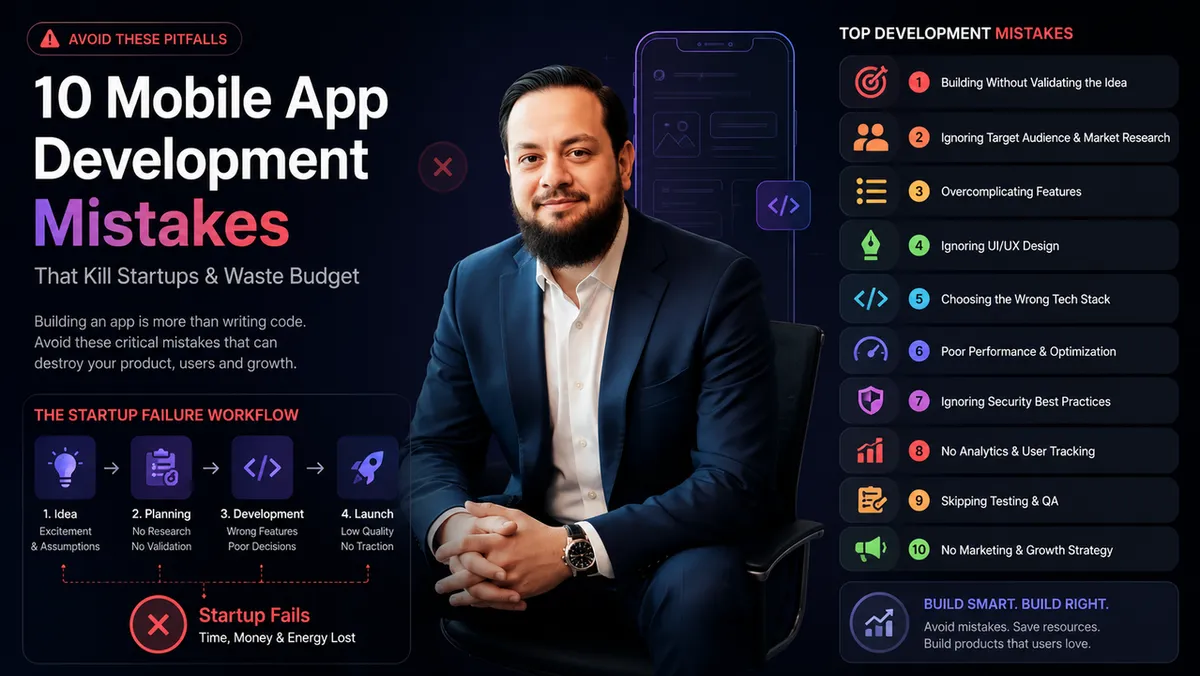
Common Mistakes Businesses Make When Building Mobile Apps (2026 Guide)
Most mobile apps do not fail because the idea is bad.
They fail because the execution is broken.
A business spends:
- months planning
- thousands of dollars developing
- endless hours discussing features
Then the app launches…
…and users disappear.
No retention. No engagement. No real growth.
This happens more often than most founders admit.
The biggest reason?
Businesses make avoidable mistakes during the app development process.
Some mistakes are technical. Others are strategic. Many are surprisingly simple.
I’ve seen startups:
- overbuild features nobody wanted
- ignore user experience completely
- launch without testing
- spend huge budgets before validating demand
And the painful part is that most of these problems could have been prevented early.
This guide breaks down:
- the biggest app development mistakes
- why mobile apps fail
- real startup problems
- how to avoid expensive errors
- practical workflows for better app launches
Whether you’re:
- a startup founder
- business owner
- SaaS creator
- agency owner
- product manager
this article will help you build smarter and avoid common app disasters.
High-Converting Article Formula
The strongest mobile app businesses rarely succeed by accident.
They usually follow a structured content + product workflow.
Best Article Production Workflow
Step 1 — Keyword Research
Focus on:
- low competition keywords
- buyer intent
- long-tail queries
Examples:
- app development mistakes
- startup app problems
- mobile app failures
- why startup apps fail
- common mobile app UX mistakes
Step 2 — Intent Mapping
Understand search intent:
- informational
- commercial
- transactional
Example:
- “why apps fail” → informational
- “hire mobile app agency” → commercial
Step 3 — Outline Creation
Use:
- H1
- H2
- H3 hierarchy
This improves:
- readability
- SEO structure
- AI indexing
Step 4 — Human Draft
Write naturally.
Use:
- practical examples
- real startup situations
- believable workflows
Avoid robotic content.
Step 5 — SEO Optimization
Add:
- semantic keywords
- internal links
- topic clusters
- FAQs
Step 6 — AI Optimization
Structure content for:
- Google SGE
- ChatGPT
- Perplexity
- AI summaries
Use:
- concise sections
- clear headings
- scannable formatting
Step 7 — Content Repurposing
Turn one article into:
- Twitter threads
- LinkedIn posts
- Facebook captions
- infographics
- Pinterest content
- YouTube scripts
Why Most Mobile Apps Fail
The app industry looks glamorous from the outside.
But behind the scenes, many apps quietly fail within months.
Common reasons include:
- poor planning
- weak UX
- no monetization strategy
- technical debt
- unrealistic expectations
Mistake #1 — Building Before Validating the Idea
This is one of the most expensive startup mistakes.
A founder gets excited and immediately starts development without validating demand.
Result:
- wasted budget
- poor retention
- low adoption
Better Approach
Before building:
- research competitors
- talk to real users
- test demand
- launch a lightweight MVP
Even simple landing pages can validate ideas early.
Mistake #2 — Ignoring User Experience (UX)
Many businesses obsess over features while ignoring usability.
But users rarely care how “advanced” an app is if:
- navigation feels confusing
- onboarding feels frustrating
- the interface feels cluttered
“Users don’t abandon apps because they lack features. They abandon apps because they feel difficult to use.”
Common UX Problems
❌ Too many screens
❌ Poor navigation
❌ Cluttered dashboards
❌ Confusing onboarding
❌ Slow interactions
Mistake #3 — Overbuilding the MVP
Founders often try to build:
- every feature
- every integration
- every possible workflow
before launch.
This creates:
- delays
- complexity
- higher costs
Smarter MVP Strategy
Launch with:
- core features only
- basic workflows
- clear value proposition
Then improve based on user feedback.
Mistake #4 — Choosing the Wrong Tech Stack
Technology decisions affect:
- scalability
- maintenance
- performance
- future upgrades
A bad stack creates long-term problems.
Common Technology Mistakes
❌ Overengineering
❌ Choosing trendy tools blindly
❌ Ignoring scalability
❌ Hiring inexperienced developers
Better Technology Strategy
Choose tools based on:
- business goals
- scalability needs
- budget
- launch speed
Mistake #5 — Weak App Performance
Users expect apps to feel fast.
Even small delays damage retention.
Performance Problems That Hurt Apps
❌ Slow loading
❌ Laggy animations
❌ App crashes
❌ Battery drain
❌ Poor optimization
Why Speed Matters So Much
Modern users compare every app against:
- TikTok
- Uber
If your app feels slow, users leave quickly.
Mistake #6 — No Clear Monetization Strategy
A surprising number of apps launch without a revenue plan.
That creates sustainability problems later.
Common Monetization Mistakes
❌ Too many ads
❌ Confusing subscriptions
❌ Weak pricing strategy
❌ No premium value
Better Monetization Planning
Decide early:
- subscriptions
- freemium models
- SaaS plans
- in-app purchases
- enterprise licensing
Mistake #7 — Ignoring App Security
Security problems destroy trust instantly.
Especially in:
- fintech apps
- healthcare apps
- SaaS platforms
Common Security Problems
❌ Weak authentication
❌ Poor API protection
❌ Storing sensitive data insecurely
❌ Missing encryption
Mistake #8 — Not Testing with Real Users
Internal testing is not enough.
Real users behave differently than development teams expect.
Why User Testing Matters
Users often:
- misunderstand flows
- ignore buttons
- abandon onboarding
- use features unexpectedly
Testing reveals friction early.
Mistake #9 — Poor Onboarding Experience
The first few minutes decide whether users stay.
Bad onboarding causes:
- uninstallations
- confusion
- drop-offs
Better Onboarding Principles
✅ Fast setup
✅ Minimal friction
✅ Immediate value
✅ Clear guidance
Mistake #10 — Designing for the Founder Instead of the User
This happens constantly.
Founders design apps around:
- personal preferences
instead of
- user behavior
Smart Product Thinking
Users care about:
- convenience
- simplicity
- speed
not founder ego.
Mistake #11 — No Retention Strategy
Downloads alone mean nothing.
Without retention:
- marketing costs rise
- growth slows
- monetization weakens
Retention Systems That Work
✅ Push notifications
✅ Personalization
✅ Habit loops
✅ Reward systems
✅ Smooth UX
Mistake #12 — Launching Without Analytics
Without analytics, businesses guess instead of learning.
Important Metrics to Track
✅ Retention rate
✅ Session time
✅ Crash reports
✅ Conversion rate
✅ User flows
Best Tools for App Analytics
Popular tools include:
- Firebase Analytics
- Mixpanel
- Amplitude
- Hotjar
Real-World Startup Example
A startup launched an AI productivity app with:
- advanced features
- polished branding
- expensive development
But retention was terrible.
The issue wasn’t technology.
It was complexity.
Users felt overwhelmed by:
- onboarding
- dashboard clutter
- confusing navigation
After simplifying the UX:
- retention improved
- engagement increased
- support tickets dropped
The biggest improvement came from removing unnecessary friction.
Why Simplicity Wins
Simple apps:
- retain users longer
- scale more easily
- monetize better
Complexity often kills momentum.
AI & Future Mobile App Challenges
AI-powered apps introduce new challenges:
- personalization complexity
- privacy concerns
- AI hallucinations
- overautomation
Businesses must balance:
- automation
with
- usability
Mobile App Trends Increasing Failure Rates
Ironically, modern trends sometimes hurt startups.
Examples:
- copying big tech blindly
- overusing animations
- AI overload
- feature bloat
Not every trend improves user experience.
How to Build Smarter Apps
Step 1 — Validate Demand
Talk to real users first.
Step 2 — Build Small
Start with core value only.
Step 3 — Prioritize UX
Reduce friction everywhere.
Step 4 — Track Analytics
Use data for decisions.
Step 5 — Improve Continuously
Apps evolve after launch.
🔗 Learn Mobile App Development Properly
Understanding the development process helps avoid expensive mistakes.
👉 Read this: https://abuqitmirlabs.tech/blog/mobile-app-development-guide-for-businesses-startups-2026
🔗 Improve Mobile App UI/UX
Retention problems often begin with weak UX design.
👉 Read this: https://abuqitmirlabs.tech/blog/mobile-app-ui-ux-design-guide-for-better-user-retention
🔗 Compare Native vs Hybrid Apps
Technology choices affect scalability and maintenance heavily.
👉 Read this: https://abuqitmirlabs.tech/blog/native-vs-hybrid-apps
🔗 Learn App Monetization Strategies
A great app still needs a sustainable business model.
👉 Read this: https://abuqitmirlabs.tech/blog/app-monetization-strategies
Final Thoughts
Most app failures are not mysterious.
They usually come from:
- rushing development
- ignoring UX
- skipping validation
- overcomplicating the product
The strongest apps focus relentlessly on:
- usability
- simplicity
- retention
- real-world value
Businesses that:
- validate ideas early
- prioritize user experience
- improve continuously
usually outperform businesses chasing hype alone.
The smartest mobile apps rarely feel overwhelming.
They feel natural.
FAQs
1. Why do most mobile apps fail?
Most fail due to poor planning, weak UX, lack of validation, and no retention strategy.
2. What is the biggest app development mistake?
Building too many features before validating real user demand.
3. How important is UI/UX for app success?
Extremely important. Poor UX destroys retention even if the app has strong features.
4. Should startups build MVPs first?
Yes. MVPs reduce risk and help validate ideas before scaling.
5. How can businesses improve app retention?
By simplifying UX, improving onboarding, personalizing experiences, and optimizing performance.
Related Engineering Resources
- Ready to turn these engineering principles into production software? Explore our custom web application development services or run a live diagnostic with our free technical website audit tool.