The Content Brief Template That Gets Writers 90% There | AbuQitmirLabs
Quick Takeaways
- A bad content brief is the number one reason articles miss the mark, require endless revisions, and fail to rank.
- You do not need to be a professional writer to create a great brief. You just need to be specific about your goals.
- A professional content brief template removes ambiguity and acts as the blueprint for your entire article.
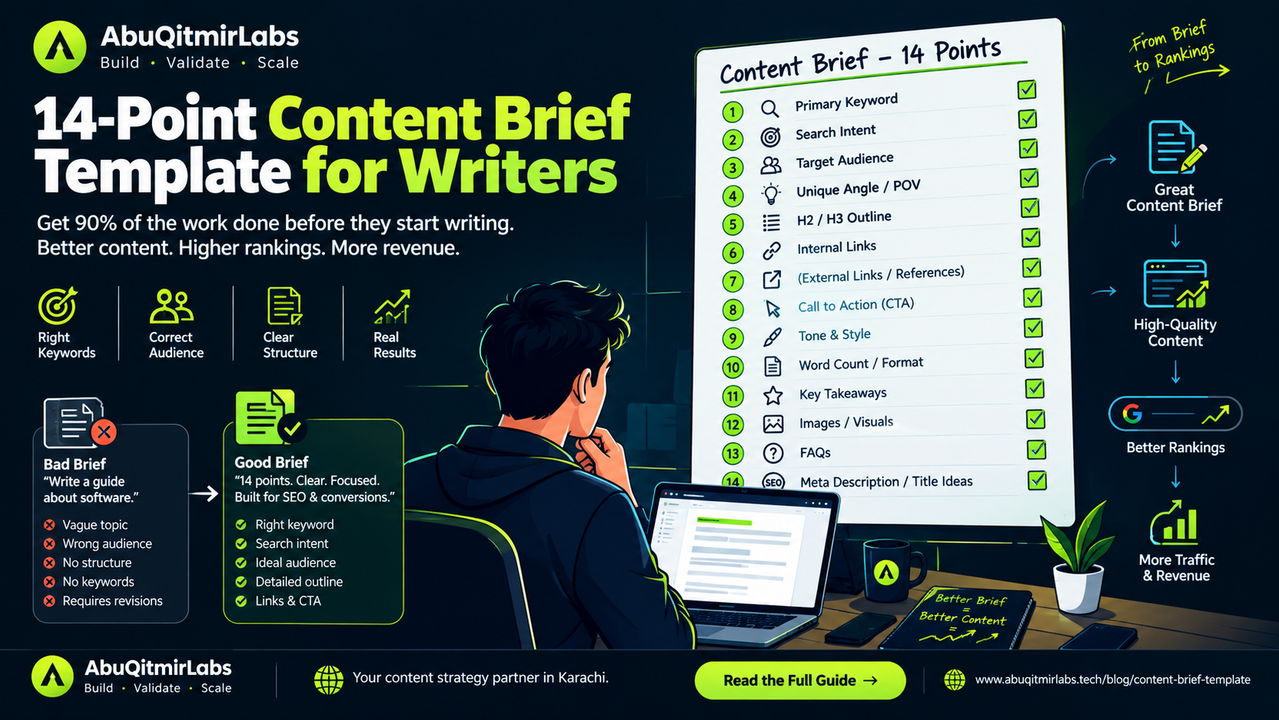
- Use the 14-point checklist below to ensure your writer hits the target on the first draft.
- AbuQitmirLabs engineers content strategies through our content writing services.
Table of Contents
- Quick Takeaways
- Introduction: The $200 "Rewrite This" Mistake
- The 14-Point Content Brief Template
- 1. Primary Keyword
- 2. Search Intent
- 3. Target Audience
- 4. Content Angle / Hook
- 5. H1 and Meta Description Drafts
- 6. The Outline (H2s and H3s)
- 7. Internal Links
- 8. External Sources / Citations
- 9. Target Word Count
- 10. Tone of Voice
- 11. Negative Constraints / Banned Words
- 12. The Call to Action (CTA)
- 13. Formatting Requirements
- 14. Deadline & Submission Process
- Downloadable Content Brief Template (Copy-Paste)
- The Content Brief: Good vs. Bad Examples
- Common Mistakes Founders Make When Writing Briefs
- Frequently Asked Questions
- Conclusion: Brief Better, Get Better Content
Introduction: The $200 "Rewrite This" Mistake
You hire a freelance writer. You tell them: "I need an article about custom software development. Make it 1,500 words and sound professional."
A week later, they send you a draft. It is technically correct, but it is completely wrong. It has no angle, no specific keywords, and no clear call to action. You ask them to rewrite it. They get frustrated, you get frustrated, and you waste $200.
The problem is not the writer's skill. The problem is the brief.
A content brief template is not a suggestion. It is the strategic blueprint for the article. When you brief a writer properly, you save time, save money on revisions, and get content that actually ranks and converts.
Here is the exact 14-point template we use at AbuQitmirLabs to get writers 90% of the way there before they even type a word.
The 14-Point Content Brief Template
1. Primary Keyword
Direct Answer: The exact word or phrase the article must rank for on search engines.
The Why: Every article must have one clear target. If you try to target multiple keywords, you will rank for none.
Actionable Tip: Provide the primary keyword and specify where it must appear (Title, H1, first 100 words, at least two H2s, and the conclusion).
2. Search Intent
Direct Answer: The underlying goal of the person searching for the keyword (Informational, Commercial, Transactional, or Navigational).
The Why: If you ask a writer for an "Informational" guide but the searcher's intent is "Transactional" (they want to buy something), the article will not rank. Google matches content to intent.
Actionable Tip: State the intent clearly. For example: "Intent: Informational. The reader wants to know how to build an MVP, not buy a SaaS tool."
3. Target Audience
Direct Answer: The specific demographic or psychographic group the article is written for.
The Why: An article written for non-technical founders will use different language than an article written for CTOs. You must define who is reading.
Actionable Tip: Be specific. Instead of "business owners," use "B2B SaaS founders generating under $1M ARR."
4. Content Angle / Hook
Direct Answer: The unique perspective, opinion, or data point that differentiates this article from everything else on page one.
The Why: In 2026, generic content is dead. Google's E-E-A-T guidelines reward unique insights. You must tell the writer why this article is different.
Actionable Tip: Give the writer a specific angle. Instead of "how to do SEO," say "Why technical SEO is dead for local businesses (and what to do instead)."
5. H1 and Meta Description Drafts
Direct Answer: A working title (H1) and meta description (under 160 characters) that align with the search intent.
The Why: This gives the writer a north star. It anchors the article and ensures the final draft fits the SEO strategy.
Actionable Tip: Provide 2-3 options for the H1 so the writer has flexibility, but lock in the meta description.
6. The Outline (H2s and H3s)
Direct Answer: The structural roadmap of the article, dictating exactly what sub-topics need to be covered.
The Why: This prevents the writer from going off on a tangent. It also guarantees that you cover the "People Also Ask" (PAA) questions that Google cares about.
Actionable Tip: List the exact H2 and H3 headings you want the writer to follow. They can expand on them, but they must hit every point.
7. Internal Links
Direct Answer: Specific URLs from your website that the writer must link to using descriptive anchor text.
The Why: Internal linking passes PageRank and builds topical authority. As we discuss in our guide on Semantic SEO Strategy, interlinked content is 30% more likely to rank than isolated pages.
Actionable Tip: Provide the URL and the exact anchor text to use. For example: Link to /custom-software using the anchor text "custom software development services."
8. External Sources / Citations
Direct Answer: Authoritative third-party sources the writer should reference to build trust.
The Why: Google's E-E-A-T requires you to cite authoritative sources. Citing industry reports, government sites, or peer-reviewed studies builds trust signals.
Actionable Tip: Suggest 2-3 specific sources. For example: Reference the 2026 Gartner report on AI agents and enterprise automation and peer-reviewed benchmark datasets (note: subscription required for full research PDFs; cite public executive summaries where appropriate).
9. Target Word Count
Direct Answer: The minimum and maximum word count for the article.
The Why: Word count sets expectations. A 500-word article will not cover a complex topic deeply enough for SEO, while a 5,000-word article might overwhelm a simple query.
Actionable Tip: Give a range. For example: "Target 1,500 to 2,000 words."
10. Tone of Voice
Direct Answer: The emotional resonance and style the article should convey (e.g., authoritative, conversational, technical).
The Why: If your brand is playful and the writer sounds like a textbook, the content will feel off-brand. This connects directly to our brand building guidelines.
Actionable Tip: Provide a link to your brand's tone-of-voice guide and list 3 words that describe the desired tone.
11. Negative Constraints / Banned Words
Direct Answer: Words, phrases, or competitor names that the writer must strictly avoid.
The Why: Protect your brand. If you do not want to be compared to a specific competitor, or you hate the word "cheap," the writer needs to know.
Actionable Tip: List any banned terms (e.g., "cheap," "freelancer," "guaranteed results").
12. The Call to Action (CTA)
Direct Answer: The single, clear next step the reader should take at the end of the article.
The Why: Every piece of content needs a goal. If the reader finishes the article and doesn't know what to do next, the article failed its conversion goal.
Actionable Tip: Specify the exact CTA text and link. For example: "End with a CTA to 'Book a Free Consultation' pointing to /contact."
13. Formatting Requirements
Direct Answer: Specific instructions for bullet points, tables, images, or bold text.
The Why: AI engines and human readers scan content. Bullet points, tables, and short paragraphs (2-4 sentences) make the content readable and extractable.
Actionable Tip: Require at least 2 tables or bulleted lists. Ask for short, punchy paragraphs.
14. Deadline & Submission Process
Direct Answer: The exact date the first draft is due and how it should be delivered.
The Why: Clear deadlines prevent project creep and keep your content calendar on track.
Actionable Tip: State the due date and format (e.g., "Submit via Google Docs by Friday at 5 PM").
Downloadable Content Brief Template (Copy-Paste)
To make implementation instantaneous for your editorial pipeline, download the clean markdown template or copy the ready-to-fill text below directly into your workspace:
- Direct Download: 📥 Download Blank Content Brief Template (.md)
- Google Docs / Notion / Asana: Copy and paste the template code below directly into your assignment card:
# [Article Title / Working H1]

## Core Project Parameters
- Primary Keyword: [e.g., custom software development]
- Secondary Keywords: [e.g., bespoke software agency, enterprise engineering]
- Search Intent: [Informational / Commercial / Transactional]
- Target Persona: [e.g., Non-technical Series A founders with 10-50 employees]
- Word Count Range: [e.g., 1,800 – 2,200 words]
- Delivery Deadline: [e.g., Friday, October 30, 2026 at 5:00 PM EST]
- Delivery Channel: [Google Docs URL / Notion Page / Markdown File]

## Positioning & Guardrails
- Core Thesis / Angle: [What is the contrarian or unique perspective?]
- Editorial Tone: [e.g., Technical, concise, no fluff, direct]
- Excluded / Banned Terms: [List prohibited buzzwords or competitor names]

## Structural Outline
- H2: [Section 1 Title]
  - Direct answer summary (2-3 sentences for GEO/AI citations)
  - Key points and practical implementation
- H2: [Section 2 Title]
  - H3: [Sub-concept]
  - Structured comparison table / actionable checklist
- H2: Frequently Asked Questions
  - 3-5 core user query answers

## Links & Citations
- Required Internal Links:
  - Link to https://www.abuqitmirlabs.tech/[service] using anchor "[exact anchor]"
- External Reference Citations:
  - Cite at least 2 authoritative sources (e.g., Gartner 2026, IEEE, official docs)

## Call to Action
- Primary CTA: [e.g., Schedule a Technical Consultation pointing to /contact]
The Content Brief: Good vs. Bad Examples
| Brief Section | Bad Brief (Vague) | Good Brief (Specific) |
|---|---|---|
| Primary Keyword | "AI automation" | "AI agent development for fintech" |
| Search Intent | "Just write a guide." | "Informational. The reader wants to know the cost and timeline of building an AI agent." |
| Angle | "Make it unique." | "Focus on the regulatory challenges (PCI DSS) of AI agents in banking." |
| Outline | "Cover everything about AI." | "H2: What is an AI agent? H2: Cost breakdown. H2: Compliance risks. H3: 3 mistakes to avoid." |
| CTA | "Link to our website." | "End with a CTA to 'Request a Free Audit' pointing to /contact." |
Common Mistakes Founders Make When Writing Briefs
Mistake 1: Assuming the Writer is a Mind Reader
If you do not tell the writer the target audience, the angle, and the intent, they will guess. And they will usually guess wrong.
Mistake 2: Forgetting Internal Links
Writers do not know your website architecture. If you do not provide internal links in the brief, they will either not link at all or link to irrelevant pages.
Mistake 3: Over-Optimizing for Keywords
If you stuff the brief with 20 keywords to hit, the writer will produce unreadable garbage. Focus on one primary keyword and 2-3 secondary variations.
Mistake 4: Ignoring AI Search (GEO/AEO)
If you don't ask the writer to include direct answers under H3 headings, your article will fail to get cited by AI engines. The brief must explicitly ask for structured data and clear, quotable sentences.
Mistake 5: Not Defining the Tone
If you don't tell the writer to be "confident and direct," they might write "corporate and boring." The tone dictates whether the audience connects with the content.
Frequently Asked Questions
What is a content brief template?
A content brief template is a structured document that outlines the exact requirements for a piece of content. It includes the target keyword, search intent, audience, outline, internal links, tone, and CTA.
How long should a content brief be?
A content brief should be detailed enough to guide the writer, but not so long that it becomes a burden to read. A well-structured 1 to 2-page brief with bullet points is usually sufficient.
Do I need a content brief for every article?
Yes. Even if you are writing the article yourself, a brief acts as your strategic roadmap. It prevents you from straying off-topic and ensures you hit your SEO goals.
Should I write the outline, or should the writer?
You should provide a rough outline (H2s and H3s) to ensure the article covers the topics that matter to your business. The writer can expand on it, but the skeleton should come from you.
How do I provide feedback on a draft?
Use the brief as your scorecard. If the draft misses a section from the brief, ask the writer to add it. If the tone is off, point back to the tone section of the brief.
Can I use AI to write content briefs?
Yes, AI can help you generate the initial outline or suggest keywords. However, you must review it. AI will often miss the unique angle, the internal linking strategy, and the exact business CTA.
What is the most important part of a content brief?
The "Search Intent" and the "Angle." If you get the intent wrong, the article will not rank. If you get the angle wrong, the article will be boring and ignored.
How does AbuQitmirLabs help with content strategy?
AbuQitmirLabs builds content engines through our content writing services. We handle the keyword research, the brief creation, the writing, and the distribution. Explore our SEO mastery guide to understand how we tie briefs to rankings, and our digital marketing services to see how we distribute the final assets.
Conclusion: Brief Better, Get Better Content
A great writer cannot save a bad brief. But a great brief can turn an average writer into a brand asset.
By using this 14-point checklist, you eliminate the guesswork. You save money on revisions, you rank higher on Google, and you get content that actually drives revenue.
If you need help auditing your current content strategy or building a scalable content engine, contact AbuQitmirLabs for a technical consultation.
If you are ready to deploy your content, make sure it looks as good as it reads. Review our graphics design services to ensure your brand assets match the quality of your writing. And if you are trying to decide what kind of content to write next, read our guide on SEO Content vs Thought Leadership to choose the right strategy.
Stop writing into the void. Start with a better brief.

Abu Qitmir Mohammad Shiraz Al-Madani
Founder & Lead Systems Architect at AbuQitmirLabs. Specializing in high-performance digital ecosystems, AI-driven architectures, and building scalable full-stack software systems.