Summary Box
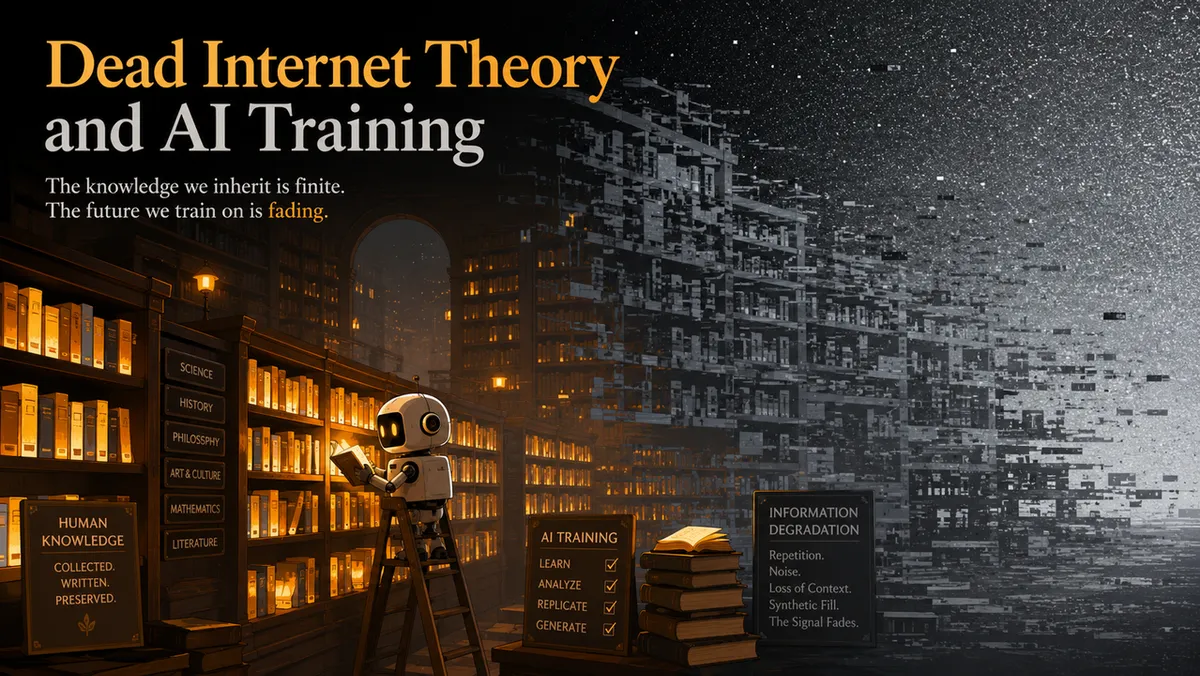
🤖 Summary: This guide explains Dead Internet Theory in the context of AI training — the observable decline of authentic human-generated content online, why experts and businesses have stopped sharing knowledge publicly, and what this means for the quality of AI systems trained on that shrinking supply. It connects directly to model collapse and explains why the practical response for businesses is building private, knowledge-grounded AI rather than depending on generic training data. AbuQitmirLabs helps businesses digitize and protect their institutional knowledge through AI agent development. Read time: approximately 10 minutes.
Table of Contents
- Introduction
- What Dead Internet Theory Actually Means
- Why Experts Stopped Sharing Knowledge Online
- The Result: A Quieter, More Generic Internet
- What Used to Be on the Internet — and What Replaced It
- Why This Matters for AI Training
- The Vicious Cycle
- Where the Real Knowledge Actually Lives Now
- Who Wins When the Internet Goes Quiet
- A Rough Timeline of the Decline
- Is the Internet Actually Dead?
- What Could Reverse This
- What Businesses Can Do Right Now
- Frequently Asked Questions
- Final Thoughts
Excerpt
Somewhere between 2018 and today, a large share of the internet's most useful content quietly stopped being written. Not because people stopped having knowledge worth sharing — but because the incentives to share it publicly broke down. What replaced that knowledge is a flood of generic, aggregated, and increasingly AI-generated content. This matters far beyond the quality of your search results. Every major AI model is trained on what's publicly available online, and a training corpus with less authentic human expertise in it produces AI systems that know less than they appear to.
Quote
"The internet did not die from lack of content. It died from a lack of the specific kind of content — hard-won, specific, occasionally uncomfortable — that experts have learned to stop giving away for free." — AbuQitmir Mohammad Shiraz Al-Madani
Key Highlights
- Dead Internet Theory, in the context of AI, describes the measurable decline in authentic human-generated content published to the open web, and its replacement with generic, aggregated, and increasingly AI-generated material
- Experts and businesses have reduced public knowledge sharing for identifiable reasons — fear of being copied, the sense that unpaid effort deserves protection, corporate policies that treat operational knowledge as a trade secret, and the decline of the platforms that used to host this kind of writing
- The specific kind of content disappearing — failure stories, edge cases, contested expert opinions, and hard-won operational detail — is exactly the kind of content that made older AI training data valuable
- This creates a self-reinforcing cycle: less authentic content leads to more generic AI outputs, which gives remaining experts even less incentive to publish, which further reduces the supply of authentic content for the next generation of models
- The knowledge that once might have been published is not gone — it has moved into private company wikis, internal chat tools, and the heads of experienced staff, where AI systems trained on public internet data have no access to it
- Businesses that digitize this private knowledge and connect it to a controlled AI system gain a compounding advantage over competitors depending on generic AI trained on an increasingly thin public corpus
- This is directly connected to model collapse — a declining supply of authentic content is one of the structural reasons AI-generated content increasingly fills the gap in training data
Introduction
Ask anyone who has been reading the same corners of the internet for the last decade whether it feels different now, and most will say yes before you finish the question. The forums are quieter. The blog posts that used to walk through a real failure in detail are harder to find. Search results increasingly return content that reads like it was assembled rather than written.
This observation has a name: Dead Internet Theory. The term originated as a fringe idea suggesting most internet activity is now bots talking to bots. The literal version of that claim is exaggerated. But the underlying observation — that authentic human participation in public internet spaces has measurably declined, and that generic, aggregated, and AI-generated content has filled the resulting gap — is not fringe at all. It is a documented shift with a clear cause and a specific, serious consequence for anyone relying on AI trained on that content.
The consequence is this: AI models learn from what's publicly available. If what's publicly available contains a shrinking proportion of genuine expertise and a growing proportion of generic filler, the models trained on it inherit that shift — not as a sudden failure, but as a quiet narrowing of what they actually know.
This guide explains why experts stopped sharing what they know, what filled the silence, and what it means for anyone depending on AI systems trained on the public internet.
What Dead Internet Theory Actually Means
Stripped of its more conspiratorial framing, Dead Internet Theory describes a real and measurable pattern: the proportion of authentic, effortful, human-written content on the public internet has been declining relative to the proportion of generic, templated, aggregated, and AI-generated content.
This is not a claim that the internet is empty. Traffic, posting volume, and total content published are all near all-time highs. The claim is narrower and more specific — that the useful fraction of that content, the fraction written by someone with genuine hard-won knowledge and no strong incentive to hide it, is shrinking as a share of the total, even as the total volume grows.
For most casual internet use, this shift is annoying but manageable — you scroll past more filler to find what you actually need. For AI training, it is structural, because AI models don't distinguish signal from noise the way an experienced human reader does. A training corpus with a shrinking proportion of genuine expertise produces a model with a shrinking proportion of genuine expertise embedded in it, spread thin across an ocean of the generic content that increasingly surrounds it.
True advice
Built to solve: Recognizing that your organization's internal knowledge has become more valuable as the public internet thins out is the first step. Turning it into something an AI system can actually use is the second — that's the specific problem AI agent development is built to solve.
Why Experts Stopped Sharing Knowledge Online
The decline in authentic content did not happen randomly. It happened because the specific incentives that used to encourage experts to write in public broke down, for several identifiable reasons.
Fear of Being Copied
The most common reason, in practice, is a belief that sharing a hard-won method online just hands it to competitors for free. This is a version of zero-sum thinking about knowledge — the assumption that what you know is valuable specifically because others don't know it, and that publishing it destroys that value. Whether or not this belief is accurate for a given field, it is widely held, and it directly reduces what gets written down.
Effort Justification
A related but distinct reason: people who spent years acquiring a specific skill or piece of domain knowledge often feel that giving it away in a five-minute blog post cheapens the effort it took to learn. This is a psychological pattern, not a business calculation, but it has the same effect — it keeps knowledge private that would otherwise have been published.
Corporate Knowledge-Hoarding
At an organizational level, the instinct to label internal knowledge "proprietary" or "trade secret" has expanded well beyond genuinely sensitive information. Standard operating knowledge that would have been openly discussed on a professional forum a decade ago is now more often treated as a competitive asset to be protected rather than shared — a form of knowledge hoarding that is common in business, even where the actual competitive risk of sharing is low.
The Decline of the Platforms That Used to Host This Content
Even experts willing to share have fewer good places to do it. Long-form community platforms have consolidated, closed, or drifted toward lower-quality content optimized for engagement rather than usefulness. Content that used to live in open forums has migrated into private, unindexed communities — Discord servers, Slack groups, paid newsletters — that AI training pipelines and search engines alike cannot see.
AI Anxiety Specifically
A newer and increasingly common reason is a direct reaction to AI itself: a sense that anything published publicly will simply be scraped and absorbed by AI systems without credit or compensation, so why bother. This creates a self-fulfilling loop — the fear that AI will consume public knowledge without giving anything back becomes a reason to stop publishing, which further shrinks the supply of authentic knowledge available for AI to learn from in the first place.
The Result: A Quieter, More Generic Internet
The combined effect of these pressures is observable in ordinary browsing, not just in academic analysis. Fewer detailed blog posts documenting a specific failure and what was learned from it. Fewer long, argumentative forum threads where practitioners disagree about the right approach to a problem. Fewer personal accounts of a project that didn't work and why. More aggregated listicles. More templated "ultimate guide" content optimized for search rankings rather than usefulness. More AI-generated filler produced to capture search traffic rather than to inform anyone.
None of this content is fake in the sense of being false. Most of it is technically accurate. It is simply generic — assembled from the statistical average of what's already been said, rather than written from direct, specific experience.
What Used to Be on the Internet — and What Replaced It
It's worth being specific about what has actually been lost, because the value of internet content was never evenly distributed.
What used to be more common: detailed accounts from people who had actually done the work, including the parts where it went wrong. Domain-specific knowledge written by someone with years of direct experience, including caveats and edge cases that only show up after real practice. Genuine disagreement between practitioners about the right way to do something, with reasoning on both sides. Context — the specific constraints (budget, team, timeline, regulation) that shaped why a decision was made, not just what the decision was.
What has become more common in its place: content written to rank in search results rather than to inform. Aggregated summaries of other aggregated summaries. Advice stripped of the context that would make it actually useful for a specific situation. Confident-sounding general guidance that avoids the nuance and disagreement that made the original expert knowledge valuable in the first place.
Why This Matters for AI Training
Every major commercial AI model learns its knowledge of the world from text collected largely from the public internet. This means the shift described above is not a cultural curiosity — it is a direct input into the quality of the AI systems businesses are increasingly depending on.
Models trained on internet data absorb whatever proportion of genuine expertise versus generic filler exists in that data. As the genuine proportion shrinks, models have progressively less authentic signal to learn the nuanced, specific, edge-case knowledge that separates real expertise from generic competence. What remains easy for models to learn is exactly the kind of content that has become more abundant — the generic, aggregated, statistically-average material that dominates a shrinking-signal internet.
This is one of the structural mechanisms behind model collapse — the well-documented pattern in which AI systems trained on progressively more AI-generated and less authentically human content degrade in quality across generations. A quieter, more generic internet is not just a symptom of that problem. It is one of its causes.
The Vicious Cycle
These dynamics reinforce each other in a loop that is worth naming explicitly, because understanding the loop is the first step to interrupting it.
Experts reduce public sharing for the reasons already described. The internet's authentic-content supply shrinks as a result. AI models trained on that shrinking supply produce more generic, less specific outputs. Remaining experts see AI-generated content flooding the space where their expertise used to live, and interpret this as further reason to stay quiet — why compete with an ocean of AI-generated noise, or feed a system that will just repackage what you say without attribution. The cycle repeats, and each iteration starts from a thinner base of authentic content than the one before it.
Breaking this cycle requires either a change in the incentives that discourage sharing, or a shift toward knowledge systems that don't depend on the public internet at all.
Where the Real Knowledge Actually Lives Now
The expertise that used to end up in public blog posts and forum threads has not disappeared. It has moved.
It lives in the heads of experienced staff who have never been asked to write it down. It lives in internal company wikis that are never indexed by search engines. It lives in years of Slack or Teams conversations where a specific problem was solved, buried in a channel nobody will ever search through systematically. It lives in the informal mentorship relationships where a senior employee explains to a junior one why the textbook answer doesn't actually work in this specific business, in this specific market, with this specific set of constraints.
None of this is accessible to a generic AI model trained on public internet data, no matter how capable that model becomes. The knowledge is real, valuable, and completely invisible to any system that only knows what's publicly published.
Who Wins When the Internet Goes Quiet
The businesses positioned to benefit from this shift are not the ones with access to the best generic AI model — every competitor has access to the same generic models. The businesses positioned to benefit are the ones that recognize their own internal knowledge has become a relatively more valuable asset precisely because it's no longer being given away for free on the public internet, and who build systems to actually use it.
This is the practical case for AI agent development built on a business's own private knowledge base rather than on generic training data alone — an approach generally described as retrieval-augmented generation, where an AI system retrieves from a controlled, authenticated set of internal documents before generating a response, rather than relying solely on what a generic model absorbed from an increasingly thin public internet.
Companies that digitize what their experienced staff know — including the failures, the edge cases, and the reasoning behind non-obvious decisions — are building an asset that compounds. Companies that don't are depending entirely on a public data supply that is measurably thinning.
A Rough Timeline of the Decline
The shift described in this guide did not happen overnight, and it is useful to see it as a gradual trend rather than a single event.
Through the mid-2010s, the open internet still carried a large and growing supply of detailed, expert-written content across blogs, forums, and community platforms. Beginning around 2018, several of the platforms that hosted this content began to decline in quality or shift toward more closed, algorithm-driven models that favored engagement over depth. By the early 2020s, the reduction in expert public writing had become noticeable to regular internet users, even before generative AI content became widespread. From roughly 2023 onward, the flood of AI-generated content compounded the existing decline, filling search results and social feeds with material that looks similar to genuine expert writing at a glance but carries little of its actual specificity. The current period represents something close to a structural turning point — the proportion of genuinely authentic content in what's newly published is now a clear minority in many domains.
Is the Internet Actually Dead?
No — and it's worth being precise here, because overstating the claim undermines the parts of it that are accurate and important.
The internet is not empty. It is not run entirely by bots. Genuine human expertise is still being published — just at a lower rate, relative to total content volume, than it used to be. The specific claim worth taking seriously is narrower: the kind of content most valuable for both human learning and AI training — specific, contested, hard-won, occasionally uncomfortable expert knowledge — has become a smaller share of what's newly published, while generic, templated, and AI-generated material has become a larger share. That specific shift is well-supported by observable evidence, even if the more dramatic "the internet is dead" framing is not.
What Could Reverse This
None of these forces are permanent laws of nature. Several changes could shift the trend.
Making sharing worth something again. Mechanisms that compensate experts for knowledge that gets used to train commercial AI systems would directly address the core incentive problem — right now, the person who does the work of writing something useful gets none of the value that AI companies extract from it.
Building better places to share. Some of the decline is simply a platform problem. Communities and formats designed specifically to reward depth and specificity, rather than engagement and virality, could pull some of this content back into public view.
Changing how organizations think about internal knowledge. The evidence from open-source software and academic research is that sharing knowledge tends to increase its value rather than dilute it, through faster problem-solving, wider adoption, and reputation building. Most corporate knowledge policies still operate as though the opposite were true.
Requiring AI systems to give something back. Policy approaches that require AI systems to attribute or compensate the sources their outputs are built on would reduce the specific anxiety that currently discourages experts from sharing.
None of these changes are close to happening at scale in the near term. That's the reason this guide spends more time on what businesses can do for themselves than on waiting for a broader fix.
What Businesses Can Do Right Now
The practical response for any organization does not depend on reversing a global trend. It depends on recognizing that the same forces reducing the value of public AI training data are increasing the relative value of an organization's own internal knowledge — and acting on that recognition before competitors do.
Start documenting what your experienced staff know, deliberately and specifically — not just process manuals, but the reasoning behind decisions, the failures and what was learned from them, and the edge cases that don't fit the standard playbook. This is the raw material that a generic AI model will never have access to.
Build a system that can actually use that knowledge. Documentation that sits in a folder nobody searches is not meaningfully different from knowledge that was never written down. A retrieval-based AI system connected to that knowledge base is what turns documentation into a working asset.
Treat this as infrastructure, not a one-time project. The value compounds the longer an organization maintains and expands its internal knowledge base, in the same way the public internet's value compounded over the years it was actively growing.
Don't wait for the public data problem to resolve itself. The trends described in this guide are structural, not temporary. An organization's competitive position increasingly depends on what it knows that a generic AI model trained on the public internet does not.
Frequently Asked Questions
What is Dead Internet Theory in simple terms?
Dead Internet Theory, in its most defensible form, describes the observable decline in the proportion of authentic, human-written content on the public internet relative to generic, aggregated, and AI-generated content. It does not mean the internet is literally empty or bot-run — it means the useful signal within it has become harder to find.
Why did experts stop sharing their knowledge online?
The most common reasons are fear that sharing a method helps competitors, a sense that hard-won knowledge shouldn't be given away for free, corporate policies that treat internal knowledge as proprietary by default, the decline of the platforms that used to host detailed expert writing, and increasing anxiety that anything published will simply be absorbed by AI systems without credit.
How does Dead Internet Theory connect to AI quality?
AI models are trained largely on public internet text. As the proportion of authentic, specific, expert-written content in that text declines, models have less genuine signal to learn from — a structural contributor to the broader pattern known as model collapse.
Is all AI-generated content on the internet a problem?
Not inherently — AI-generated content that is accurate and useful has real value. The concern is specifically about the ratio: as AI-generated content becomes a larger share of what's newly published, and authentic expert content becomes a smaller share, future AI models trained on that mix inherit progressively less genuine, specific knowledge.
Where does real expertise actually exist if it's not being published online?
Increasingly in private company systems — internal wikis, chat history, documented decisions, and the direct knowledge of experienced staff who have never been asked to write it down publicly. This knowledge is real and valuable but invisible to any AI system trained only on public internet data.
What can a business do about this?
The most direct response is digitizing internal knowledge — including failures, edge cases, and the reasoning behind decisions — and connecting it to a retrieval-based AI system built specifically for the organization, rather than depending entirely on generic AI trained on a thinning public data supply.
Can this trend be reversed?
Potentially, through mechanisms that compensate experts for shared knowledge, platforms designed to reward depth over engagement, a broader shift in how organizations value internal knowledge sharing, and policy requiring AI systems to attribute or compensate their sources. None of these are close to happening at scale, which is why the more immediate response is organizational rather than systemic.
Final Thoughts
The internet did not run out of things to say. It ran out of people willing to say the specific, hard-won, occasionally inconvenient things that made it valuable in the first place — and the reasons for that are understandable, even rational, from the perspective of the individuals and organizations making that choice.
The consequence is a public data supply that is thinner than it looks, and AI systems trained on it that know less than they sound like they know. For any business depending on generic AI for anything requiring real, specific expertise, this is not an abstract cultural observation. It is a direct input into the quality of the tools that business is relying on.
The response available to any individual organization does not require waiting for the broader trend to reverse. It requires recognizing that what an organization already knows — documented properly and connected to a system that can actually use it — has become a more valuable and more differentiating asset precisely because the public internet has become a less reliable place to find it.
If your organization has real institutional knowledge that has never been captured in a form an AI system could use, AbuQitmirLabs helps businesses turn that knowledge into a working, retrieval-based AI system — built on what your team actually knows, not on what's left of the public internet.
True advice: If your organization has real institutional knowledge that has never been captured in a form an AI system could use, AbuQitmirLabs helps businesses turn that knowledge into a working, retrieval-based AI system — built on what your team actually knows, not on what's left of the public internet.