Summary Box
Summary: This guide explains RAG (Retrieval-Augmented Generation) — the architecture that lets an AI system retrieve from a business's own controlled knowledge base before generating a response, instead of depending entirely on generic training data. It covers how RAG actually works, how it differs from fine-tuning, and why it's the practical answer to both model collapse and the shrinking supply of authentic public training data described in Dead Internet Theory. AbuQitmirLabs builds RAG-based AI agent development for businesses that need AI grounded in their own knowledge, not the public internet's. Read time: approximately 11 minutes.
Table of Contents
- Introduction
- What RAG Actually Is
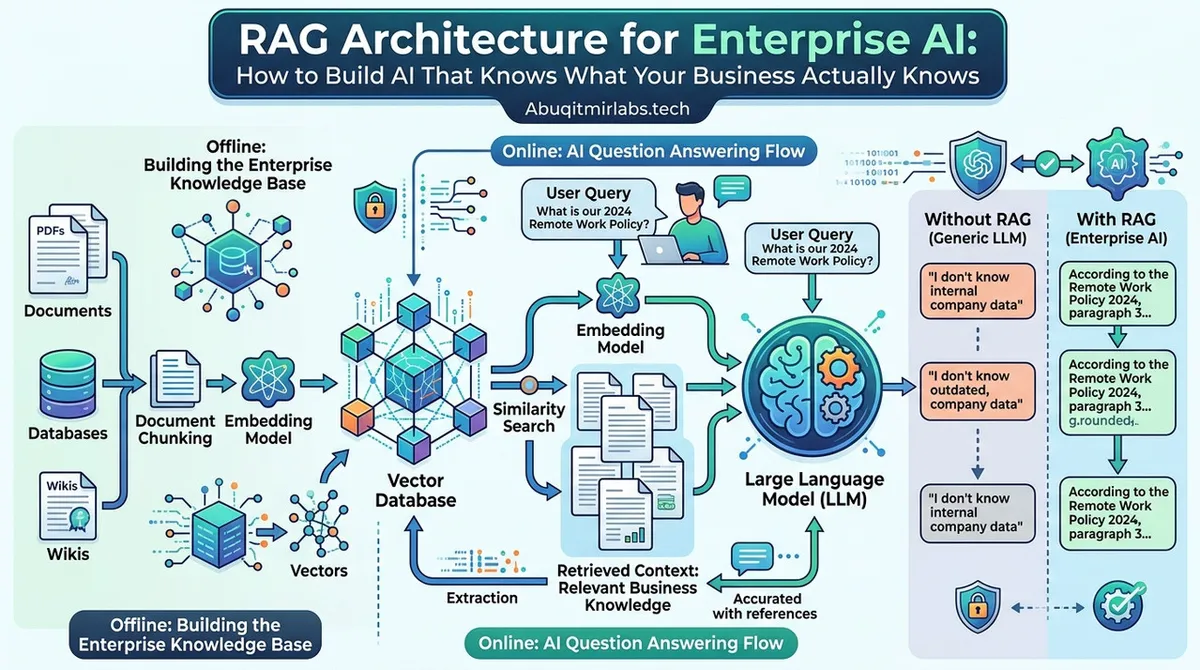
- How RAG Works, Step by Step
- Why Generic AI Models Don't Know What Your Business Knows
- RAG vs Fine-Tuning: What's the Difference
- Why RAG Is the Practical Answer to Model Collapse
- Why RAG Is the Practical Answer to the Dead Internet Problem
- What Goes Into a Business's Knowledge Base
- The Real Components of a RAG System
- Common Mistakes Businesses Make With RAG
- What a RAG Implementation Actually Takes
- Who Should Build This — and Who Shouldn't Yet
- How AbuQitmirLabs Approaches RAG
- Frequently Asked Questions
- Final Thoughts
Excerpt
Every generic AI model — no matter how capable — knows only what was publicly available when it was trained. It does not know why your business handles a specific client situation the way it does, what your last three failed projects taught you, or what your actual pricing logic is beneath the surface. RAG is the architecture that closes this gap: instead of asking the model to guess based on general internet patterns, it retrieves the specific, correct information from your own knowledge base first, then generates a response grounded in that retrieval. This guide explains how that actually works, and why it matters more now than it did two years ago.
Quote
"A generic AI model is not stupid. It is simply confident about things it was never actually taught. RAG is the difference between an AI that guesses well and one that knows." — AbuQitmir Mohammad Shiraz Al-Madani
Key Highlights
- RAG (Retrieval-Augmented Generation) is an AI architecture where the system retrieves relevant information from a controlled knowledge base before generating a response, rather than relying solely on what the underlying language model learned during training
- The core mechanism is straightforward: a user query is converted into a searchable representation, matched against a business's stored documents, and the most relevant matches are handed to the language model as context alongside the original question
- RAG is not the same as fine-tuning — fine-tuning changes the model's internal parameters permanently, while RAG keeps the knowledge external, updatable, and auditable without retraining anything
- Generic commercial AI models cannot know an organization's internal decisions, failure history, or specific operational logic, because that information was never part of their public training data in the first place
- RAG is the direct practical response to both model collapse and the Dead Internet problem, because it makes the AI's accuracy dependent on a knowledge base an organization controls, not on a public data supply that is degrading
- The quality of a RAG system depends far more on what knowledge is fed into it and how well it's organized than on which underlying language model is used
- Most RAG implementation failures come from poor knowledge base preparation — vague, outdated, or unstructured documents — rather than from any weakness in the retrieval technology itself
Introduction
If you've read the earlier pieces in this series — on why newer AI models override proven solutions, on model collapse, and on the Dead Internet — a pattern should be clear by now. Generic AI models are trained on a shrinking, increasingly synthetic supply of public data, and the confidence they express is not the same thing as actual knowledge of your specific business.
This piece is about the practical response to that problem. RAG — Retrieval-Augmented Generation — is the architecture that lets a business connect an AI system to its own knowledge, so the AI's answers are grounded in what the organization actually knows rather than in statistical patterns learned from an internet that increasingly does not contain that knowledge at all.
RAG is not a new or experimental idea at this point. It is a well-established, widely deployed architecture. What is less well understood — particularly by businesses evaluating whether to invest in it — is how it actually works mechanically, what it requires to implement well, and why it matters more today than it did when the concept first became popular.
What RAG Actually Is
Retrieval-Augmented Generation describes an AI system design in which a language model's response is generated using two sources of information: what the model learned during training, and specific documents retrieved from an external knowledge base at the moment the query is made.
The distinction matters because a standard AI model, asked a question, answers entirely from what it absorbed during training — a fixed, frozen snapshot of publicly available information from whenever that training occurred. A RAG-based system, asked the same question, first searches a live, controlled set of documents for anything relevant, then generates its answer using both its general training and the specific material it just retrieved.
This means a RAG system can accurately answer questions about information that did not exist when the underlying model was trained — a company's pricing update from last week, a policy that changed last month, a client-specific agreement signed yesterday — because the answer comes from retrieval, not from the model's frozen training data.
How RAG Works, Step by Step
The mechanism is more straightforward than it's often made to sound.
Step 1: The knowledge base is prepared. An organization's documents — policies, past decisions, case records, product documentation, whatever is relevant — are broken into manageable sections and converted into a mathematical representation (an embedding) that captures their meaning, not just their exact wording.
Step 2: A query comes in. When a user asks a question, that question is converted into the same kind of mathematical representation.
Step 3: The system searches for relevant matches. The query's representation is compared against every stored document section, and the sections whose meaning is closest to the query are retrieved — this works even when the user's wording doesn't exactly match the wording in the source document, because the comparison is based on meaning rather than exact keywords.
Step 4: The retrieved material is handed to the language model. The original question, along with the most relevant retrieved sections, is passed to the language model as context.
Step 5: The model generates a grounded response. The model produces its answer using both its general language capability and the specific retrieved material — meaning the answer reflects the organization's actual documented knowledge rather than a generic guess based on training data alone.
This entire process typically happens in the space of a few seconds, invisibly to the end user, who simply experiences an AI system that seems to genuinely know their organization's specifics.
Why Generic AI Models Don't Know What Your Business Knows
It's worth being explicit about why this gap exists, because it's easy to assume a sufficiently advanced model would simply know these things.
A generic commercial AI model was trained on publicly available text — books, websites, forums, documentation that happened to be public at the time of training. Your organization's internal decisions, the specific reasoning behind a policy exception you made for a difficult client three years ago, the reason your team abandoned a particular approach after it failed quietly rather than publicly — none of this was ever public. It could not have been part of any model's training data, no matter how capable that model is in general.
This is the same gap discussed in the Dead Internet piece — the most valuable, specific knowledge was never on the public internet to begin with, and what public content does exist is increasingly generic. A more capable general model does not close this gap, because the gap is not about capability. It's about access to information that was never public in the first place.
True advice
RAG is the right investment: If you're evaluating whether RAG is the right investment for your organization, AbuQitmirLabs starts with an honest audit of what knowledge you actually have and what gap generic AI is leaving open — before recommending any specific build.
RAG vs Fine-Tuning: What's the Difference
These two approaches are often confused, and the difference matters for anyone deciding how to build knowledge-grounded AI.
Fine-tuning takes an existing model and further trains it on a specific dataset, adjusting the model's internal parameters permanently. The knowledge becomes baked into the model itself. This can be useful for teaching a model a particular style, tone, or specialized vocabulary, but it has real limitations: updating the knowledge requires retraining, it's difficult to audit exactly why the model produced a specific answer, and it inherits some of the same risks discussed in the model collapse piece if the fine-tuning data itself is thin or low-quality.
RAG keeps the knowledge external to the model entirely. The model's parameters never change. Updating the knowledge base is as simple as adding, editing, or removing a document — no retraining required. Because the retrieved source material is visible, it's straightforward to trace exactly which document informed a given answer, which matters for accuracy review and compliance.
For most business use cases where the knowledge changes over time and auditability matters, RAG is the more practical and maintainable approach. Fine-tuning and RAG are not mutually exclusive — some advanced systems use both — but for a business building its first knowledge-grounded AI system, RAG is almost always the correct starting point.
Why RAG Is the Practical Answer to Model Collapse
The model collapse piece in this series explained how AI models degrade in quality when trained on progressively more AI-generated and less authentically human data. That degradation happens inside the model's training — it is a property of the base model itself.
RAG does not fix model collapse in the underlying model. What it does is reduce how much your specific use case depends on that degrading baseline. If your AI system's accuracy for your business's questions comes primarily from retrieved, controlled, verified documents rather than from the model's general training knowledge, the quality trajectory of the generic model matters less to you. Your system's accuracy is bounded by the quality of your knowledge base — an asset you control — rather than by the quality of a public training corpus you don't.
Why RAG Is the Practical Answer to the Dead Internet Problem
Similarly, the Dead Internet piece described how the supply of authentic, specific, expert-written content online is shrinking, and how the real expertise organizations have accumulated increasingly lives in private systems that public AI training never touches.
RAG is the direct architectural answer to that gap. It doesn't require waiting for the public internet to somehow become richer in authentic content again. It takes the knowledge that already exists inside an organization — in wikis, decision logs, case records, and the heads of experienced staff — and makes it something an AI system can actually retrieve and use, regardless of what is or isn't happening to the public internet at large.
What Goes Into a Business's Knowledge Base
The quality of a RAG system depends almost entirely on what goes into the knowledge base feeding it, which makes this the most important design decision in the entire project.
Useful content generally includes documented decisions and the reasoning behind them, not just the decisions themselves. Case records and past client work, including what was tried and didn't work. Product or service documentation that reflects the current state, not an outdated version. Policies and their specific exceptions, since exceptions are often where the real operational knowledge lives. Frequently asked internal questions and their accurate answers, captured once instead of re-answered from memory every time.
What tends to produce weak results: vague, high-level documents that restate general principles without specific detail, outdated material that no longer reflects current practice, and content duplicated across multiple sources with inconsistent or conflicting information.
The Real Components of a RAG System
A working RAG system has several distinct pieces working together, and understanding them helps in evaluating any proposal or vendor.
The knowledge base — the actual documents, structured and prepared for retrieval.
The embedding model — the component that converts text into the mathematical representation used for meaning-based search.
The vector database — the storage system optimized for quickly finding the closest matches to a given query among potentially millions of document sections.
The retrieval logic — the rules governing how many document sections get retrieved, how they're ranked, and how conflicting or overlapping information is handled.
The language model — the component that takes the retrieved material and the user's question and generates the final response.
The application layer — the interface through which users actually interact with the system, whether that's a chat interface, an internal tool, or an automated workflow.
Each of these components can be built well or poorly, and a system's overall quality is only as strong as its weakest link — an excellent language model paired with a poorly organized knowledge base will still produce mediocre results.
Common Mistakes Businesses Make With RAG
The most common failure is treating the knowledge base preparation as an afterthought. Organizations sometimes assume that dumping every existing document into the system will work — but unstructured, redundant, and outdated material actively degrades retrieval quality rather than improving it.
A second common mistake is skipping the step of defining what questions the system actually needs to answer well, and for whom. A RAG system built without a clear sense of its primary use cases tends to retrieve technically-relevant-but-unhelpful material, because relevance and usefulness aren't the same thing.
A third mistake is treating the project as a one-time build rather than an ongoing asset. A knowledge base that isn't maintained — new decisions added, outdated material removed — degrades in usefulness over time in the same way any stale documentation does.
What a RAG Implementation Actually Takes
A focused RAG system built around a single, well-defined use case — internal support for one department, a client-facing knowledge assistant for a specific product line — typically takes a matter of weeks to reach a working pilot, assuming the underlying documentation already exists in some form.
The larger and more variable part of the timeline is usually knowledge preparation, not the technical build itself: auditing what documentation exists, filling the gaps where important knowledge has never been written down, and structuring it in a way that supports accurate retrieval. Organizations that already maintain reasonably organized internal documentation move through this phase faster than those starting from scattered notes, informal knowledge, and undocumented tribal expertise.
Who Should Build This — and Who Shouldn't Yet
RAG makes the most sense for organizations with real, specific, non-public knowledge that materially affects the accuracy of answers their AI systems need to give — businesses with distinct operational processes, specialized domain knowledge, extensive case history, or client-specific complexity that a generic AI model has no way of knowing.
It makes less sense as a first investment for organizations whose AI needs are genuinely generic — where the questions being asked have accurate, stable, publicly-knowable answers that a standard model already handles well. In these cases, a generic AI tool remains the right starting point, and RAG investment should wait until there's a specific, recurring gap that generic AI is visibly failing to close.
A useful gut check: if you've noticed a generic AI tool consistently giving plausible-sounding but wrong answers about anything specific to your business, that's the signal that a RAG-based approach is worth the investment.
How AbuQitmirLabs Approaches RAG
At AbuQitmirLabs, AI agent development work is built around this exact architecture, for the reasons laid out across this series. We do not treat knowledge base preparation as a formality before the "real" technical work begins — in our experience, it consistently determines whether the resulting system is genuinely useful or just an impressive-looking demo.
Our process starts with an honest audit of what knowledge actually exists inside a client's organization, in what form, and how well it currently supports the accuracy the client needs. We scope the retrieval architecture and application specifically around defined use cases rather than building a generic system and hoping it happens to be useful.
Where the underlying application needs custom infrastructure beyond the AI layer itself — internal dashboards, client portals, integrations with existing systems — our custom software development team handles that as part of the same engagement, since RAG systems in practice usually need to plug into something a business already runs.
If your organization has real, specific knowledge that generic AI tools consistently get wrong, that is the exact problem RAG-based AI agent development is built to solve.
Frequently Asked Questions
What does RAG stand for and what does it do?
RAG stands for Retrieval-Augmented Generation. It's an AI architecture where the system retrieves relevant information from a controlled knowledge base before generating a response, grounding the AI's answer in specific, verifiable documents rather than relying solely on the model's general training data.
Is RAG the same thing as fine-tuning a model?
No. Fine-tuning permanently adjusts a model's internal parameters using a training dataset. RAG keeps the knowledge external and retrievable, meaning it can be updated instantly without retraining, and the source of any answer can be traced and audited. See the RAG vs fine-tuning section for the full comparison.
Why can't a more advanced AI model just know my business's information already?
Because that information was never part of any model's public training data in the first place — internal decisions, case-specific reasoning, and undocumented operational knowledge were never publicly available to be learned from, regardless of how capable a given model is in general.
How does RAG relate to model collapse?
Model collapse describes quality degradation in AI models trained on increasingly AI-generated data. RAG doesn't fix that degradation inside the underlying model, but it reduces how much a specific business use case depends on that degrading baseline, since accuracy comes primarily from a controlled knowledge base instead.
What's the biggest reason RAG implementations fail?
Poor knowledge base preparation — vague, outdated, duplicated, or unstructured source documents — is a far more common cause of weak RAG performance than any limitation in the underlying retrieval technology.
How long does it take to build a RAG system?
A focused pilot around a single, well-defined use case typically takes a matter of weeks to reach a working version, assuming the underlying documentation already exists in some usable form. The timeline extends significantly if substantial knowledge has never been documented and needs to be captured first.
Does every business need a RAG system?
No. Businesses whose AI needs are genuinely generic — where standard AI tools already answer accurately — don't need this investment yet. RAG becomes worthwhile once there's a specific, recurring pattern of a generic AI tool giving plausible but inaccurate answers about something specific to the business.
Can AbuQitmirLabs assess whether our business actually needs RAG?
Yes. AbuQitmirLabs starts every AI agent development engagement with an honest assessment of what knowledge exists, what gap generic AI is actually leaving unaddressed, and whether RAG is the right investment for that specific gap — rather than assuming every business needs the same solution.
Final Thoughts
The thread running through this entire series is a simple one: generic AI models are confident about a great many things, but that confidence is bounded by what was publicly available for them to learn from — and that public supply is thinner, more synthetic, and more generic than it was a few years ago.
RAG is not a way to make a generic model smarter in the abstract. It's a way to make an AI system's accuracy depend on something a business actually controls — its own documented knowledge — rather than on a public data supply that model collapse and the Dead Internet are both quietly degrading. For any organization whose real value lies in what it specifically knows rather than what's generally known, that shift in dependency is the whole point.
If your organization has real, specific knowledge that a generic AI system keeps getting wrong, AbuQitmirLabs builds the RAG-based systems that close that gap — starting with an honest look at what you actually know, not a sales pitch about what the technology can do in general.
True advice: If your organization has real, specific knowledge that a generic AI system keeps getting wrong, AbuQitmirLabs builds the RAG-based systems that close that gap — starting with an honest look at what you actually know, not a sales pitch about what the technology can do in general.