Summary Box
RAG (Retrieval-Augmented Generation) combines large language models with your business data to provide more accurate, context-aware, and up-to-date responses. Businesses use RAG systems for AI chatbots, customer support, automation, internal knowledge systems, and personalized customer experiences.
Key Highlights
- RAG combines AI models with real business knowledge
- RAG reduces AI hallucinations significantly
- Businesses can use their own data securely
- Customer support becomes faster and smarter
- AI systems become more accurate and personalized
- RAG supports scalable automation systems
- Knowledge retrieval improves decision making
- Businesses can create intelligent assistants
- RAG works across websites, apps, and SaaS platforms
- AI experiences become more useful for customers
Introduction
Many businesses want AI.
But most businesses do not actually need an AI that simply generates text.
They need an AI system that understands:
- their products
- their services
- their documents
- their customers
- their internal knowledge
Traditional AI systems sometimes create answers that sound correct but may contain inaccurate information.
This becomes risky for:
- customer support
- healthcare
- education
- SaaS platforms
- legal systems
- internal business workflows
That is where RAG enters.
Retrieval-Augmented Generation allows AI to retrieve information from your own business knowledge before creating responses.
Instead of guessing, AI becomes more informed.
What Is RAG?
RAG stands for:
Retrieval-Augmented Generation
It combines two major processes:
Retrieval
The system searches relevant information from:
- PDFs
- databases
- websites
- knowledge bases
- internal documents
- FAQs
- product data
Generation
The AI model then uses retrieved information to generate an answer.
Instead of depending entirely on pre-trained knowledge, AI receives real business context first.
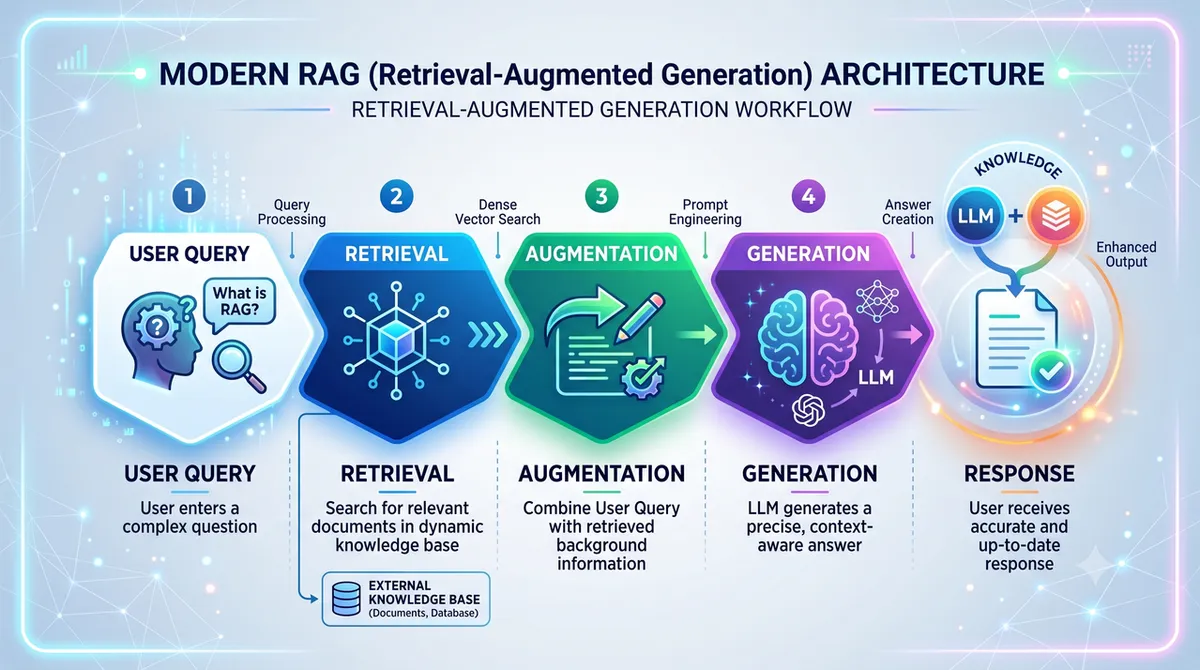
How RAG Works
Step 1 — Business Data Collection
Information sources may include:
- websites
- support documentation
- CRM systems
- FAQs
- PDFs
- databases
- APIs
Step 2 — Data Processing
The system converts information into searchable formats.
Often this includes:
- embeddings
- vector databases
- indexing systems
Step 3 — Information Retrieval
When users ask questions:
The AI retrieves the most relevant information.
Step 4 — Response Generation
The AI combines retrieved information with language understanding and creates contextual responses.
Why Businesses Need RAG in 2026
Better Accuracy
Traditional AI sometimes invents information.
RAG helps reduce this issue by retrieving actual business data before responding. AI systems connected with relevant knowledge sources generally provide more context-aware answers.
Personalized Customer Experiences
Businesses increasingly want AI assistants that understand:
- products
- pricing
- services
- customer history
- internal processes
Faster Customer Support
AI assistants powered by RAG can answer questions instantly.
Examples:
- order tracking
- onboarding support
- FAQs
- documentation assistance
Business Automation
AI systems can automate repetitive workflows:
- lead qualification
- customer support
- document search
- internal processes
- reporting
Real Business Example: AI-Powered Quran Learning Experience
One practical example of RAG implementation can be seen in a client project where an AI-based Quran learning experience was integrated into:
👉 https://www.tajweedpage.com/ai
The purpose of the implementation was to create a system capable of understanding platform-specific learning content and helping users receive more contextual responses related to Quran learning and Tajweed guidance.
Rather than functioning as a generic chatbot, the objective of a RAG-powered approach is allowing AI to retrieve relevant information before generating responses.
This type of approach can be useful across many industries:
- education
- healthcare
- SaaS
- customer support
- eCommerce
- business automation
Where Businesses Use RAG Systems
Customer Support Systems
Examples:
- AI support agents
- help desks
- knowledge assistants
SaaS Platforms
Examples:
- onboarding assistants
- internal search
- smart recommendations
Healthcare
Examples:
- medical document search
- internal knowledge systems
Education
Examples:
- AI tutors
- personalized learning assistants
Enterprise Systems
Examples:
- internal documentation
- HR assistants
- employee support
Common Mistakes Businesses Make with AI
Using Generic Chatbots
Many businesses install basic chatbots that know nothing about:
- products
- services
- internal workflows
Ignoring Data Quality
AI quality often depends heavily on knowledge quality.
Poor information leads to poor outputs.
Building Without Scalability
AI systems should support future growth.
Scalable systems often include:
- APIs
- databases
- automation workflows
- cloud infrastructure
Internal Resources
Custom Software
👉 https://abuqitmirlabs.tech/custom-software
Businesses often integrate RAG into larger software ecosystems.
Mobile App Development
👉 https://abuqitmirlabs.tech/mobile-app-development
RAG systems increasingly appear inside mobile applications.
Business Automation (Internal Resources)
👉 https://abuqitmirlabs.tech/business-automation
Automation workflows become more powerful with AI retrieval systems.
React Development Services
👉 https://abuqitmirlabs.tech/react-development
Next.js Development Services
👉 https://abuqitmirlabs.tech/nextjs-development
SaaS Development
👉 https://abuqitmirlabs.tech/saas-development
Pillar Page — Custom Web Development Service
👉 https://abuqitmirlabs.tech/web-development
Featured Signals
Businesses evaluating AI systems typically focus on:
- data security
- scalability
- response accuracy
- long-term maintenance
- user experience
- business workflows
Strong AI systems often depend more on data architecture than on models alone.
Featured Answer
What is RAG and why do businesses use it?
RAG (Retrieval-Augmented Generation) is an AI architecture that retrieves information from business knowledge sources before generating responses. Businesses use RAG to improve AI accuracy, reduce hallucinations, automate support, and create personalized customer experiences.
Related Engineering Resources
- For engineering teams deploying production workflows, explore our blueprint on custom AI agent development and enterprise RAG architecture and our AI automation solutions.
FAQ
What does RAG stand for?
RAG stands for Retrieval-Augmented Generation.
It combines information retrieval systems with AI language models to generate more accurate responses.
Why is RAG better than a normal chatbot?
Traditional chatbots often rely on fixed responses or pre-trained knowledge.
RAG systems can:
- retrieve live information
- understand business data
- provide more accurate answers
Can RAG reduce AI hallucinations?
Yes.
Because the AI retrieves relevant information before generating responses, RAG can reduce incorrect or fabricated answers.
Which businesses benefit from RAG?
Industries commonly using RAG include:
- SaaS
- education
- healthcare
- customer support
- eCommerce
- finance
Can RAG work with websites?
Yes.
RAG systems can integrate with:
- websites
- mobile applications
- SaaS platforms
- CRM systems
- internal dashboards
QUOTE
"AI becomes significantly more useful when it stops guessing and starts understanding your business knowledge."
Need a custom AI assistant, RAG system, or business automation platform?
AbuQitmir Labs builds scalable AI solutions, custom software, and intelligent automation systems designed around your business workflows.
🚀 Book your free consultation today. +923233260859