Summary Box
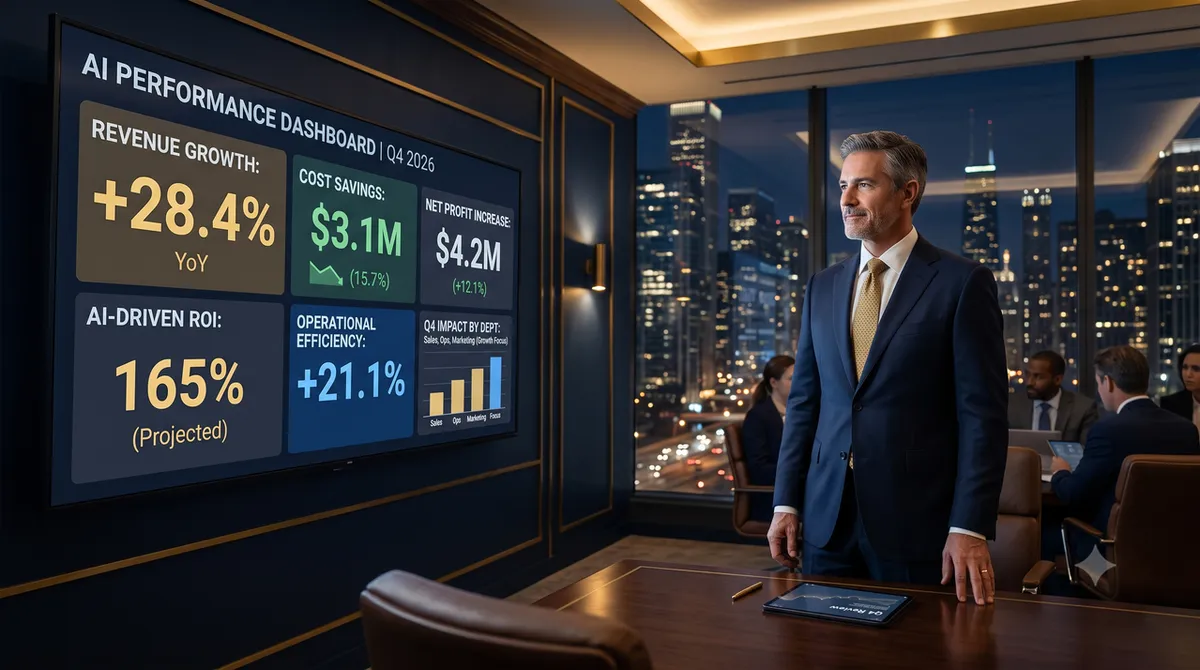
For the past two years, enterprise AI success was measured in consumption. Companies celebrated how many employees used AI tools, how many queries were run, and how many tokens flowed through their systems. That era is ending. In 2026, a fundamental shift is underway: from "token-maxxing" — consuming as much AI as the budget allows — to "value-maxxing," where all AI spend is expected to justify itself in business outcomes. This guide explains why this shift is happening, what it means for enterprise leaders, and how to build an accountability framework for AI that actually delivers ROI. AbuQitmirLabs helps businesses implement AI strategies that focus on measurable outcomes, not just consumption. Read time: approximately 8 minutes.
Excerpt
Enterprise AI has a new report card — and this time, it's not grading token volume. For two years, companies measured AI success by adoption metrics: how many employees used the tools, how many queries were run, how many tokens flowed through the systems. "Token" became a corporate vanity metric, a proxy for being AI-forward. That era is ending. In conversations with founders and operators, a clear shift has emerged: enterprises are moving from "token-maxxing" — consuming as much AI as the budget allows — to "value-maxxing," where every dollar of AI spend must justify itself in business outcomes. This is the accountability era of enterprise AI.
Pull Quote
"Cost per token was never the question; it was the cost per completed task — and ultimately, per business outcome." — AbuQitmir Mohammad Shiraz Al-Madani
🔑 Key Highlights
- For two years, enterprise AI success was measured by consumption metrics — tokens, queries, and user adoption — rather than business outcomes
- The Jevons paradox is now playing out in AI: cheaper tokens don't reduce spend; they unlock new consumption, as reasoning models, autonomous agents, and ballooning context windows drive usage explosion
- AI spending is migrating from "innovation budgets" to "operating budgets," where the CFO demands measurable returns rather than experimental learning
- Enterprise AI leaders are shifting from "token-maxxing" to "value-maxxing" — where all AI spend must justify itself in business outcomes
- Three disciplines define value-maxxing: workload tiering, cost-per-task measurement, and linking AI spend directly to business KPIs
- Gartner predicts worldwide end-user spending on AI models and platforms will reach $64 billion in 2026, up 63.4% from 2025 — but scrutiny on ROI has never been higher
- Organizations that treat model selection like a portfolio manager treats capital allocation — deploying expensive assets only where their marginal return justifies the cost — will win the accountability era
Introduction
For the past two years, enterprise AI success has been measured in consumption. Companies celebrated how many employees used AI tools, how many queries were run, and how many tokens flowed through their systems. "Token" became a sort of corporate vanity metric, a proxy for being AI-forward.
That era is ending.
In conversations with founders and operators, a clear shift has emerged in how enterprises think about intelligence: from what is colloquially referred to as "token-maxxing" — consuming as much AI as the budget allows — to "value-maxxing," where all AI spend is expected to justify itself in business outcomes.
This isn't a subtle shift. It's a fundamental reorientation of how enterprises evaluate, deploy, and scale AI. Understanding why this shift is happening, and what disciplines it demands, may be the most important issue technology leaders face in 2026.
The numbers tell the story. Gartner predicts worldwide end-user spending on AI models and platforms will reach $64 billion in 2026, up 63.4% from the $39 billion recorded in 2025. Spending on generative AI models is forecast to grow 117% this year. But as one Gartner analyst put it: "Enterprise AI budgets are coming under greater scrutiny, with increased focus on usage efficiency, cost control and measurable outcomes".
The party isn't over, but the industry is starting to sober up.
The Token Paradox
Here is the puzzle that triggered the change: The price of AI computation has fallen since 2022. What cost a dollar not long ago can now cost pennies. By the logic of pure procurement, AI bills should be shrinking.
But instead, for many organizations, they are rising.
The industry is new, but the explanation may be an old one. In the 19th century, economist William Stanley Jevons argued that when coal-powered engines became more efficient, coal consumption would rise rather than fall, because the new efficiency would encourage more and more use. AI is now living through its own Jevons moment. Cheaper tokens do not reduce spend — they instead unleash new consumption.
Modern reasoning models "think" in long, internal chains, consuming far more compute than their predecessors. Autonomous agents make dozens of calls to complete a single task. Context windows have ballooned, so each request carries more data. The unit price fell, but the number of units exploded.
This is the moment many leadership teams discover that they have been managing the wrong number. Cost per token was never the question; it was the cost per completed task — and ultimately, per business outcome.
The Budget Migration
There is a second force at work, and it's organizational rather than technical. In the experimentation era, AI lived in the "innovation" budget, where learning and adoption were the success metrics. As AI systems take on real operational work, the spend migrates to the operating budget, and the operating budget answers to the CFO.
That migration changes how intelligence is evaluated. Innovation budgets ask, "Are we keeping up?" Operating budgets ask, "What did we get for this?"
This is the fundamental tension of the accountability era. As AI becomes embedded in core operations — moving from pilots to production — the question is no longer whether you're using AI, but whether the AI you're using is actually delivering value.
KPMG data shows that 88 percent of organisations are already embedding AI agents into their workflows, products and value streams. The focus in 2026 has shifted from celebrating AI's potential to deploying it as critical infrastructure for business transformation.
The Disciplines of Value-Maxxing
What does value-maxxing look like in practice? It rests on three principles.
1. Workload Tiering
Not every task needs a frontier model. A customer inquiry triage, a document classification, or routine data extraction can often run on smaller, cheaper models, while the most complex judgment calls are routed to the most capable models. The organizations that get this right will treat model selection the way a portfolio manager treats capital allocation: the expensive asset is deployed only where its marginal return justifies the cost.
This is where domain-specific language models (DSLMs) and specialized models enter the picture. Gartner expects DSLMs to grow 210% in 2026. As one industry observer put it: "CIOs and CEOs are demanding more business value from AI, but generic large language models (LLMs) often fall short for specialised tasks. Domain-specific language models fill this gap with higher accuracy, lower costs, and better compliance".
2. Cost-Per-Task Measurement
Cost per token is the wrong metric. Cost per completed task is the right one. This requires a fundamental shift in how organizations measure AI performance — from volume to value, from consumption to completion.
3. Linking AI Spend to Business KPIs
Every dollar of AI spend must be traceable to a business outcome. This is the discipline that separates the accountability era from the experimentation era. It demands new tools, new dashboards, and new conversations between technology leaders and the CFO.
From Hype to Infrastructure
The shift from token-maxxing to value-maxxing reflects a broader transition: AI is moving from hype to infrastructure.
As one analysis put it: "If 2025 was the year AI got a vibe check, 2026 will be the year the tech gets practical. The focus is already shifting away from building ever-larger language models and toward the harder work of making AI usable".
The experts see 2026 as a year of transition, "one that evolves from brute-force scaling to researching new architectures, from flashy demos to targeted deployments, and from agents that promise autonomy to ones that actually augment how people work".
This pragmatism extends to how enterprises think about AI models themselves. "Fine-tuned SLMs will be the big trend and become a staple used by mature AI enterprises in 2026, as the cost and performance advantages will drive usage over out-of-the-box LLMs," said Andy Markus, AT&T's chief data officer. "We've already seen businesses increasingly rely on SLMs because, if fine-tuned properly, they match the larger, generalized models in accuracy for enterprise business applications, and are superb in terms of cost and speed".
Measurable Value
The accountability era demands a new approach to AI strategy — one that measures business outcomes, not just consumption. If your organization is still tracking tokens instead of ROI, it's time to rethink your approach. AbuQitmirLabs helps businesses build AI strategies that deliver measurable value.
The Risks of Getting It Wrong
The accountability era carries real risks for organizations that fail to adapt.
Uncontrolled Spending. Without value-maxxing discipline, AI spend can balloon uncontrollably. The Jevons paradox is not a theoretical curiosity — it's a financial reality playing out in real-time across enterprises.
Wasted Investment. AI initiatives that don't link to business outcomes produce shallow, brittle prototypes that scratch individual itches but rarely scale. This is the trap of "citizen-led AI" — valuable for discovery, but not for durable enterprise solutions.
Security and Governance Risks. As AI agents gain permission to perform business tasks, they introduce an entirely new attack surface that traditional security systems were never designed to protect. Without proper governance, the risks multiply.
Competitive Disadvantage. The organizations that learn to value-maxx will outcompete those still token-maxxing. The winners in 2026 are the ones mastering the disciplines of accountability — not just the ones spending the most on AI.
A Timeline of the Shift
| Period | What Happened |
|---|---|
| 2022-2024 | The experimentation era. Companies measured AI success by adoption, queries, and token volume. AI lived in "innovation" budgets. |
| 2025 | AI got a "vibe check." The limits of scaling laws became apparent. Organizations began questioning whether more compute was the answer. |
| 2026 | The accountability era begins. AI spend migrates to operating budgets. CFOs demand ROI. Value-maxxing replaces token-maxxing. |
| 2026-2028 | Domain-specific models (DSLMs) and specialized models surge. Workload tiering becomes standard practice. |
| 2026-2030 | Enterprise AI spending shifts from model subscriptions toward AI infrastructure — inference platforms, orchestration software, deployment frameworks, security, and enterprise integration. |
What This Means for Your Organization
The accountability era demands a new set of disciplines from enterprise AI leaders.
For Technology Leaders
- Stop measuring tokens. Start measuring completed tasks and business outcomes.
- Build a workload tiering strategy. Not every task needs a frontier model. Match the model to the task.
- Develop cost-per-task metrics. Understand what each AI interaction actually costs in terms of business value delivered.
- Prepare for the budget migration. As AI moves from innovation to operating budgets, the conversation shifts from "are we keeping up?" to "what did we get for this?"
For Business Leaders
- Ask the right questions. Not "how many employees are using AI?" but "what business outcomes is AI delivering?"
- Demand accountability. Every dollar of AI spend should be traceable to a business outcome.
- Think infrastructure, not experiment. AI is no longer a pilot program. It's critical business infrastructure.
For Organizations as a Whole
- Build governance frameworks. As AI agents take on more operational work, governance becomes essential.
- Invest in data quality. AI is only as intelligent as the data it receives. Without clean data, automation simply allows mistakes to spread faster.
- Treat AI as a portfolio. Not every AI investment will deliver the same return. Manage AI like a financial portfolio — with clear metrics, regular reviews, and disciplined allocation.
Frequently Asked Questions
What is token-maxxing?
Token-maxxing is the practice of consuming as much AI as the budget allows, measured by volume metrics like tokens, queries, and user adoption. It was the dominant enterprise AI strategy from 2022 to 2025.
What is value-maxxing?
Value-maxxing is the emerging enterprise AI strategy where all AI spend is expected to justify itself in business outcomes. It shifts the focus from consumption metrics to completed tasks and business ROI.
Why is AI spending increasing even though AI costs are falling?
This is the Jevons paradox in action: cheaper tokens unlock new consumption. Reasoning models "think" longer, agents make more calls, and context windows have ballooned, all driving usage explosion.
What's the difference between innovation budgets and operating budgets?
Innovation budgets ask "are we keeping up?" Operating budgets ask "what did we get for this?" As AI moves from experimentation to production, spend migrates from innovation to operating budgets.
What is workload tiering?
Workload tiering means matching the right model to the right task. Not every task needs a frontier model. Routine tasks can run on smaller, cheaper models, while complex judgment calls use the most capable models.
Why are domain-specific language models (DSLMs) growing so fast?
Generic LLMs often fall short for specialised tasks. DSLMs fill this gap with higher accuracy, lower costs, and better compliance, which is why Gartner expects them to grow 210% in 2026.
Final Thoughts
The enterprise AI accountability era is not a retreat from ambition. It is what maturity looks like.
For two years, the industry celebrated adoption. Now it must demonstrate value. The shift from token-maxxing to value-maxxing is not a subtle change — it's a fundamental reorientation of how enterprises evaluate, deploy, and scale AI.
The organizations that succeed in this new era will be those that treat model selection the way a portfolio manager treats capital allocation: the expensive asset is deployed only where its marginal return justifies the cost. They will measure cost per completed task, not cost per token. They will link every dollar of AI spend to a business outcome.
And they will recognize that AI is no longer an experiment — it is critical business infrastructure.
If your organization is still measuring AI success by tokens and queries rather than business outcomes, the accountability era is a clear signal: it's time to change how you think about AI.
AbuQitmirLabs helps businesses implement AI strategies that focus on measurable outcomes, not just consumption. From AI agent development to enterprise AI strategy, we build systems that deliver real business value.
Real Business Value
If your organization is still measuring AI success by tokens and queries rather than business outcomes, the accountability era is a clear signal: it's time to change how you think about AI. AbuQitmirLabs helps businesses implement AI strategies that focus on measurable outcomes, not just consumption. From AI agent development to enterprise AI strategy, we build systems that deliver real business value.