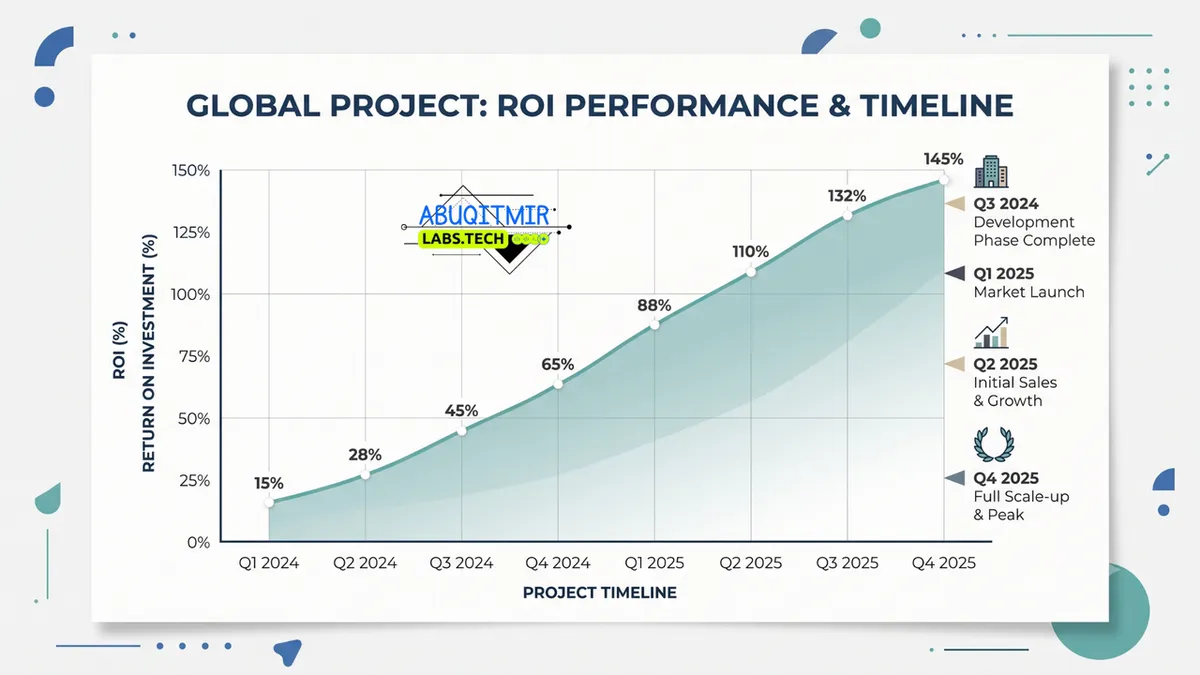
Summary Box
Summary: This article explains how enterprises should actually measure the ROI of digital transformation — moving past vanity metrics toward operational, financial, and strategic indicators — and how AbuQitmirLabs approaches transformation engagements around measurable business outcomes rather than technology adoption for its own sake.
quote
"The technology is never the return. The return is what the business can now do that it couldn't do before — faster, cheaper, or at a scale that wasn't previously possible."
key highlights
- Most digital transformation ROI conversations measure the wrong things — activity instead of outcomes
- Real ROI shows up across three layers: operational efficiency, revenue impact, and strategic optionality
- The biggest hidden cost in transformation initiatives is rarely the software — it's the opportunity cost of a slow rollout
- A properly scoped custom software development company builds ROI measurement into the initiative from day one, not as an afterthought
- The organizations that see the strongest returns treat transformation as a portfolio of smaller bets, not a single monolithic bet
- Karachi-based engineering teams increasingly deliver enterprise-grade transformation work at a cost structure that changes the ROI math entirely
Introduction
Somewhere between the initial pitch deck and the eighteen-month mark, most digital transformation initiatives lose their business case. Not because the work stopped mattering, but because nobody built a way to actually measure whether it was working. The dashboard that was supposed to prove the value never got built. The baseline metrics that should have been captured before the project started were never captured at all. By the time a CFO asks "what did we actually get for this," the honest answer is usually a shrug dressed up in enthusiasm.
This is the most common failure mode in digital transformation — not bad technology, not bad intentions, but a business case that was real at approval time and became unfalsifiable within a year.
The organizations that get this right treat ROI of digital transformation as a design question from the very beginning, not a reporting exercise tacked on at the end. This requires a proper digital transformation framework — one that builds measurement into the architecture rather than bolting it on after launch. This is, increasingly, one of the areas where a disciplined custom software development company earns its keep — not just building the system, but building the measurement into the system itself.
Why Most ROI Conversations Measure the Wrong Things
A great deal of transformation reporting focuses on activity rather than outcome: systems deployed, users onboarded, tickets closed, dashboards built. These numbers are easy to produce and feel like progress, but they answer the wrong question. A CRM with 100% user adoption that hasn't moved a single revenue or retention metric isn't a success — it's an expensive habit change with no proven payoff.
Genuine ROI measurement separates into three layers, and most reporting only ever touches the first.
"Activity metrics tell you the project happened. Outcome metrics tell you whether it mattered."
The Three Layers of Real Digital Transformation ROI
1. Operational Efficiency
The most measurable and most commonly reported layer: time saved, manual work eliminated, error rates reduced, cycle times shortened. This is real value, and it's the easiest to attach a number to — hours reclaimed multiplied by a loaded labor cost, error reduction multiplied by the cost of the errors it used to cause.
2. Revenue and Customer Impact
Harder to measure cleanly because more variables are in play, but often the larger number: faster time-to-market, improved conversion from a better digital experience, reduced churn from more responsive service, new revenue from capabilities that didn't previously exist. This layer requires a baseline captured before the initiative starts — the single most commonly skipped step in transformation planning.
3. Strategic Optionality
The least discussed and often the most valuable layer over a multi-year horizon: what a business can now consider doing that it structurally couldn't before. A logistics company with clean, real-time operational data can consider dynamic pricing. A retailer with unified customer data can consider a loyalty program that wasn't previously feasible. This value doesn't show up on next quarter's report, but it's frequently where the largest long-term return actually lives.
Common Mistakes That Quietly Destroy Transformation ROI
- Skipping the baseline. Without a "before" number, there is no honest "after" number — only a story that sounds good in a review meeting and falls apart under scrutiny.
- Measuring vanity metrics instead of business outcomes. Logins, feature usage, and dashboard views feel like progress but rarely correlate with the financial case that got the initiative approved in the first place.
- Treating the initiative as one monolithic bet. A single eighteen-month program with no interim checkpoints means eighteen months pass before anyone finds out whether the underlying assumptions were right.
- Underestimating the opportunity cost of a slow rollout. A transformation initiative that takes twice as long to deliver doesn't just cost twice as much — it delays every downstream benefit by the same margin, which compounds against the business case far more than most timelines account for.
- Choosing a technology partner based on cost per hour rather than delivery discipline. The cheapest hourly rate frequently produces the most expensive total outcome once delays, rework, and missed baselines are factored in.
Listen to the conversation.
Important thing: If your last transformation initiative is still running but nobody can say what it actually returned, AbuQitmirLabs is happy to start with a conversation about what a properly measured baseline would reveal.
How AbuQitmirLabs Builds ROI Into Transformation Work
Baseline First, Build Second
Every engagement establishes what "before" actually looks like — operational metrics, cost structures, and customer data — before any system architecture decisions get made. This isn't a formality. It's the only way an "after" number means anything six months later.
Portfolio Sequencing Over Monolithic Bets
Rather than a single large transformation program, initiatives get sequenced into smaller, independently measurable pieces. This allows a business to see real ROI signals within months rather than waiting eighteen months to discover whether the entire premise was sound — and lets custom software architecture evolve based on what the earlier pieces actually reveal about the business.
Engineering Cost Structure as Part of the ROI Case
For businesses working with a Karachi-based engineering team, the cost side of the ROI equation shifts meaningfully compared to hiring locally in higher-cost markets — not because the work is discounted in quality, but because the underlying cost structure of a mature, internationally-trained talent pool operating from Pakistan changes what breakeven actually looks like. This is a structural input to the ROI case, not a marketing footnote.
A Realistic Example
A regional retail chain approached AbuQitmirLabs after an earlier transformation initiative — a new inventory and CRM platform built by a previous vendor — had been running for over a year with no clear answer to what it had actually returned. Adoption was high. The dashboards were full. Nobody could say whether the business was better off.
The engagement started by reconstructing a baseline retroactively from the data that did exist — stockout frequency, manual reconciliation hours, and customer repeat-purchase rates from before the platform launched. Once that baseline existed, it became clear the platform had genuinely reduced stockouts, but a costly manual reconciliation process it was meant to eliminate had simply moved to a different team rather than disappearing, quietly erasing a large share of the projected savings.
The fix wasn't a rebuild — it was a targeted integration closing the specific gap the original build had missed, paired with a proper baseline-and-checkpoint structure going forward. Within two quarters, the client had a number they trusted for the first time: a real efficiency gain, finally distinguishable from the activity that had been mistaken for it.
Digital Transformation Across Industries: Where ROI Actually Concentrates
Not every industry sees the same shape of return, and the digital transformation strategies that work well in one sector often need real adaptation before they translate to another.
Digital transformation in manufacturing tends to concentrate ROI in operational efficiency first — predictive maintenance reducing unplanned downtime, connected production data eliminating manual reconciliation between floor and finance. The strategic-optionality layer here often arrives later, once real-time production data makes entirely new offerings, like outcome-based service contracts, feasible.
Digital transformation in banking carries a different profile, weighted heavily toward customer experience and compliance efficiency simultaneously — faster onboarding, automated fraud detection, and regulatory reporting that used to consume weeks of manual work. Because banking already runs on structured transactional data, baseline measurement tends to be more feasible here than in most other sectors.
Digital transformation in healthcare is shaped by a stricter compliance layer than almost any other industry, which means ROI calculations have to account for the cost of doing transformation properly — secure data architecture, audit trails, and privacy-by-design — rather than treating compliance as a tax on the "real" project. Done well, the operational efficiency gains (reduced administrative burden, faster patient data access) are substantial, but they arrive alongside, not instead of, the compliance investment.
Across all three, one pattern holds: the role of AI in digital transformation has shifted from experimental add-on to a genuine efficiency multiplier — but only for organizations whose underlying data is clean and well-structured enough for AI to reason over in the first place. This is exactly why the baseline-first approach described above matters as much for AI-driven initiatives as it does for any other transformation work.
Choosing Between Digital Transformation Services, Solutions, and Consulting
Businesses evaluating a technology partner for this work often encounter three overlapping categories of offering, and understanding the difference matters for setting realistic ROI expectations.
Digital transformation services typically refers to the hands-on engineering work — building the systems, integrations, and platforms the strategy calls for. Digital transformation solutions more often describes pre-packaged or semi-customized products meant to solve a specific, common problem quickly, trading some flexibility for speed. Digital transformation consulting services sit upstream of both — strategy, diagnosis, and roadmap work, ideally followed by (or paired with) the engineering team that will actually build what the strategy calls for.
The businesses that see the strongest ROI tend to avoid splitting these three across unrelated vendors with no shared accountability for the outcome. A single team that can move fluidly between strategy and engineering — diagnosing the problem, then building the actual system — tends to protect the ROI case far better than a consulting deliverable handed off to a separate implementation vendor with no stake in whether the original business case holds up.
Why ROI Measurement Should Shape the Technology Partner You Choose
There is a meaningful difference between a vendor who delivers a system and a custom software development company that treats measurable business outcomes as part of the deliverable itself. The former hands over a working product and moves on. The latter builds the baseline, the checkpoints, and the reporting structure into the engagement from day one — because a system nobody can evaluate honestly is a system whose value is permanently in question.
This is the layer most procurement processes miss. Two proposals can look identical on features and timeline, right up until eighteen months in, when only one of them can actually answer what the business got for its investment.
Frequently Asked Questions
How long does it take to see ROI from a digital transformation initiative?
Operational efficiency gains often show up within the first two to three months of a properly scoped initiative. Revenue and customer-impact returns typically take two to four quarters, since they depend on external market response, not just internal deployment.
What's the most common reason digital transformation ROI is hard to prove?
Missing baseline data. Without a documented "before" state, any "after" comparison is closer to a narrative than a measurement.
Should digital transformation ROI be measured differently than a typical IT project?
Yes. A typical IT project is often measured on delivery (on time, on budget). Digital transformation should additionally be measured on business outcome — revenue, retention, efficiency — which requires instrumentation most standard IT project plans don't include by default.
Does working with a Karachi-based custom software development company change the ROI calculation?
Often significantly, on the cost side of the equation specifically. A mature, internationally-trained engineering talent pool operating from Pakistan can shift the breakeven point of a transformation initiative meaningfully, independent of the quality of the engineering work itself.
What industries see the clearest digital transformation ROI?
Logistics, retail, and financial services tend to produce the clearest numbers, since operational efficiency and transaction-level data are usually already tracked in some form — making baseline reconstruction more feasible than in industries with less structured historical data.
Final Thoughts
The organizations that consistently show strong digital transformation ROI rarely have better technology than everyone else. They have better discipline about what they measured before they started, and enough patience to sequence the work into pieces small enough to actually evaluate honestly along the way.
That discipline — baseline first, build second, measure continuously — is the standard AbuQitmirLabs builds toward on every engagement, whether the client is in Karachi or looking at Pakistan from well beyond it. The technology is rarely the hard part. Knowing, with real numbers, whether it actually worked — that's the part most initiatives quietly skip, and the part that determines whether the next budget cycle trusts transformation work at all.
Listen to the conversation. (Part 2)
New digital transformation: Whether you're scoping a new digital transformation initiative or trying to finally answer what an existing one delivered — visit AbuQitmirLabs to start the baseline conversation that should happen before the build, not eighteen months after it.