Summary Box
🔄 Summary: This guide explains what digital transformation actually means for businesses in 2026 — beyond the buzzword. It covers the four pillars of real transformation, why 70% of digital transformation initiatives fail, practical examples across industries, and what a transformation strategy looks like when it is built around business outcomes rather than technology for its own sake. AbuQitmirLabs builds the custom software, web systems, and AI infrastructure that digital transformation actually requires. Read time: approximately 12 minutes.
Table of Contents
- Introduction
- What Digital Transformation Actually Means
- What Digital Transformation Is Not
- The Four Pillars of Real Digital Transformation
- Why 70% of Digital Transformation Initiatives Fail
- Digital Transformation Examples by Industry
- The Business Case — What Transformation Actually Delivers
- Where to Start — The Digital Transformation Readiness Assessment
- How AbuQitmirLabs Supports Digital Transformation
- Digital Transformation and SEO — The Connection Most Businesses Miss
- Frequently Asked Questions
- Final Thoughts
Quote
"Digital transformation is not about technology. It is about what the business becomes capable of doing because of technology — and those are very different conversations." — AbuQitmir Mohammad Shiraz Al-Madani
Key Highlights
- Digital transformation is a fundamental rethinking of how a business delivers value using digital capabilities — not a technology project with a finish line
- 70% of digital transformation initiatives fail — primarily because they focus on technology adoption rather than business outcome design
- Real transformation happens across four pillars: operational processes, customer experience, business model, and organizational culture
- Digital transformation is not one project — it is a continuous evolution that compounds in value as digital capabilities mature
- SEO, content strategy, and digital marketing are inseparable from digital transformation — a transformed business that cannot be found online has not fully transformed
- Custom software, AI systems, and web infrastructure are the tools of transformation — but the strategy must come before the technology selection
- The businesses winning in 2026 are not those with the most technology — they are those whose technology serves the clearest business outcomes
Introduction
Digital transformation is the most overused phrase in business strategy — and possibly the least consistently understood one.
Ask ten business leaders what it means and you will receive ten different answers. Moving to the cloud. Using AI. Updating the website. Going paperless. Building a mobile app. Automating the back office. Completely rethinking how the business operates and delivers value.
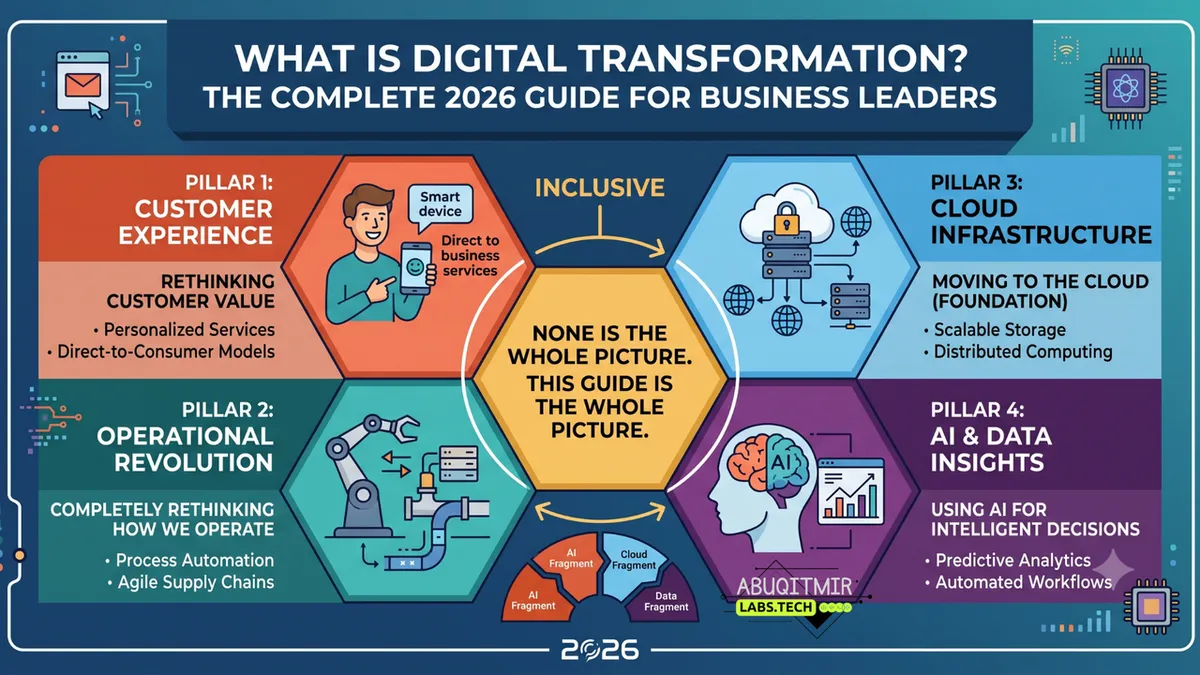
All of those answers contain a fragment of the truth. None of them is the whole picture.
The confusion is not accidental. Technology vendors, consulting firms, and software companies have all defined digital transformation in ways that conveniently position their particular product or service as the solution. The result is a term that is simultaneously everywhere and consistently misapplied — used to describe everything from replacing a paper form with a PDF to restructuring an entire business around digital-first customer relationships.
This guide is the whole picture. It covers what digital transformation actually means, what it is not, why most initiatives fail, what successful transformation looks like across industries, and how to approach the decision in a way that produces measurable business outcomes rather than expensive technology deployments that change the tools without changing the results.
What Digital Transformation Actually Means
Digital transformation is the process by which a business fundamentally rethinks how it creates, delivers, and captures value — using digital technologies as the enabling infrastructure for that rethinking.
Three words in that definition carry the weight: fundamentally rethinks.
Not updates. Not improves. Not digitizes. Fundamentally rethinks.
A business that moves its paper invoicing to a digital invoicing tool has digitized a process. That is useful. It is not transformation. A business that rethinks its entire revenue collection model — automated billing, real-time payment tracking, predictive cash flow forecasting, and customer self-service account management — because digital infrastructure makes that model possible, is transforming.
The distinction matters because the investment, the timeline, the organizational change, and the business outcome are completely different between digitization and transformation.
"Digitization changes the format. Transformation changes what the business is capable of. Investing digitization budgets while expecting transformation outcomes is where most failed initiatives begin."
The Three Levels of Digital Change
Level 1 — Digitization: Converting analog processes to digital formats. Paper forms become digital forms. Physical files become digital records. Analog communication becomes email. Useful, necessary, not transformative.
Level 2 — Digitalization: Using digital tools to improve existing processes. CRM software that makes the sales process more efficient. Accounting software that makes financial reporting faster. Project management tools that make team coordination more visible. Genuinely valuable, but still serving existing business models.
Level 3 — Digital Transformation: Rethinking the business model, the customer relationship, and the value creation process because digital capabilities make new models possible that were previously impossible. This is transformation.
Most businesses are operating at Level 1 or Level 2 and calling it Level 3. The gap between what they are doing and what they believe they are doing is where transformation budgets disappear without producing transformation outcomes.
What Digital Transformation Is Not
Clarity about what digital transformation is not is as important as the definition itself — because the misconceptions are where failed initiatives begin.
It is not a technology project with a finish line. Digital transformation is not a project that gets completed and checked off. It is a continuous evolution — a sustained capability-building effort that compounds in value as digital capabilities mature and the business learns to use them more effectively. Organizations that treat it as a project finish the project and wonder why they do not feel transformed.
It is not the same as buying new software. Purchasing a new CRM, deploying a new ERP, or subscribing to a cloud platform is a technology procurement decision. Whether it contributes to transformation depends entirely on whether it changes how the business operates and delivers value — or simply replaces the previous tool with a more expensive version of the same process.
It is not a department's responsibility. Digital transformation initiatives that are owned entirely by the IT department — without meaningful involvement from operations, sales, customer service, finance, and leadership — produce technology deployments that the rest of the business does not adopt, does not trust, and eventually works around.
It is not exclusively about customer-facing technology. Many businesses focus transformation efforts on customer-facing digital products — a new website, a mobile app, an e-commerce store — while leaving internal operations, data infrastructure, and organizational processes unchanged. The customer experience improves. The underlying business does not transform.
It is not optional in 2026. Businesses that have not begun meaningful digital transformation are not standing still while competitors advance. They are falling behind at an accelerating rate — because the gap between digitally mature and digitally immature businesses compounds over time rather than remaining constant.
The Four Pillars of Real Digital Transformation
Real digital transformation happens across four interconnected dimensions. Investing in one or two while neglecting the others produces partial results — improvements in isolated areas that do not add up to organizational transformation.
Pillar 1: Operational Processes
This is where most transformation efforts begin — and where they often stop. Operational transformation means redesigning the processes that run the business, not just the tools those processes use.
What this looks like in practice:
- Automated workflows that replace manual handoffs between departments
- Real-time data visibility across operations, replacing periodic reporting that describes what already happened
- AI-assisted decision support at the points where humans currently make judgment calls with incomplete information
- Integrated systems that eliminate the data silos where information gets lost between departments
Operational transformation is measurable: in cost reduction, in throughput increase, in error rate reduction, in the speed at which the business can respond to change.
Pillar 2: Customer Experience
Digital transformation of the customer experience means rethinking how customers interact with the business across every touchpoint — not just adding a website or a chat widget to existing touchpoints.
What this looks like in practice:
- Seamless omnichannel experiences where the customer's history and context carry across every interaction channel
- Personalization at scale — experiences that adapt to individual customer behavior and preferences rather than treating all customers identically
- Self-service capabilities that give customers control over their relationship with the business without requiring human intervention for routine tasks
- Proactive communication — reaching customers with relevant information before they have to ask for it
Customer experience transformation is measurable: in retention rates, in net promoter scores, in customer acquisition cost, in the lifetime value of customer relationships.
Pillar 3: Business Model
The deepest level of digital transformation involves rethinking what the business sells, to whom, and how. Digital capabilities enable business models that were previously impossible — and the businesses that recognize this early create sustainable competitive advantages that are very difficult for late-movers to replicate.
What this looks like in practice:
- Product businesses that become platform businesses — connecting buyers and sellers rather than only selling their own products
- Service businesses that create recurring revenue through digital subscription models rather than one-time transactions
- Manufacturing businesses that layer digital services on top of physical products — adding data, analytics, and remote management to products that previously had no digital dimension
- Businesses that monetize data and intelligence generated by their operations in ways that create new revenue streams alongside the core business
Business model transformation is the rarest and most consequential form of digital transformation — and the one most likely to redefine competitive dynamics in an industry.
Pillar 4: Organizational Culture
Technology without culture change is the most common reason digital transformation initiatives deliver less than they promised. The tools change. The behavior does not.
What cultural transformation looks like in practice:
- Data-driven decision making that replaces intuition-led decisions with evidence-led ones — at every level of the organization, not just at the leadership level
- Experimentation as a normal organizational behavior — the willingness to test, measure, learn, and adjust rather than committing to a single approach and defending it
- Cross-functional collaboration across the silos that digital transformation is supposed to dissolve — requiring cultural change that technology alone cannot produce
- Digital literacy across the organization — not everyone becoming a developer, but everyone understanding the digital tools they use well enough to use them effectively
Why 70% of Digital Transformation Initiatives Fail
Research consistently places the failure rate of digital transformation initiatives at 70% or higher. For initiatives of this scale and investment, that is a remarkable failure rate — and the causes are remarkably consistent.
Cause 1: Technology-first, strategy-second thinking. The most common failure pattern: a business selects a technology — a new platform, an AI tool, a cloud migration — and then builds a business case around the technology rather than identifying the business outcome first and selecting technology to serve it. The result is a technically successful deployment that does not change what the business is capable of doing.
Cause 2: Lack of leadership commitment beyond the announcement. Digital transformation requires sustained leadership attention, decision-making authority, and resource commitment — not just an announcement at the beginning of the year. When transformation becomes a project delegated to a team while leadership returns to normal operations, the transformation stalls at the first significant obstacle.
Cause 3: Underestimating organizational change. The technology component of digital transformation is typically the easiest part. The hardest part is changing how people work — the habits, processes, incentives, and cultural norms that determine whether new digital tools are actually used effectively. Transformation initiatives that invest heavily in technology and lightly in change management consistently underperform.
Cause 4: Trying to transform everything simultaneously. Organizations that launch comprehensive transformation programs — replacing multiple major systems, restructuring multiple departments, and changing multiple customer touchpoints at the same time — regularly discover that the complexity of simultaneous change exceeds the organization's capacity to absorb it.
Cause 5: No clear success metrics defined before the initiative begins. A transformation initiative without defined success metrics cannot be evaluated, adjusted, or defended when it encounters resistance. If the business cannot articulate what success looks like in measurable terms before the initiative begins, it will not be able to demonstrate value after significant investment.
Digital Transformation Examples by Industry
Financial Services: A traditional bank that moved from branch-only service to a fully digital banking experience — mobile account management, automated credit decisions, real-time fraud detection, and AI-assisted financial planning tools — did not just add a banking app. It transformed the customer relationship model, reduced operational cost significantly, and created a platform for services that the branch model could not support.
Healthcare: A clinic network that digitized patient records (Level 1), then connected those records across facilities (Level 2), then built AI-assisted diagnostic support and predictive appointment scheduling that uses patient history to anticipate care needs before patients request it (Level 3) — that is transformation. Each level built the capability for the next.
Retail: A physical retail chain that added an e-commerce website (digitization) evolved to a fully integrated omnichannel operation — inventory visible across all channels, customer purchase history accessible by every touchpoint, personalized recommendations driven by behavioral data, and a supply chain that responds to demand signals in near real-time. The transformation did not eliminate the physical stores. It made them part of a fundamentally different retail model.
Professional Services: A consulting firm that moved from email-based client communication to a client portal (digitalization) evolved to a model where client engagements are managed through integrated project dashboards, AI-assisted research tools, and automated reporting that clients access directly — transforming the service delivery model and the perceived value of the engagement.
The Business Case — What Transformation Actually Delivers
Digital transformation is not an IT investment. It is a business investment — and the business case should be built around business outcomes, not technology specifications.
Operational efficiency: Automated processes reduce the labor cost of routine tasks and eliminate the error rate of manual ones. The savings compound over time as automation extends to more processes.
Revenue growth: New digital channels, personalized customer experiences, and data-driven sales processes produce revenue growth that is difficult to achieve through traditional means.
Customer retention: Digital customers who have seamless, personalized experiences with a business are measurably more loyal than customers served through fragmented, inconsistent touchpoints.
Speed to market: Businesses with digital operational infrastructure can respond to market changes, launch new products, and adjust pricing and positioning faster than competitors operating on manual or legacy systems.
Data as an asset: A transformed business accumulates structured, actionable data about its operations, its customers, and its market as a natural byproduct of digital operations. That data is itself an asset — usable for AI systems, market intelligence, and strategic decision-making.
Competitive resilience: Digitally mature businesses are more resilient to disruption — because they can adapt faster, serve customers better, and redeploy resources more efficiently than competitors whose operations depend on manual processes and legacy systems.
Attention required.
Mapping current capabilities: If your business is at the readiness assessment stage — mapping current capabilities and defining what transformation needs to deliver — AbuQitmirLabs is happy to start with that conversation before any technology decisions are made.
Where to Start — The Digital Transformation Readiness Assessment
The most common mistake in starting a digital transformation is starting with a technology selection. The right starting point is an honest assessment of where the business is and what it most needs to change.
Step 1: Map the current state of your digital capabilities What digital tools does the business currently use? How effectively are they used? Where are the manual processes that digital tools could replace? Where are the data silos that prevent information from flowing where it is needed?
Step 2: Define the business outcomes you need transformation to deliver Not technology outcomes — business outcomes. Cost reduction by a specific percentage. Customer retention improvement by a specific number of points. Revenue growth in a specific new channel. Response time reduction to a specific threshold. Measurable, specific, and connected to business performance rather than technology adoption.
Step 3: Identify the transformation priorities Which of the four pillars — operational processes, customer experience, business model, organizational culture — represents the highest-value opportunity for the business? Which represents the most urgent risk if left unchanged? Start there.
Step 4: Assess organizational readiness for change Technology deployments fail when the organization is not ready to change how it works. Honest assessment of leadership commitment, staff digital literacy, cross-functional collaboration capability, and change management capacity determines what is achievable in what timeline.
Step 5: Select technology to serve the strategy Technology selection is Step 5, not Step 1. The right custom software, the right platform, the right AI infrastructure — all of these decisions are shaped by the strategy defined in Steps 1 through 4.
How AbuQitmirLabs Supports Digital Transformation
Strategy Before Technology
Every digital transformation engagement at AbuQitmirLabs begins with the business outcomes — not the technology selection. The custom software, web systems, and AI infrastructure we build are in service of specific, measurable business outcomes that the client defines before a single technical decision is made.
The Technical Infrastructure of Transformation
Digital transformation requires technical infrastructure that is built for the long term — not the fastest solution to today's problem. Custom software built around the business's actual operational requirements, web systems built for performance and integration, AI capabilities built to reason over the business's real data — these are the building blocks that transformation actually requires, and they compound in value as the business's digital maturity grows.
SEO and Content as Transformation Infrastructure
A transformed business that cannot be found online has not fully transformed. SEO mastery and content writing are not marketing add-ons to digital transformation — they are the digital visibility layer that ensures the operational and customer experience improvements of transformation translate into market presence and customer acquisition.
The Long-Term Partnership Model
Digital transformation is not a project — and the right technology partner is not a vendor. AbuQitmirLabs works with transformation clients on a sustained basis, because the capability-building that transformation requires is ongoing rather than delivered in a single engagement.
Digital Transformation and SEO — The Connection Most Businesses Miss
One of the most consistently underinvested dimensions of digital transformation is digital visibility — the ability of a transformed business to be found by the customers it is newly capable of serving.
A business can transform its operations, its customer experience, and its business model — and still lose to a less operationally capable competitor that ranks higher in search, produces more valuable content, and maintains a stronger digital presence.
SEO mastery is the transformation of a business's digital visibility — building the technical foundation, the content authority, and the search ranking that turns digital capability into customer acquisition.
Content writing is the transformation of a business's market communication — building the content infrastructure that communicates expertise, answers customer questions, and earns the search rankings that make digital visibility sustainable rather than dependent on paid advertising.
Together, they complete the transformation picture: a business that operates better, serves customers better, and can be found by those customers in the channels where they look.
Frequently Asked Questions
What is digital transformation in simple terms?
Digital transformation is the process by which a business fundamentally rethinks how it creates and delivers value — using digital technologies as the enabling infrastructure. It goes beyond digitizing existing processes to rethinking what the business is capable of doing because of digital tools.
What are the main drivers of digital transformation?
The main drivers are customer expectation shifts (customers expect digital-first experiences across industries), competitive pressure (digitally mature competitors operate more efficiently and serve customers better), data opportunity (digital operations generate data that drives better decisions), and operational efficiency (digital processes are faster, cheaper, and more accurate than manual ones).
What are the four pillars of digital transformation?
Operational processes, customer experience, business model, and organizational culture. Real transformation requires progress across all four — investment in one or two while neglecting the others produces partial results that do not add up to organizational transformation.
Why do most digital transformation initiatives fail?
The most common causes are technology-first thinking (selecting technology before defining business outcomes), lack of sustained leadership commitment, underestimating the organizational change required, trying to transform too many things simultaneously, and failing to define measurable success metrics before the initiative begins.
How long does digital transformation take?
Meaningful progress on specific transformation priorities can be achieved within six to twelve months. Full organizational digital maturity is a multi-year journey — because transformation compounds in value as digital capabilities mature and the organization learns to use them more effectively. It is a continuous evolution rather than a project with a finish line.
What is the difference between digitization and digital transformation?
Digitization converts analog processes to digital formats — paper forms become digital forms. Digital transformation rethinks what the business does and how it delivers value, because digital capabilities make new models possible. Digitization changes the format. Transformation changes the capability.
Where should a business start with digital transformation?
Start with a readiness assessment — mapping current digital capabilities, defining the business outcomes transformation needs to deliver, and identifying the highest-value transformation priorities. Technology selection comes after strategy definition, not before it.
What role does SEO play in digital transformation?
SEO is the digital visibility layer of transformation — ensuring that operational and customer experience improvements translate into market presence and customer acquisition. A transformed business that cannot be found online has not fully transformed its market position.
Final Thoughts
Digital transformation is one of those concepts that suffers most from the gap between how it is discussed and what it actually requires. In discussion, it is a strategy initiative — visionary, exciting, and full of possibility. In practice, it is an operational discipline — patient, measurement-driven, and sustained over a timeline longer than most businesses initially plan for.
The businesses that succeed at digital transformation in 2026 are not the ones that launched the most ambitious initiatives. They are the ones that defined the clearest outcomes, chose the right starting point, built transformation on genuine technical infrastructure rather than vendor promises, and sustained the discipline to measure and improve rather than declare victory at the go-live date.
That is the standard AbuQitmirLabs builds toward — not a transformation announcement, but a sustained capability-building partnership that produces measurable business outcomes long after the initial conversation about strategy and technology has been had.
Attention required. (Part 2)
Transformed business: Whether the priority is custom software that automates your operational processes, web infrastructure that transforms your customer experience, AI systems that add intelligence to your data, or SEO and content that makes your transformed business visible to the market it serves — visit AbuQitmirLabs to start the discovery conversation that transformation actually requires.