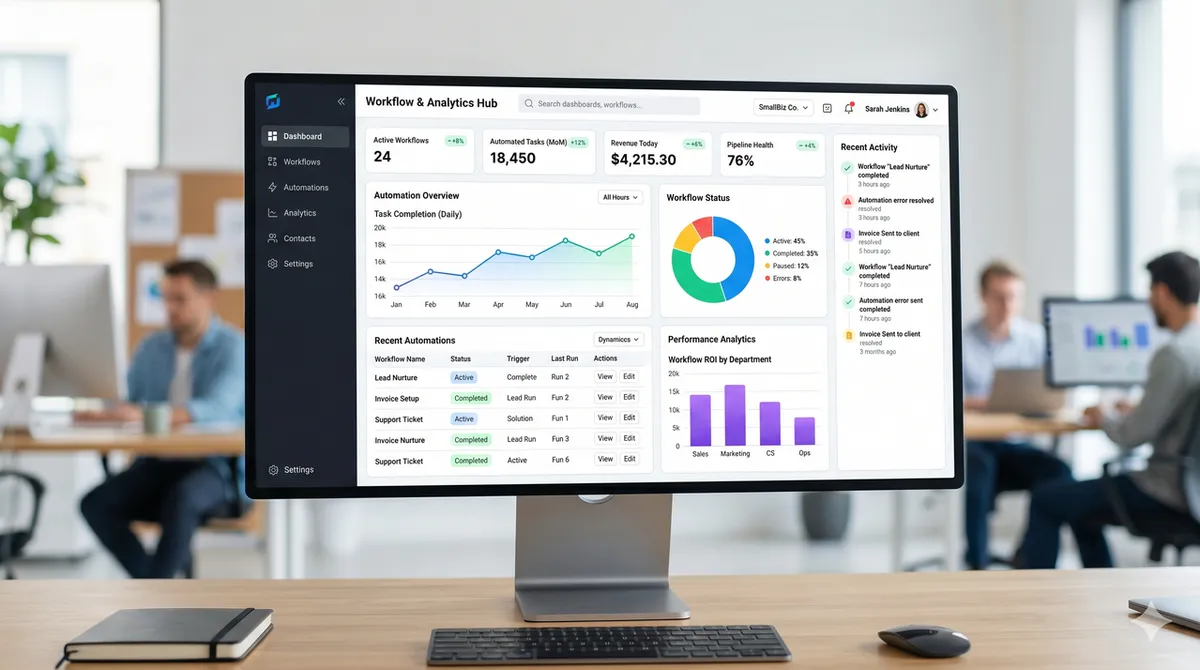
How Custom Web Applications Help Small Businesses Automate Workflows (2026 Guide)
Running a small business often means managing dozens of tasks at the same time.
Business owners frequently deal with:
- customer inquiries
- sales tracking
- inventory management
- employee coordination
- invoicing
- reporting
- marketing activities
As businesses grow, manual processes become difficult to manage.
This is why many companies are investing in custom web applications for small business automation.
Unlike generic software tools, custom web applications are designed specifically around your workflows, processes, and business goals.
The result is:
- higher productivity
- reduced operational costs
- fewer manual errors
- improved customer experience
- scalable business growth
In this guide, we'll explore how custom web applications help automate workflows and why they have become essential for modern businesses in 2026.
Summary Box
Custom web applications help small businesses automate workflows by eliminating repetitive tasks, centralizing business operations, improving team collaboration, reducing manual errors, and increasing operational efficiency. Modern business automation software enables companies to scale faster while delivering better customer experiences.
What Are Custom Web Applications?
A custom web application is software built specifically for your business needs.
Unlike off-the-shelf tools, custom solutions are developed around your unique workflows.
Examples include:
- CRM systems
- customer portals
- inventory management systems
- booking systems
- HR platforms
- project management dashboards
- workflow automation systems
- reporting platforms
These applications can be accessed through any web browser and are designed to improve operational efficiency.
Why Small Businesses Need Workflow Automation
Many small businesses rely heavily on manual processes.
Common examples include:
- manually entering customer data
- sending invoices individually
- updating spreadsheets
- tracking inventory manually
- assigning tasks through emails
While manageable initially, these methods become inefficient as businesses grow.
Problems Caused by Manual Processes
- Human errors
- Slow response times
- Data duplication
- Missed opportunities
- Poor customer experiences
- Reduced productivity
Workflow automation helps eliminate these bottlenecks.
How Custom Web Applications Automate Business Workflows
Centralized Data Management
Many businesses store information across multiple systems.
This creates confusion and inefficiency.
Custom web applications centralize:
- customer records
- orders
- invoices
- projects
- employee information
- analytics
Having everything in one place improves decision-making and reduces administrative work.
Automated Customer Management
Customer management is one of the biggest areas where automation delivers value.
A custom CRM system can automatically:
- capture leads
- assign sales representatives
- send follow-up emails
- track customer interactions
- generate reports
This allows teams to focus more on sales and customer relationships.
Automated Task Assignment
Many businesses lose time manually assigning work.
A workflow automation system can automatically:
- assign tasks
- notify employees
- track progress
- escalate overdue tasks
- update project statuses
This improves team productivity significantly.
Automated Reporting
Business reporting often consumes valuable time.
Custom web applications can automatically generate:
- sales reports
- customer analytics
- financial summaries
- operational dashboards
- performance metrics
Real-time reporting enables faster business decisions.
Customer Self-Service Portals
Customers increasingly expect instant access to information.
Custom portals allow customers to:
- place orders
- track requests
- download invoices
- submit support tickets
- manage accounts
This reduces support workload while improving customer satisfaction.
Real-World Examples of Workflow Automation
Service-Based Businesses
Custom systems can automate:
- appointment booking
- customer onboarding
- invoicing
- payment tracking
- reminders
E-Commerce Companies
Automation can handle:
- order processing
- inventory updates
- shipping notifications
- customer communications
Educational Platforms
Learning platforms often automate:
- student enrollment
- attendance tracking
- course progress monitoring
- assessments
- certificates
Healthcare Providers
Custom applications can streamline:
- patient scheduling
- records management
- appointment reminders
- billing systems
Benefits of Custom Web Applications for Small Businesses
Increased Productivity
Employees spend less time on repetitive tasks and more time on high-value work.
Reduced Operational Costs
Automation reduces labor-intensive activities and minimizes costly mistakes.
Better Customer Experience
Faster responses and personalized services improve customer satisfaction.
Improved Accuracy
Automated workflows significantly reduce human errors.
Scalability
Custom applications grow alongside your business.
You can add new features as your needs evolve.
Why Off-the-Shelf Software Often Falls Short
Generic software is built for broad audiences.
As a result, businesses often encounter:
- unnecessary features
- workflow limitations
- integration challenges
- scaling issues
Custom software solves these problems by adapting to your business rather than forcing your business to adapt to software.
For organizations requiring tailored functionality, investing in Custom Software Development often delivers better long-term value than relying solely on generic SaaS tools.
The Role of Modern Web Technologies
Modern web applications are increasingly built using technologies such as:
- React
- Next.js
- Node.js
- TypeScript
- Cloud Infrastructure
These technologies help create:
- fast-loading applications
- secure systems
- scalable architectures
- responsive user experiences
Businesses seeking modern digital platforms often combine React Development Services with Next.js Development Services to achieve both performance and scalability.
Business Automation Beyond Websites
Automation is no longer limited to websites.
Modern organizations are implementing:
- AI-powered workflows
- CRM automation
- document processing
- customer support automation
- sales pipeline automation
Many companies integrate these capabilities into broader Business Automation strategies to streamline operations across departments.
Custom Web Applications vs SaaS Tools
| Feature | Custom Web Applications | Generic SaaS Tools |
|---|---|---|
| Customization | High | Limited |
| Scalability | Excellent | Moderate |
| Ownership | Full Control | Subscription-Based |
| Integrations | Flexible | Restricted |
| Long-Term Cost | Often Lower | Ongoing Monthly Fees |
| Competitive Advantage | Strong | Limited |
How Mobile Applications Complement Workflow Automation
Many businesses benefit from combining web applications with mobile solutions.
This enables employees and customers to access systems from anywhere.
Companies frequently pair automation platforms with Mobile App Development projects to create seamless cross-device experiences.
Future Trends in Workflow Automation (2026–2030)
The future of business automation includes:
- AI-powered decision support
- predictive analytics
- intelligent process automation
- conversational AI assistants
- automated customer service
- workflow orchestration platforms
Businesses adopting automation early often gain significant competitive advantages.
Featured
When evaluating automation solutions, businesses should consider:
- scalability
- security
- performance
- vendor expertise
- long-term support
- integration capabilities
Experienced software development teams focus on building systems that remain valuable as organizations grow.
Website Automation Checklist
Before investing in automation, evaluate whether your business needs:
✓ Customer Management System
✓ Workflow Automation
✓ Employee Portal
✓ Inventory Management
✓ Reporting Dashboard
✓ CRM Integration
✓ Customer Self-Service Portal
✓ Mobile Accessibility
✓ Automated Notifications
✓ AI-Powered Automation
Resources
Custom Web Development Service
Explore tailored web solutions designed for modern businesses.
👉 https://abuqitmirlabs.tech/web-development
Custom Software Development
Learn how custom software can improve operational efficiency.
👉 https://abuqitmirlabs.tech/custom-software
Mobile App Development
Extend your workflows through mobile applications.
👉 Mobile App Development Services
React Development Services
Build scalable front-end applications using React.
👉 React Development Services
Next.js Development Services
Improve performance and SEO with Next.js solutions.
👉 Next.js Development Services
SaaS Development
Launch scalable cloud-based software platforms.
👉 SaaS Development Services
Key Highlights
- Custom web applications automate repetitive business processes
- Workflow automation reduces manual errors and saves time
- Centralized data management improves decision-making
- Customer self-service portals enhance user experience
- Automated reporting provides real-time business insights
- Custom software scales with business growth
- Modern web technologies support faster and more secure applications
- Workflow automation improves team productivity
- Business automation reduces operational costs
- Small businesses gain competitive advantages through automation
Featured Answer
How do custom web applications help small businesses automate workflows?
Custom web applications automate workflows by streamlining repetitive tasks, centralizing data, automating reporting, improving customer management, and increasing operational efficiency. They help small businesses reduce costs, improve productivity, and scale more effectively.
Frequently Asked Questions (FAQ)
What is a custom web application?
A custom web application is software specifically designed to meet a business's unique operational requirements, workflows, and objectives.
Are custom web applications suitable for small businesses?
Yes. Small businesses often benefit significantly because automation reduces manual work and improves efficiency.
How much can workflow automation improve productivity?
The impact varies, but many businesses experience substantial time savings by automating repetitive administrative tasks.
What types of workflows can be automated?
Businesses commonly automate:
- sales processes
- customer support
- inventory management
- reporting
- invoicing
- employee management
Can custom web applications integrate with existing software?
Yes. Modern custom applications can integrate with CRMs, ERPs, payment gateways, marketing platforms, and other business systems.
Are custom web applications scalable?
Absolutely. They are built to grow alongside business requirements and can support future expansion.
QUOTE
"The most successful small businesses in 2026 are not working harder—they are automating smarter."
Get Free Consultations
Ready to Automate Your Business Workflows? Stop wasting time on repetitive manual tasks. Abu Qitmir Labs builds custom web applications, workflow automation systems, business software, SaaS platforms, and scalable digital solutions tailored to your business goals. Book a free consultation today and discover how automation can help your business grow faster, operate smarter, and reduce operational costs. 👉 https://abuqitmirlabs.tech
Related Engineering Resources
- For engineering teams deploying production workflows, explore our blueprint on custom AI agent development and enterprise RAG architecture and our AI automation solutions.