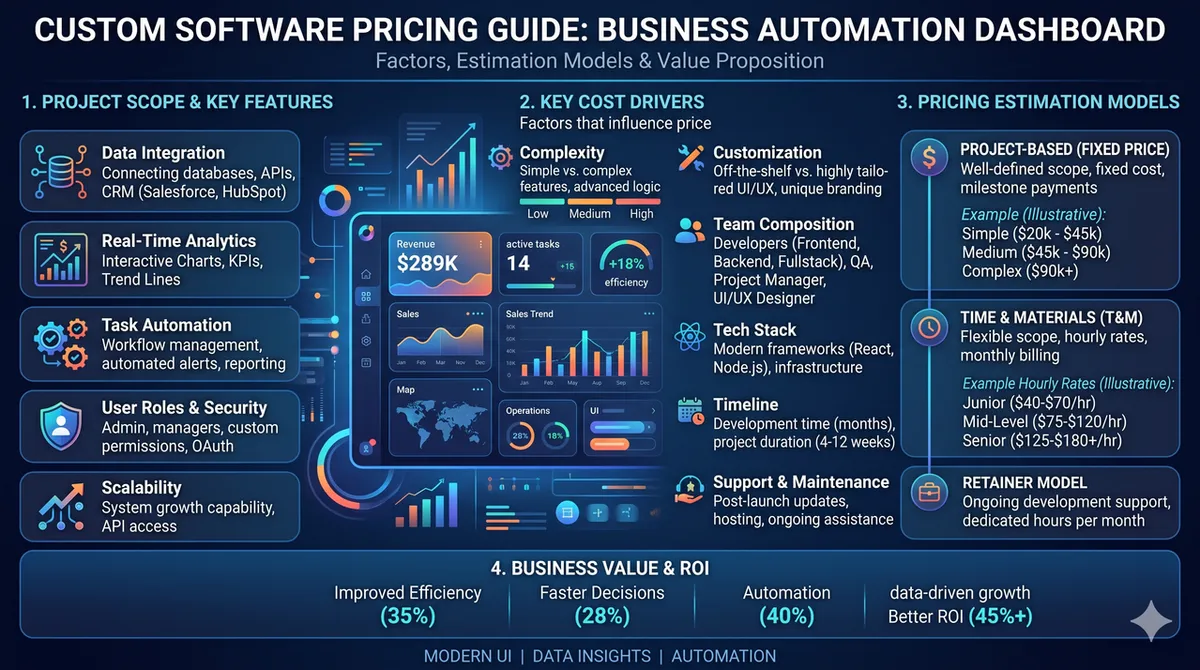
How Much Does Custom Software Development Cost in 2026?
Most businesses don’t realize how expensive inefficient systems become over time.
Manual work. Disconnected tools. Repeated data entry. Operational mistakes. Slow customer handling.
At first, these issues seem manageable.
But as businesses grow, small inefficiencies quietly turn into major financial problems.
That’s usually the moment companies start exploring custom software development.
One of the first questions they ask is:
“How much does custom software development actually cost in 2026?”
The honest answer?
It depends on:
- business goals
- software complexity
- integrations
- scalability requirements
- design quality
- automation features
- AI capabilities
A simple internal dashboard costs very differently from a full-scale SaaS platform or enterprise automation system.
This guide explains:
- realistic custom software pricing
- software development budget planning
- hidden costs businesses ignore
- MVP vs enterprise software costs
- AI software pricing trends
- how to reduce development expenses smartly
- how businesses choose the right development strategy
If you’re planning to build:
- business software
- SaaS platforms
- automation systems
- CRM software
- AI-powered tools
- enterprise applications
this article will help you budget realistically before starting development.
Why Businesses Invest in Custom Software
Many businesses initially try:
- spreadsheets
- generic SaaS tools
- disconnected apps
Eventually operational complexity increases.
Common problems include:
- duplicated work
- poor reporting
- workflow confusion
- customer management issues
- scaling limitations
Custom software helps businesses centralize operations and automate repetitive work.
That’s why more businesses are investing in:
- workflow automation
- business software solutions
- AI-powered systems
- cloud-based software platforms
especially in 2026.
What Affects Custom Software Development Cost?
Software pricing varies because every project has different requirements.
Several factors influence development cost.
1. Software Complexity
The biggest pricing factor is complexity.
Simple Software
Examples:
- admin dashboards
- booking systems
- inventory tools
- CRM panels
Usually require:
- fewer integrations
- smaller teams
- limited architecture
Medium Complexity Systems
Examples:
- customer portals
- SaaS platforms
- marketplace systems
- mobile app ecosystems
Require:
- APIs
- authentication systems
- databases
- cloud infrastructure
Enterprise-Level Platforms
Examples:
- AI-powered automation systems
- logistics platforms
- fintech systems
- healthcare software
Usually involve:
- large infrastructure
- security compliance
- advanced integrations
- scalability engineering
These projects cost significantly more.
2. Features & Functionality
Every feature increases:
- development time
- testing requirements
- maintenance complexity
Common Features That Increase Cost
✅ Real-time chat
✅ Payment systems
✅ AI integrations
✅ Analytics dashboards
✅ Mobile synchronization
✅ GPS tracking
✅ Multi-user systems
✅ Automation workflows
3. UI/UX Design Quality
Businesses often underestimate UI/UX costs.
Good software design improves:
- usability
- efficiency
- customer retention
Poor UX creates:
- frustration
- operational inefficiency
- lower engagement
Modern Businesses Expect Premium UX
In 2026, users expect software that feels:
- fast
- intuitive
- modern
- mobile-friendly
That requires professional UI/UX design.
4. AI & Automation Features
AI-powered systems usually increase pricing because they require:
- AI integrations
- advanced backend logic
- predictive systems
- data processing infrastructure
Examples of AI Features
✅ AI chat support
✅ Predictive analytics
✅ AI reporting
✅ Recommendation engines
✅ Smart automation
5. Mobile App Integration
Many custom software systems now connect with:
- Android apps
- iOS apps
- admin dashboards
- customer portals
Cross-platform integration increases development scope.
6. Cloud Infrastructure
Most modern software uses cloud infrastructure.
Platforms commonly include:
- AWS
- Google Cloud
- Azure
Cloud systems improve:
- scalability
- performance
- remote accessibility
but infrastructure planning also affects long-term costs.
Realistic Software Development Cost Ranges (2026)
Small MVP Software
Typical examples:
- internal dashboards
- appointment systems
- booking platforms
- startup MVPs
Usually involve:
- basic functionality
- limited integrations
- smaller teams
Medium Business Platforms
Examples:
- SaaS products
- CRM systems
- workflow automation tools
- mobile-connected systems
Require:
- scalable architecture
- APIs
- advanced dashboards
- cloud infrastructure
Enterprise Software Systems
Examples:
- fintech systems
- AI automation platforms
- logistics software
- healthcare systems
Usually require:
- advanced security
- large databases
- performance engineering
- DevOps infrastructure
Hidden Costs Businesses Ignore
Many businesses only focus on initial development pricing.
That creates budgeting mistakes.
Common Hidden Costs
✅ Maintenance
✅ Hosting
✅ Security updates
✅ Cloud infrastructure
✅ Scaling upgrades
✅ API costs
✅ Ongoing support
✅ Feature expansion
Why Cheap Software Often Becomes Expensive Later
Low-budget software sometimes creates:
- technical debt
- weak architecture
- poor scalability
- performance issues
Businesses later spend far more fixing these problems.
Real-World Example
A small logistics company initially hired very cheap developers to build dispatch software.
The system worked temporarily.
But later:
- the app became slow
- integrations failed
- reporting broke
- scaling became impossible
Eventually the company rebuilt the entire system properly.
The “cheap solution” became more expensive overall.
Why Businesses Build MVPs First
Smart businesses often begin with an MVP.
MVP means: Minimum Viable Product
This approach focuses on:
- core functionality
- validation
- faster launch
- reduced initial cost
Benefits of MVP Development
✅ Lower initial investment
✅ Faster market testing
✅ Real user feedback
✅ Reduced financial risk
Features Businesses Should Prioritize First
Good MVPs usually focus on:
- core workflow
- user management
- basic automation
- reporting essentials
Not unnecessary complexity.
Common Software Pricing Models
Fixed Pricing
Best for:
- clearly defined projects
- smaller systems
- limited scope
Hourly Development
Useful when:
- requirements change often
- flexibility is important
Dedicated Development Teams
Common for:
- long-term projects
- SaaS companies
- scalable platforms
Why AI Is Changing Software Costs
AI development tools are accelerating workflows.
Developers increasingly use:
- GitHub Copilot
- Cursor AI
- ChatGPT
- AI testing tools
This reduces repetitive coding work.
But AI does not eliminate development costs entirely.
What AI Actually Changes
AI mainly improves:
- development speed
- productivity
- debugging efficiency
- automation workflows
Human developers still handle:
- architecture
- scalability
- UX
- security
- business logic
How to Reduce Software Development Costs Smartly
1. Start Small
Build:
- essential features first
Avoid overbuilding early.
2. Prioritize Scalability
Cheap architecture becomes expensive later.
3. Invest in Good UX
Good design reduces:
- user confusion
- operational mistakes
- future redesign costs
4. Choose Experienced Developers
Experienced teams often save money long-term by avoiding technical mistakes.
5. Use Modern Development Frameworks
Popular frameworks include:
- Flutter
- React
- Node.js
- Laravel
- Firebase
These improve development speed and scalability.
Why Cloud-Based Software Dominates 2026
Cloud systems became standard because businesses need:
- remote access
- scalability
- easier maintenance
- global accessibility
Cloud-based custom software is now preferred for most modern businesses.
Security Costs Matter More Than Ever
Businesses increasingly store:
- customer data
- financial records
- operational information
Security can’t be ignored.
Important Security Features
✅ Encrypted databases
✅ Secure APIs
✅ Authentication systems
✅ Access controls
✅ Backup infrastructure
Why Business Automation Software Is Growing
Businesses increasingly invest in:
- automation systems
- workflow software
- AI dashboards
because operational efficiency directly impacts profitability.
Examples of Automation Features
✅ Auto-generated reports
✅ Customer follow-ups
✅ Invoice automation
✅ Inventory alerts
✅ AI analytics
SaaS vs Custom Software Cost
SaaS tools often appear cheaper initially.
But over time:
- subscription costs increase
- feature limitations appear
- scaling becomes expensive
Custom software becomes valuable when businesses need:
- flexibility
- automation
- scalability
- ownership
When Custom Software Makes Financial Sense
Custom software becomes worthwhile when:
- operations become inefficient
- teams waste time manually
- multiple disconnected systems exist
- SaaS limitations slow growth
Real-World Business Transformation
A growing healthcare business managed appointments manually.
Problems included:
- scheduling errors
- delayed reporting
- staff inefficiency
The company implemented custom healthcare software with:
- patient dashboards
- automated reminders
- centralized records
- reporting systems
Results:
- smoother operations
- improved patient handling
- reduced administrative workload
The software itself became operational infrastructure.
Why Good Software Is an Investment
Strong software systems often improve:
- operational speed
- customer experience
- scalability
- efficiency
Businesses increasingly see software as a long-term growth asset rather than just a technical expense.
🔗 Understand the Software Development Process
Before budgeting software, understand how modern systems are built.
👉 Read this: https://abuqitmirlabs.tech/blog/how-custom-software-is-built-step-by-step-process-2026-guide
🔗 Learn About Future Software Trends
AI and automation are reshaping software development rapidly.
👉 Read this: https://abuqitmirlabs.tech/blog/future-of-custom-software-development-2026
Final Thoughts
Custom software development costs vary because every business has different operational needs.
The most successful software projects usually begin with:
- realistic budgeting
- clear business goals
- scalability planning
- user-focused design
Businesses that invest strategically in software often gain:
- operational efficiency
- automation advantages
- stronger scalability
- better customer experiences
In 2026, software is no longer only a technical tool.
For many businesses, it becomes the foundation of long-term growth.
FAQs
1. How much does custom software development cost in 2026?
Software pricing depends on:
- complexity
- features
- integrations
- scalability
- AI functionality
- design requirements
2. Why is custom software expensive?
Custom systems require:
- planning
- design
- development
- testing
- security
- infrastructure
- maintenance
Each business also has unique requirements.
3. Is custom software better than SaaS?
It depends on business needs.
Custom software provides:
- flexibility
- ownership
- scalability
- workflow customization
while SaaS tools are faster to adopt initially.
4. What affects software development budget most?
Major factors include:
- software complexity
- AI features
- integrations
- UI/UX quality
- scalability requirements
5. Can small businesses afford custom software?
Yes. Many businesses begin with smaller MVP systems and scale gradually over time.
Related Engineering Resources
- For engineering teams deploying production workflows, explore our blueprint on custom AI agent development and enterprise RAG architecture and our AI automation solutions.
- High-converting software pairs engineering rigor with distinctive positioning—explore our strategic brand building and UI/UX design systems and graphics design studio.