Quick Takeaways
- Retail software and logistics software solve two genuinely different problems — what to sell and how much to stock, versus how to move it — and treating them as one project is where most custom software engagements go wrong
- The global logistics software market is growing from $16.24 billion in 2025 at a CAGR of over 10%, and 67% of shipping and logistics firms have already implemented formal digital transformation strategies
- Most retail supply chain software handles execution well but leaves the planning layer incomplete — the gap between demand signals and actual purchasing decisions still depends on human judgment working from lagging data
- Demand sensing (real-time signal-based prediction) is not the same as demand forecasting (historical pattern projection) — and most businesses are still buying the second when 2026 supply chains require the first
- A logistics software development company worth hiring challenges your requirements and understands both TMS and WMS workflows — not just one, since most real operations need both to talk to each other
- Fleet management, route optimization, and last-mile tracking are logistics problems; inventory forecasting, omnichannel sync, and fulfillment sequencing are retail problems — and the software architecture for each is different enough that conflating them produces a system that does neither well
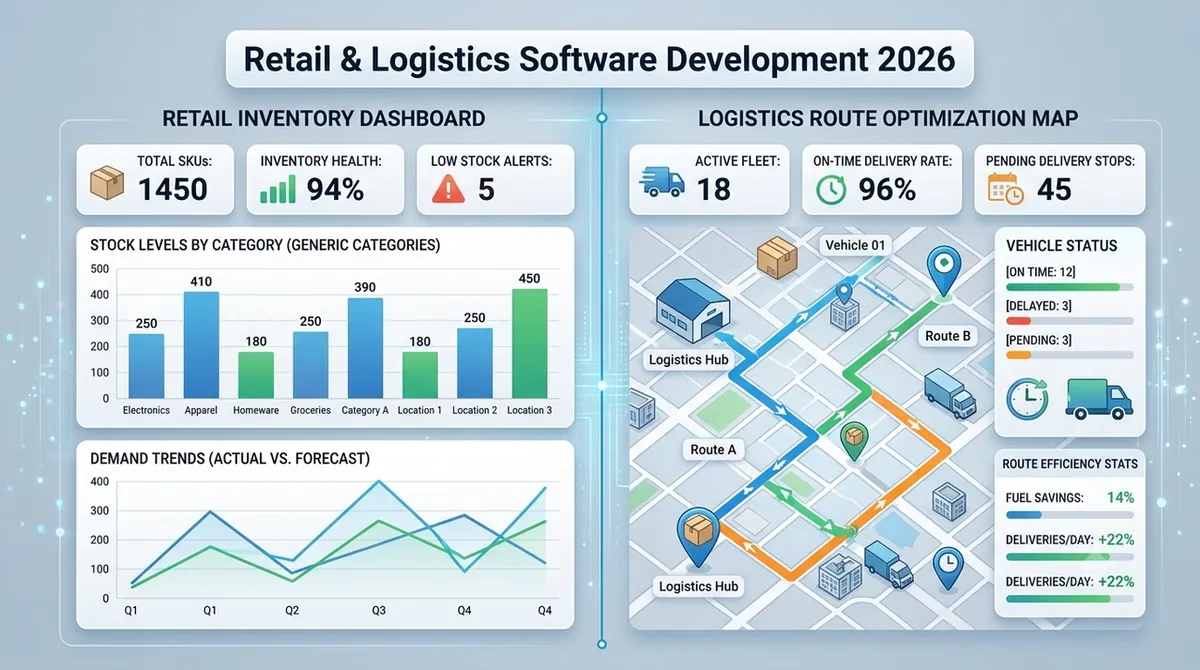
There is a specific mistake that shows up constantly in retail and logistics software projects: a business decides it needs "better software for the warehouse and the store," briefs a single vendor, and receives a single system that handles neither the retail planning problem nor the logistics execution problem particularly well.
This happens because retail software and logistics software answer two different questions. Retail software answers: what should we stock, how much, and where, based on what customers are actually buying across every channel? Logistics software answers: once we know what needs to move, how do we get it from point A to point B as fast and cheaply as possible? These are related questions — but they are not the same question, and a logistics software development company that treats them as identical produces an architecture that inherits the weaknesses of both.
This guide separates the two problems clearly, covers what each actually requires, and explains where they genuinely need to connect — which is different from where most vendors default to merging them.
The Retail-Logistics Software Confusion That Costs Businesses Money
The confusion is understandable. A retailer experiencing stockouts assumes the problem is "the warehouse system." A distributor experiencing late deliveries assumes the problem is "the inventory system." Both diagnoses are often wrong, because the actual failure point is frequently the connection between planning and execution — not either system in isolation.
Most retail supply chain software handles execution capably: it coordinates order fulfillment, warehouse management, and supplier communication across hundreds of SKUs. What it frequently leaves incomplete is the planning layer — the decisions about what to buy, when to replenish, and where to position inventory — which still depends on human judgment working from data that is already out of date by the time a decision gets made.
That gap costs margin in both directions. Overstocking ties up working capital and fills warehouses with markdown-bound inventory. Understocking loses sales and forces emergency freight costs that erase whatever the original software investment was supposed to save.
"A business that briefs 'better software for the warehouse and the store' as a single request usually gets a single system that half-solves two different problems, rather than a good answer to either one."
What Retail Software Actually Does
Inventory Management and Demand Forecasting
Inventory management software tracks stock levels, locations, and movement across every channel a retailer sells through. Demand forecasting layers prediction on top of that tracking — projecting what customers will want and when, so purchasing and replenishment decisions are made ahead of need rather than in reaction to a stockout.
The distinction that matters most in 2026: demand forecasting uses historical sales data to project future demand on a weekly or monthly cadence, which makes it inherently backward-looking. Demand sensing, by contrast, ingests real-time signals — point-of-sale data, current market conditions, live logistics feeds — to generate a short-horizon read that updates continuously, closing the gap between what the forecast predicted last week and what is actually happening today.
What this requires architecturally: a data pipeline that can ingest real-time sales signals rather than only batch-processed historical reports, and a model that treats demand sensing and demand forecasting as complementary layers rather than choosing one or the other.
Omnichannel Retail Architecture
Omnichannel retail software unifies inventory visibility, pricing, and customer data across every channel — physical stores, e-commerce, marketplaces, and mobile — so a customer's experience and a retailer's inventory accuracy remain consistent regardless of where a sale happens.
What this requires architecturally: a single source of truth for inventory that every channel reads from and writes to in near real time, rather than separate systems per channel that periodically sync and drift out of accuracy between syncs.
E-Commerce Fulfillment Software
E-commerce fulfillment software manages the sequence from order placement to shipment — inventory allocation, pick-and-pack workflow, and carrier selection — specifically for the fulfillment patterns of online orders, which differ meaningfully from bulk retail replenishment.
What this requires architecturally: integration with the logistics layer (carrier APIs, shipping rate calculation) without the fulfillment logic itself being owned by a logistics system that was designed for freight movement rather than individual order sequencing.
What Logistics Software Actually Does
Warehouse Management Systems (WMS)
A WMS manages the physical operations inside a warehouse or distribution center — receiving, put-away, picking, packing, and shipping — optimizing the movement of goods within a facility rather than between facilities or to end customers.
Transportation Management and Route Optimization
Transportation management software (TMS) plans and optimizes the movement of goods between locations — carrier selection, load planning, and route optimization that accounts for real-time traffic, weather, and delivery windows to reduce cost and transit time.
Real-Time Tracking and Last-Mile Delivery
Real-time tracking software gives visibility into where a shipment is at any given moment — increasingly expected by both business customers and consumers as a baseline feature rather than a premium one. Last-mile delivery software specifically addresses the final, most expensive, and most customer-visible leg of the delivery journey — where 2026's competitive differentiation increasingly happens.
Fleet Management Software
Fleet management software tracks vehicle location, maintenance schedules, driver behavior, and fuel efficiency for businesses operating their own delivery or transport fleet — a distinct operational concern from route optimization, though the two need to communicate closely.
What all four require architecturally: systems built around movement, timing, and physical logistics constraints — vehicle capacity, driver hours, delivery windows — which is a fundamentally different modeling problem than retail's inventory and demand questions.
Where Retail and Logistics Software Must Connect — and How They Fail When They Don't
The two systems are not meant to be built as one monolith, but they are not meant to be built in isolation from each other either. The connection point that actually matters: retail software determines what needs to move and when it is needed; logistics software determines how it moves and how fast it can arrive. A clean API-level integration between the two — rather than one system trying to own both problems — lets each system be architected correctly for what it actually does.
Where this fails in practice: a retail platform with no real-time connection to logistics execution generates purchase orders based on forecasted demand that never accounts for actual carrier lead times, producing stockouts that the forecasting model could not have predicted because it had no visibility into the logistics side at all. Conversely, a logistics system with no connection to retail demand data optimizes routes and fleet allocation for shipment volumes that may already be outdated by the time the truck leaves the warehouse.
The right architecture treats retail and logistics as two systems with a well-defined, real-time data contract between them — not one undifferentiated platform, and not two systems that only sync in an overnight batch job.
AI in Retail and Logistics — What's Actually Useful in 2026
AI's real value in retail and logistics in 2026 is concentrated in a few specific applications rather than spread evenly across every feature vendors market as "AI-powered."
Genuinely useful: demand sensing that closes the gap between forecast and reality using live signals; route optimization that processes real-time traffic and weather to reduce delivery costs measurably; predictive maintenance for fleet vehicles that flags issues before they cause a breakdown mid-route.
Overstated in most vendor marketing: fully autonomous supply chain "orchestration" that removes human judgment entirely — industry practitioners are consistent that AI accelerates decision-making and spots inefficiencies faster, but does not yet replace the core logistics logic that experienced operations teams apply to genuinely novel situations.
The market reflects this shift: the AI in supply chain market is projected to grow from $13.93 billion in 2025 to $50.41 billion by 2032, concentrated specifically in the targeted applications — forecasting, route optimization, and resource planning — rather than in generalized "AI does everything" platforms.
How AbuQitmirLabs Builds Retail and Logistics Software
Two Problems, Architected Separately, Connected Deliberately
Every retail and logistics engagement at AbuQitmirLabs starts by identifying which problem is actually being solved — the retail planning problem, the logistics execution problem, or genuinely both — before any architecture decision is made. Where both are needed, we build a clean, real-time data contract between the two rather than forcing one system to own both domains.
Full-Stack Retail and Logistics Technology
AbuQitmirLabs builds across the custom software stack that retail and logistics operations require — backend inventory and routing engines, web platforms for operational dashboards and customer-facing tracking, and mobile applications for warehouse staff, delivery drivers, and end customers who need real-time visibility on the move.
Demand Sensing, Not Just Demand Forecasting
Where AI is genuinely useful — demand sensing that ingests live signals rather than only historical batch data, route optimization that accounts for real-time conditions — AbuQitmirLabs builds it as a native part of the architecture, not a bolted-on dashboard widget marketed as "AI-powered."
Retail and Logistics Software by Business Type
Retailers (Physical + E-Commerce) — Priority is omnichannel inventory accuracy and demand forecasting that accounts for both in-store and online sales patterns, connected to fulfillment logic that sequences orders correctly regardless of which channel they originated from.
Third-Party Logistics Providers (3PLs) — Priority is WMS and TMS integration at scale across multiple clients' inventory, with real-time tracking that each client can access without exposing other clients' data — a multi-tenancy architecture requirement most generic logistics software was not built for.
E-Commerce Brands — Priority is fulfillment sequencing and carrier integration that keeps shipping cost and delivery speed competitive, connected tightly enough to inventory data that promised delivery dates are accurate at checkout, not optimistic guesses.
Manufacturers with Distribution Operations — Priority is supply chain visibility from raw material through finished goods distribution, where demand forecasting needs to account for production lead times that retail-only forecasting models do not typically handle.
Frequently Asked Questions
What is the difference between retail software and logistics software?
Retail software manages what to stock, how much, and where — inventory, demand forecasting, and omnichannel sales data. Logistics software manages how goods physically move — warehouse operations, transportation planning, and delivery tracking. They need to connect through real-time data sharing, but they solve different problems and typically require different architectures.
Do I need both retail and logistics software, or can one system handle both?
Most operations genuinely need both, connected through a clean data integration rather than merged into a single platform. A system that tries to own both the retail planning problem and the logistics execution problem typically does neither as well as two properly architected systems with a real-time connection between them.
What is demand sensing, and how is it different from demand forecasting?
Demand forecasting projects future demand from historical sales data on a weekly or monthly cycle, making it backward-looking by design. Demand sensing ingests real-time signals — current sales, market conditions, live logistics data — to generate a continuously updated short-horizon prediction that closes the gap between what was forecasted and what is actually happening right now.
How much does custom retail or logistics software cost to build?
Cost depends heavily on scope — a focused inventory or route optimization module costs significantly less than a full omnichannel retail platform or multi-client 3PL logistics system. The more consequential cost driver is usually integration complexity: connecting to existing carrier APIs, POS systems, and warehouse hardware typically affects the budget more than the core application logic itself.
Conclusion
The businesses getting real value from retail and logistics software in 2026 are not the ones that bought the most feature-rich platform. They are the ones that correctly identified which problem they were actually solving — retail planning, logistics execution, or both — and built or bought software architected specifically for that problem, connected deliberately rather than merged by default.
AbuQitmirLabs builds custom retail and logistics software — inventory and demand forecasting systems, warehouse and transportation management platforms, and the real-time data connections between them — for retailers, 3PLs, e-commerce brands, and distribution operations across the US, UK, Pakistan, Canada, Poland, and Australia.