Introduction
Most startup founders wait too long to build a brand. They think they need a massive budget, a full agency team, or a hundred thousand users before they can invest in their identity.
That is a mistake. In 2026, roughly 60% of all searches are zero-click. Buyers are evaluating your credibility on Google, LinkedIn, and AI Overviews before they ever talk to you. If your brand looks fragmented, you lose the deal before it starts.
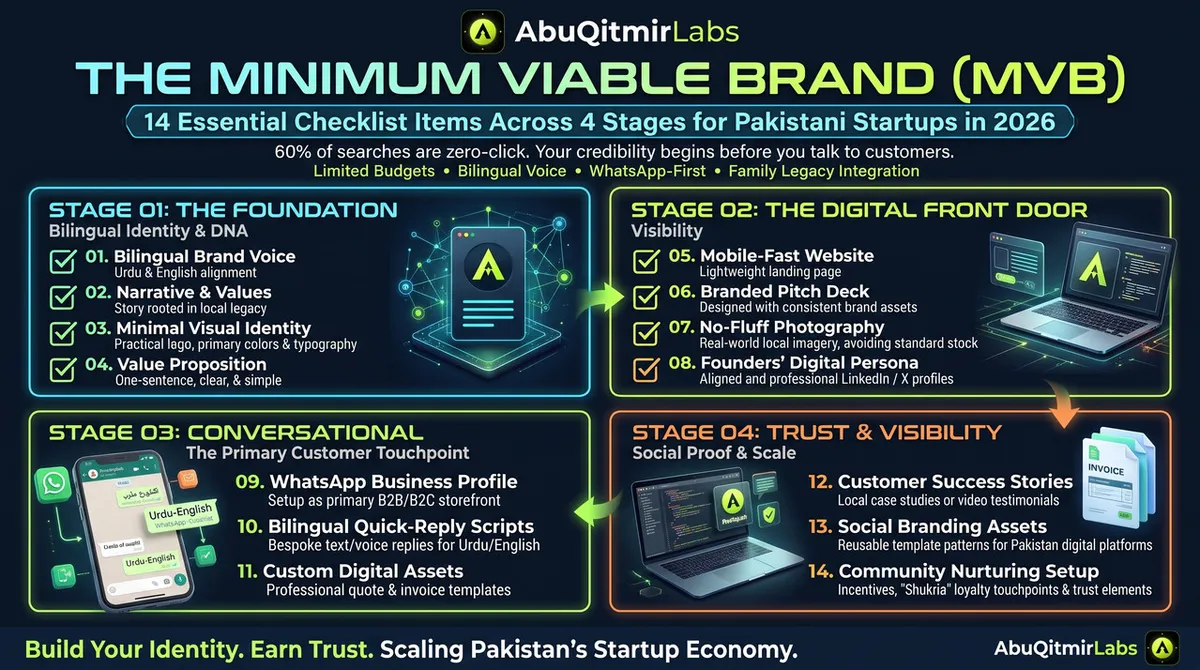
This checklist is designed specifically for pre-seed and seed-stage startups in Pakistan. It cuts through the fluff of Western branding agencies. Instead, it focuses on what actually matters at your stage: limited budgets, family-business legacies, bilingual (Urdu and English) brand voice needs, and WhatsApp-first customer engagement.
At AbuQitmirLabs, we have seen both sides of this equation. We know what happens when a startup rushes to launch without a solid brand foundation. This guide breaks down the 14 essential items you need across four distinct stages.
Quick Verdict: The Minimum Viable Brand (MVB)
For a Pakistani startup, the minimum viable brand requires four things: a defined positioning statement, a functional logo system, a bilingual voice guide, and a high-converting landing page. You do not need a 100-page brand book at pre-seed. You need the foundational elements that build immediate trust.
Stage 1: Foundation (The Strategy)
Before you pick a single font or color, you must define your strategic foundation. This is what separates a real business from a side project. The following 3 items are non-negotiable.
1. Define Your Positioning Statement
Direct Answer: A positioning statement is a single sentence that defines who you serve, what you provide, and why you are different.
Why it matters at pre-seed: It prevents you from chasing every potential customer. It tells investors and early adopters exactly where you fit in the market.
Low-Budget Implementation: Do not hire a consultant for this. Book a two-hour session with your co-founders. Fill in this template: "For [Target Audience] who [Pain Point], our product is a [Product Category] that provides [Key Benefit]. Unlike [Competitor], we [Key Differentiator]."
2. Map Your Target Audience Persona
Direct Answer: An audience persona is a detailed profile of your ideal customer, including their daily frustrations, where they spend time online, and how they make buying decisions.
Why it matters at pre-seed: Generic marketing attracts generic leads. Specific marketing attracts buyers.
Low-Budget Implementation: Create a simple 1-page Google Doc. Talk to 5 potential customers on WhatsApp or LinkedIn. Ask them what keeps them up at night regarding your industry. Write down their exact words. Use those words in your marketing.
3. Establish Competitive Differentiation
Direct Answer: Competitive differentiation is the specific combination of features, price, or service that makes you the obvious choice over your competitors.
Why it matters at pre-seed: If you cannot explain why you are better in 10 seconds, you do not have a brand. You have a commodity.
Low-Budget Implementation: List your top 3 competitors. Create a simple table. Map out what they do well and what they do poorly. Find the gap. (e.g., "Competitors are cheap but slow. We are affordable and deliver in 7 days.")
Stage 2: Visual System (The Look)
Your visual system is how your brand looks to the outside world. You do not need a massive design system yet, but you do need consistency across your website and social media. If you need help, our graphics design services are built for startups.
4. Build a Logo Suite (Not Just a Logo)
Direct Answer: A logo suite is a collection of logo variations: the primary logo, a secondary logo, and a brand mark or icon.
Why it matters at pre-seed: A horizontal logo works on a website header. It will not work on an Instagram profile picture. You need variations for different contexts.
Low-Budget Implementation: Hire a professional for this. Do not use a $5 template. Ensure the deliverable includes SVG, PNG, and EPS files. If you want to know exactly what to ask for, read our guide on how to brief a graphic designer.
5. Lock In Your Color Palette
Direct Answer: A color palette is a set of 4 to 5 specific colors (with exact Hex codes) that represent your brand.
Why it matters at pre-seed: Colors trigger psychological responses and build visual memory. If your Instagram colors do not match your website colors, you confuse the buyer.
Low-Budget Implementation: Use a free tool like Coolors.co. Pick one primary brand color, one dark contrast color, one light background color, and two accent colors. Save the exact Hex codes (e.g., #CCFF00) in a document.
6. Select Your Typography Hierarchy
Direct Answer: Typography is the specific set of fonts your brand uses for headlines and body text.
Why it matters at pre-seed: Bad fonts make a startup look amateur. Consistent fonts make a startup look established.
Low-Budget Implementation: Use Google Fonts. Pick one font for headlines (e.g., Montserrat or Playfair Display) and one highly readable font for body text (e.g., Inter or Roboto). Define sizes: H1, H2, Body, and Caption.
7. Create a Basic Iconography Style
Direct Answer: Iconography is the visual style of the icons you use on your website, app, or pitch deck.
Why it matters at pre-seed: Mixed icon styles (some solid, some outlined, some colorful) look messy.
Low-Budget Implementation: Pick one style and stick to it. Use a platform like Lucide or FontAwesome for free, consistent icons. Our guide on design systems for startups explains how to structure this.
Stage 3: Voice & Messaging (The Words)
How you speak to your customers is just as important as how you look. This is especially critical in the Pakistani market, where trust is built through clear, culturally relevant communication.
8. Develop Brand Voice Guidelines
Direct Answer: Brand voice guidelines define the tone your company uses in its communication. It dictates whether you sound formal, friendly, authoritative, or playful.
Why it matters at pre-seed: In Pakistan, failing to address the Urdu/English dynamic can alienate users. You need to define when to use English, when to use Roman Urdu, and when to mix them.
Low-Budget Implementation: Write down 3 things your brand is, and 3 things it is not. (e.g., "We are direct, but we are not rude. We are professional, but we are not robotic.") Our content writing team uses this exact framework.
9. Craft a Memorable Tagline
Direct Answer: A tagline is a short, punchy phrase that encapsulates your brand promise.
Why it matters at pre-seed: It is the hook that makes people remember what you do.
Low-Budget Implementation: Write 20 variations. Pick the one that clearly states the benefit without using jargon. Test it on 5 friends. If they do not get it immediately, rewrite it.
10. Write Your Boilerplate Copy
Direct Answer: A boilerplate is a standardized 50 to 100 word paragraph that describes your company. It is used in press releases, pitch decks, and your website footer.
Why it matters at pre-seed: It ensures that every time someone writes about you, they use the same description.
Low-Budget Implementation: Write one paragraph that answers: Who are we? What do we do? Who do we do it for? Why does it matter? Keep it strictly factual.
Stage 4: Launch Assets (The Execution)
Now you have the foundation, the look, and the words. It is time to put them together to launch your product. If you need help building the technical side, our web development team can assist.
11. Design a High-Converting Landing Page
Direct Answer: A landing page is a single web page designed specifically to convert visitors into leads or customers.
Why it matters at pre-seed: This is your digital storefront. It must load fast, explain the value proposition clearly, and have a single call to action.
Low-Budget Implementation: Do not overcomplicate it. Use a simple structure: Headline, Subheadline, Problem, Solution, Social Proof, and a Call-to-Action button. Ensure it is mobile-optimized.
12. Build a Professional Pitch Deck
Direct Answer: A pitch deck is a 10 to 15 slide presentation used to explain your business to investors or partners.
Why it matters at pre-seed: Investors fund clarity, not confusion. A messy deck kills momentum.
Low-Budget Implementation: Use Canva or Pitch. Stick to the visual system you just built. Keep text minimal. Focus on the problem, the market size, the solution, and the traction.
13. Create Social Media Templates
Direct Answer: Social media templates are pre-designed graphics that allow you to post consistently on platforms like LinkedIn, Instagram, and Facebook without redesigning from scratch.
Why it matters at pre-seed: Consistency builds trust. If you post text one day and a blurry screenshot the next, you look disorganized.
Low-Budget Implementation: Design 3 to 5 templates in Canva. One for quotes, one for industry news, one for product updates. Ensure your logo and colors are in the exact same spot every time.
14. Create a Basic Brand Guidelines Document
Direct Answer: A brand guidelines document is a simple PDF or presentation that houses all your brand rules: logo usage, colors, fonts, and voice.
Why it matters at pre-seed: It prevents freelancers, developers, and employees from misusing your brand assets.
Low-Budget Implementation: Do not write a 100-page manual. Create a 5-page Google Slide presentation. Page 1: Logo usage. Page 2: Color codes. Page 3: Fonts. Page 4: Voice rules. Page 5: Contact info for brand questions.
Frequently Asked Questions
What is a brand identity checklist for startups?
A brand identity checklist for startups is a structured guide that outlines the essential visual, verbal, and strategic elements a new business needs to build a recognizable and trustworthy brand. It ensures founders do not skip foundational steps.
How much does it cost to build a startup brand in Pakistan?
You can build a minimum viable brand for under PKR 50,000 if you focus on the essentials (logo, colors, landing page). Full agency branding can range from PKR 80,000 to PKR 250,000 depending on the depth of research and deliverables.
When should a startup invest in brand identity?
A startup should invest in a basic minimum viable brand right before launching its product or seeking its first round of funding. You need a credible identity to attract early adopters and investors.
Should I use Urdu or English for my startup brand?
You should use a bilingual approach. Use English for formal communications, technical documentation, and investor decks. Use Roman Urdu for social media engagement, customer support, and WhatsApp marketing to build trust with local consumers.
What is a Minimum Viable Brand (MVB)?
A Minimum Viable Brand is the absolute minimum amount of brand strategy, design, and messaging required to launch a credible business. It includes a positioning statement, a professional logo, a color palette, a voice guide, and a landing page.
Why is a logo system better than just a single logo?
A logo system provides variations (horizontal, vertical, icon) for different platforms. A single logo often looks distorted on app icons or social media profiles, creating a fragmented brand presence. Read our guide on brand identity vs logo design for more details.
How do I choose the right colors for my brand?
Choose colors based on the psychology of your target audience and your industry. For example, blue conveys trust (suitable for fintech), while bold yellows and greens convey energy and growth (suitable for consumer startups).
What is the biggest branding mistake Pakistani startups make?
The biggest mistake is copying global brands without localization. A brand that works in Silicon Valley will not automatically resonate in Karachi. You must adapt your messaging, tone, and visual triggers to local cultural contexts. We cover this in small business branding mistakes.
Conclusion
Building a brand does not require a massive budget. It requires clarity, consistency, and a focus on the right priorities for your stage.
Use this 14-point checklist to build your Minimum Viable Brand. Start with the Foundation and Visual System. If you need expert help to get it right the first time, our brand building services are designed specifically for pre-seed and seed-stage startups.
Do not let a fragmented brand cost you your next client. Build a system that scales.
Get in touch today to discuss your startup brand strategy.