When to Invest in AI Agent: 2026 Cost Guide | AbuQitmirLabs
Quick Takeaways
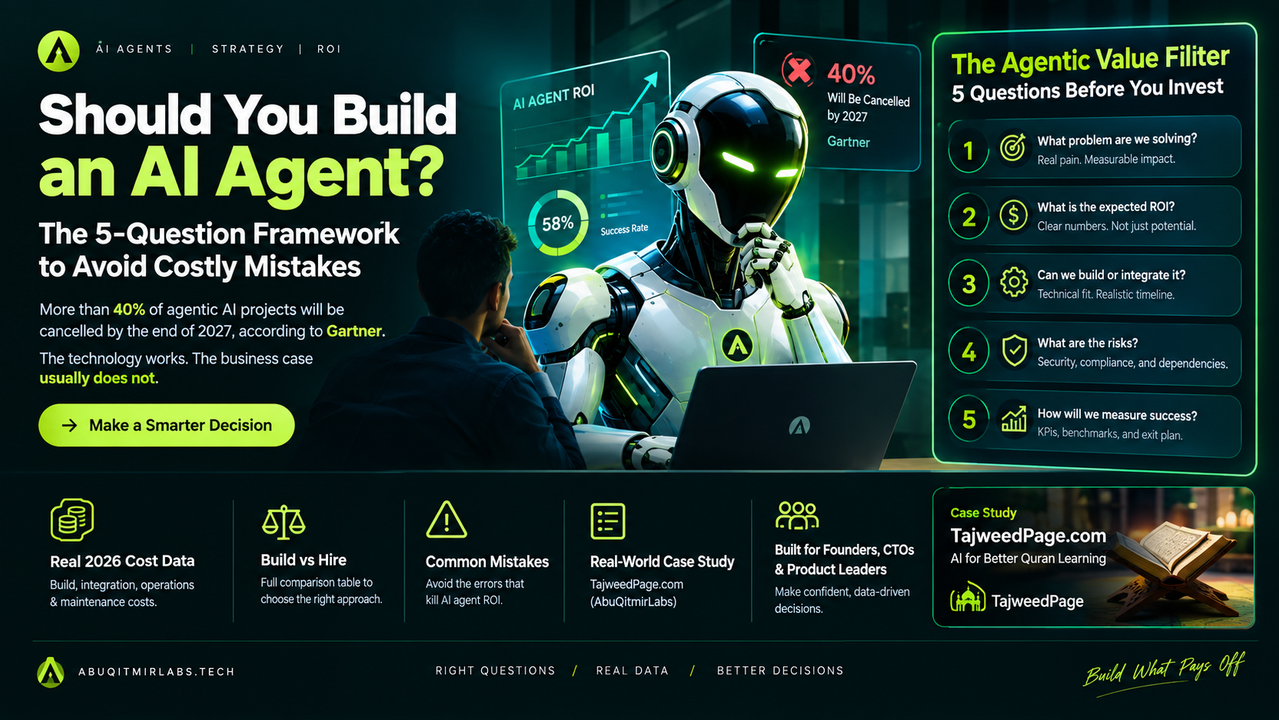
- More than 40% of agentic AI projects are expected to be cancelled by the end of 2027, largely because of unclear business value, rising costs, and inadequate risk controls.
- AI agents can reduce per-task costs by 90% or more for the right workloads, but simple cost comparisons often ignore development, integration, operations, and maintenance.
- The Agentic Value Filter is a five-question framework designed to help founders determine whether an AI agent has a realistic path to paying for itself before committing a major budget.
- Specialised, domain-specific agents are more likely to produce measurable ROI than broad, general-purpose agents.
- A realistic AI agent budget should account for four cost layers: build, integration, operations, and maintenance.
- AbuQitmirLabs builds production AI systems for startups and enterprises, including a RAG-based AI education platform at TajweedPage.com.
- The key question is not whether an AI agent can be built. The real question is whether the business case still works after every major cost is included.
Introduction: The AI Agent Investment Problem
Almost every founder has heard the same promise:
AI agents can automate your operations, reduce repetitive work, and dramatically lower costs.
There is truth behind that promise.
A 2026 benchmark cited in this research found that AI agents completed certain tasks for approximately $0.94 to $2.39 per task, compared with $24.79 for human workers. For the right type of workload, that represents a potential cost reduction of roughly 90% to 96%.
Gartner also expects task-specific AI agents to become increasingly common across enterprise applications.
But there is another side to the story.
Gartner predicts that more than 40% of agentic AI projects will be cancelled by the end of 2027. The reasons include escalating costs, unclear business value, and inadequate risk controls. Industry research also indicates that many generative AI pilots fail to produce measurable profit-and-loss impact.
So both statements can be true:
AI agents can save businesses significant amounts of money.
And:
Many AI agent projects fail to prove that they created measurable financial value.
The difference usually comes down to how the project is selected, scoped, integrated, measured, and maintained.
AbuQitmirLabs builds production AI systems for startups and enterprises through its AI agent development practice, including a RAG-based AI education platform at TajweedPage.com.
This guide presents the decision framework we use to evaluate whether an AI agent is worth building before a company commits significant development budget.
Why Most AI Agent Cost Comparisons Are Misleading
Many comparisons between AI agents and human employees look extremely attractive.
The problem is that they often compare two very different cost structures.
There are two common issues.
1. The Comparison Is Asymmetric
The AI side is often represented by a simple API or token cost.
The human side may include:
- Salary
- Benefits
- Management overhead
- Training
- Recruitment
- Office expenses
- Administrative costs
That makes the AI option look dramatically cheaper before the AI system has even entered production.
A production AI agent has its own expenses, including:
- Model inference
- Token usage
- Data pipelines
- RAG infrastructure
- Evaluation
- Monitoring
- Orchestration
- Security
- API integrations
- Human review
- Maintenance
- Ongoing optimisation
A prototype can be inexpensive.
A reliable production system is a different financial calculation.
2. Successful Case Studies Create Selection Bias
Successful AI projects receive attention.
Failed projects usually do not.
That creates a dangerous assumption:
"Another company saved millions with AI, so our company should save millions too."
Not necessarily.
The workload, task volume, data quality, integrations, risk tolerance, and maintenance requirements may be completely different.
The research cited in the original article also notes that AI is not automatically cheaper than employees in every environment.
The economics depend on:
- What the agent does
- How frequently it operates
- How many systems it connects to
- How reliable it must be
- How much data it processes
- How expensive the underlying models are
- How much engineering and maintenance are required
The honest comparison is therefore not:
AI token cost vs employee salary.
It is:
Total cost of the AI system vs total cost of the existing business process.
That is the number founders should actually care about.
The Real Total Cost of an AI Agent
An AI agent should be evaluated across four major cost layers.
Most buyers focus on the first layer and underestimate the other three.
Layer 1: Build Cost
The initial development cost depends heavily on the complexity of the agent.
Planning ranges from the source research include:
- $10,000–$30,000 for a basic task-specific AI agent
- $25,000–$80,000 for a custom business agent using proprietary data and API integrations
- $80,000–$200,000+ for complex multi-agent systems
- $15,000–$40,000 for a two-to-four-week feasibility or discovery assessment
These figures should be treated as planning ranges rather than universal prices.
A simple agent that classifies support tickets is fundamentally different from an agent that operates across an ERP, CRM, document system, internal database, and customer portal.
Layer 2: Integration Cost
Integration is where many AI budgets become significantly larger than expected.
A production agent may need to connect with:
- CRM systems
- ERP platforms
- Support software
- Internal databases
- Document repositories
- Authentication systems
- Payment platforms
- Existing business APIs
The source research estimates agentic AI infrastructure deployment at approximately $40,000–$200,000+, depending on the environment and complexity.
Re-engineering an existing agent for a different platform may also cost approximately $15,000–$80,000 per agent.
This leads to an important principle:
The intelligence is only one part of the system. The integrations are often where much of the engineering effort lives.
Layer 3: Ongoing Operational Cost
The cost does not stop when the agent goes live.
Production deployments can generate recurring expenses for:
- Model inference
- Token consumption
- Cloud infrastructure
- Vector databases
- Orchestration
- Logging
- Monitoring
- Observability
- External API usage
The source research places average production operational spending in the range of approximately $3,200–$13,000 per month.
An agent that appears inexpensive during development can therefore become expensive at scale if usage is not monitored and optimised.
Layer 4: Maintenance and Adaptation
AI agents are not set-and-forget software.
Models change.
APIs change.
Business processes change.
Knowledge bases become outdated.
Security requirements evolve.
User behaviour changes.
A system that performs well today may require engineering work six months from now.
Maintenance should therefore be treated as a recurring business expense, not as an optional post-launch activity.
The Full Cost Picture
| Cost Layer | What It Includes | Financial Impact |
|---|---|---|
| Build | AI logic, prompts, RAG, tools, workflows, UI | Initial development investment |
| Integration | CRM, ERP, APIs, databases, authentication | Can become a major project cost |
| Operations | Models, tokens, infrastructure, monitoring | Recurring monthly expense |
| Maintenance | Updates, optimisation, API changes, security | Continuous long-term expense |
Once all four layers are included, the fully loaded cost of a production AI agent can be significantly higher than the model or token bill.
That does not mean the investment is a bad idea.
It means the investment needs to be evaluated using total cost of ownership.
The Agentic Value Filter: A Five-Question Decision Framework
The Agentic Value Filter is a five-question framework for determining whether an AI agent has a realistic chance of paying for itself.
Answer these questions before committing a significant development budget.
Question 1: Is the Task High-Volume and Repetitive?
AI agents generally become more economically attractive as task volume increases.
Consider the difference between:
- A support agent processing 10,000 routine tickets per month
- An internal agent processing 50 occasional requests per month
The first workflow has many more opportunities to recover the development investment.
The second may not generate enough savings to justify building a custom system.
Practical Threshold: High-Volume Tasks
If a process consumes more than 40 hours of human time per week, it is worth seriously evaluating for AI automation.
If it consumes less than 20 hours per week, the development cost may be difficult to justify unless the process has unusually high value, risk, or strategic importance.
The exact threshold depends on the business.
The broader principle is:
High-value + high-volume + repetitive work is the strongest starting point for AI automation.
Question 2: Does the Task Require Reasoning Across Multiple Systems?
Not every automation problem needs an AI agent.
Some workflows can be solved more cheaply with:
- Scripts
- API integrations
- Scheduled jobs
- RPA
- Traditional automation platforms
Agents become more interesting when a workflow crosses multiple systems and requires contextual decisions.
For example:
- Read an invoice from email.
- Extract the relevant information.
- Match the supplier against company records.
- Check purchase-order information.
- Identify discrepancies.
- Update the ERP.
- Escalate unusual cases to a human.
That is significantly more complex than submitting a form through an API.
For workflows that span several systems, enterprise AI automation solutions can provide the orchestration layer required to connect the different parts of the process.
Practical Threshold: Cross-System Reasoning
If a workflow crosses three or more systems and involves authentication, reasoning, and decision-making, an AI agent may be worth evaluating.
If it touches only one system and follows predictable rules, a script or RPA workflow may accomplish the same job for less.
Do not build an AI agent simply because AI is available.
Build one when the workflow actually benefits from agent-like reasoning and action.
Question 3: Do You Have Clean and Accessible Data?
This is one of the most overlooked factors in AI projects.
An AI agent can only work with information it can reliably access.
If your:
- Knowledge base is outdated
- Data is fragmented
- APIs are undocumented
- Documents contradict each other
- Permissions are unclear
- Business rules exist only in employees' heads
then the AI system inherits those problems.
RAG does not magically turn poor source material into reliable knowledge.
A sophisticated retrieval pipeline connected to outdated or contradictory information can still produce poor results.
Practical Threshold: Data Readiness
Before development, you should be able to answer:
"Where does the information for each step of this workflow live, and how will the agent retrieve it?"
If you cannot answer that clearly, you may need a data and systems readiness project before an AI agent project.
Question 4: Is the Task Domain-Specific Enough to Measure?
One of the strongest patterns in agentic AI is the value of specialised systems.
A general-purpose agent that claims to:
"Handle customer service, finance, HR, operations, research, and sales."
is difficult to evaluate.
A specialised agent that performs one clearly defined job is much easier to measure.
Examples include:
- Healthcare claims review
- Prior-authorisation processing
- Workers' compensation claims review
- Document classification
- Customer-support triage
- Internal knowledge retrieval
- Education and tutoring workflows
The source research cites Gartner's analysis that a large majority of tangible agentic AI ROI is expected to come from specialised, domain-specific agents rather than broad general-purpose systems.
Practical Threshold: Domain Specificity
You should be able to describe the agent's purpose in one sentence and connect it to a measurable KPI.
For example:
"The agent classifies incoming support requests and routes them to the correct team with at least 95% accuracy."
That is measurable.
"Build an AI employee that improves the business" is not.
If you cannot define the job clearly, the scope is probably too broad.
Question 5: Can You Survive the First Six Months Without a Return?
AI agent projects require time to mature.
Even when the technology works, the production system may require:
- Evaluation
- Prompt optimisation
- Workflow tuning
- Integration fixes
- Data cleaning
- Human feedback
- Error analysis
- Cost optimisation
The source research cites a Forrester Total Economic Impact study of the GitLab Duo Agent Platform that found a payback period of under six months and significant ROI over three years.
However, a mature platform deployment should not be treated as a guarantee for every custom AI project.
Custom systems may take longer because they have to be:
- Designed
- Integrated
- Tested
- Evaluated
- Tuned
- Deployed
- Monitored
Practical Threshold: Six-Month Payback Window
If your business cannot comfortably absorb six to twelve months of development, testing, tuning, and optimisation before meaningful returns appear, the project may be premature.
The goal is not to force an AI project into existence.
The goal is to make sure the business can support the investment long enough for the economics to become measurable.
The Agentic Value Filter at a Glance
| Question | Strong Signal | Warning Sign |
|---|---|---|
| 1. Volume | High-volume repetitive work | Low-frequency task |
| 2. Complexity | Multiple systems + reasoning | Simple one-step automation |
| 3. Data | Clean, structured, accessible data | Fragmented or unreliable data |
| 4. Scope | Specialised job with measurable KPI | Broad "do everything" agent |
| 5. Payback | Business can tolerate 6–12 months | Immediate ROI required |
If several answers are weak, the right decision may be:
Do not build the agent yet.
That can be a much better business decision than spending money simply because agentic AI is currently popular.
Build In-House vs Hire an AI Agent Development Agency
Once a use case passes the Agentic Value Filter, the next question is:
Who should build it?
There is no universal answer.
The decision depends on:
- Internal technical talent
- Speed requirements
- Product strategy
- Integration complexity
- Long-term AI plans
- Available budget
Build vs Hire Comparison
| Factor | Build In-House | Hire an Agency |
|---|---|---|
| When it makes sense | AI agents are core to your product and you already have senior AI engineers | You need a production agent and do not have an experienced team |
| Team requirement | Senior AI engineer, data engineer, DevOps, QA | Agency provides the required specialists |
| Time to production | Often 6–12 months including hiring and setup | Potentially 90 days or less for a well-scoped project |
| Upfront cost | Approximately $150K–$400K+ in salaries and setup before launch | Approximately $25K–$200K+ depending on complexity |
| Ongoing cost | Salaries, benefits, infrastructure, management | Project fee or ongoing retainer |
| IP ownership | Full ownership | Contract-dependent; ownership should be clearly defined |
| Best for | AI is a permanent core capability | AI supports an existing product or business process |
When Hiring an AI Agent Development Agency Makes Sense
An experienced agency can make sense when:
- You need to launch quickly.
- Your team has not shipped a production AI agent before.
- The system requires several enterprise integrations.
- Authentication and permissions are complex.
- You operate in a regulated environment.
- You need to launch in under 90 days.
- You do not want to hire a complete AI engineering team before validating the business case.
A serious AI development partner should be able to demonstrate experience with:
- Production AI deployments
- RAG systems
- API integrations
- Evaluation
- Observability
- Security
- Failure handling
- Human-in-the-loop workflows
- Cost optimisation
The goal should not be to build a flashy demo.
The goal should be to build a system that can survive real users, real data, real integrations, and real business requirements.
When In-House Development Makes More Sense
Build internally when AI agents are expected to become a permanent part of your company's core product or operations.
It makes even more sense when you can support the long-term team required for:
- AI engineering
- Data engineering
- Infrastructure
- QA
- Evaluation
- Security
- Operations
The mistake is hiring an agency simply because AI is complicated when you actually need a permanent internal AI capability.
The opposite mistake is hiring a full AI engineering team when you only need one specialised agent.
Real-World Example: TajweedPage.com
AbuQitmirLabs built an AI-powered Quran learning platform at TajweedPage.com.
The platform combines structured learning experiences with AI-powered functionality, including an AI Tajweed Teacher Chat built around a RAG-based approach and the platform's own verified educational content.
The project provides a useful example of applying the Agentic Value Filter to a specialised domain.
1. Volume
Students can access the platform from different locations and time zones.
An AI learning assistant can therefore provide support beyond the scheduling limitations of individual human tutors.
2. Reasoning Across Systems
The AI experience can work with structured course content and learning context instead of functioning as a generic chatbot.
The system is designed around a specific educational workflow.
3. Data Quality
The AI experience is grounded in the platform's own structured educational material.
That matters because domain-specific AI systems depend heavily on the quality of the information they retrieve.
4. Domain Specificity
The agent has a clear purpose:
Help students learn Tajweed.
It is not trying to become a universal AI assistant.
That narrower scope makes the system easier to evaluate, improve, and govern.
5. Long-Term Availability
A digital AI learning layer can operate continuously without the scheduling limitations of human tutors.
That creates a different cost structure and gives the platform an opportunity to support more learners without scaling human availability at exactly the same rate.
The TajweedPage project demonstrates how a RAG-based AI system can be integrated into a modern web application to provide context-aware, domain-specific functionality.
Common Mistakes That Kill AI Agent ROI
Even technically impressive AI projects can fail financially.
Here are five common mistakes founders should avoid.
Mistake 1: Starting With a General-Purpose Agent
The temptation is to build one large AI system that can perform dozens of jobs.
That makes evaluation harder and usually increases development complexity.
A better approach is:
- Select one valuable workflow.
- Automate that workflow.
- Measure the result.
- Improve reliability.
- Expand only after the economics are proven.
Start narrow. Prove ROI. Then expand.
Mistake 2: Ignoring Maintenance Costs
AI agents are not set-and-forget software.
Models update.
APIs change.
Business requirements evolve.
Knowledge bases change.
The source research recommends budgeting approximately 20%–30% of build cost annually for maintenance and adaptation.
Treat that expense as part of the original business case.
Mistake 3: Measuring Hours Saved Instead of Business Outcomes
"Employees saved 500 hours" sounds impressive.
But what happened to those hours?
Did the company:
- Reduce payroll?
- Increase output?
- Process more customers?
- Reduce overtime?
- Improve response times?
- Reduce errors?
- Increase revenue?
Time saved does not automatically equal financial value.
Better metrics include:
- Cost reduction
- Cost avoidance
- Revenue growth
- Error reduction
- Risk reduction
- Faster processing
- Increased throughput
- Customer retention
Measure business outcomes, not just hours saved.
Mistake 4: Removing Human Oversight Too Early
A production AI agent needs appropriate boundaries.
Without human oversight where it is needed, an agent can:
- Misinterpret instructions
- Make an incorrect decision
- Trigger an unintended action
- Lose important context
- Escalate a small issue into a larger one
High-impact workflows should have an appropriate human escalation path.
The goal is not always to remove humans from the process.
Sometimes the strongest AI system is one that handles routine work while humans focus on exceptions and high-value decisions.
Mistake 5: Deploying Too Many Unmanaged Agents
Once a company discovers that agents can work, it can become tempting to deploy them everywhere.
That can create agent sprawl.
Multiple unmanaged agents may lead to:
- Fragmented governance
- Duplicate functionality
- Security risks
- Unauthorised automated actions
- Difficult monitoring
- Inconsistent business rules
A better strategy is:
Start with one. Operate it properly. Measure it. Then scale.
Frequently Asked Questions
How much does it cost to build an AI agent in 2026?
A basic task-specific AI agent may cost approximately $10,000–$30,000.
A custom business agent involving proprietary data and API integrations may cost approximately $25,000–$80,000.
A more complex multi-agent system can reach $80,000–$200,000+.
Production operations may add approximately $3,200–$13,000 per month, depending on model usage, infrastructure, integrations, monitoring, and scale.
These should be treated as planning ranges rather than fixed prices.
The actual cost depends on:
- Workflow complexity
- Data requirements
- Number of integrations
- Security requirements
- Model selection
- Expected usage
- Production reliability requirements
How long does it take to see ROI from an AI agent?
There is no universal payback period.
The source research cites a Forrester study of GitLab Duo Agent Platform that found payback in under six months.
Custom AI systems may take longer because they require data preparation, integration, testing, evaluation, workflow tuning, and production optimisation.
For a well-scoped, domain-specific agent, six to twelve months can be a more realistic planning window for full payback.
High-volume workloads with clear financial metrics can potentially recover the investment faster.
Is it cheaper to build an AI agent or hire a human employee?
It depends entirely on the job.
The source research cites a 2026 benchmark where AI agents completed certain tasks at approximately $0.94–$2.39 per task, compared with $24.79 for human workers.
However, that comparison does not include the complete cost of building and maintaining the AI system.
For high-volume, repetitive, measurable tasks, an agent can become substantially cheaper over time.
For low-volume, complex, relationship-driven, or highly contextual work, a human may remain the more economical option.
What percentage of AI agent projects fail?
Gartner predicts that more than 40% of agentic AI projects will be cancelled by the end of 2027.
The source research identifies escalating costs, unclear business value, and inadequate risk controls as major reasons.
Projects are particularly vulnerable when they begin with:
- Broad scope
- Poor data foundations
- No measurable KPI
- Unrealistic ROI assumptions
- Underestimated integration costs
- No long-term maintenance plan
Should I hire an AI agent development company or build in-house?
Hire an experienced agency when:
- You need to launch quickly.
- Your team lacks production AI experience.
- The project requires complex integrations.
- You need specialised AI engineering expertise.
- You need an external team to validate the business case.
Build in-house when AI agents will become a permanent core capability and you can support the engineering, infrastructure, evaluation, security, and operations teams required to maintain them.
What is the difference between an AI agent and a chatbot?
A chatbot primarily responds to user input.
An AI agent is designed to pursue a goal through multiple steps.
Depending on its implementation, an agent may:
- Understand the objective.
- Plan the next action.
- Retrieve information.
- Call external tools.
- Execute actions.
- Evaluate the result.
- Continue or escalate when necessary.
If a system simply answers questions, it may be more accurate to call it a chatbot.
An agent is more appropriate when the system can take actions toward a defined outcome.
How does AbuQitmirLabs approach AI agent development?
AbuQitmirLabs builds production AI agents and AI-powered systems for startups and enterprises.
Before proposing an AI agent, we use the Agentic Value Filter to evaluate:
- The business problem
- Expected ROI
- Workflow complexity
- Data availability
- Integration requirements
- Risk
- Long-term operating costs
If the numbers do not make sense, the right answer may be not to build the agent.
When the business case is strong, we focus on domain-specific systems using technologies such as:
- RAG pipelines
- LLM integration
- AI agent workflows
- API integrations
- Production orchestration
- Context-aware retrieval
- Human-in-the-loop controls
Our work includes TajweedPage.com, a RAG-based AI education platform.
Conclusion: Invest When the Math Works
AI agents are not guaranteed cost-saving machines.
They are software investments with a measurable business case.
That means the calculation should include all four major cost layers:
- Build
- Integration
- Operations
- Maintenance
Then apply the Agentic Value Filter.
Ask:
- Is the task high-volume and repetitive?
- Does it require reasoning across multiple systems?
- Is the required data clean and accessible?
- Is the use case specialised enough to measure?
- Can the business tolerate six to twelve months before full payback?
If the answers are strong, the project deserves serious consideration.
If several answers are weak, that is not a reason to force an AI project into existence.
It is a reason to rethink the use case.
The strongest AI agent ROI generally comes from specialised systems solving specific, measurable business problems.
Not vague "AI transformation."
Not a general-purpose digital employee.
Not an agent that tries to do everything.
One agent. One job. One measurable outcome.
That is the foundation of a defensible AI investment.
If you are evaluating an AI agent investment and want a second opinion on the technical approach, cost, integrations, and potential ROI, contact AbuQitmirLabs for a technical consultation.
We will help you determine whether your use case actually clears the Agentic Value Filter — and if it does not, we will tell you that too.
Related Internal Content
- AI Agent Development Pillar: https://www.abuqitmirlabs.tech/ai-agent-development
- Enterprise AI Automation: https://www.abuqitmirlabs.tech/solutions/ai-automation
- RAG AI Integration Guide: https://www.abuqitmirlabs.tech/blog/the-complete-guide-to-rag-ai-integration-for-startups
- Custom Software Development: https://www.abuqitmirlabs.tech/custom-software
- TajweedPage Case Study: https://www.abuqitmirlabs.tech/case-studies/tajweedpage

Abu Qitmir Mohammad Shiraz Al-Madani
Founder & Lead Systems Architect at AbuQitmirLabs. Specializing in high-performance digital ecosystems, AI-driven architectures, and building scalable full-stack software systems.