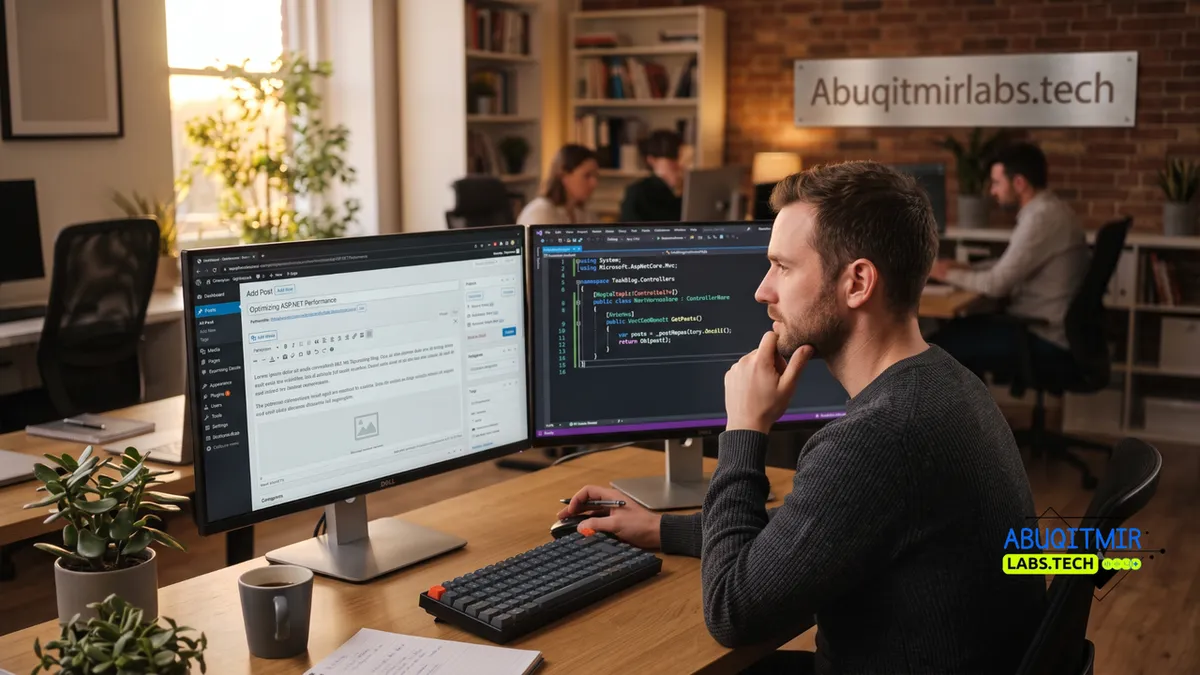
Summary Box
🌐 Summary: This guide delivers a complete, honest comparison of WordPress and ASP.NET for enterprise web development in 2026 — covering performance, security, scalability, cost of ownership, customization depth, and integration capability. It explains precisely which platform wins in which scenario and when neither is the right answer. AbuQitmirLabs builds custom enterprise web solutions on both platforms and beyond, for businesses across the US, UK, and Europe. Read time: approximately 12 minutes.
Table of Contents
- Introduction
- What This Comparison Is Actually About
- WordPress for Enterprise — The Real Picture
- ASP.NET for Enterprise — The Real Picture
- Head-to-Head Comparison: 8 Critical Factors
- When WordPress Is the Right Enterprise Choice
- When ASP.NET Is the Right Enterprise Choice
- When Neither WordPress Nor ASP.NET Is the Answer
- The Integration Question — Where Platform Choice Gets Serious
- How AbuQitmirLabs Navigates Platform Decisions
- Enterprise Web Development by Industry
- Frequently Asked Questions
- Final Thoughts
Quote
"Platform choice is not a technology question. It is a business question — and the right answer depends on what the business needs its web presence to do, not on which platform the development team prefers to work in." — AbuQitmir Mohammad Shiraz Al-Madani
Key Highlights
- WordPress powers over 40% of the web but was not designed for enterprise-scale applications — and the gap between its design intent and enterprise requirements shows up predictably in security, performance, and integration depth
- ASP.NET is a mature, enterprise-grade framework with superior performance and security architecture but carries higher development cost and a more specialized talent pool requirement
- The correct platform choice is determined by the business's specific requirements — not by which platform is more popular or which the development team prefers
- Neither platform is the right answer for businesses that need deep operational integration with proprietary systems — where custom development beyond either platform's defaults is required
- Security vulnerability exposure is the most underappreciated risk in WordPress enterprise deployments, driven primarily by third-party plugin dependency rather than the WordPress core itself
- Total cost of ownership over three to five years frequently favors ASP.NET for complex enterprise applications despite its higher initial development cost
- Custom web development built on the right foundation — chosen for the business's specific requirements — outperforms either platform used generically
Introduction
The WordPress vs. ASP.NET debate for enterprise has been running for years, producing more heat than light. Most of the content on this topic falls into one of two predictable camps.
The first camp minimizes WordPress's enterprise limitations — citing its massive ecosystem, its flexibility, and the countless large organizations that have deployed it successfully. What this camp tends not to mention is the security posture of large WordPress deployments, the performance ceiling of plugin-heavy implementations, and the architectural constraints that surface when enterprise-scale operational integration is required.
The second camp overstates the complexity and cost of ASP.NET — positioning it as a technology that only Fortune 500 companies with large internal development teams can realistically use. What this camp tends not to mention is that ASP.NET's performance architecture, security model, and integration depth have become significantly more accessible with modern .NET tooling.
Neither version is particularly useful for a business that needs to make an actual platform decision. This guide is the honest version — a structured comparison of what each platform actually delivers for enterprise use cases, where each wins, where each fails, and when neither is the right answer for what the business needs its web development to accomplish.
What This Comparison Is Actually About
Before comparing platforms, it is worth being precise about what "enterprise" means in this context — because the word gets applied to a wide range of situations that have very different requirements.
For this guide, enterprise web development means:
- A web presence or web application that handles significant traffic volume — thousands of sessions per day or more
- Integration with operational systems — CRM, ERP, payment processors, databases, authentication systems, or custom software built for the business
- Security requirements that go beyond a basic SSL certificate and password protection
- A team of more than one person managing the website's content, functionality, or development
- A requirement that the web presence scale with the business over a multi-year horizon without requiring a full rebuild
By this definition, many businesses that consider themselves mid-market rather than enterprise are making enterprise web development decisions — and choosing their platform accordingly matters.
WordPress for Enterprise — The Real Picture
WordPress began as a blogging platform in 2003 and has evolved into the world's most widely used content management system, powering over 40% of all websites. Its dominance is real, and it reflects genuine strengths: a vast ecosystem of themes and plugins, a large pool of developers familiar with the platform, an accessible content editing interface, and a community that has produced solutions for an enormous range of use cases.
Where WordPress Genuinely Works at Enterprise Scale
Content-heavy publishing. For organizations whose primary web function is publishing large volumes of content — news organizations, media companies, content marketing operations — WordPress's content management architecture is mature, flexible, and well-supported. Its editorial workflow, multi-author management, and content taxonomies are genuinely enterprise-capable for this use case.
Marketing and campaign sites. WordPress's flexibility for marketing teams — the ability to create landing pages, run A/B tests through plugins, manage multiple campaign sites, and integrate with marketing automation tools — makes it a practical choice for the marketing layer of an enterprise's web presence.
Rapid deployment with known requirements. When the requirements are well-understood, the functionality maps to existing plugins, and the deployment timeline is a genuine constraint, WordPress can deliver a capable result faster than a custom ASP.NET build.
Where WordPress Falls Short at Enterprise Scale
Security vulnerability surface. WordPress's security model is as strong as its weakest plugin — and an enterprise WordPress deployment typically runs dozens of plugins, each maintained by a different developer on a different update schedule. The WordPress core is well-maintained, but the plugin ecosystem is not uniformly so. Enterprise deployments that rely on third-party plugins for critical functionality are exposing that functionality to the vulnerability posture of the plugin's maintainer.
Performance under genuine load. WordPress's PHP architecture, combined with the database query overhead generated by complex plugin stacks, produces performance characteristics that require significant infrastructure investment to maintain under enterprise-scale traffic. Caching layers, CDN configurations, and database optimization can address this — but they add complexity and cost that a well-architected ASP.NET application does not require to the same degree.
Deep operational integration. WordPress integrates readily with third-party services through its plugin ecosystem. It integrates with difficulty with proprietary operational systems — legacy databases, custom authentication systems, bespoke business logic — because its integration model was designed around publicly available APIs, not enterprise-specific internal systems.
Multi-environment development discipline. Enterprise development requires staging environments, version-controlled deployments, and CI/CD pipelines. WordPress's architecture does not naturally support these practices — they require additional tooling and discipline to implement, and the risk of environment inconsistency is real.
ASP.NET for Enterprise — The Real Picture
ASP.NET is Microsoft's web development framework, first released in 2002 and significantly modernized through the open-source, cross-platform .NET Core evolution that produced the current .NET 8 framework. It is a mature, enterprise-grade framework used by major financial institutions, healthcare organizations, logistics operators, and government systems worldwide.
Where ASP.NET Genuinely Wins at Enterprise Scale
Performance architecture. ASP.NET consistently produces some of the fastest server-response times of any web framework. Its compiled, statically-typed architecture eliminates the runtime interpretation overhead of PHP-based platforms, and its async request handling model scales efficiently under high concurrent load.
Security model. ASP.NET's security architecture — built-in authentication and authorization systems, CSRF protection, SQL injection prevention through parameterized queries, and the security track record of the underlying .NET runtime — provides an enterprise security posture that does not depend on the maintenance discipline of third-party plugin authors.
Deep integration capability. ASP.NET is designed for integration with enterprise systems — Microsoft's own ecosystem (Azure, Active Directory, SQL Server) as well as third-party enterprise systems through well-defined integration patterns. Custom authentication systems, proprietary databases, and bespoke business logic integrate more naturally into ASP.NET's architecture than into WordPress's plugin model.
Type safety and long-term maintainability. C#'s static typing and ASP.NET's strongly-typed architecture produce codebases that are easier to maintain, refactor, and extend over multi-year timelines. In an enterprise context where the codebase will be maintained by changing teams across years of development, this matters significantly.
Enterprise development practices. ASP.NET naturally supports the development practices that enterprise software requires — unit testing, CI/CD pipelines, multi-environment deployment, code review workflows, and automated quality gates — because it was designed for exactly this context.
Where ASP.NET Falls Short
Development cost and talent pool. ASP.NET development requires developers with specific .NET and C# expertise. The talent pool is smaller and the day rates are higher than WordPress development. For projects where the requirements are within WordPress's capability, the cost difference is not justified.
Content management out of the box. WordPress's content editing experience is significantly more accessible for non-technical content editors than a standard ASP.NET CMS implementation. Enterprise ASP.NET deployments that need accessible content management typically require additional development investment in the CMS layer or integration with a headless CMS.
Speed to first deployment. A WordPress site can be live in days. An ASP.NET application requires architectural planning and development time that produces a better long-term result but a longer path to initial deployment.
Head-to-Head Comparison: 8 Critical Factors
Factor 1: Performance
WordPress — Capable with significant infrastructure investment (caching, CDN, database optimization). Plugin overhead is a persistent performance liability. Achieves good performance; requires ongoing effort to maintain it.
ASP.NET — Compiled architecture with async request handling produces faster server response times by design. Performance is a structural advantage, not an infrastructure investment.
Winner: ASP.NET
Factor 2: Security
WordPress — Strong core, vulnerable ecosystem. Security posture is directly tied to plugin maintenance discipline. Large WordPress deployments are high-value targets and require dedicated security monitoring.
ASP.NET — Enterprise security architecture built into the framework. Security posture does not depend on third-party plugin authors. Better fit for industries with strict compliance requirements (healthcare, finance, legal).
Winner: ASP.NET
Factor 3: Content Management
WordPress — Purpose-built for content management. Accessible editing interface for non-technical users. Mature editorial workflow for multi-author environments. Strong for content-heavy publishing.
ASP.NET — Requires additional investment in CMS layer. Better suited for application logic than editorial content management. Headless CMS integration is increasingly common but adds architectural complexity.
Winner: WordPress
Factor 4: Integration Depth
WordPress — Excellent for publicly available API integrations. Limited for proprietary operational systems. Plugin ecosystem covers common third-party tools comprehensively.
ASP.NET — Designed for deep enterprise integration. Custom authentication, legacy databases, proprietary APIs, and enterprise system integration are natural rather than workarounds.
Winner: ASP.NET (for enterprise operational requirements)
Factor 5: Development Cost
WordPress — Lower initial development cost. Larger talent pool at lower rates. Plugin-first approach reduces custom development requirements for standard features.
ASP.NET — Higher initial development cost. Specialized talent pool at premium rates. Custom development required for features that WordPress handles through plugins.
Winner: WordPress (short-term) | ASP.NET (total cost of ownership, complex applications)
Factor 6: Scalability
WordPress — Scalable with infrastructure investment. Horizontal scaling requires careful architecture. Plugin interdependencies can create scaling bottlenecks.
ASP.NET — Built for enterprise-scale from the foundation. Scales horizontally and vertically without architectural constraints specific to the framework.
Winner: ASP.NET
Factor 7: Maintainability Over Time
WordPress — Plugin dependency creates long-term maintenance complexity. Major version updates can break plugin compatibility. Technical debt accumulates in large plugin stacks.
ASP.NET — Statically typed, compiled codebase is more maintainable across changing teams. Microsoft's long-term support commitments provide predictable upgrade paths.
Winner: ASP.NET
Factor 8: Time to Market
WordPress — Faster initial deployment for standard requirements. Plugin ecosystem covers common features without custom development.
ASP.NET — Longer initial development timeline. Architectural planning required before development begins.
Winner: WordPress
Summary Scorecard
| Factor | WordPress | ASP.NET |
|---|---|---|
| Performance | ⚠️ Requires investment | ✅ Structural advantage |
| Security | ⚠️ Ecosystem dependent | ✅ Framework-level |
| Content Management | ✅ Purpose-built | ⚠️ Requires investment |
| Integration Depth | ⚠️ Plugin-limited | ✅ Enterprise-native |
| Initial Cost | ✅ Lower | ⚠️ Higher |
| Scalability | ⚠️ With investment | ✅ Built-in |
| Long-term Maintainability | ⚠️ Plugin debt | ✅ Type-safe codebase |
| Time to Market | ✅ Faster | ⚠️ Longer |
When WordPress Is the Right Enterprise Choice
WordPress is the right platform for enterprise when:
- The primary function is content publishing — news, media, marketing, editorial — where WordPress's content management architecture is a genuine advantage
- The team managing the site includes non-technical content editors who need an accessible interface without developer involvement for routine updates
- The integration requirements are met by publicly available APIs and the WordPress plugin ecosystem
- The deployment timeline is a genuine constraint and the requirements are within WordPress's capability without significant custom development
- The security requirements are manageable through proper WordPress security practices — dedicated security plugin, regular updates, managed hosting, and limited plugin count
When ASP.NET Is the Right Enterprise Choice
ASP.NET is the right platform for enterprise when:
- The application involves complex business logic — financial calculations, workflow engines, multi-step transactional processes — that benefit from a strongly-typed, compiled architecture
- Security and compliance requirements are strict — healthcare (HIPAA), finance (PCI DSS), government — and the security posture must not depend on third-party plugin authors
- Deep integration with proprietary operational systems — legacy databases, custom authentication, enterprise ERP or CRM — is a core requirement
- The development team needs to maintain and extend the codebase across a multi-year horizon with changing personnel
- Performance under genuine concurrent load is a requirement that cannot be addressed through infrastructure investment alone
- The business is deploying a web application rather than a website — with user accounts, transaction processing, data entry workflows, or complex personalization
When Neither WordPress Nor ASP.NET Is the Answer
There is a category of enterprise web development requirement that neither platform serves optimally — and understanding this category is as important as the WordPress vs. ASP.NET comparison itself.
Custom web development beyond either platform's defaults becomes the right answer when:
- The application requires a unique architecture — microservices, event-driven systems, real-time data streaming — that neither platform's default architecture accommodates well
- The performance requirements are extreme — sub-100ms response times under thousands of concurrent requests — that require framework-level optimization beyond what either platform delivers out of the box
- The integration requirements include AI systems, autonomous agents, or RAG-based knowledge layers that are architectural peers to the web application rather than add-ons to it
- The custom software the business runs operationally was built on a different technology stack that the web application needs to integrate with at a deep level
- The business's competitive advantage is directly tied to capabilities the web application delivers — meaning the web application is itself a product, not a marketing surface
In these cases, the WordPress vs. ASP.NET question is the wrong question. The right question is: what architecture does this application actually require, and which technology decisions serve that architecture?
The Integration Question — Where Platform Choice Gets Serious
For most enterprise businesses, the most consequential dimension of the WordPress vs. ASP.NET decision is not performance or security or content management — it is integration.
A web presence that needs to integrate with a CRM, an ERP, a payment processor, a proprietary database, a customer authentication system, or custom software the business has built is making a decision that determines whether the web development investment produces a connected, functional business tool or an isolated marketing surface that cannot communicate with the systems that run the business.
WordPress integration reality: WordPress integrates excellently with publicly available, API-first third-party tools — HubSpot, Salesforce (through supported plugins), payment processors with official WordPress support, and the standard marketing stack. It integrates poorly with proprietary systems, legacy databases, and custom-built internal tools — because its integration model was designed around public APIs, not enterprise-specific internal systems. Workarounds exist but add complexity, maintenance burden, and failure risk.
ASP.NET integration reality: ASP.NET's integration architecture is designed for the enterprise environment — direct database connections, custom authentication systems, service-oriented integrations with legacy systems, and the full .NET ecosystem for consuming and exposing APIs. Deep integration is a first-class capability, not a workaround.
The implication: a business that chooses WordPress for its lower upfront cost but then spends six months and significant developer time building integration workarounds for its proprietary systems has made the more expensive choice without realizing it.
Please stop.
Happy to start: If your current platform choice is creating constraints that are limiting what your web presence can do — in performance, integration, or scalability — AbuQitmirLabs is happy to start with a requirements conversation before any platform recommendation is made.
How AbuQitmirLabs Navigates Platform Decisions
The Business Requirements Come First
Every web development engagement at AbuQitmirLabs begins with a structured requirements discovery — not a platform recommendation. The platform decision follows the requirements, not the other way around. A team that always recommends WordPress is not making a platform decision — they are making a staffing convenience decision. A team that always recommends ASP.NET for its technical elegance is not making a business decision — they are making an architecture preference decision.
We Build on Both — and Beyond
AbuQitmirLabs builds enterprise web solutions on WordPress where WordPress is the right answer — specifically optimized, security-hardened, plugin-minimized implementations that perform at the level the business requires. We build on ASP.NET where the integration depth, security posture, and long-term maintainability requirements justify it. And we build on neither where the requirements call for a custom architecture that neither platform's defaults accommodate.
Design Integrated From the Start
Regardless of platform, graphics design and engineering at AbuQitmirLabs are a single conversation. The visual language, the interaction design, and the technical implementation are built together — producing a result that does not look like a template applied to a platform, but a brand expressed through its digital presence.
The Delivered Product Is Owned by the Client
Whether the platform is WordPress, ASP.NET, or a custom architecture, the code is documented, structured for maintainability, and owned outright by the client. No proprietary dependency. No vendor relationship required to keep the site functional. The custom software principles that govern every AbuQitmirLabs engagement apply equally to web development platform decisions.
Enterprise Web Development by Industry
Fintech and Financial Services — Security and compliance requirements typically favor ASP.NET. PCI DSS compliance, audit logging, and the security posture requirements of financial regulators align better with ASP.NET's framework-level security architecture than with WordPress's plugin-dependent model.
Healthcare — HIPAA compliance, patient data handling, and the integration requirements of healthcare information systems make ASP.NET the more natural platform choice. WordPress can be HIPAA-compliant with the right configuration, but the compliance burden is significantly higher than with a purpose-built ASP.NET implementation.
Media and Publishing — WordPress's content management strengths make it the natural platform choice for organizations whose primary web function is editorial publishing. Large media organizations run WordPress at scale with appropriate infrastructure.
E-commerce — Both platforms serve e-commerce, with WordPress (WooCommerce) stronger for standard product catalog and checkout flows, and ASP.NET better suited for complex pricing logic, custom inventory integration, and B2B e-commerce with complex account and approval workflows.
Professional Services — For law firms, consulting organizations, and professional services businesses, the choice often comes down to content management needs (favoring WordPress) versus CRM and operational integration depth (favoring ASP.NET).
SaaS and Technology — Web applications that are products rather than marketing surfaces almost always favor ASP.NET or custom architecture over WordPress — the application logic, user management, and integration requirements exceed what WordPress was designed to handle.
Frequently Asked Questions
What is the main difference between WordPress and ASP.NET for enterprise?
WordPress is a content management system built on PHP that offers a large plugin ecosystem and accessible content editing. ASP.NET is a compiled, enterprise-grade web framework built on .NET that offers superior performance, security, and integration depth. The right choice depends on whether the business primarily needs content management capability or application-grade engineering.
Is WordPress secure enough for enterprise use?
WordPress core is well-maintained and secure. Enterprise WordPress security depends heavily on plugin selection, update discipline, hosting configuration, and security monitoring. Organizations with strict compliance requirements (healthcare, finance) typically find ASP.NET's framework-level security architecture a better fit.
Which is faster — WordPress or ASP.NET?
ASP.NET consistently produces faster server-response times due to its compiled, statically-typed architecture. WordPress can achieve good performance with proper infrastructure investment — caching, CDN, database optimization — but the performance advantage is structural with ASP.NET.
Is ASP.NET more expensive than WordPress?
ASP.NET has higher initial development costs due to its specialized talent pool and the development time required for custom functionality that WordPress handles through plugins. Total cost of ownership over three to five years for complex applications frequently favors ASP.NET, as WordPress plugin stack maintenance and workaround development costs accumulate.
Can WordPress handle enterprise-scale traffic?
Yes, with the right infrastructure. Large media organizations run WordPress at significant scale. The infrastructure investment required — managed hosting, caching layers, CDN, database optimization — is higher than a comparable ASP.NET deployment.
What is the best platform for enterprise web development in 2026?
There is no single best platform — the right choice depends on the specific requirements. Content-heavy publishing favors WordPress. Complex applications with deep integration requirements, strict security posture needs, or significant business logic favor ASP.NET. Applications with unique architectural requirements may require custom development beyond either platform's defaults.
Can AbuQitmirLabs build on both WordPress and ASP.NET?
Yes. AbuQitmirLabs builds enterprise web solutions on both platforms, selecting based on the specific requirements of the engagement rather than platform preference. We also build custom architectures where neither platform is the optimal fit.
How do I decide between WordPress and ASP.NET for my business?
Start with requirements, not platform preferences. Define what the web presence needs to do — specifically in terms of content management, integration requirements, security posture, performance needs, and scalability horizon. The platform decision follows the requirements. A development partner who recommends a platform before understanding the requirements is making the wrong decision for the wrong reasons.
Final Thoughts
The WordPress vs. ASP.NET debate is, at its core, the wrong debate. The right question is not which platform is better — it is which platform is better for this specific business, these specific requirements, this specific trajectory.
WordPress wins in content management, in speed to market, and in the cost of initial deployment for standard requirements. ASP.NET wins in performance, in security posture, in integration depth, and in long-term maintainability for complex applications. Neither wins universally — and the most expensive mistake in enterprise web development is applying the wrong platform to a situation it was not designed for, discovering the limitations at scale, and paying the rebuild cost that a better initial decision would have avoided.
That is the standard AbuQitmirLabs builds toward — not a platform preference, but a requirements-first discipline that produces the right architecture for the business rather than the most comfortable one for the development team.
Please stop. (Part 2)
Start the discovery conversation: Whether the requirement points to WordPress, ASP.NET, or a custom architecture built for what neither platform handles optimally — visit AbuQitmirLabs to start the discovery conversation that should come before any platform decision, not after the wrong one has already been made.