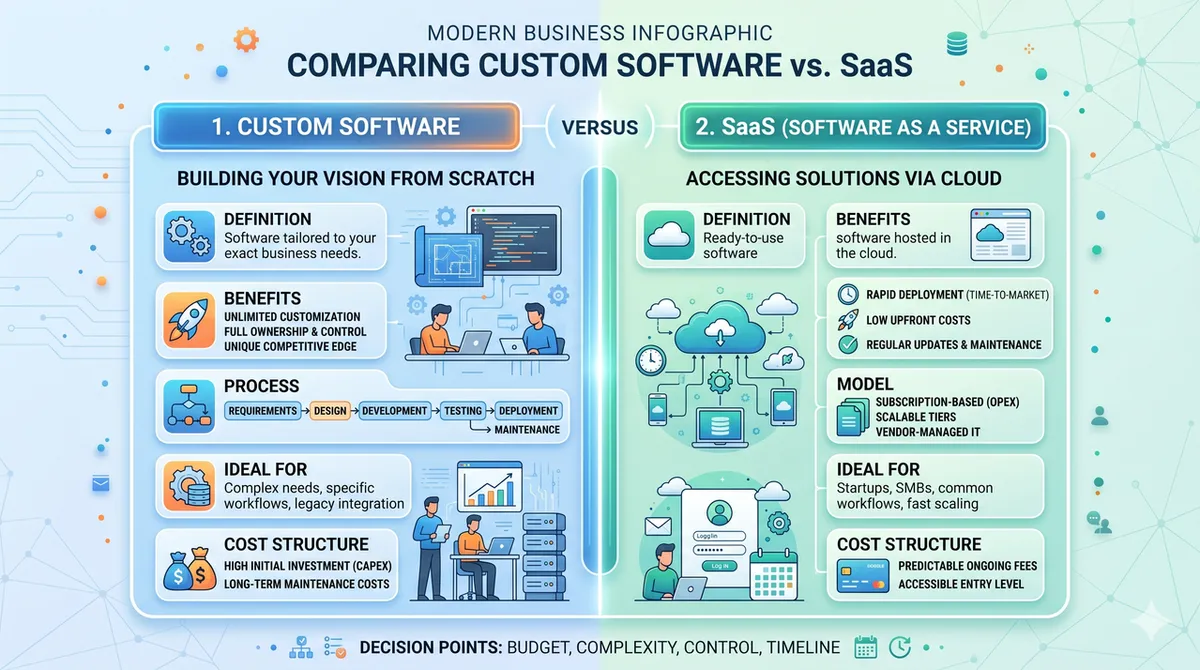
Custom Software vs SaaS — Which Is Better for Businesses?
Most businesses eventually reach a point where their existing tools stop fitting the way they actually work.
At first, SaaS tools feel convenient.
You sign up. Pay a monthly subscription. Start using dashboards immediately.
For many startups and small businesses, that works perfectly in the beginning.
But over time, businesses often face problems like:
- workflow limitations
- disconnected systems
- expensive subscriptions
- poor scalability
- missing features
- operational inefficiency
That’s usually when the conversation changes from:
“Which SaaS tool should we use?”
to:
“Should we build custom software instead?”
This is one of the biggest software decisions businesses make in 2026.
And the answer depends entirely on:
- business goals
- scalability needs
- operational complexity
- automation requirements
- long-term growth strategy
This guide explains:
- custom software vs SaaS differences
- real-world business use cases
- pricing comparisons
- scalability factors
- automation advantages
- long-term ROI
- when businesses should choose each option
If you're deciding between:
- SaaS platforms
- custom business software
- workflow automation systems
- scalable enterprise software
this article will help you make a smarter decision.
What Is SaaS?
SaaS stands for: Software as a Service
These are cloud-based platforms businesses subscribe to monthly or yearly.
Examples include:
- Shopify
- Slack
- Trello
- HubSpot
- Notion
- Salesforce
SaaS products are designed for mass usage.
They provide standardized solutions for many businesses.
What Is Custom Software?
Custom software is built specifically for a business’s unique workflows and operational needs.
Instead of adapting your business around generic software…
the software adapts around your business.
Custom systems may include:
- CRM platforms
- automation software
- inventory systems
- healthcare dashboards
- logistics systems
- enterprise applications
- SaaS platforms
- AI-powered workflows
Why This Decision Matters More in 2026
Businesses now rely heavily on:
- automation
- AI systems
- operational efficiency
- cloud infrastructure
- customer personalization
As operations grow, software becomes business infrastructure.
That’s why choosing the right software model matters.
Quick Comparison: SaaS vs Custom Software
| Feature | SaaS | Custom Software |
|---|---|---|
| Setup Speed | Fast | Slower |
| Initial Cost | Lower | Higher |
| Monthly Costs | Ongoing | Lower long-term |
| Flexibility | Limited | High |
| Scalability | Depends | Fully customizable |
| Ownership | No | Yes |
| Customization | Limited | Full |
| Integrations | Restricted | Flexible |
| Business Automation | Partial | Advanced |
| Competitive Advantage | Low | High |
Why Businesses Choose SaaS First
SaaS platforms are attractive because they are:
- easy to adopt
- affordable initially
- quick to deploy
For startups, this can be extremely useful.
SaaS Advantages
1. Faster Launch
Businesses can start immediately.
No development process required.
2. Lower Initial Cost
No large upfront development investment.
This is useful for:
- startups
- small teams
- early-stage businesses
3. Maintenance Included
The SaaS provider manages:
- hosting
- updates
- infrastructure
- security
4. Easy Accessibility
Most SaaS tools are cloud-based and accessible from anywhere.
Why Businesses Eventually Outgrow SaaS
As operations become more complex, limitations appear.
Common SaaS Problems
❌ Limited customization
❌ Expensive scaling
❌ Workflow restrictions
❌ Poor integrations
❌ Feature overload
❌ Data limitations
Real Business Example
A logistics company initially used multiple SaaS tools for:
- dispatching
- customer management
- inventory
- reporting
At first it worked.
But eventually:
- systems became disconnected
- reporting slowed down
- staff wasted time switching platforms
The company later invested in custom logistics software.
Operations became centralized and significantly more efficient.
Why Businesses Choose Custom Software
Custom software gives businesses more control.
Especially when:
- workflows are unique
- automation becomes important
- scaling increases complexity
Custom Software Advantages
1. Full Workflow Customization
The software fits your business instead of forcing your business to fit the software.
This is critical for:
- operational efficiency
- automation
- scalability
2. Better Business Automation
Custom systems can automate:
- invoices
- customer communication
- reporting
- internal workflows
- analytics
This reduces repetitive manual work.
3. Scalability
Custom software grows with your business.
Features can evolve over time.
4. Competitive Advantage
Most competitors use the same SaaS tools.
Custom systems allow businesses to create unique operational advantages.
5. Long-Term Cost Efficiency
SaaS subscriptions become expensive over time.
Especially when businesses pay for:
- multiple platforms
- additional users
- advanced features
Custom software often becomes more cost-efficient long-term.
When SaaS Makes More Sense
SaaS is usually better when:
- businesses are early-stage
- workflows are simple
- budgets are limited
- speed matters most
Best SaaS Use Cases
✅ Small startups
✅ Simple internal workflows
✅ Short-term operations
✅ Quick testing environments
When Custom Software Makes More Sense
Custom software becomes valuable when:
- operations are growing rapidly
- SaaS limitations appear
- automation needs increase
- workflows become complex
Best Custom Software Use Cases
✅ Logistics systems
✅ Healthcare platforms
✅ Enterprise dashboards
✅ AI automation systems
✅ SaaS startups
✅ Large-scale operations
SaaS vs Custom Apps for Startups
This is where many founders struggle.
Should startups build custom software immediately?
Not always.
Smart Startup Strategy
Many startups begin with:
- SaaS tools
- no-code systems
- MVP platforms
Then later move toward custom software as growth increases.
This reduces early financial risk.
Why MVP Development Matters
MVP means: Minimum Viable Product
Instead of building massive software immediately, businesses first validate:
- demand
- workflows
- user behavior
This is often the smartest approach.
AI Is Changing Both SaaS & Custom Software
AI is rapidly transforming software development.
Modern systems increasingly include:
- AI automation
- predictive analytics
- AI dashboards
- workflow intelligence
- AI copilots
SaaS AI Limitations
Most SaaS AI tools offer:
- generalized AI features
- limited customization
Businesses with unique workflows often require custom AI systems.
Why AI Benefits Custom Software More
Custom software allows businesses to:
- personalize AI logic
- automate operations deeply
- integrate proprietary workflows
This creates stronger competitive advantages.
Real-World Example
A healthcare business used SaaS appointment software for years.
Problems included:
- limited reporting
- workflow restrictions
- poor integrations
The company later built custom healthcare software with:
- patient dashboards
- automated scheduling
- AI reminders
- centralized analytics
Operational efficiency improved significantly.
Security Comparison
Security matters more in 2026 because businesses store:
- customer data
- financial records
- operational systems
SaaS Security
SaaS platforms generally provide:
- built-in security
- hosting management
- infrastructure protection
But businesses have less control.
Custom Software Security
Custom systems allow:
- advanced permissions
- custom authentication
- security architecture control
But security quality depends on the development team.
Which Option Is Cheaper?
This depends on timeline.
SaaS Cost Structure
SaaS usually has:
- lower upfront costs
- recurring subscriptions
Over time, monthly payments accumulate.
Custom Software Cost Structure
Custom software usually has:
- higher upfront investment
- lower long-term platform dependency
For growing businesses, this often becomes financially smarter over time.
Hidden SaaS Costs Businesses Ignore
❌ User-based pricing
❌ Premium feature upgrades
❌ API limitations
❌ Multiple subscriptions
❌ Integration costs
Why Some Businesses Move Away From SaaS
As businesses scale, SaaS complexity increases.
Eventually companies realize they are:
- paying for too many tools
- managing disconnected systems
- losing operational efficiency
That’s when centralized custom software becomes valuable.
Cloud Infrastructure & Modern Software
Both SaaS and custom software now rely heavily on cloud systems.
Common infrastructure includes:
- AWS
- Google Cloud
- Azure
Cloud architecture improves:
- scalability
- accessibility
- performance
The Future of Business Software
Businesses increasingly want:
- automation
- AI-powered workflows
- centralized operations
- scalable systems
Custom software is becoming more attractive because businesses want operational flexibility.
Signs Your Business Needs Custom Software
✅ Your team uses too many disconnected tools
✅ Operations feel inefficient
✅ SaaS costs keep increasing
✅ Workflows are highly unique
✅ Automation is becoming critical
Signs SaaS Is Still Enough
✅ Your operations are simple
✅ Speed matters most
✅ Budget is limited
✅ You are still validating the business model
🔗 Understand Software Development Costs
Before building custom software, understand realistic development budgets.
👉 Read this: https://abuqitmirlabs.tech/blog/how-much-does-custom-software-development-cost-in-2026
🔗 Explore Future Software Trends
AI and automation are rapidly reshaping modern business software.
👉 Read this: https://abuqitmirlabs.tech/blog/future-of-custom-software-development-2026
🔗 Explore Custom Software Services
Learn how custom business software helps companies automate workflows and scale operations efficiently.
👉 Explore: https://abuqitmirlabs.tech/custom-software
Final Thoughts
There is no universal answer in the SaaS vs custom software debate.
The best choice depends on:
- business stage
- operational complexity
- scalability goals
- automation requirements
- long-term strategy
SaaS platforms are excellent for:
- simplicity
- speed
- early-stage operations
Custom software becomes powerful when businesses need:
- deeper automation
- operational flexibility
- scalable infrastructure
- competitive advantages
The smartest businesses usually focus less on trends and more on operational reality.
Because the right software decision can shape how efficiently a company grows for years.
FAQs
1. What is the difference between SaaS and custom software?
SaaS is subscription-based software built for mass usage, while custom software is designed specifically for a business’s unique workflows.
2. Is custom software better than SaaS?
It depends on business needs. Custom software provides more flexibility and scalability, while SaaS is faster and cheaper initially.
3. Why do businesses move away from SaaS?
Common reasons include:
- workflow limitations
- rising subscription costs
- poor integrations
- scalability problems
4. Is custom software expensive?
Custom software usually requires higher upfront investment but may become more cost-efficient long-term.
5. Which businesses benefit most from custom software?
Businesses with:
- complex workflows
- automation needs
- scalability requirements
- unique operational systems
benefit most from custom software.
Need custom software for your business? Get a free consultation from +923233260859
Related Engineering Resources
- For engineering teams deploying production workflows, explore our blueprint on custom AI agent development and enterprise RAG architecture and our AI automation solutions.
- Ready to turn these engineering principles into production software? Explore our custom web application development services or run a live diagnostic with our free technical website audit tool.