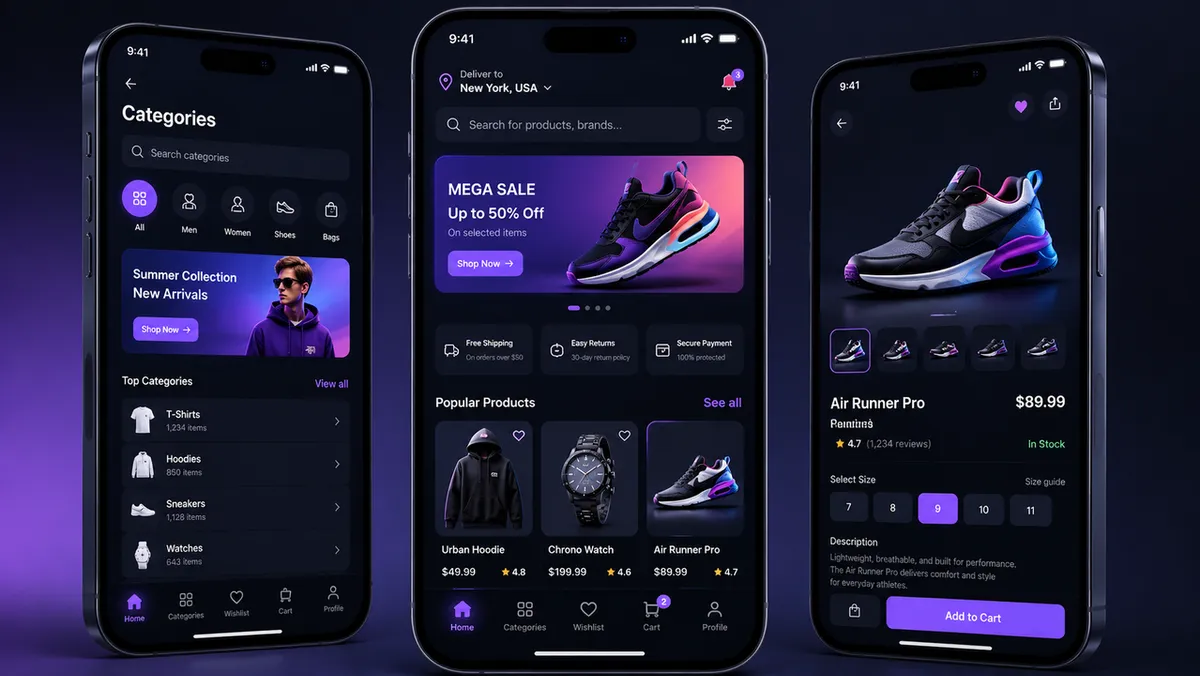
E-commerce App Features Guide 2026 for Startups & Businesses
Most e-commerce apps fail for one simple reason:
They focus on products instead of user experience.
A customer may love your products, but if:
- checkout feels slow
- search is frustrating
- navigation is confusing
- the app crashes
they leave immediately.
Modern users compare your app experience with giants like:
- Amazon
- Daraz
- Shopify stores
- Temu
- Alibaba
That means expectations are already high — even for startups.
And in 2026, people no longer judge e-commerce apps only by pricing.
They judge:
- convenience
- speed
- personalization
- mobile experience
- trust
“The best e-commerce apps make buying feel effortless.”
This guide explains:
- the most important e-commerce app features
- must-have vs advanced functionality
- AI-powered shopping features
- customer experience strategies
- real-world app workflows
- common mistakes businesses make
Whether you’re building:
- an online shopping app
- a marketplace platform
- a fashion app
- a grocery delivery app
- a B2B commerce system
this guide will help you understand what features actually matter in 2026.
Why E-commerce Apps Matter More Than Ever
People increasingly shop through smartphones instead of desktop websites.
Customers now expect:
- instant browsing
- one-tap payments
- personalized recommendations
- fast delivery tracking
A weak mobile experience directly affects:
- sales
- retention
- customer trust
Businesses that once relied only on websites are now prioritizing mobile-first commerce systems.
Core Goals of an E-commerce App
A successful e-commerce app should:
- simplify buying
- reduce friction
- increase trust
- improve retention
- encourage repeat purchases
Good e-commerce design is not about adding endless features.
It’s about removing obstacles.
Essential E-commerce App Features
Some features are now considered mandatory.
Without them, users may see the app as outdated.
1. Simple User Registration & Login
The onboarding experience matters heavily.
Users should be able to:
- register quickly
- use social login
- sign in with Google or Apple
- reset passwords easily
Long signup forms reduce conversions fast.
2. Smart Product Search
Search is one of the most important features in shopping apps.
Users expect:
- fast results
- typo correction
- filters
- AI recommendations
Important Search Filters
✅ Price
✅ Category
✅ Brand
✅ Ratings
✅ Delivery Speed
✅ Discounts
3. Product Detail Pages
A product page should answer customer questions immediately.
Important Product Features
✅ High-Quality Images
✅ Product Videos
✅ Reviews & Ratings
✅ Product Variants
✅ Availability Status
✅ Shipping Information
4. Shopping Cart
The cart experience should feel smooth and reliable.
Customers should:
- edit quantities
- save products
- remove items easily
- apply coupons quickly
5. Secure Checkout System
Checkout is where many apps lose customers.
Complicated payment systems increase abandoned carts.
Best Checkout Features
✅ Multiple Payment Options
✅ One-Tap Payments
✅ Guest Checkout
✅ Address Autofill
✅ Secure Transactions
6. Push Notifications
Push notifications improve:
- engagement
- retention
- repeat purchases
Common Notification Types
✅ Order Updates
✅ Flash Sales
✅ Price Drops
✅ Cart Reminders
✅ Personalized Offers
7. Wishlist Feature
Wishlists help users save products for later.
This also improves:
- repeat visits
- conversion opportunities
8. Order Tracking
Modern users expect real-time order visibility.
Tracking systems reduce customer frustration significantly.
9. Customer Reviews & Ratings
Reviews build trust faster than marketing slogans.
Customers heavily rely on:
- ratings
- photos
- real feedback
before making purchases.
10. Customer Support Integration
Strong support systems improve user confidence.
Popular support features include:
- live chat
- AI chatbots
- WhatsApp integration
- help centers
Advanced E-commerce App Features (2026)
Modern e-commerce apps increasingly use AI and automation.
AI Product Recommendations
AI systems analyze:
- browsing behavior
- purchase history
- customer preferences
to recommend products intelligently.
Voice Search
Voice-based shopping is growing rapidly.
Users increasingly search products using:
- voice assistants
- AI systems
- smart devices
Visual Search
Users can upload images to find similar products.
Very useful for:
- fashion apps
- furniture apps
- lifestyle marketplaces
AI Chat Shopping Assistants
AI assistants help users:
- discover products
- compare options
- answer questions
- reduce support load
Personalized Home Screens
Apps increasingly customize:
- banners
- products
- offers
based on user behavior.
Loyalty & Rewards Systems
Retention often matters more than first-time sales.
Reward systems encourage:
- repeat purchases
- referrals
- higher spending
Subscription Systems
Many modern e-commerce apps now use:
- subscription delivery
- premium memberships
- loyalty subscriptions
E-commerce App Development Process
Strong e-commerce apps require careful planning.
Step 1: Define the Business Model
Different apps require different structures.
Examples:
- single-vendor stores
- marketplaces
- B2B commerce
- subscription commerce
Step 2: Understand Customer Behavior
Study:
- shopping habits
- browsing patterns
- abandoned cart reasons
- user frustrations
Step 3: Design Mobile-First UX
Most users now shop through smartphones.
Interfaces should feel:
- clean
- fast
- easy to navigate
Step 4: Build MVP First
Many businesses overbuild early versions.
Smart startups launch:
- core shopping features
- simplified systems
- smaller product catalogs
first.
Step 5: Test Checkout Flow
Even small checkout problems reduce conversions heavily.
Testing should include:
- payment systems
- shipping workflows
- mobile responsiveness
Common E-commerce App Mistakes
❌ Complicated Navigation
Users should find products quickly.
❌ Slow Performance
Even a few seconds of delay affects conversions.
❌ Weak Product Images
Poor visuals reduce trust instantly.
❌ Overloading the Homepage
Too many banners and offers confuse users.
❌ Ignoring Mobile UX
Desktop-focused designs fail badly on smartphones.
AI in E-commerce Apps
AI is transforming online shopping rapidly.
AI Features Growing in 2026
✅ Personalized Recommendations
✅ Smart Search
✅ Predictive Shopping
✅ AI Customer Support
✅ Automated Marketing
✅ Dynamic Pricing
Best Technologies for E-commerce App Development
Flutter
Excellent for:
- cross-platform apps
- startup MVPs
- scalable shopping apps
React Native
Popular for:
- fast development
- startup teams
- hybrid commerce apps
Firebase
Useful for:
- authentication
- notifications
- cloud databases
Shopify APIs
Helpful for:
- e-commerce backend systems
- product management
- order systems
AI APIs
Used for:
- recommendations
- search optimization
- chatbot systems
E-commerce App Costs (2026)
Pricing depends heavily on:
- app complexity
- marketplace size
- AI integrations
- backend systems
Basic Shopping App
Estimated Cost:
$5,000–$20,000
Includes:
- product listings
- checkout
- login system
- notifications
Mid-Level Marketplace App
Estimated Cost: (Mid-Level Marketplace App)
$20,000–$80,000
Includes:
- vendor systems
- analytics
- AI recommendations
- advanced admin panels
Enterprise E-commerce Platform
Estimated Cost: (Enterprise E-commerce Platform)
$80,000–$300,000+
Includes:
- AI personalization
- automation systems
- large-scale infrastructure
- advanced logistics integration
Real-World Mini Case Study
A fashion startup launched an e-commerce app with:
- hundreds of products
- aggressive promotions
- complex navigation
Users struggled to find items quickly.
The business redesigned the app:
- simplified categories
- faster search
- cleaner product pages
- AI recommendations
Sales improved significantly.
The biggest improvement wasn’t adding features.
It was reducing friction.
That’s one of the most important lessons in e-commerce app development.
Future of E-commerce Apps
E-commerce apps are moving toward:
- AI-driven shopping
- voice commerce
- predictive recommendations
- hyper-personalization
- augmented reality shopping
Apps will increasingly feel more like:
- personal shopping assistants
than traditional online stores.
🔗 Learn the Complete Mobile App Development Process
Building strong e-commerce apps requires proper planning.
👉 Read this: https://abuqitmirlabs.tech/blog/mobile-app-development-guide-for-businesses-startups-2026
Learn:
- app workflows
- MVP development
- scalable architecture
- UI/UX strategy
🔗 Compare Flutter vs React Native
Framework choice affects:
- speed
- scalability
- performance
- maintenance costs
👉 Read this: https://abuqitmirlabs.tech/blog/flutter-vs-react-native-which-framework-is-better-for-mobile-app-development-2026
🔗 Learn App Monetization Strategies
E-commerce apps require smart monetization systems.
👉 Read this: https://abuqitmirlabs.tech/blog/how-to-monetize-a-mobile-app-proven-strategies-2026
Learn:
- subscriptions
- ads
- marketplace revenue
- premium features
Final Thoughts
Successful e-commerce apps are not built around flashy interfaces.
They are built around customer behavior.
The strongest shopping apps usually focus on:
- simplicity
- trust
- convenience
- personalization
Customers want buying to feel:
- fast
- smooth
- predictable
And apps that remove friction consistently outperform apps overloaded with unnecessary complexity.
Because great e-commerce experiences don’t feel like “using software.”
They feel effortless.
FAQs
1. What are the most important e-commerce app features?
The most essential features include:
- search
- secure checkout
- product pages
- cart systems
- notifications
- order tracking
2. How much does an e-commerce app cost?
E-commerce app development can cost anywhere from $5,000 for basic systems to over $300,000 for enterprise platforms.
3. Which framework is best for e-commerce apps?
Flutter and React Native are both strong choices depending on scalability and business requirements.
4. Can AI improve e-commerce apps?
Yes. AI improves:
- recommendations
- search
- customer support
- personalization
- automation
5. What is the biggest mistake in e-commerce app development?
Overcomplicating the user experience is one of the most common mistakes.
Related Engineering Resources
- For engineering teams deploying production workflows, explore our blueprint on custom AI agent development and enterprise RAG architecture and our AI automation solutions.
- To build compounding organic visibility across Google Search and AI Overviews, review our Generative Engine Optimization (GEO) and technical SEO mastery framework and our Programmatic SEO TajweedPage case study.