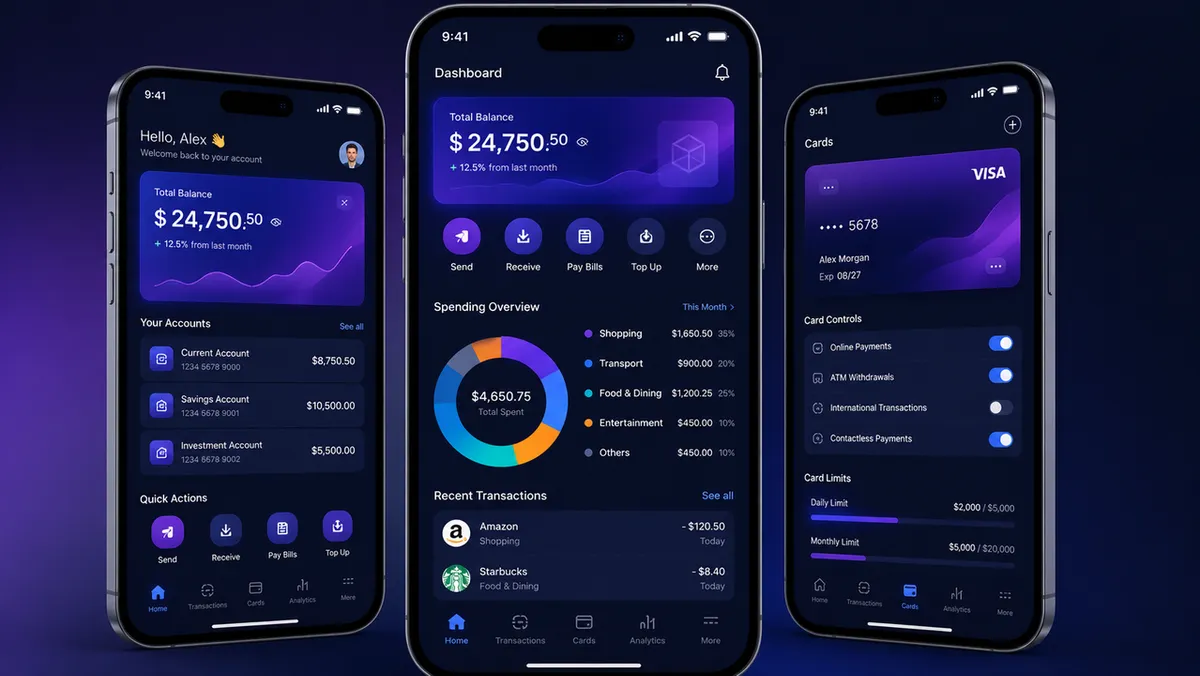
Fintech App Development Guide 2026 for Startups & Businesses
Money has become mobile.
People now:
- transfer money from smartphones
- invest through apps
- buy crypto instantly
- apply for loans online
- pay bills digitally
- manage businesses remotely
A few years ago, traditional banking apps were enough.
That’s no longer true.
Modern users expect:
- fast transactions
- real-time notifications
- AI-powered financial insights
- smooth onboarding
- secure digital wallets
And if a fintech app feels slow or confusing, users leave immediately.
That’s why fintech app development has become one of the fastest-growing industries in tech.
But fintech apps are different from normal apps.
You’re not just building screens.
You’re building:
- trust
- security
- reliability
- financial workflows
One mistake in a fintech app can affect real money.
That changes everything.
“People may test a new social app casually. They test fintech apps cautiously.”
This guide explains:
- how fintech app development works
- key app features
- costs
- security requirements
- AI integration
- monetization strategies
- real-world fintech workflows
Whether you’re building:
- a payment app
- a digital wallet
- a banking platform
- a crypto startup
- an investment app
this guide will help you understand what matters most in 2026.
What Is a Fintech App?
A fintech app is a financial technology application designed to improve or automate financial services.
These apps help users:
- manage money
- transfer payments
- invest
- track expenses
- access banking services
- automate financial tasks
Fintech apps are used by:
- startups
- banks
- payment companies
- investors
- freelancers
- e-commerce businesses
Types of Fintech Apps
Fintech is a massive category.
Different fintech products solve different financial problems.
1. Digital Wallet Apps
These apps allow users to:
- store money digitally
- send payments
- scan QR codes
- make online purchases
Examples:
- PayPal-style apps
- mobile wallets
- cashless payment systems
2. Banking Apps
Modern banking apps include:
- account management
- bill payments
- transfers
- transaction history
- financial analytics
3. Investment Apps
Users can:
- buy stocks
- manage portfolios
- track investments
- automate savings
4. Cryptocurrency Apps
Crypto fintech apps support:
- digital asset trading
- wallets
- blockchain transactions
- crypto analytics
5. Lending Apps
These platforms help users:
- apply for loans
- verify identity
- receive financing digitally
6. Expense Management Apps
Popular among:
- freelancers
- startups
- businesses
These apps track:
- spending
- invoices
- subscriptions
- cash flow
Why Fintech Apps Are Exploding in 2026
Consumer behavior changed dramatically over the last few years.
People now expect financial services to work:
- instantly
- remotely
- securely
Traditional financial systems often feel slow compared to fintech experiences.
Major Fintech Growth Drivers
✅ Mobile-First Banking
Many users prefer apps over physical bank branches.
✅ Digital Payments
Cashless systems continue growing globally.
✅ AI Automation
AI is improving:
- fraud detection
- customer support
- financial insights
- risk analysis
✅ Startup Innovation
Fintech startups are solving problems traditional banks ignored for years.
Essential Features of a Fintech App
Strong fintech apps focus heavily on:
- trust
- speed
- usability
- security
Core Fintech Features
✅ Secure User Authentication
This includes:
- biometrics
- 2FA
- device verification
✅ Payment Processing
Reliable transaction systems are essential.
✅ Transaction History
Users expect complete financial visibility.
✅ Push Notifications
Important for:
- transaction alerts
- fraud warnings
- payment confirmations
✅ Analytics Dashboard
Users increasingly want:
- spending analysis
- budgeting insights
- financial tracking
✅ AI Financial Assistance
AI chat assistants now help users:
- manage spending
- understand transactions
- automate support
Fintech App Development Process
Fintech app development requires far more planning than many other app categories.
You’re building systems that manage:
- sensitive data
- financial transactions
- user trust
Step 1: Define the Core Financial Problem
The best fintech startups solve very specific problems.
Examples:
- easier freelancer payments
- faster business invoicing
- better budgeting tools
- digital banking access
Step 2: Research Financial Regulations
Fintech apps often require compliance with:
- payment regulations
- financial laws
- security standards
Ignoring regulations early creates major problems later.
Step 3: Design Trust-Focused UX
Fintech UI should feel:
- stable
- clear
- reliable
Users hesitate when financial apps feel confusing.
Step 4: Choose the Right Technology Stack
Popular fintech technologies include:
- Flutter
- React Native
- Node.js
- Firebase
- AWS
Advanced fintech systems often integrate:
- AI APIs
- fraud detection systems
- blockchain services
Step 5: Build MVP First
Many fintech founders try building massive “all-in-one” platforms immediately.
That usually increases:
- costs
- delays
- technical complexity
Smart startups launch smaller focused solutions first.
Step 6: Security Testing
Security testing is absolutely critical in fintech.
Testing should include:
- API protection
- transaction security
- authentication systems
- encryption workflows
Step 7: Launch & Optimize
Successful fintech apps improve continuously through:
- user analytics
- transaction behavior
- customer feedback
Fintech App Development Costs (2026)
Fintech app pricing depends heavily on:
- complexity
- security requirements
- compliance
- AI integrations
Basic Fintech MVP
Estimated Cost:
$8,000–$25,000
Includes:
- authentication
- payment systems
- dashboards
- notifications
Mid-Level Fintech Platform
Estimated Cost: (Mid-Level Fintech Platform)
$25,000–$80,000
Includes:
- advanced analytics
- admin systems
- AI assistance
- automation
Advanced Fintech Ecosystem
Estimated Cost: (Advanced Fintech Ecosystem)
$80,000–$300,000+
Includes:
- AI fraud systems
- blockchain integrations
- investment systems
- scalable architecture
Security in Fintech App Development
Security is the backbone of fintech apps.
Without trust, fintech products fail quickly.
Essential Security Features
✅ End-to-End Encryption
Protects financial data during transmission.
✅ Two-Factor Authentication
Critical for account security.
✅ Biometric Authentication
Face ID and fingerprint login improve both:
- security
- user convenience
✅ Fraud Detection Systems
AI-powered monitoring helps detect suspicious behavior.
✅ Secure APIs
Fintech APIs require strong validation systems.
AI in Fintech Apps
AI is reshaping fintech rapidly.
AI Use Cases in Fintech
✅ Fraud Detection
AI identifies suspicious activity patterns quickly.
✅ AI Chat Support
Reduces customer support workload.
✅ Smart Financial Insights
AI can analyze:
- spending habits
- budgets
- investment patterns
✅ Predictive Analytics
Fintech companies increasingly use AI to forecast:
- risks
- financial behavior
- trends
Best Technologies for Fintech Apps
Flutter
Excellent for:
- fintech MVPs
- fast cross-platform development
- scalable interfaces
React Native
Popular among:
- startups
- rapid development teams
Firebase
Useful for:
- authentication
- notifications
- real-time systems
AWS & Cloud Platforms
Critical for:
- scalability
- security
- infrastructure
Blockchain Tools
Used in:
- crypto apps
- digital assets
- decentralized finance systems
Common Fintech Startup Mistakes
❌ Weak Security Planning
Security cannot be added “later.”
❌ Overcomplicated User Experience
Fintech apps should feel simple even when systems are complex internally.
❌ Ignoring Compliance
Legal issues can destroy fintech startups quickly.
❌ Building Too Many Features
Focused fintech apps usually outperform overloaded apps.
❌ Poor Performance Optimization
Users expect fintech apps to feel fast and stable.
Real-World Mini Case Study
A startup built a budgeting app for freelancers.
Initially, users struggled because:
- expense tracking was confusing
- analytics felt overwhelming
- onboarding was too long
The startup simplified the app:
- faster onboarding
- cleaner dashboards
- AI-powered spending summaries
User retention improved significantly.
The biggest improvement wasn’t advanced AI.
It was reducing friction.
That lesson applies to most fintech apps.
How Fintech Apps Make Money
Fintech monetization models vary heavily.
Common Revenue Models
✅ Transaction Fees
Small fee per payment or transfer.
✅ Subscription Plans
Premium analytics or business features.
✅ Lending Interest
Used by financing platforms.
✅ Advertising Partnerships
Common in finance marketplaces.
✅ SaaS Business Model
Recurring payments for financial tools.
Future of Fintech App Development
Fintech apps are moving toward:
- AI financial assistants
- embedded finance
- predictive analytics
- blockchain systems
- hyper-personalization
Users increasingly expect financial experiences that feel:
- instant
- intelligent
- secure
🔗 Learn the Full Mobile App Development Process
Fintech apps require strong technical architecture.
👉 Read this: https://abuqitmirlabs.tech/blog/mobile-app-development-guide-for-businesses-startups-2026
Learn:
- app planning
- UI/UX workflows
- MVP strategy
- scalable development systems
🔗 Understand Mobile App Security
Security is essential for fintech platforms.
👉 Read this: https://abuqitmirlabs.tech/blog/mobile-app-security-guide
This guide explains:
- API protection
- encryption
- secure authentication
- fraud prevention workflows
🔗 Compare Flutter vs React Native
Choosing the right framework affects:
- performance
- scalability
- security
- development speed
👉 Read this: https://abuqitmirlabs.tech/blog/flutter-vs-react-native-which-framework-is-better-for-mobile-app-development-2026
Final Thoughts
The most successful fintech apps are not always the ones with the most advanced technology.
They’re the ones users trust consistently.
Trust comes from:
- reliability
- security
- simplicity
- performance
A fintech app handling payments or investments must feel stable every single time a user opens it.
Because people are not just trusting your interface.
They’re trusting your system with their money.
And that responsibility changes how fintech products should be built.
FAQs
1. What is fintech app development?
Fintech app development involves creating financial technology applications for payments, banking, investing, lending, and digital finance systems.
2. How much does a fintech app cost?
Fintech apps can cost anywhere from $8,000 for simple MVPs to over $300,000 for advanced financial platforms.
3. Are fintech apps secure?
Yes, when built with:
- encryption
- secure APIs
- authentication systems
- fraud protection
4. Which framework is best for fintech apps?
Flutter and React Native are both strong options depending on budget, scalability, and business requirements.
5. Can AI improve fintech apps?
Absolutely. AI is widely used for:
- fraud detection
- automation
- customer support
- financial analytics
Related Engineering Resources
- For engineering teams deploying production workflows, explore our blueprint on custom AI agent development and enterprise RAG architecture and our AI automation solutions.
- Regulated platforms require strict architectural guardrails from day one—learn how we architect compliance-first custom software engineering and enterprise fintech systems.