Measure Marketing ROI Without Tracking | AbuQitmirLabs
Introduction
Most founders believe they have a measurement problem. They do not. They have an attribution problem disguised as a measurement problem.
Here is what actually happens. A prospect sees your ad on LinkedIn on Monday. Reads your blog on Wednesday. Opens your newsletter on Friday. Searches your brand on Google on Sunday. Converts on Tuesday. Your analytics platform credits the conversion to the last touch - the organic search - and ignores the four other touchpoints that actually created the sale.
Or worse. Your team runs brand marketing for six months. Revenue grows 40%. But you cannot see the connection in your dashboard because brand campaigns do not generate last-click attributions. So you cut the brand budget, revenue flatlines, and you cannot figure out why.
This guide solves that problem. You will learn how to measure marketing ROI when attribution is impossible, using incrementality testing, marketing mix modeling, and a practical framework built for startups. It is written for founders, marketing leads, and growth teams who need to make budget decisions without perfect data.
At AbuQitmirLabs, a Karachi-based digital marketing and software development studio, we have helped startups across the US market and UAE market build measurement systems that work without perfect attribution. This framework comes from those engagements.
Quick Answer: The Three Methods That Work Without Attribution
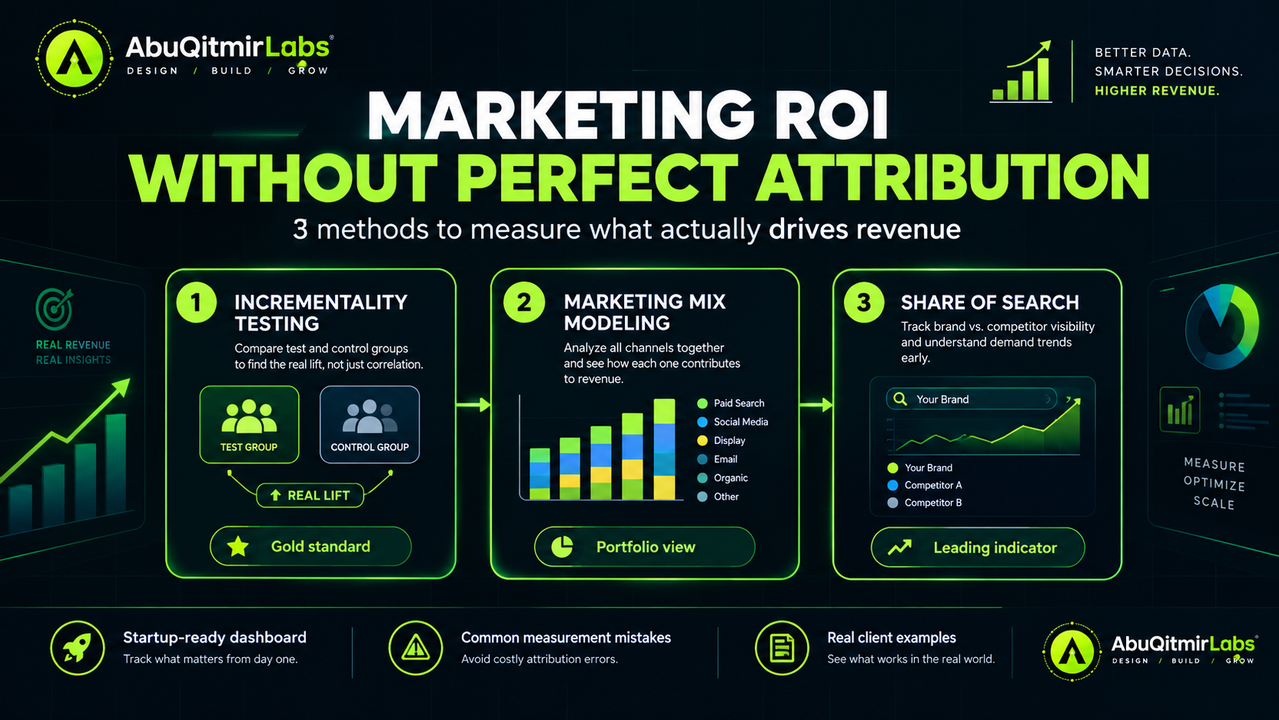
When attribution is impossible, use three methods: incrementality testing (the gold standard), marketing mix modeling (the portfolio approach), and share of search (the leading indicator). Each method answers a different question and takes a different amount of time and resources. Together they form a complete measurement system that does not require perfect tracking.
Why Attribution Broke in the First Place
Attribution broke because the modern customer journey is not linear, and the tools built for a linear journey cannot describe a non-linear reality.
Three forces broke attribution. First, privacy changes - iOS 14.5, GDPR, and the deprecation of third-party cookies - removed the tracking signals that attribution models relied on. Second, the customer journey became multi-device and multi-session. A user might see an ad on mobile, research on desktop, and convert on tablet. No single platform sees the whole picture. Third, walled gardens. Google, Meta, TikTok, and LinkedIn each report their own version of reality, and those versions contradict each other.
The result: platform-reported ROAS is inflated on every platform. If you add up the reported conversions from Google, Meta, and LinkedIn, you often get 200 to 300 percent of your actual sales. Attribution is not broken in one place. It is broken everywhere at once.
Our guide to performance marketing vs brand marketing covers how this broken attribution drives bad budget decisions. The measurement frameworks in this article fix that.
Method 1: Incrementality Testing (The Gold Standard)
Incrementality testing measures the true causal impact of a marketing channel by comparing outcomes in a test group exposed to the channel against a control group that is not exposed.
It is the only method that answers the question "what would have happened if we had not run this campaign?" That is the actual question founders care about. Attribution cannot answer it. Incrementality can.
How incrementality testing works:
- Split your audience into two groups - a test group and a control group. The split must be random or statistically matched.
- Expose the test group to your marketing channel. Withhold it from the control group.
- Measure the difference in conversion rate between the two groups.
- Multiply the incremental lift by your average order value to calculate incremental revenue.
- Subtract the cost of the campaign to calculate incremental ROI.
Three types of incrementality tests:
Geo-based tests split markets by region. Run the campaign in Lahore and Karachi, but not in Islamabad and Faisalabad. Compare conversion rates. This works well for businesses with strong geographic segmentation.
Audience-based tests split by customer segment. Run the campaign against high-intent audiences but not low-intent audiences. Compare conversion rates. This works well for e-commerce and subscription businesses.
Time-based tests run the campaign during certain weeks but not others. Pause the campaign for two weeks, then run it for two weeks, and compare. This is the least reliable method because of seasonality, but it is the easiest to run.
Real example: A B2B SaaS client of ours wanted to know whether their LinkedIn ads were actually driving signups. We ran a four-week test: paused LinkedIn ads in three US states and continued them in 12 others. The test states generated 40 percent fewer signups than the control states. We calculated the incremental ROI at 1.8x. Without the test, platform-reported attribution claimed 4.2x - more than double the true number.
Incrementality is resource-intensive, but it is the only method that gives you ground truth. Run it once per quarter on your largest channel.
Method 2: Marketing Mix Modeling (The Portfolio Approach)
Marketing mix modeling (MMM) is a statistical technique that uses historical data to estimate the contribution of each marketing channel to revenue, while controlling for external factors like seasonality, pricing, and economic conditions.
MMM does not require user-level tracking. It operates on aggregate data - weekly or monthly spend and revenue - which makes it immune to privacy changes. This is why companies like Google, Meta, and Procter & Gamble have invested heavily in MMM since 2020.
How MMM works:
- Collect 12 to 24 months of weekly data on marketing spend by channel, revenue, and control variables (seasonality, promotions, competitor activity, economic indicators).
- Run a regression model that estimates the marginal contribution of each channel.
- Decompose revenue into a baseline (what you would have earned without marketing) and incremental contribution by channel.
- Calculate ROI by dividing incremental revenue by channel spend.
What MMM gives you that attribution cannot:
- It captures cross-channel effects. Attribution treats each channel in isolation. MMM sees the whole portfolio.
- It accounts for diminishing returns. Attribution assumes linear scaling. MMM captures saturation curves.
- It works with aggregate data. No user-level tracking required.
Tools for startups:
Full MMM platforms like Recast, Northbeam, and Rockerbox are expensive - typically $2,000 to $10,000 per month. For startups, we recommend starting with a simplified model in Python or R. A competent data analyst can build a basic MMM in a few weeks using open-source libraries. Once the model is running, monthly maintenance takes two to four hours.
When MMM is the right method: You spend more than $20,000 per month on marketing across multiple channels, you have at least 12 months of consistent data, and you need a portfolio-level view of channel performance.
Method 3: Share of Search (The Leading Indicator)
Share of search measures the percentage of branded search volume in your category that belongs to your brand. It is a leading indicator of market share.
The formula is simple. Add up all branded search queries for every brand in your category. Your share of search is your branded search volume divided by the total. Track it monthly or quarterly.
Why share of search matters:
Research from Les Binet and other marketing analysts has shown that share of search correlates strongly with market share, often with a three to six month lag. If your share of search is growing, your market share is likely to grow.
Share of search captures the cumulative impact of brand marketing that attribution cannot see. If you run a brand campaign in Q1, sales may not move until Q3. But share of search will move in Q2. This gives you an early signal that your investment is working.
How to track share of search:
- Identify the branded search terms for your brand and for the top five to ten competitors in your category.
- Use Google Keyword Planner, Ahrefs, or Semrush to estimate monthly search volume for each branded term.
- Calculate your share of search monthly.
- Track the trend over 12 months.
What share of search cannot tell you: It does not tell you the ROI of a specific campaign. It is a leading indicator, not a causal measure. Use it alongside incrementality testing and MMM, not instead of them.
Building a Measurement Dashboard for Startups
You do not need a perfect measurement system. You need a decision-ready system. Here is a simple dashboard that works for most startups under $10 million in revenue.
Layer 1: North Star Metric
Pick one metric that represents the outcome you care about most. Revenue, qualified pipeline, or activated users. Everything else in the dashboard rolls up to this.
Layer 2: Channel Contribution
For each marketing channel, track three metrics: spend, incremental revenue, and incremental ROAS. Populate this layer using your quarterly incrementality tests.
Layer 3: Leading Indicators
Track share of search, branded search volume, and direct traffic. These metrics move before revenue does and give you early signal on whether brand investment is working.
Layer 4: Efficiency Metrics
Track customer acquisition cost (CAC), lifetime value (LTV), and LTV to CAC ratio. These metrics tell you whether the business model is healthy.
Layer 5: Attribution (for directional guidance only)
Track platform-reported ROAS as a directional signal, not a source of truth. Use it to compare campaigns within a single platform. Never use it to compare across platforms.
Our guide to the 2026 digital marketing stack covers the specific tools we recommend for each layer of the dashboard.
How AbuQitmirLabs Approaches Measurement
We do not promise perfect attribution. It does not exist. Instead, we build measurement systems that answer the founder's actual question: "Where should I put the next dollar?"
That question is answered through a three-part framework. First, run quarterly incrementality tests on your largest channel. Second, run an MMM that produces monthly channel-level ROAS estimates. Third, track share of search as your leading indicator for brand investment.
We also use tools like Semantic SEO strategy to help clients understand how their organic search investment contributes to brand awareness that later converts through paid channels. And we build content that supports measurement - like our guide to content writing and our SEO mastery framework.
For clients targeting high-consideration markets - Saudi Arabia market, Qatar market, or Kuwait market - we adjust the framework to account for longer sales cycles and different attribution patterns. The methods are the same. The weights are different.
Common Mistakes in Marketing ROI Measurement
Mistake 1: Trusting platform-reported ROAS. Every platform over-reports. If you sum them, you get a number that does not match your bank account. Never use platform-reported ROAS as ground truth.
Mistake 2: Using last-click attribution. Last-click ignores 80 to 90 percent of the customer journey. It systematically overvalues bottom-of-funnel channels and undervalues brand.
Mistake 3: Assuming attribution will get fixed. It will not. Privacy changes are permanent. Build measurement systems that do not require user-level tracking.
Mistake 4: Measuring everything and deciding nothing. A dashboard with 40 metrics is worse than a dashboard with five. Pick the metrics that inform the next decision.
Mistake 5: Skipping incrementality testing because it is hard. Incrementality is the only method that answers the causal question. If you skip it, you are guessing.
Mistake 6: Running MMM on insufficient data. MMM requires 12 to 24 months of consistent data. If you have less, run incrementality tests instead.
Mistake 7: Ignoring share of search. Share of search is the cheapest and fastest leading indicator available. Most startups do not track it. Do.
Mistake 8: Cutting brand marketing because attribution does not show ROI. This is the most expensive mistake a founder can make. Brand drives long-term growth. If you cannot see its ROI in attribution, that is a measurement problem, not a marketing problem.
Frequently Asked Questions
Why is marketing attribution so hard in 2026?
Marketing attribution is hard in 2026 because privacy changes removed user-level tracking, the customer journey became multi-device and multi-session, and walled gardens report contradictory numbers. No single platform sees the full picture, so accurate attribution is impossible.
What is the best way to measure marketing ROI without attribution?
The best way to measure marketing ROI without attribution is incrementality testing. It splits audiences into test and control groups and measures the true causal impact of a channel. Incrementality answers the question attribution cannot: what would have happened if we had not run this campaign?
What is marketing mix modeling and do I need it?
Marketing mix modeling (MMM) is a statistical technique that estimates channel contribution from aggregate data. It does not require user-level tracking. You need MMM if you spend more than $20,000 per month across multiple channels and have at least 12 months of consistent data.
How much does incrementality testing cost?
Incrementality testing costs the revenue you forgo in the control group plus the cost of analysis. For a small test, expect $2,000 to $10,000 in foregone revenue plus 20 to 40 hours of analyst time. This is the price of ground truth.
What is share of search and why does it matter?
Share of search is your branded search volume divided by the total branded search volume in your category. It matters because it correlates with future market share, typically with a three to six month lag. It is the cheapest leading indicator available.
Can I measure brand marketing ROI?
Yes, you can measure brand marketing ROI using incrementality testing, marketing mix modeling, and share of search. Brand marketing has a longer feedback loop than performance marketing, so use leading indicators to track progress between tests.
How often should I run measurement tests?
Run incrementality tests quarterly on your largest channel. Run MMM continuously with monthly updates. Track share of search monthly. Review the full dashboard weekly.
What tools do startups need for marketing ROI measurement?
Startups need four tools: an analytics platform (GA4 or Plausible), a search volume tool (Ahrefs or Semrush), a spreadsheet or Python environment for MMM, and a dashboard tool (Looker Studio or Metabase). Total cost: $200 to $500 per month.
Conclusion
The question is not "how do I get perfect attribution?" Perfect attribution does not exist and never will. The question is "how do I make confident marketing decisions without it?"
Three methods answer that question. Incrementality testing gives you ground truth on your largest channels. Marketing mix modeling gives you portfolio-level estimates across all channels. Share of search gives you a cheap leading indicator that moves before revenue does.
You do not need all three at once. Start with share of search - it takes a weekend to set up and costs nothing. Add incrementality testing when you have a large enough channel to test. Add MMM when you spend more than $20,000 per month across multiple channels.
At AbuQitmirLabs, we help startups build measurement systems that work without perfect attribution. Our team combines performance marketing, SEO services, and content strategy to create growth engines that scale. If you want help building a measurement framework for your business, get in touch.

Abu Qitmir Mohammad Shiraz Al-Madani
Founder & Lead Systems Architect at AbuQitmirLabs. Specializing in high-performance digital ecosystems, AI-driven architectures, and building scalable full-stack software systems.