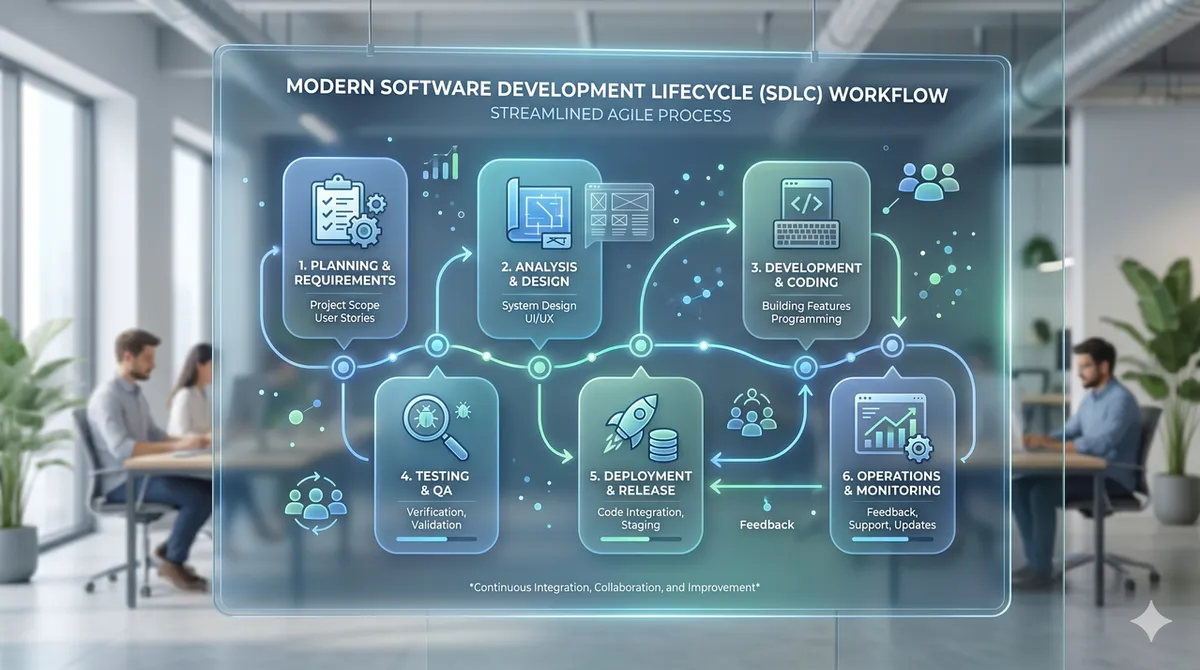
Software Development Process Step-by-Step (2026 Guide)
Building software without a proper process usually creates chaos.
Deadlines slip. Budgets grow unexpectedly. Features break. Teams become confused. Customers get frustrated.
A lot of businesses think software development is mostly coding.
It’s not.
Professional software development is actually a structured workflow involving:
- planning
- research
- architecture
- UI/UX design
- testing
- deployment
- scaling
- maintenance
That’s why modern businesses increasingly follow a clear software development process instead of randomly building features.
Whether you're creating:
- custom business software
- SaaS platforms
- AI-powered systems
- mobile apps
- automation software
- enterprise platforms
understanding the software lifecycle helps you:
- reduce risk
- improve scalability
- avoid expensive mistakes
- launch faster
- create better user experiences
This guide explains the complete software development process step-by-step for 2026 using practical, real-world workflows businesses actually use.
Why the Software Development Process Matters
Businesses often fail because they jump straight into development without:
- validating ideas
- planning workflows
- understanding users
- defining architecture
The result? Software becomes expensive, confusing, and difficult to scale.
A structured agile software workflow helps teams build software systematically.
What Is the Software Development Process?
The software development process is the structured sequence teams follow to:
- plan
- design
- build
- test
- launch
- maintain software systems
This is often called:
- SDLC (Software Development Lifecycle)
- software engineering workflow
- agile software lifecycle
Modern Software Development in 2026
Software development changed dramatically over the last few years.
Modern workflows now heavily involve:
- AI-assisted development
- cloud infrastructure
- automation systems
- rapid iteration
- agile teams
- continuous deployment
Businesses now expect software to be:
- scalable
- fast
- secure
- mobile-friendly
- AI-enabled
That requires smarter development processes.
The Complete Software Development Lifecycle
1. Discovery & Business Analysis
This is the most overlooked stage.
And honestly, one of the most important.
Before coding starts, businesses need clarity.
Questions Teams Must Answer
✅ What problem does the software solve?
✅ Who will use it?
✅ What workflows are required?
✅ What systems need integration?
✅ What business goals matter most?
Real-World Example
A retail business once requested:
“We need inventory software.”
After deeper analysis, the real issue wasn’t inventory itself.
The actual problems were:
- delayed reporting
- warehouse confusion
- poor supplier tracking
The software scope changed completely after proper discovery.
That saved thousands in unnecessary development.
What Happens During Discovery?
Development teams usually create:
- workflow diagrams
- requirement documents
- technical architecture plans
- user stories
- feature prioritization
Why Businesses Skip Discovery
Some companies try saving money by skipping planning.
Usually this creates:
- scope confusion
- constant revisions
- delayed launches
- higher development costs
2. Market & Competitor Research
Good software solves real operational problems.
That’s why teams study:
- competitors
- user behavior
- existing solutions
- workflow gaps
Research Helps Identify
✅ Missing features
✅ Customer frustrations
✅ Market opportunities
✅ Automation possibilities
Example
A healthcare startup researched appointment systems and discovered patients mostly complained about:
- reminder failures
- slow booking workflows
- poor mobile experiences
Those insights shaped the product roadmap.
3. Software Planning & Architecture
Now the technical planning begins.
This stage defines:
- backend architecture
- database structure
- APIs
- cloud infrastructure
- scalability strategy
Why Architecture Matters
Weak architecture creates:
- performance issues
- scaling problems
- expensive future rebuilds
Good architecture supports:
- growth
- automation
- integrations
- AI systems
Popular Modern Tech Stacks (2026)
Frontend
- React
- Flutter
- Next.js
Backend
- Node.js
- Laravel
- Django
Databases
- PostgreSQL
- MongoDB
- Firebase
Cloud Infrastructure
- AWS
- Google Cloud
- Azure
4. UI/UX Design
This is where software becomes visible.
Good UI/UX design is not just “making things look pretty.”
It directly impacts:
- user retention
- productivity
- engagement
- operational efficiency
What UI/UX Teams Create
✅ Wireframes
✅ User flows
✅ Dashboard layouts
✅ Mobile responsiveness
✅ Design systems
Why UX Matters More in 2026
Users now expect software to feel:
- simple
- intuitive
- fast
- mobile-friendly
Bad UX increases:
- support requests
- abandonment
- operational inefficiency
Real-World Example (Part 2)
A logistics company redesigned their dispatch dashboard.
Nothing changed technically.
But better UI reduced employee task time by nearly half because workflows became easier to understand.
5. Agile Software Development
Now actual development begins.
Most modern teams use:
Agile methodology
instead of older rigid development models.
What Is Agile?
Agile development breaks software into smaller iterative stages called:
- sprints
Instead of building everything at once, teams release improvements gradually.
Agile Software Workflow Benefits
✅ Faster releases
✅ Easier improvements
✅ Better testing
✅ Reduced risk
✅ Continuous feedback
Example Agile Workflow
Week 1–2:
- authentication system
Week 3–4:
- dashboards
Week 5–6:
- reporting tools
Week 7–8:
- integrations
This approach keeps development organized.
6. Backend Development
Backend systems handle:
- databases
- APIs
- business logic
- automation workflows
- authentication systems
This is the operational engine behind software.
Backend Features Often Include
✅ User authentication
✅ Payment systems
✅ Notifications
✅ AI integrations
✅ Reporting engines
Why Backend Scalability Matters
Businesses often underestimate scaling.
A system working for:
- 100 users
may fail under:
- 100,000 users
That’s why scalable backend architecture matters early.
7. Frontend Development
Frontend development creates what users actually interact with.
This includes:
- dashboards
- mobile apps
- admin panels
- interfaces
Modern Frontend Priorities
✅ Fast performance
✅ Mobile responsiveness (Modern Frontend Priorities)
✅ Accessibility
✅ Smooth navigation
✅ Interactive UX
Why Mobile-First Development Dominates
Most businesses now operate in mobile-first environments.
Software must work perfectly on:
- smartphones
- tablets
- desktops
especially in 2026.
8. AI Integration & Automation
Modern software increasingly includes AI systems.
Businesses now integrate:
- AI chat systems
- predictive analytics
- automation workflows
- recommendation engines
Common AI Features
✅ AI customer support
✅ Smart reporting
✅ Predictive insights
✅ AI search systems
✅ Workflow automation
Why AI Is Reshaping Software Development
AI improves:
- operational efficiency
- personalization
- automation
- decision-making
This is becoming standard for modern software products.
9. Testing & Quality Assurance
Testing prevents businesses from launching broken software.
And honestly, skipping proper QA becomes extremely expensive later.
Types of Software Testing
✅ Functional testing
✅ Security testing
✅ Performance testing
✅ Mobile responsiveness testing
✅ API testing
Common Problems Testing Prevents
❌ Security vulnerabilities
❌ Payment failures
❌ Broken workflows
❌ Database issues
❌ Performance crashes
Real Example
A SaaS startup skipped load testing before launch.
The platform crashed during onboarding traffic.
Customer trust dropped immediately.
After rebuilding infrastructure properly, they relaunched successfully.
10. Deployment & Launch
Once testing is complete, the software goes live.
Deployment involves:
- server configuration
- cloud deployment
- security setup
- monitoring systems
Modern Deployment Tools
✅ Docker
✅ Kubernetes
✅ Vercel
✅ CI/CD pipelines
Why Launch Is Not The End
A lot of businesses think:
“The software is finished.”
Actually… launch is only the beginning.
11. Monitoring & Maintenance
Software constantly evolves.
Businesses continue improving:
- performance
- security
- features
- scalability
Ongoing Maintenance Includes
✅ Security updates
✅ Feature enhancements
✅ Performance optimization
✅ Infrastructure scaling
✅ Bug fixes
Why Maintenance Matters
Technology changes quickly.
Without maintenance:
- systems become outdated
- security risks increase
- integrations break
12. Scaling The Software
As businesses grow, software must scale too.
Scaling may involve:
- database optimization
- cloud scaling
- microservices architecture
- AI infrastructure
Signs Software Needs Scaling
✅ Slow performance
✅ Increased traffic
✅ Higher operational load
✅ More integrations
✅ Larger user base
Common Software Development Mistakes
1. Building Too Many Features Early
Many businesses overbuild before validating workflows.
This increases:
- cost
- complexity
- delays
2. Ignoring User Experience
Poor UX creates operational inefficiency.
3. Weak Architecture
Cheap development shortcuts often create long-term technical debt.
4. No Scalability Planning
Software must support future growth.
5. Poor Communication Between Teams
Miscommunication creates:
- delays
- rework
- confusion
Why Agile Development Dominates 2026
Agile became standard because businesses need:
- faster iteration
- adaptability
- rapid improvements
- continuous releases
Traditional rigid development models struggle to keep up with modern software demands.
The Future of Software Development
Software development increasingly involves:
- AI-assisted coding
- cloud-native infrastructure
- automation systems
- predictive analytics
- low-code workflows
Businesses that modernize their software workflows gain operational advantages faster.
Why Businesses Invest in Custom Software
Modern businesses increasingly require:
- operational flexibility
- workflow automation
- scalable infrastructure
- AI integration
That’s why custom software demand continues growing rapidly.
🔗 Learn About Software Development Costs
Before building software, understand realistic development budgets.
👉 Read this: https://abuqitmirlabs.tech/blog/how-much-does-custom-software-development-cost-in-2026
🔗 Compare Custom Software vs SaaS
Many businesses struggle deciding between SaaS platforms and custom-built systems.
👉 Read this: https://abuqitmirlabs.tech/blog/custom-software-vs-saas-which-is-better-for-businesses
🔗 Explore Future Software Trends
AI and automation are rapidly changing how modern software is built.
👉 Read this: https://abuqitmirlabs.tech/blog/future-of-custom-software-development-2026
🔗 Explore Custom Software Services
Learn how scalable business software helps companies automate operations and improve efficiency.
👉 Explore: https://abuqitmirlabs.tech/custom-software
Final Thoughts
The software development process is much more than writing code.
Modern software requires:
- strategic planning
- scalable architecture
- thoughtful UX
- testing
- automation
- continuous improvement
Businesses that follow structured software workflows usually launch:
- faster
- more stable systems
- scalable products
- better user experiences
In 2026, software quality is directly connected to business efficiency.
And the businesses building software strategically are usually the ones scaling more successfully.
FAQs
1. What is the software development process?
The software development process is the structured workflow used to plan, design, build, test, launch, and maintain software systems.
2. What is SDLC?
SDLC stands for: Software Development Lifecycle.
It refers to the stages involved in software creation and maintenance.
3. Why is agile software development important?
Agile allows teams to:
- release faster
- improve continuously
- reduce development risks
- adapt quickly to changes
4. What is the most important stage in software development?
Discovery and planning are often the most critical stages because they define business goals and workflows before development begins.
5. Why do software projects fail?
Common reasons include:
- poor planning
- weak communication
- lack of scalability
- ignoring user experience
- unclear requirements
Need custom software for your business? Get a free consultation +923233260859
Related Engineering Resources
- For engineering teams deploying production workflows, explore our blueprint on custom AI agent development and enterprise RAG architecture and our AI automation solutions.
- If you are scoping a mobile product roadmap, see our guide to cross-platform and native mobile app engineering and estimate your build with our interactive project cost estimator.