Summary Box
Summary: This guide explains model collapse — the process by which AI systems progressively degrade in quality when trained on AI-generated data rather than authentic human knowledge. It covers the mechanism behind it, why it is accelerating in 2026, what it means for businesses depending on commercial AI tools, and what practical steps organizations can take to protect themselves. AbuQitmirLabs builds custom AI agent systems and knowledge-grounded applications for businesses that cannot afford to depend on degrading generic models. Read time: approximately 12 minutes.
Table of Contents
- Introduction
- What Model Collapse Actually Means
- The Mechanism — How AI Learns From Itself
- Why This Is Accelerating in 2026
- The Connection to the Dead Internet
- What Model Collapse Looks Like in Practice
- Eight Business Risks You Need to Understand
- What Model Collapse Does Not Mean
- How Businesses Can Protect Themselves
- The Case for Private, Knowledge-Grounded AI
- How AbuQitmirLabs Approaches This Problem
- Frequently Asked Questions
- Final Thoughts
Excerpt
Most conversations about AI quality focus on benchmark scores, capability announcements, and version numbers. Almost none of them address the structural problem that sits underneath all of it: the internet — the primary source of training data for every major commercial AI — is running out of authentic human-generated content to learn from. What fills the gap is AI-generated content. And when AI models train on the outputs of previous AI models, the quality of each successive generation quietly degrades. This is model collapse, and it is not a future risk. It is happening now.
Quote
"Model collapse is not a failure of AI technology. It is a predictable consequence of what happens when the source of AI training data shifts from the accumulated knowledge of human experience to the statistical outputs of previous AI systems." — AbuQitmir Mohammad Shiraz Al-Madani
Key Highlights
- Model collapse occurs when AI systems are trained — intentionally or incidentally — on data generated by other AI systems rather than authentic human knowledge, producing progressive degradation in output quality across generations
- The mechanism is not technical failure but information compression: AI-generated text approximates patterns without preserving the full variance, nuance, and edge cases present in the original human knowledge it was trained on
- The accelerant is the Dead Internet — the significant and ongoing decline in authentic human-generated content being published online, which reduces the supply of genuine training data and increases AI dependence on synthetic alternatives
- Businesses that rely exclusively on generic commercial AI tools face increasing exposure to degraded output quality as model collapse compounds across successive training cycles
- The practical defense is not better commercial AI — it is knowledge-grounded AI that retrieves from a controlled, authentic, business-specific knowledge base rather than depending on training data quality
- Custom AI agent development built on RAG architecture provides isolation from model collapse because the retrieval layer is controlled, not dependent on what was in the training corpus
- Organizations that digitize their internal knowledge — decisions, processes, failure records, domain heuristics — compound their AI advantage over time rather than degrading with the generic model baseline
Introduction
Most conversations about AI quality focus on things that are easy to measure and easy to announce: benchmark scores, reasoning capability improvements, new modalities, context window expansions. These are real advances, and it would be inaccurate to dismiss them.
What these conversations almost never address is the structural problem that sits underneath all of them — the problem that determines the long-term trajectory of AI quality regardless of what the benchmark scores say today.
That problem is the source of training data.
Every major commercial AI model — every large language model that businesses are currently depending on for content generation, analysis, customer interaction, and decision support — was trained on text collected from the internet. The quality of that training data determines, more than any other single factor, the quality of what the model produces.
The internet, for most of the last two decades, contained a large and growing body of authentic human-generated content: expert writing, professional analysis, technical documentation, academic research, forum discussions, case studies, professional blogs, and the accumulated record of human knowledge across an enormous range of domains.
That is changing. The supply of authentic human-generated content being published to the open internet is declining, for reasons this guide will explain in detail. What is filling the gap — increasingly — is AI-generated content. Content produced by the same models whose successors will be trained on it.
When AI models train on the outputs of previous AI models, something predictable happens. This guide explains what that is, why it matters for your business, and what to do about it.
This analysis is based on observable patterns and published research, not proprietary access to AI training pipelines. The mechanisms described here represent the current understanding of how model collapse works — not a definitive internal account of how any specific commercial model is trained.
What Model Collapse Actually Means
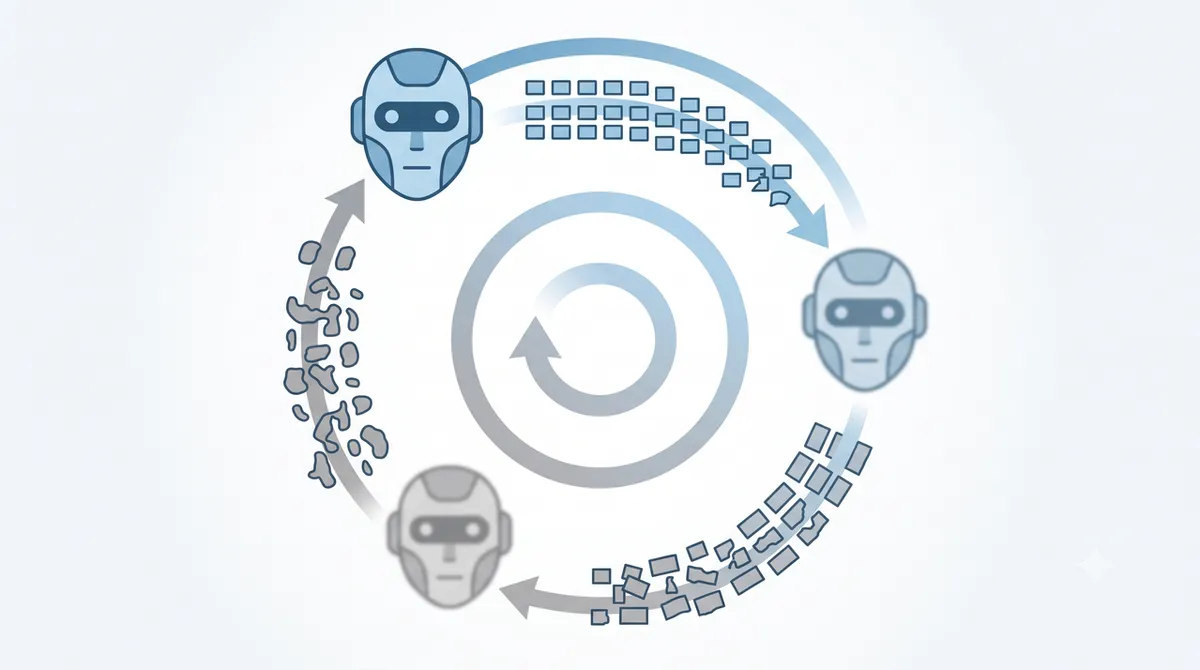
Model collapse is the process by which AI systems trained on AI-generated data — rather than authentic human-generated data — progressively degrade in quality across successive training generations.
The term comes from academic research published in 2024 by a team at the University of Edinburgh and other institutions, which demonstrated mathematically that the iterative training of language models on their own outputs produces systematic quality degradation. The research showed that models trained in this way lose the ability to represent rare but important information, converge toward a narrowed range of outputs, and produce text that is progressively less varied, less nuanced, and less accurate in representing the full complexity of the knowledge domain in question.
What this means practically is this: if you take a model trained on human-generated text, generate a large volume of AI-produced text with it, then train the next model on that AI-produced text — the second model will be systematically worse than the first in ways that are not immediately obvious from surface-level output quality but that become apparent in the tail — in edge cases, in nuanced distinctions, in domain-specific accuracy, in the preservation of expert knowledge that sits outside the statistical mainstream of the training corpus.
The degradation is not dramatic. It does not look like a sudden failure. It looks like progressive genericness — outputs that are technically coherent, professionally formatted, and systematically less reliable at the edges where precision matters most.
This is what makes it a business risk rather than a purely academic concern.
The Mechanism — How AI Learns From Itself
Understanding the business risk requires understanding the mechanism. The mechanism is not complicated.
How Authentic Training Data Works
When a large language model is trained on authentic human-generated text, it learns to approximate the statistical distribution of that text — which words follow which other words, which ideas tend to appear together, which patterns of reasoning are common in which domains.
Authentic human-generated text contains something important beyond its surface patterns: variance. Human experts writing about a domain disagree with each other. They represent minority positions and acknowledge edge cases. They document failures as well as successes. They preserve the full range of what is known about a topic — including the parts that are contested, uncertain, or rare.
A model trained on this kind of data learns to represent that variance. It learns that the answer to many questions is "it depends" rather than "here is the confident mainstream answer."
What Happens When AI Trains on AI
AI-generated text approximates the patterns in its training data, but it does not preserve the full variance. It produces outputs that cluster toward the statistical center of what it learned — the common patterns, the mainstream positions, the frequently-stated answers.
When the next generation of models trains on this AI-generated text, it learns to approximate the patterns in AI output rather than the patterns in original human knowledge. The distribution narrows further. The edges — the expert disagreements, the acknowledged uncertainty, the rare-but-important cases — are underrepresented in the training data and therefore underrepresented in what the model learns.
Each successive training cycle on AI-generated data narrows the distribution further. The outputs become more coherent, more formatted, more mainstream — and progressively less accurate in representing the full complexity of the knowledge domain.
This is the information-theoretic basis of model collapse. It is not a metaphor. It is a mathematical property of sequential compression.
The Compounding Problem
The compounding element is this: the degradation is not uniform across all types of knowledge. It is worst for exactly the knowledge that is most valuable — specialist expertise, domain-specific nuance, non-mainstream but correct positions, failure cases and their lessons, and the tacit knowledge that experts hold but rarely publish.
This is the knowledge that was already underrepresented in internet training data. Model collapse makes the underrepresentation progressively worse.
Why This Is Accelerating in 2026
Model collapse would be a manageable problem if the internet were continuing to produce authentic human-generated content at the rate it did between 2005 and 2019. It is not.
Several converging factors are reducing the supply of authentic training data available to successive model generations:
The AI content flood. The widespread adoption of AI content generation tools has produced an enormous volume of AI-generated text being published across the web. Blog posts, product descriptions, news summaries, SEO articles, social media posts — a significant and growing proportion of what appears on the open internet is AI-generated. This content enters the training corpus for future models as though it were authentic human knowledge.
The expert retreat. Professionals with genuine domain expertise are publishing less to the open web than they were five years ago. This happens for multiple reasons: the perception that AI will extract value from their published knowledge without compensation, the consolidation of professional discourse into closed platforms and paywalled publications, and the declining ROI of public content publishing as AI-generated content crowds out authentic expert writing in search results.
Platform consolidation and closure. The forums, communities, and question-and-answer platforms that once served as the primary repositories of specific, experience-grounded human knowledge have declined significantly. Several major platforms have closed entirely. Others have seen activity migrate to private communities inaccessible to public indexing. The authentic, conversational, experience-grounded content that these platforms produced has not been replaced.
The paywalling of expertise. Professional and academic publications have continued to move behind paywalls, reducing the volume of expert-generated content accessible for training at scale.
The combined effect of these factors is a training data environment in which AI-generated content constitutes an increasing proportion of what is available — and in which each new model generation trains on a corpus that contains more AI-generated and less authentically human-generated text than the previous one.
The Connection to the Dead Internet
The phenomenon described above has a name in broader cultural discussion: the Dead Internet. The term refers to the observable decline in authentic human participation in public internet spaces — the replacement of human-generated content, conversation, and community with algorithmically generated content, bot activity, and AI-produced text.
The Dead Internet concept predates generative AI — it was initially used to describe the decline of authentic community and the rise of algorithmic content curation. Generative AI has significantly accelerated the dynamic it describes.
For AI training purposes, the Dead Internet creates a structural problem: the training data environment is increasingly circular. Models train on data that includes the outputs of previous models. The proportion of authentic human knowledge in the training corpus declines with each cycle. The outputs of each successive generation are more distant from the authentic human knowledge that the first generation learned to approximate.
The business relevance of this is direct. If your organization is depending on commercial AI tools for outputs that require accuracy, domain specificity, or expert-level knowledge — you are depending on a supply chain whose upstream quality is declining.
This is not a prediction. It is a description of what the training data environment currently looks like and the direction it is moving.
What Model Collapse Looks Like in Practice
Model collapse does not produce obvious failures. It produces subtle, progressive degradation of the kind that is easy to miss if you are not specifically looking for it.
Increasing genericness. Outputs cluster toward the mainstream. Responses to specialized or nuanced questions produce confident-sounding answers that represent the statistical center of the training distribution rather than the accurate answer to the specific question. The text is well-formatted and professional. The specific accuracy is quietly reduced.
Loss of edge-case handling. Questions that require knowledge of exceptions, limitations, or minority-but-correct positions receive answers that ignore or minimize the exception. The model has learned that the mainstream answer is more statistically common in its training data and produces it more confidently.
Reduced acknowledgment of uncertainty. As training data becomes more AI-generated, models learn the confident formatting of AI-generated text rather than the epistemic humility of expert human writing. Outputs become more definitive in areas where more definitiveness is not warranted.
Domain vocabulary without domain accuracy. Models learn to produce text that sounds domain-specific — using the correct terminology, the expected structure, the appropriate professional register — without the underlying accuracy that genuine domain knowledge produces. This is particularly dangerous in technical, legal, medical, and financial domains where the cost of confident inaccuracy is high.
Homogenization across providers. As multiple AI providers train on overlapping internet data that contains increasing proportions of AI-generated content, the outputs of different models become more similar to each other — and more similar to the narrowed statistical mainstream that model collapse converges toward.
True advice
Honest requirements: If your organization is assessing its AI architecture and wants to understand where generic commercial AI remains appropriate and where knowledge-grounded investment is warranted — AbuQitmirLabs starts with an honest requirements assessment before any system recommendation is made.
Eight Business Risks You Need to Understand
Risk 1: Accuracy Degradation in Knowledge-Dependent Outputs
Any business function that depends on AI for outputs requiring domain accuracy — legal analysis, technical documentation, financial modeling, medical information, compliance guidance — is exposed to progressive accuracy degradation as model collapse advances. The degradation is subtle enough to miss in individual outputs but compounds over time and across use cases.
Risk 2: Brand Voice Homogenization
AI-generated content for brand communications, marketing materials, and customer-facing copy is increasingly trained on a narrowed statistical distribution of how professional content "should" sound. Businesses using generic commercial AI for brand content risk producing outputs that are indistinguishable from competitor outputs generated by the same models — eliminating the differentiation that brand voice is supposed to create.
Risk 3: Compounding Dependency on Degrading Baseline
Organizations that build internal processes around generic commercial AI tools are building on a baseline that is degrading. As the tools become less accurate in domain-specific applications, the processes that depend on them degrade correspondingly — often without visible failure events that would prompt reassessment.
Risk 4: Loss of Institutional Knowledge Leverage
Organizations that have accumulated significant institutional knowledge — in the form of documented processes, case records, decision histories, and domain expertise — and have not made this knowledge accessible to their AI systems are losing the leverage that knowledge represents. Generic models do not know what your organization knows. Model collapse means they are progressively less likely to approximate it.
Risk 5: Customer Experience Quality Decline
Customer-facing AI applications — chatbots, AI-assisted support, automated response systems — that are built on generic commercial models inherit the quality trajectory of those models. As the models degrade in domain specificity, the customer experience they produce degrades correspondingly.
Risk 6: False Confidence in AI Outputs
The formatting and confidence of AI-generated outputs does not degrade proportionally with the accuracy. A model producing less accurate content due to model collapse will still produce it in well-formatted, authoritative-sounding text. Organizations without robust AI output review processes are at risk of treating progressively less accurate outputs as reliable.
Risk 7: Competitive Disadvantage to Knowledge-Grounded Organizations
Organizations that have built knowledge-grounded AI systems — systems that retrieve from controlled, authenticated business-specific knowledge rather than depending on generic training data — are building an AI capability that compounds rather than degrades. The performance gap between knowledge-grounded and generic AI will widen as model collapse advances.
Risk 8: Vendor Lock-in to a Declining Baseline
Significant investment in workflows, integrations, and processes built around specific commercial AI providers creates switching costs that may prevent organizations from responding appropriately as the quality trajectory of those providers' models becomes clear. Building on open standards and knowledge-portable architectures from the beginning reduces this risk.
What Model Collapse Does Not Mean
Precision on this point matters, because overstated claims about AI quality decline are as unhelpful as denial of the problem.
Model collapse does not mean AI is becoming useless. For tasks where the statistical mainstream answer is the correct answer — summarization of mainstream topics, formatting and editing, code generation for common patterns, translation, classification — current commercial AI remains highly capable and is likely to remain so.
Model collapse does not mean all AI outputs are degrading at the same rate. The degradation is domain-specific and task-specific. It is most severe for specialist knowledge, rare-but-important information, nuanced expert positions, and domain-specific accuracy. It is least severe for tasks that require only mainstream pattern reproduction.
Model collapse does not mean your current AI tools will stop working tomorrow. The degradation is gradual and the timeline is uncertain. The point is not that current tools are useless but that the long-term quality trajectory is declining in ways that should inform how organizations build their AI dependency.
Model collapse does not apply equally to all AI architectures. RAG-based systems that retrieve from controlled knowledge bases are significantly less exposed to model collapse than systems that depend entirely on training data quality. The architecture of the AI system matters as much as the underlying model.
How Businesses Can Protect Themselves
The practical response to model collapse is not to abandon commercial AI tools but to build AI systems that are not entirely dependent on training data quality.
Step 1: Audit Your AI Dependency
Understand which business functions currently depend on AI outputs, what accuracy requirements those functions have, and what the cost of accuracy degradation in those functions would be. This audit is the foundation for prioritizing where knowledge-grounded AI is worth investing in versus where generic commercial AI remains appropriate.
Step 2: Digitize Your Institutional Knowledge
The knowledge your organization has accumulated — in the form of documented processes, case records, decision logs, post-mortems, domain heuristics, client-specific information, and the recorded expertise of your team — is the raw material for knowledge-grounded AI. Organizations that have this knowledge accessible in a structured, searchable form can build AI systems that retrieve from it. Organizations that have not digitized this knowledge cannot.
The digital transformation framework that most organizations are working through includes knowledge digitization as a foundational element — not because it is required for basic digital operations but because it is the prerequisite for effective AI deployment that does not depend on generic training data.
Step 3: Build Knowledge-Grounded AI Systems
RAG — Retrieval Augmented Generation — is the primary architecture for knowledge-grounded AI. In a RAG system, when a user query is processed, the system first retrieves relevant documents from a controlled knowledge base, then passes those documents along with the query to the language model as context. The model generates its response based on the retrieved content rather than solely on what it learned during training.
This architecture does not eliminate model collapse in the underlying language model. It means the language model's training data quality is less important for your specific use cases, because the knowledge your application depends on is coming from your knowledge base rather than from the training corpus.
Step 4: Version and Monitor AI Outputs
Organizations that do not systematically monitor AI output quality over time have no early warning system for quality degradation. Establishing baselines for AI output accuracy in key functions, and monitoring against those baselines as models are updated, provides the visibility needed to detect and respond to degradation before it becomes a significant business problem.
Step 5: Maintain Human Review in High-Stakes Functions
In functions where the cost of AI inaccuracy is high — legal, medical, financial, compliance, customer-critical communications — maintaining human review of AI outputs is not a temporary concession to current AI limitations. It is a permanent process design requirement given the quality trajectory of generic commercial AI.
The Case for Private, Knowledge-Grounded AI
The structural response to model collapse is the same response that the ROI of digital transformation analysis consistently supports for technology investment: build on a foundation you control rather than on a foundation whose quality is determined by factors outside your organization.
For AI, this means building systems where the knowledge layer — the domain-specific information that makes the AI useful for your specific business context — is owned, controlled, and maintained by your organization rather than borrowed from a generic training corpus that is subject to model collapse.
The business case for this investment compounds over time:
Quality advantage. An AI system built on your organization's authentic knowledge will produce better outputs for your specific use cases than a generic model trained on internet data — and the gap widens as model collapse advances the generic baseline.
Proprietary moat. The knowledge base your organization builds becomes a competitive asset. Generic commercial AI tools are available to every competitor. An AI system built on your organization's 20 years of accumulated expertise, process knowledge, and domain heuristics is not.
Stability. A knowledge-grounded AI system built on a stable, controlled knowledge base does not degrade when the underlying language model provider updates their training. The knowledge layer is yours.
Alignment with actual requirements. Generic commercial AI is optimized for the average use case across all users. An AI system built specifically for your business is optimized for your use case.
This is not an argument for building foundation AI models from scratch — that is neither practical nor necessary for the vast majority of businesses. It is an argument for building the knowledge layer, the retrieval architecture, and the application logic specifically for your organization, using commercial foundation models as a component rather than as the complete solution.
How AbuQitmirLabs Approaches This Problem
At AbuQitmirLabs, our position on model collapse is straightforward: it is a real problem with a practical solution, and the solution is worth investing in before the problem becomes acute rather than after.
Our AI agent development work is built around knowledge-grounded architectures for exactly this reason. We do not build AI applications that depend entirely on generic commercial models for domain accuracy. We build systems where the knowledge layer — the information the AI needs to be genuinely useful for the client's specific context — is controlled, authenticated, and maintained by the client organization.
This approach requires work that generic AI tool deployment does not: knowledge auditing, content digitization, knowledge base architecture, retrieval system design, and ongoing knowledge base maintenance. That work is also the work that builds a compounding AI advantage rather than a generic AI dependency.
We work with clients across industries where domain-specific accuracy matters — where the cost of confident AI inaccuracy is real and where the gap between generic AI output and knowledge-grounded AI output is commercially significant.
If your organization is at the point of building serious AI capability and is thinking about the architecture decisions that will determine its long-term quality trajectory — rather than just deploying generic tools and hoping the quality holds — that is the conversation we are built for.
The custom software foundation that most knowledge-grounded AI systems require is also something we build — because the knowledge base and retrieval architecture typically need to integrate with operational systems that require custom development rather than off-the-shelf connectivity.
Frequently Asked Questions
What exactly is model collapse?
Model collapse is the progressive degradation of AI model quality that occurs when successive generations of models train on AI-generated data rather than authentic human-generated data. The degradation is worst for specialist, nuanced, and rare-but-important knowledge, and produces outputs that are increasingly generic and less accurate at the edges of the knowledge domain.
Is model collapse proven or theoretical?
The mathematical basis for model collapse has been established in peer-reviewed research. The observable manifestations of it — the increased genericness of AI outputs, the homogenization across providers, the reduced nuance in specialist domains — are widely reported by practitioners. The precise rate and extent of model collapse in current commercial models is not publicly documented by AI providers.
Does model collapse mean AI is getting worse overall?
Not uniformly. For tasks that require mainstream pattern reproduction — common text formatting, basic summarization, standard code patterns — current commercial AI remains highly capable. The degradation is most significant for tasks requiring specialist knowledge, nuanced expert positions, and domain-specific accuracy. The quality trajectory is declining in the areas that matter most for business applications that require genuine domain expertise.
Which businesses are most at risk from model collapse?
Organizations that depend on AI for outputs requiring domain accuracy — legal, medical, financial, technical, and compliance functions — face the highest risk. Organizations in industries with significant proprietary knowledge that is not publicly documented also face high risk, as the gap between generic model output and authentic domain knowledge is greatest in these cases.
What is RAG and how does it help?
RAG — Retrieval Augmented Generation — is an AI architecture in which the system retrieves relevant information from a controlled knowledge base before generating a response, so the model's output is grounded in retrieved knowledge rather than solely in training data. This reduces dependence on training data quality and provides isolation from model collapse in the underlying language model.
How long does it take to build a knowledge-grounded AI system?
The timeline depends primarily on the state of the organization's knowledge — how much of it is already digitized, how well-structured it is, and what retrieval and integration requirements the application has. A focused pilot system for a single function can be operational in four to eight weeks. An enterprise-grade knowledge-grounded AI system with broad organizational knowledge integration is typically a multi-month engagement.
Is knowledge-grounded AI more expensive than generic commercial AI?
The initial investment is higher. The long-term economics depend on the use case — for functions where AI accuracy matters significantly, the cost of generic AI inaccuracy (in rework, errors, and liability exposure) frequently exceeds the investment in knowledge-grounded alternatives. The compounding quality advantage of a knowledge-grounded system also means the investment produces increasing returns over time rather than stable or declining returns as model collapse advances.
Can AbuQitmirLabs assess whether our current AI setup is model-collapse-exposed?
Yes. We conduct AI architecture reviews that include assessment of knowledge-grounding, retrieval architecture, and quality monitoring — and we provide clear recommendations on where generic commercial AI remains appropriate and where knowledge-grounded investment is warranted. Contact us through our AI agent development page to start that conversation.
Final Thoughts
Model collapse is not a headline risk. It does not arrive with an announcement or produce a visible failure event. It advances quietly, expressed as the progressive genericness of AI outputs, the subtle narrowing of the knowledge that commercial models can reliably represent, and the widening gap between what generic AI tools produce and what domain-specific accuracy requires.
Organizations that understand this dynamic have a structural advantage over those that do not — not because understanding it is sufficient, but because it changes what they invest in. The difference between building AI capability on a generic foundation that is subject to model collapse and building it on a knowledge-grounded foundation that is not is the difference between a declining AI asset and a compounding one.
The businesses that will have the most capable AI in five years are not necessarily the ones that have access to the best commercial models today. They are the ones that are building knowledge infrastructure today — digitizing their institutional knowledge, grounding their AI systems in that knowledge, and creating an AI capability that becomes more accurate and more differentiated over time rather than tracking a generic baseline that is moving in the wrong direction.
That is the investment that model collapse makes urgent. Not because the crisis arrives tomorrow, but because the compounding starts from when you begin.
Whether the requirement points to knowledge-grounded AI agent development, the custom software foundation it often requires, or a clear-eyed assessment of where generic commercial AI remains appropriate — visit AbuQitmirLabs to start the conversation that should come before the architecture decisions, not after the wrong ones have already been made.
True advice (Part 2)
Architecture decisions: Whether the requirement points to knowledge-grounded AI agent development, the custom software foundation it often requires, or a clear-eyed assessment of where generic commercial AI remains appropriate — visit AbuQitmirLabs to start the conversation that should come before the architecture decisions, not after the wrong ones have already been made.